
Nielsen measured streaming at 48.6% of US television use in May 2026; that is a usage measure, not global market share or proof that any single title will succeed.
A universe creates value only when story rules, production methods, rights, marketing assets and costs can be repeated. More lore is not infrastructure.
New seasons can reactivate earlier seasons, but that library effect depends on a world audiences can rediscover and a production system that can deliver it again.
Award routes must remain precise: eligible films released in 2027 can enter the new Oscar category under the forthcoming rules; series cannot.
The market does not buy a world. It buys the ability to deliver it again.
A pitch deck can contain character trees, regions, timelines, spin-offs and five seasons. It rarely proves whether the production method can recreate that world at comparable quality, within a controllable time, with the necessary rights.
That is the invisible gap between title value and asset value. Title value asks whether this film or season attracts an audience now. Asset value asks whether the world remains internationally intelligible, whether its visual and physical language survives new directors and units, whether cast, format, archive and making-of rights remain usable, and whether the production can supply discovery material after launch.
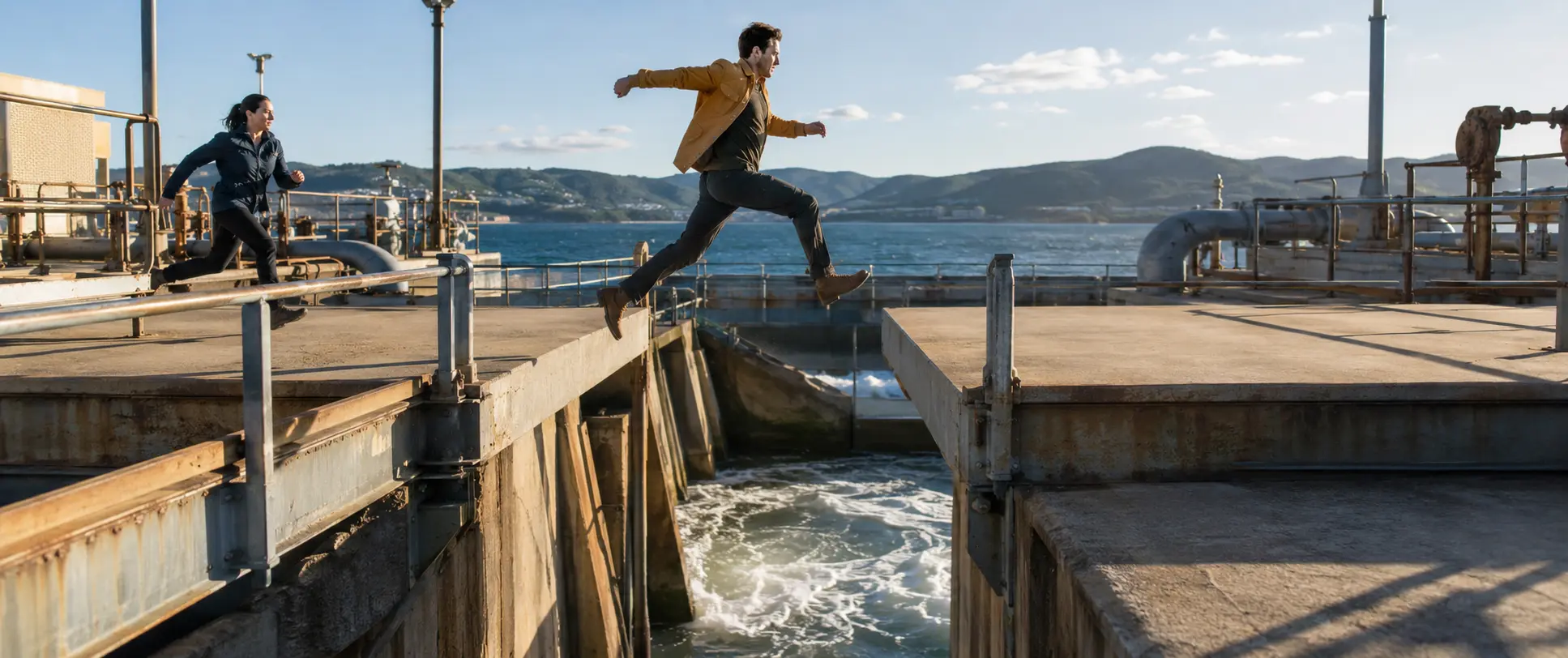
Action is part of this system, not the whole system. Its value is diagnostic because action makes hidden dependencies visible: story rules, performer capability, geography, camera access, specialist departments, post, safety, resets and proof all have to agree. A world that can repeat that agreement is more durable than one that merely promises a larger sequel.
Confirmed fact
Streaming’s share of US television use in May
Nielsen The Gauge, total US TV usage through the television screen. This is not global streaming market share, subscriber share or profitability.
More streaming does not make discovery easier
As more viewing moves through streaming interfaces, the competition inside those surfaces becomes denser. Discovery is not finished when a launch thumbnail goes live. Trailer, artwork, press, social, recaps, featurettes and later rediscovery need enough common identity to make the title recognisable again.
Netflix’s first-half 2026 engagement report says new seasons can drive viewing of earlier seasons. That is a platform-specific observation, not a universal franchise law, but it captures the durable-value opportunity: a later release can reactivate the library when the audience understands what world it is returning to.
This is why a creation story matters commercially. Making-of material can give campaigns human scale, local specificity and a continuing supply of truthful production moments. Netflix’s situational VFX delivery guidance identifies BTS, before-and-after, work-in-progress, test and marketing or awards finals as potential wrap assets in relevant contexts. It is not a universal mandate; it shows why buyers should ask what will exist and who can use it.
One screen world, four release surfaces
| Route | What diligence must make visible |
|---|---|
| Theatrical film | Release eligibility · campaign timing · Stunt Design route |
| Streaming film | Delivery · rights · discovery inventory · provenance |
| Series | Episode and season continuity · TV eligibility · library reactivation |
| Co-production / sales | Territories · partner handoffs · reusable rights · repeatability |
Streaming-service landscape / Plain-text market examples
The same screen world enters four different service systems
Netflix, Prime Video, Disney+, Apple TV+ and Max are named as market examples in ordinary text—not shown as partner logos. The current contract and release plan govern every requirement.
A four-part visual showing global subscription services, theatrical distribution, television and advertising-supported routes, and international sales or co-production. Each route demands a different rights, delivery, discovery and provenance check.
Awards are an option, not a quality added after delivery
Achievement in Stunt Design begins with films released in 2027, under detailed rules still to come. Current 99th-Oscar theatrical requirements can inform scenario planning but cannot be treated as confirmed rules for the 100th Oscars. A streaming launch by itself does not settle Oscar eligibility. Series remain outside this category and must follow eligible television routes such as the Emmy stunt categories.
The category’s name nevertheless creates a powerful acquisition inference. Stunt Design makes the quality of integration, originality, execution and creative resolution the relevant field—not a simple ranking by stunt size. The Academy has not published scoring weights, but a design-centred category creates a real opportunity for German, European and other international films whose advantage may be intelligence and identity rather than tentpole scale.
Early qualified Stunt Design involvement improves the conditions and chances for award-calibre work because story, cast, locations, units, camera and post can be shaped around one intent. It does not guarantee a campaign outcome. For a buyer, the diligence question is whether that integration genuinely exists and whether release, credits and evidence can support the route being discussed.
Making-of can be proof, marketing and a future option at once
On configured WarpCam® setups, a supplementary 360° camera can record the working space around the hero camera while practical action is performed. For the act visibly recorded, that simultaneous view is a contemporaneous production record: it documents that physical work took place instead of being generated wholesale by AI. It does not certify the released composite. The same cleared record can support social, press, featurettes, local-team storytelling and future library reactivation.
A complete asset record goes further. The 360° record does not claim that the final composite is untouched. Wire removal, compositing, retiming, face work, digital doubles, environment work or synthetic extensions may still shape the image. Shot and timecode references, capture metadata, releases, territory, storage, approvals and a VFX change log determine whether the record becomes usable provenance. C2PA can bind signed origin and edit assertions to those assets.
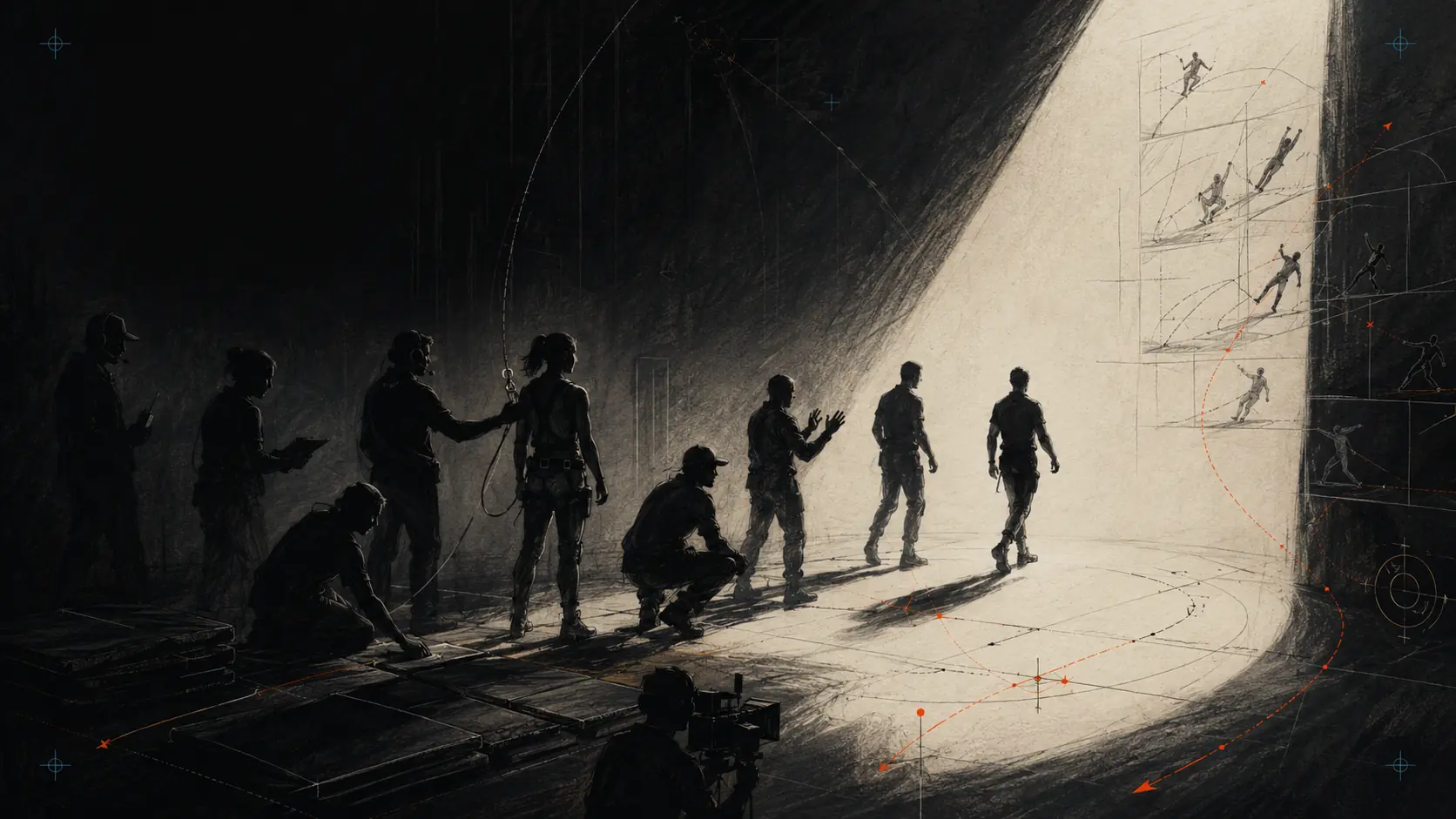
The SlamArtist.com system brings together Action Direction, Stunt Coordination and Performance, specialist moving-camera systems, Tactical Cinematics and flexible Action or Splinter Units. Floating Action Unit addresses scalable unit structure. The buyer’s transferable question is whether the production system creates not only the image, but also usable evidence of how that image was made.
The timing of that question is part of the acquisition price. The producer report shows where dependencies should be exposed before the shoot. The showrunner report turns continuity into a multi-season production system. The series overview connects both to the 2027/28 decision window. The acquisition risk is not that every title must become a universe. It is that repeatability discovered only after success is already negotiating from the most expensive position.
Sources and market record
- The Gauge — May 2024 — Nielsen, 2024-06-18. Accessed 2026-07-29.
- Streaming Reaches Historic TV Milestone — May 2025 Gauge — Nielsen, 2025-06-17. Accessed 2026-07-29.
- Streaming Embarks on Annual Summer Ascent — May 2026 Gauge — Nielsen, 2026-07-28. Accessed 2026-07-29.
- Ineffective Content Discovery and Streaming Satisfaction — Nielsen / Gracenote, 2025-06-24. Accessed 2026-07-29.
- What We Watched the First Half of 2026 — Netflix, 2026-07-16. Accessed 2026-07-29.
- Situational VFX Delivery Specifications — Netflix Partner Help Center. Accessed 2026-07-29.
- Academy Establishes Stunt Design Award for 100th Oscars — Academy of Motion Picture Arts and Sciences, 2025-04-10. Accessed 2026-07-12.
- 99th Academy Awards — Complete Rules — Academy of Motion Picture Arts and Sciences, 2026-05-01. Accessed 2026-07-29.
- 2026 Emmy Awards Rules and Procedures — Television Academy, 2026-04-07. Accessed 2026-07-12.
- C2PA Technical Specification 2.4 — Coalition for Content Provenance and Authenticity. Accessed 2026-07-20.
- WarpCam® 360 Documentation Configuration — Practice Record — SlamArtist.com. Accessed 2026-07-29.
- European Film Market, Berlinale 2017 — Licensed Photograph — Maximilian Bühn / Wikimedia Commons, 2017-02-09. Accessed 2026-07-29.

Loading approved comments…