The new Achievement in Stunt Design category begins with films released in 2027; the detailed rules are due in 2027, and the release year—not the shoot year—is the current confirmed trigger.
Series do not enter this Oscar category. Eligible television productions have separate Emmy routes for Stunt Coordination and Stunt Performance.
The real leverage is not simply more action. It is earlier design across story, character, camera, units, safety, VFX, edit, marketing and the record of what was physically achieved.
A production that waits until the shoot has not automatically lost—but each locked decision removes cheaper ways to make the work distinctive, repeatable and provable.
Choose your decision path
Go straight to the risk you own
The overview is shared. The next irreversible decision depends on your role.
Three direct routes lead producers to budget and schedule dependencies, showrunners to series continuity, and streaming or acquisition teams to durable asset value.
The most visible change begins out of sight
The Academy currently schedules the 100th Oscars for 5 March 2028, expressly subject to change. Achievement in Stunt Design is set to be presented for the first time, covering films released in 2027. Recipient roles, voting, submission materials, presentation and the complete eligibility rules have not yet been published.
That makes the runway concrete: production decisions being made in 2026 shape films intended for release in 2027 and, if they satisfy the forthcoming rules, possible consideration at the ceremony currently dated 5 March 2028.
That uncertainty does not prevent a sound creative strategy. An award named Stunt Design identifies design—not merely the biggest isolated stunt—as the competitive field. The Academy has not announced scoring weights, so no one can claim an official formula. The strong editorial inference is nevertheless clear: integration, originality, execution and intelligent problem-solving belong at the centre of the conversation, while sheer scale alone cannot define design quality.
That creates a real lever for German, European and other international films. A production does not have to simulate a tentpole budget to develop a precise, original action language. A smaller sequence built around character, space, performance and camera can be more distinctively designed than a much larger sequence built only around volume. Early engagement of qualified Stunt Design expertise improves the conditions—and therefore the chance—of producing award-calibre work. It cannot guarantee eligibility, nomination or a win.
The Fall Guy made the changing language visible before the category begins: NBCUniversal described how Chris O’Hara received the Stunt Designer credit to name creative responsibility in pre-production. One film does not define Academy rules, but it demonstrates why the language of design now matters in practice.
Where the room to redesign disappears
Each production phase closes a different set of options. This is an order of commitment, not a score.
Five production stages show the qualitative order in which room to redesign narrows.
The real competition is remaining decision space
A sequence is executed on set, but its value is determined earlier. Dramaturgy decides what changes for a character or relationship. Production geometry connects location, performers, effects, camera paths, units, resets and editorial coverage. Continuity determines which physical and visual rules must still work in episode eight, season three or a second film. Evidence planning decides which previs, rehearsal, behind-the-scenes and rights records will survive delivery.
This is not limited to action genres. A fall, struggle, escape or vehicle beat can carry the same character and image logic as the rest of a drama. Stunt Design then becomes part of the directing and production language, rather than spectacle attached after the story has already made its choices.
The responsibility changes by role. Producers need to see the dependency network behind a story beat. Showrunners need to preserve a physical and visual grammar across episodic handoffs. Streamer and acquisition teams need to distinguish attractive lore from a world that can actually be delivered again.
Practice
Four disciplines. One action system.
Design, execution, camera access and production evidence create more value when they share one intent before the units split.
The connected action system carries story intent through Action Direction, Stunt Coordination and Performance, WarpCam specialty camera access with configured 360 documentation, and Tactical Cinematics into main, action, second or splinter units.
Making-of can become evidence
In an AI-image economy, the hero shot is only half the asset. On configured WarpCam® setups, a supplementary 360° camera can record the working space around the hero camera while the practical action is performed. That simultaneous view creates a contemporaneous record of the physical act it visibly captures. It can show that the act occurred on set; it does not certify the released composite or every step that follows.
The boundary is the point. Wire removal, compositing, retiming, face work, digital doubles, environment work or synthetic extensions may still shape the final image. A complete provenance package can link the 360° record to shot and timecode references, capture metadata, releases and a VFX change log. C2PA and Content Credentials can bind signed origin and edit assertions to those assets.
Planned with rights, storage and approvals, the same capture can become execution evidence, continuity memory and a cleared EPK, press, social or long-form campaign asset. Planned late, the production may retain footage without usable rights—or no angle that proves how the action was physically achieved.
The hero camera records the shot. The 360° camera records the physical fact around it.
A four-stage WarpCam proof chain moves from physical action to a simultaneous 360-degree set record, then to rights metadata and a VFX change record, and finally to usable proof, marketing and archive assets.
A screen world is not a franchise folder
Not every project needs a universe. Some stories become stronger by ending. But a project intended to cross seasons, films or territories needs more than mythology added retrospectively. It needs production rules: what characters can physically do, how consequence works, where the camera belongs, which techniques are repeatable, and which evidence and rights remain available for marketing and later exploitation.
Within the SlamArtist.com Universe, Ferdi Fischer and the practice around him approach those questions through Action Direction, Stunt Coordination and Performance, the WarpCam® moving-camera ecosystem, Tactical Cinematics and scalable Action or Splinter Units. The transferable principle is broader: the clearer the handoffs between story, execution, camera and proof material, the more likely the original intention is to survive the journey to the cut.
The pressure is simpler: every week without clear creative and organisational ownership converts open design into later repair. Films and series headed toward 2027 are already fixing cast, locations, budgets, units, VFX capacity, post slots and campaign assets. The window is not imaginary; it is the space before those choices harden.
Sources and evidence record
- Academy Establishes Stunt Design Award for 100th Oscars — Academy of Motion Picture Arts and Sciences, 2025-04-10. Accessed 2026-07-12.
- Academy and ABC Announce Show Dates for 99th and 100th Oscars — Academy of Motion Picture Arts and Sciences, 2026-04-07. Accessed 2026-07-12.
- 2026 Emmy Awards Rules and Procedures — Television Academy, 2026-04-07. Accessed 2026-07-12.
- Safety Bulletin #4 — Stunts — Industry-Wide Labor-Management Safety Committee / Contract Services, 2025-03-27. Accessed 2026-07-23.
- C2PA Technical Specification 2.4 — Coalition for Content Provenance and Authenticity. Accessed 2026-07-20.
- WarpCam® 360 Documentation Configuration — Practice Record — SlamArtist.com. Accessed 2026-07-29.
- The Stunt Community Is the Star of The Fall Guy — NBCUniversal, 2024-05-02. Accessed 2026-07-12.
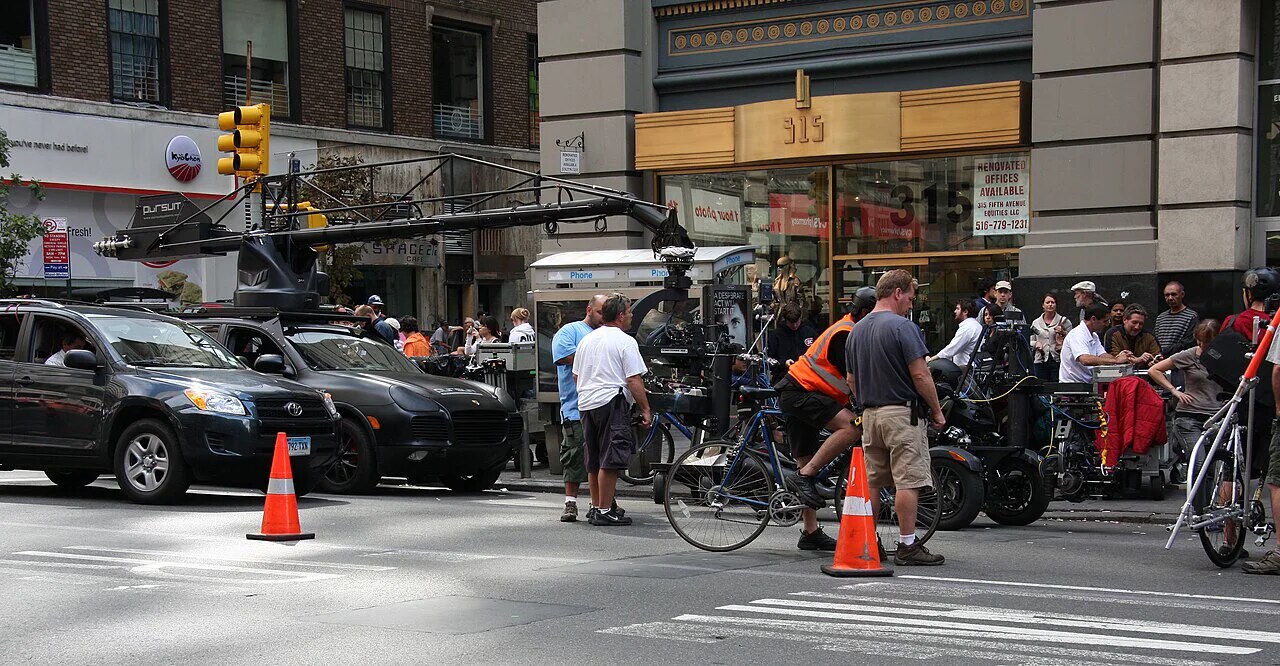
- Premium Rush Shooting — Licensed Production Photograph — Yerpo / Wikimedia Commons, 2010-09-18. Accessed 2026-07-29.

Loading approved comments…