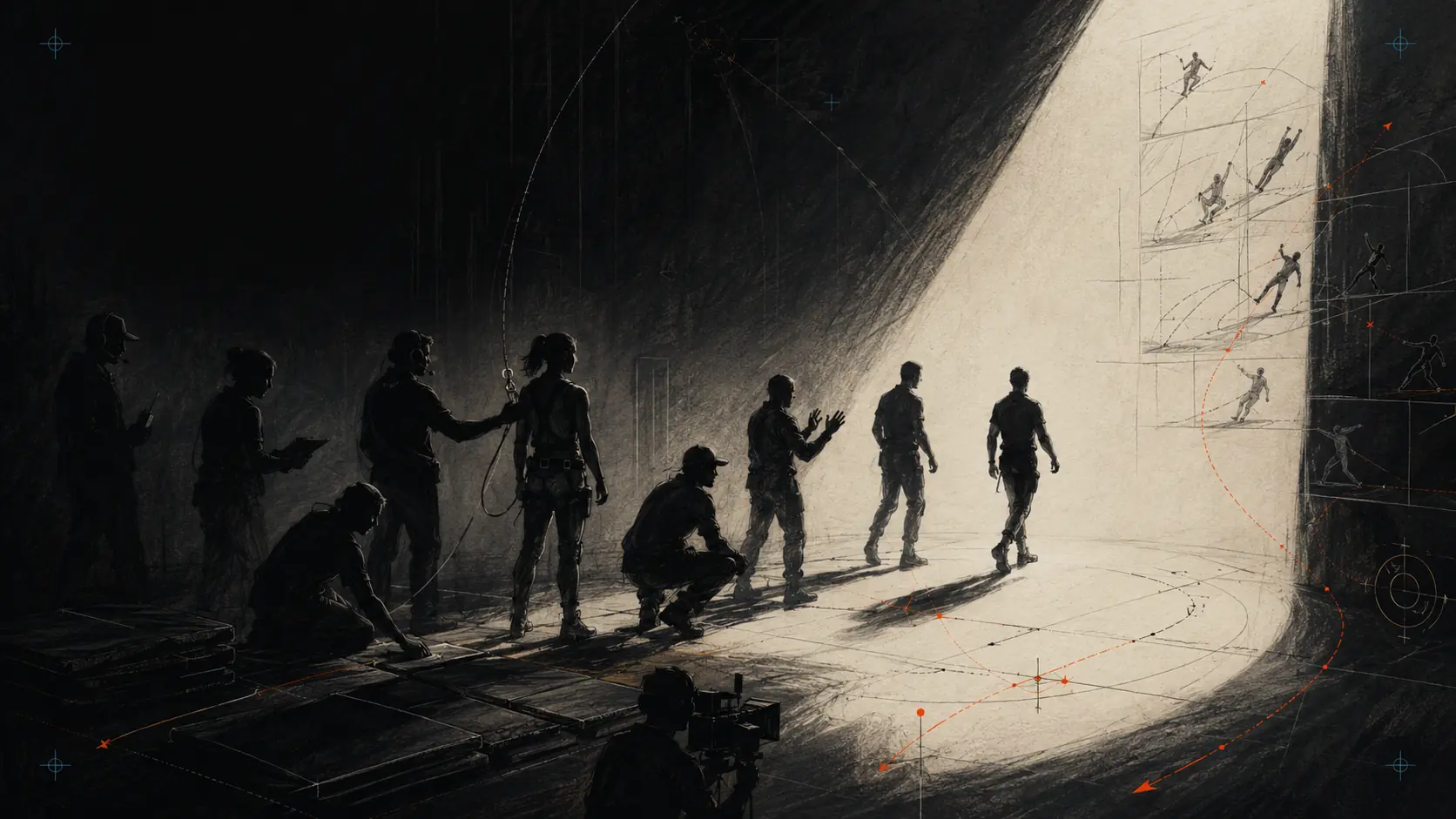
The Academy’s Achievement in Stunt Design award begins with films released in 2027. It will be presented at the 100th Oscars.
At this article’s material update, the public announcement confirmed the category. It did not confirm the final architecture examined here. That architecture covers recipients, eligibility and voting.
The analysis argues that the rules must recognise designed screen action. It also argues that visible danger must not become the criterion for excellence.
A modern action sequence can have a Stunt Designer, an Action Director, a Second Unit Director, several Stunt Coordinators, local leads, fight choreographers, performers, riggers, specialist drivers, camera teams, physical-effects crews, visual-effects artists and editors; the Academy has now created one category to recognise the work, without yet saying which of those people can receive a statuette.
That is the tension inside the long-awaited OSCAR® for Achievement in Stunt Design. The category is confirmed for films released in 2027 and is due to be presented at the 100th ACADEMY AWARDS® ceremony in 2028. Detailed eligibility and voting rules, eligible recipient functions and the presentation format have not yet been publicly announced. The Academy has settled whether stunt design belongs in its annual awards; its 2027 rules must still define what the work is.
This is not a semantic dispute. A rule built around one Hollywood credit could erase creative heads in other production systems. A rule built around visible danger could reward the wrong thing. A rule with no credible way to examine authorship could turn recognition into a new credit bottleneck.
Since the early days of cinema, stunt design has been an integral part of filmmaking.— Academy CEO Bill Kramer and Academy President Janet Yang — official announcement, 10 April 2025 · Source ↗
A practitioner’s definition of Stunt Design
For this report, STUNT.BLOG spoke with Ferdi Fischer, a German Action Director and Stunt Coordinator who founded SlamArtist.com.
The conversation focuses on what ‘design’ adds to the award debate: early narrative authorship, camera integration, international role equivalence, controlled risk and the distinction between designing action and merely rewarding visible danger.
Fischer’s contribution is presented as an attributed practitioner definition. It is grounded in his professional practice. The Academy’s institutional position and rules remain separately sourced.
The highest discipline is to sell the maximum illusion of danger while reducing and controlling the actual risk.— Ferdi Fischer — STUNT.BLOG interview; translated and condensed from German · Ferdi Fischer on Achievement in Stunt Design
A century in the blind spot
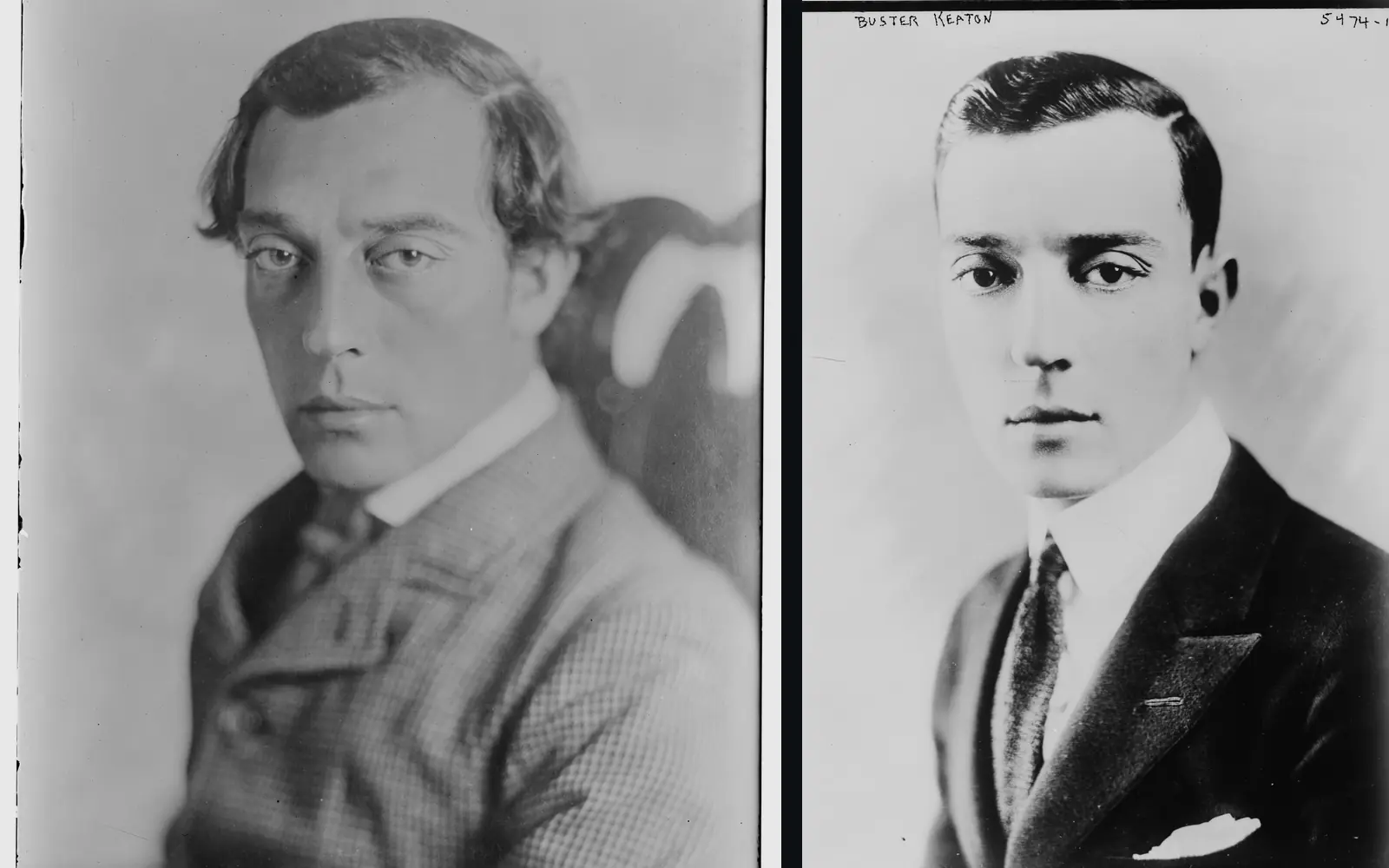
As the BFI’s historical overview makes clear, screen action was designed long before the profession had a stable name. Silent-era filmmakers combined physical performance with set construction, doubles, camera position and forced perspective. Harold Lloyd’s clock sequence in Safety Last! was not powerful because the audience could calculate the roof height; it was powerful because architecture, lens position, performance and concealment produced one coherent illusion. Buster Keaton’s most durable gags likewise depended on choreography, engineering and camera precision, not daring alone.
The Academy occasionally recognised individuals without creating a recurring film category. Yakima Canutt received an Honorary Award at the 39th ACADEMY AWARDS® ceremony for stunt achievement and safety developments. Hal Needham received an Honorary Award in 2012 as an innovator, mentor and technician. Those honours mattered, but neither created an annual process for comparing the design of one film with another.
According to Stunts Unlimited’s participant account, Jack Gill began pushing for an OSCAR® in 1991. Read alongside the Academy’s own branch records, that history points to more than a debate about merit: stunt professionals also needed institutional representation and a workable awards process for a deeply collaborative department. The Academy created its Production and Technology Branch in 2023, explicitly including stunt coordinators; by the 2025 category announcement, it said that branch contained more than 100 stunt professionals.
Taken together, those records suggest an accumulated breakthrough: decades of campaigning, stronger Academy representation and a clearer creative vocabulary. Stunts Unlimited’s participant account separately identifies direct presentations led by Chris O’Hara, David Leitch and Kelly McCormick in the final campaign phase. No single film or individual can credibly own the result.
Why the word ‘design’ changed the argument
The Academy did not call the category Best Stunts or Stunt Performance. It chose Achievement in Stunt Design. That wording moves attention from the hardest-looking moment toward the system that makes an action idea narratively legible, technically achievable, repeatable for the camera and controllable for the people performing it.
The title had already gained institutional momentum. NBCUniversal’s account of The Fall Guy says the production, 87North, SAG-AFTRA and the DGA worked to credit Chris O'Hara as Stunt Designer rather than only Stunt Coordinator. O'Hara described the title as a way to make the creative scope visible: the department can be involved early in preproduction, designing sequences rather than simply administering a take.
His most useful formulation is also a safety principle: stunt professionals are “creating the illusion of danger by eliminating the risk.” No production can reduce every risk to zero, but the sentence correctly relocates excellence. The viewer judges the illusion; the production must manage the actual exposure.
The vocabulary also appears in Fischer’s archive: a Wayback capture of SlamArtist.com from 14 December 2005 visibly includes ‘STUNTDESIGN’. That record establishes public use on this site by that date.
Where design begins
In Fischer’s working definition, design begins before coordination or performance: it starts when action first enters a script or creative brief. It establishes intention, story logic, character logic and the shape of a solution before the department translates that idea into precise execution.
Camera belongs inside that process, the source argues, because movement, angle, lens position, timing and edit logic determine whether physical work is legible onscreen. The proposed assessment criteria therefore run from story and character through originality, technical solution, performer integration, precision, safety and audience effect.
That perspective also explains the source’s preference for eventual stunt-ensemble recognition over a prize for an individual performer. The concern is that singling out one visible feat could turn risk into campaign currency; an ensemble model could recognise execution without treating injury, uncontrolled exposure or endurance as artistic merit.
Four award systems, four different answers
The Academy does not need to invent every principle from zero. Other awards already recognise stunt work, but they disagree about the object being judged and the people who receive the physical award. That disagreement is useful: it exposes the choices hidden inside the apparently simple phrase Stunt Design.
How existing awards distribute recognition
| System | Recognises | Recipient logic | Lesson for this category |
|---|---|---|---|
| Actor Awards | Action performance by a stunt ensemble in film and television. | Eligible stunt players receive certificates; up to four Actor statuettes are selected by the stunt coordinator. | A team title does not remove the difficult decision about who receives the object. Source ↗ |
| Television Academy | Separate awards for stunt coordination and stunt performance. | Coordination goes to credited coordinators; performance can be individual or a team capped at four. | Design leadership and physical performance can be honoured without pretending they are the same achievement. Source ↗ |
| Taurus World Stunt Awards | Multiple specialist categories plus coordination and second-unit direction. | Up to five credited professionals by category; rules can include second-unit and appropriate local leads. | International and specialist responsibility can be recognised more precisely than one top-line credit. Source ↗ |
| Hong Kong Film Awards | Best Action Choreography. | Nominees and winners may be individuals or multi-person teams. | Action authorship has long been treated as a creative film achievement that can belong to a group. Source ↗ |
Analysis
There is no settled industry model
Design, coordination, performance and action choreography overlap, but they are not synonyms. The Actor Awards centre the performers. The Emmys divide leadership from execution. Taurus subdivides the craft and admits local responsibility. Hong Kong treats action choreography as creative authorship, often shared.
The Academy’s category name points toward film-wide design rather than one selected feat. But the name alone cannot decide whether a principal creative head, several unit heads or an ensemble should receive the statuette.
The camera is not an afterthought—and VFX is not the enemy
An action idea can be physically impressive and cinematically useless. Screen direction, lens distance, eyelines, geography, movement speed and edit points determine whether the audience reads intention or only motion. That makes camera logic part of stunt design from the beginning, even though the camera department retains its own craft and authorship. Our IMAX production analysis shows how capture-format constraints can narrow those choices before action reaches the lens.
For that reason, action, camera and edit logic must be developed in contact with one another if the final sequence is to preserve the design. That does not make cinematography or editing subordinate to the stunt department; it makes the boundaries collaborative.
The same collaboration complicates the VFX boundary. An Academy educational guide on visual effects gives a practical safety example: once supports can be erased digitally, stronger and safer cables and wires can be used. Digital work does not automatically make a practical performance less legitimate; it can be part of the control system.
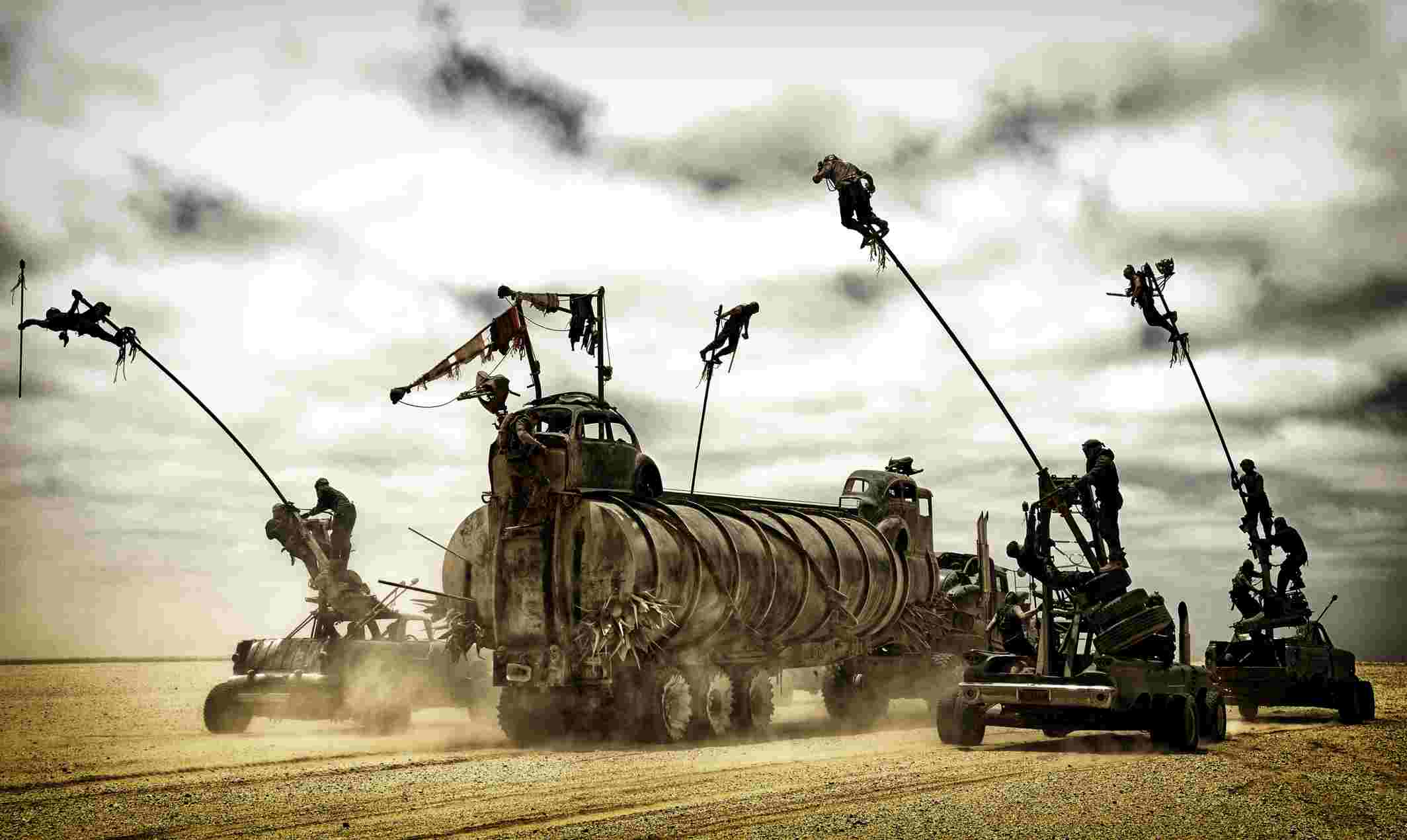
The useful distinction is not practical equals pure and digital equals fake. It is whether the submitted achievement contains substantial human stunt design and physical execution, how digital intervention changed what the audience sees, and which departments authored each part. Our stunt-rigging field guide documents how real systems, performer work and digital removal already coexist in the same image, while our analysis of AI action cinema examines why provenance becomes more valuable as synthetic spectacle improves. The Emmys and Taurus draw different lines. The Academy must publish its own.
Judge the illusion, not the danger
Awards create incentives. If campaigns sell records, impact counts and stars doing their own stunts, voters may confuse evidence of exposure with evidence of design. A record can be meaningful in publicity and still be irrelevant to whether an action idea serves its story.
A defensible judging framework starts elsewhere. Does the action advance the story? Is it credible for the character? Is the idea original within that narrative rather than merely novel in isolation? Does the performer integration feel continuous? Do the camera and edit reveal cause, intention and consequence? Did the technical solution produce a strong result without using scale or budget as a substitute for invention?
Safety belongs in that framework, but it cannot be scored by watching the finished clip and guessing how dangerous it was. A calm-looking movement can require exceptional control; a violent-looking image can be produced with extensive protection and digital removal. The historical shift behind that evidence problem is examined in our Buster Keaton safety analysis. Voters may need a short design reel, previs or rehearsal evidence, credited contribution statements and disclosure of material digital alterations. Any such requirement must protect confidential methods and avoid turning an award submission into a public safety manual.
Future debate over individual or ensemble performance recognition should remain separate from the design category. The Emmys and Taurus demonstrate that performance can be recognised under explicit rules, but every model should make one principle unmistakable: injury, uncontrolled exposure and brute endurance are not artistic merit.
The credit paradox
The award can change material conditions before it is ever presented. Once studios can campaign stunt design, departments have a stronger argument for earlier engagement, real preparation time, previs resources, appropriate fees and credits that describe creative responsibility. Recognition can help excellent teams cross borders and make their methods legible to producers who previously saw stunts only as execution.
Prestige can also harden existing networks. A scarce statuette can intensify gatekeeping and disputes over who gets named. The risk is not unique to stunts; it is built into every collective craft compressed into a few nominees. It is more acute here because titles are inconsistent and many decisive contributions occur in second units, splinter units and local teams.
A transparent process would require the production to identify proposed recipients early, map their responsibilities to defined eligible functions and allow a documented challenge before ballots are final. The Academy should not ask voters to solve a private credit dispute by reading the end crawl.
The first winner will set a precedent larger than one film. If the choice appears to reward scale, celebrity proximity or the most marketable behind-the-scenes story, the category will teach campaigns the wrong lesson. If it rewards story, originality, precise authorship and controlled execution, it can reset how the industry understands the craft.
The rules the Academy still owes the craft
None of the decisions below has yet been publicly announced. They are the minimum questions the 2027 rulebook must answer if Achievement in Stunt Design is to function as an international competitive award rather than a symbolic headline.
Ten unresolved decisions
- Eligible functions
- Which credited roles can be designated, and can function override title?
- Recipient cap
- How many people may be nominated and receive statuettes?
- International equivalence
- How will Action Directors, Second Unit Directors, local coordinators and choreographers map across production systems?
- Work under judgment
- Is the award for a whole film, a body of sequences or one submitted sequence?
- Evidence
- Will voters receive finished clips, design reels, previs, rehearsal material and contribution statements?
- Hybrid action
- How must practical performance, rigging, physical effects, VFX and digital doubles be disclosed?
- Controlled execution
- How will rules prevent visible risk, records, budget or injury from becoming proxies for quality?
- Voting
- Who creates any shortlist, who nominates and who votes in the final round?
- Credit disputes
- What review process applies when units or proposed recipients disagree?
- Presentation
- Will the category be presented in the main live ceremony, and in what form?
Analysis
Recognition is only as good as the definition
The category’s existence is historic. Its quality will be determined by less glamorous work: definitions, recipient limits, evidence standards, international equivalence and a voting body capable of reading action beyond spectacle.
After almost a century of ACADEMY AWARDS® ceremonies, the Academy no longer has to decide whether stunt design is cinema. It has to decide whether its rules can recognise modern collaborative action filmmaking without creating another narrow gate through which only one kind of credit can pass.
Sources and interview record
- Academy Establishes Stunt Design Award for 100th Oscars — Academy of Motion Picture Arts and Sciences, 2025-04-10. Accessed 2026-07-12.
- Academy Regulations — Editorial Use — Academy of Motion Picture Arts and Sciences. Accessed 2026-07-18.
- Oscar Statue 2/28/2014 — Justin Higuchi / Wikimedia Commons / Flickr, 2014-02-28. Accessed 2026-07-18.
- Academy and ABC Announce Show Dates for 99th and 100th Oscars — Academy of Motion Picture Arts and Sciences, 2026-04-07. Accessed 2026-07-12.
- Academy Establishes New Production and Technology Branch — Academy of Motion Picture Arts and Sciences, 2023-03-31. Accessed 2026-07-12.
- The Birth of Action: 10 Sensational Stunts from the Silent Era — British Film Institute, 2024-11-25. Accessed 2026-07-12.
- The 39th Academy Awards — Yakima Canutt Honorary Award — Academy of Motion Picture Arts and Sciences. Accessed 2026-07-12.
- 2012 Governors Awards — Hal Needham Honorary Award — Academy of Motion Picture Arts and Sciences. Accessed 2026-07-12.
- And the Oscar Goes to… Stunts! — Stunts Unlimited, 2025-04-11. Accessed 2026-07-12.
- The Stunt Community Is the Star of The Fall Guy — NBCUniversal, 2024-05-02. Accessed 2026-07-12.
- The Fall Guy Stunt Designer Chris O'Hara on Staging the Illusion of Danger — The Credits / Motion Picture Association, 2024-05-06. Accessed 2026-07-12.
- Visual Effects: Seeing Is Believing — Teacher’s Resource Guide — Academy of Motion Picture Arts and Sciences / Young Minds Inspired. Accessed 2026-07-12.
- 32nd Annual Actor Awards Rules and Regulations — Actor Awards presented by SAG-AFTRA. Accessed 2026-07-12.
- 2026 Emmy Awards Rules and Procedures — Television Academy, 2026-04-07. Accessed 2026-07-12.
- Taurus World Stunt Awards Rules — Taurus World Stunt Awards. Accessed 2026-07-12.
- Hong Kong Film Awards — Best Action Choreography — Hong Kong Film Awards Association. Accessed 2026-07-12.
- Ferdi Fischer on Achievement in Stunt Design — STUNT.BLOG Editorial Desk, 2026-07-12. Accessed 2026-07-21.
- Ferdi Fischer — Official Professional Profile — FerdiFischer.com. Accessed 2026-07-21.
- Archived SlamArtist.com Homepage — 14 December 2005 — Internet Archive Wayback Machine, 2005-12-14. Accessed 2026-07-21.

.jpg)
Loading approved comments…