Generative-video systems can already produce striking action at shot scale, while current research still finds persistent failures in physical commonsense and dependent chains of events.
The likely production default is hybrid: real performance and authorship combined with generative planning, digital replicas, synthetic extensions and conventional VFX.
If spectacular images become cheap, verifiable physical authorship may become premium — but the value is controlled craft, consent and consequence, not injury or unnecessary danger.
Analysis
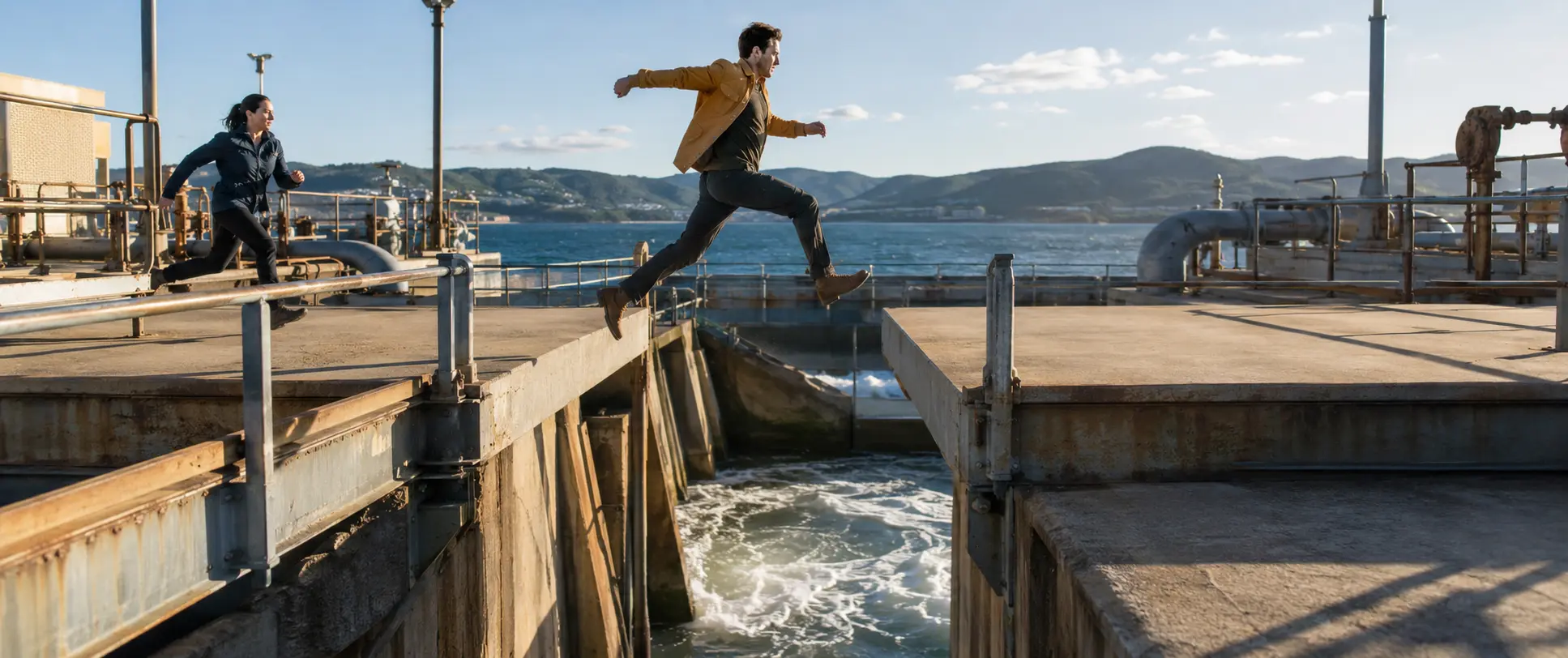
The runner is already airborne. Beneath him, seawater hammers through a concrete spillway. Behind him, a second body eats the last metres of steel. The receiving deck is clear. His front foot reaches for it while the frame holds the distance open just long enough to make the drop register.
It is a superb action image.
There was no runner. No spillway. No lens. No take.
That second description is about to become ordinary.
This is where most arguments about artificial intelligence and filmmaking become strangely small. One side declares the end of crews, cameras and physical production. The other waits for a broken hand, a floating wheel or one impossible reflection and calls the revolution off. Both mistake a temporary capability test for the shape of an industry.
AI will not end the action sequence. It will end the assumption that an image is evidence of an event.
The image has lost its alibi
Cinema has never been a neutral record. A practical stunt is designed, rehearsed, framed, cut and often digitally cleaned. A wire may carry a body while visual effects erase the wire. A real vehicle may enter a controlled collision while a synthetic environment extends the road. The physical and the fabricated have shared the frame for decades.
Generative video changes something deeper than the amount of manipulation. It can sever the image from physical acquisition altogether. The frame no longer needs a photographed event underneath it. It may begin as a prompt, a reference image, a motion path or a statistical possibility.
That does not make the result artistically worthless. Animation has never needed to pretend it was documentary. The new problem is not that a synthetic crash is somehow morally fake. The problem is that a photographed crash and a generated crash can now arrive in the same visual language while representing completely different kinds of authorship, labour and consequence.
Commercial systems are advancing fast. Current developer releases from ByteDance and Runway market stronger motion, consistency and control, with some systems also generating synchronized sound. At the scale of an individual shot, the result can be astonishing. But a convincing second is not the same thing as a convincing sequence.
A collision is a chain of debts. Mass owes momentum. Glass owes force. A tire owes the road. A human body owes every movement to balance, resistance and the position it occupied one instant earlier. Action is not a collection of beautiful frames. It is causality under pressure.
That is still difficult for systems trained to generate plausible appearances. The 2025 PhyGenBench study presented at ICML found that the tested text-to-video models struggled with physical commonsense, particularly in dynamic situations, and that more scale or more detailed prompting did not simply remove the problem. A July 2026 preprint on the ‘seriality gap’ narrows the issue further: in its controlled collision experiments, performance deteriorated as one event depended on another.
Neither paper places a permanent ceiling over generative video. They identify the current fault line. Appearance is becoming cheap faster than consequence is becoming reliable.
FULLY AI-GENERATED ACTION FRAME — NO CAMERA, NO VESSEL, NO TRANSFER.
One convincing instant
Three futures running in parallel
The useful forecast is not a clean war between ‘AI films’ and ‘real films.’ It is a market separating into three production lanes.
Synthetic spectacle
The first lane creates the action without physical acquisition. No vehicle needs to move, no set needs to exist and no performer needs to execute the beat. Its competitive advantage is not truth. It is velocity.
This is where impossible worlds, rapid iteration, personalized content and imagery that could never justify a physical build will flourish. Some of it will be disposable. Some of it will be extraordinary. The decisive creative skill will move toward taste, selection, continuity and the ability to direct a system whose output is abundant but not automatically meaningful.
Synthetic action does not fail because nothing happened. It fails only when it asks the audience to value it as if something did.
Hybrid cinema
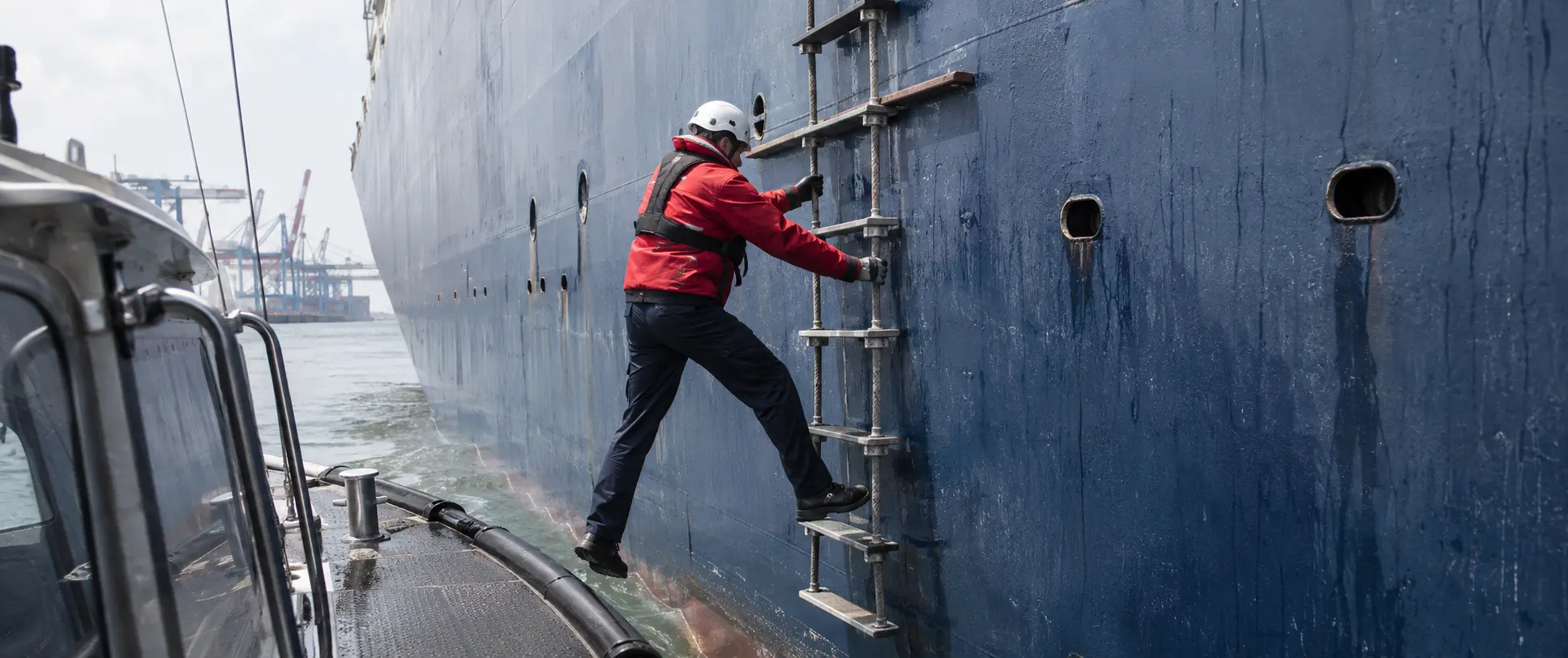
The second lane will probably become the industrial default because it is less ideological and more useful. Human performers, physical environments and conventional camera work remain in the pipeline. Generative systems assist with concept exploration, previs, synthetic extensions, digital crowds, face or voice processes and selected transitions. Traditional VFX continues to handle work better solved through controlled simulation, compositing, animation and artist-led finishing.
These categories matter. Generative AI is not a new label for every digital tool. The ratified 2026 SAG-AFTRA TV/Theatrical framework explicitly distinguishes generative systems from traditional CGI and VFX. The distinction is not semantic housekeeping. It tells us who performed, what was captured, what was synthesized and which rights attach to each layer.
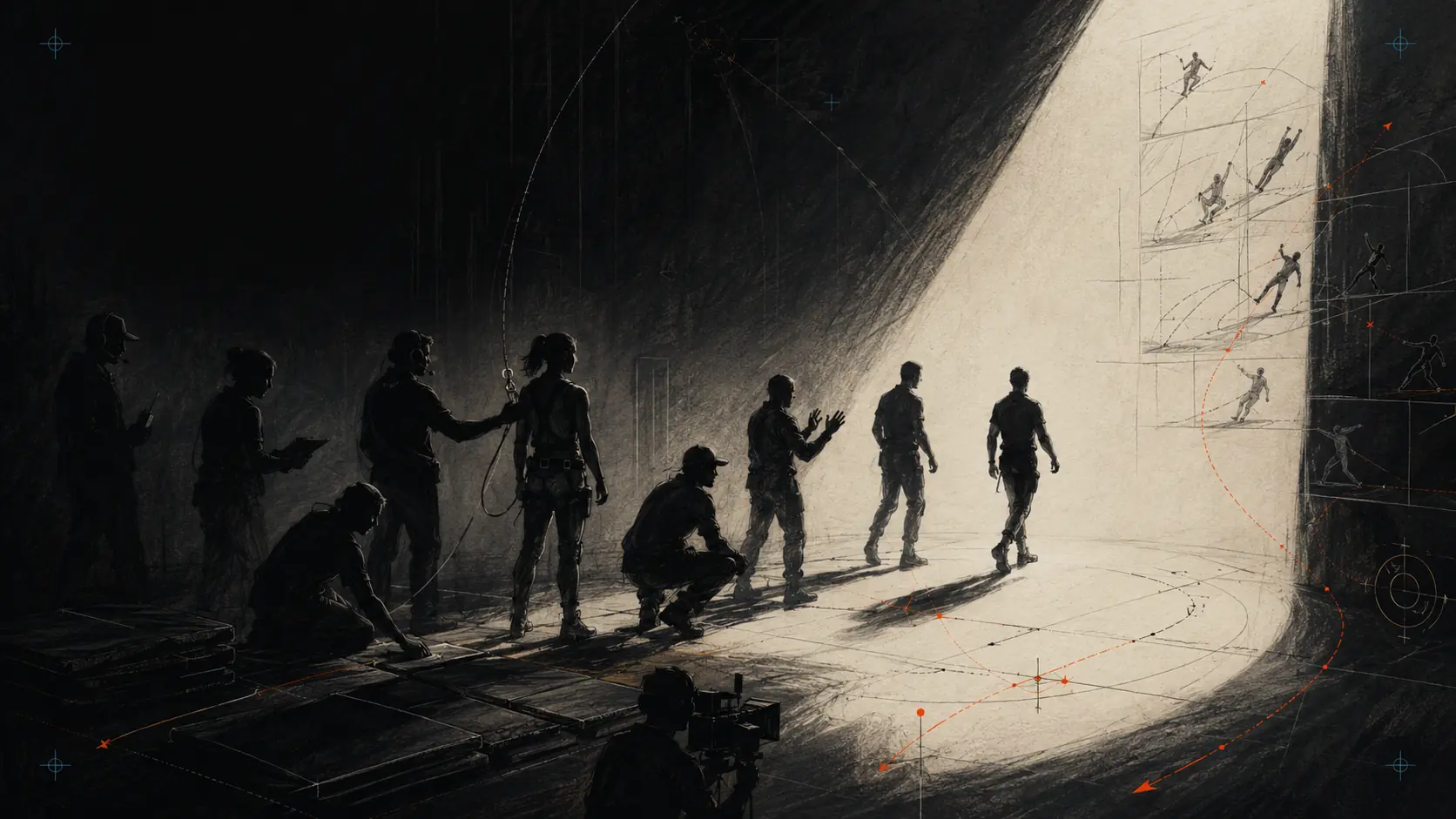
Hybrid action existed long before the current AI wave. Our field guide to stunt rigging shows the underlying pattern: a physical system can carry weight and timing while post-production removes the evidence of support. AI adds new instruments to that orchestra. It does not erase the orchestra.
Verified physical action
The third lane is not ‘no CGI.’ That slogan collapses the moment a safety line is removed, a horizon is extended or a dangerous element is replaced. A more honest category is verified physical action: the production can demonstrate that a meaningful core of the performance occurred in shared physical space under controlled conditions.
The proof might involve rehearsal records, credited specialists, production photography, witnessable physical effects, declared digital alterations or a documented chain of capture. The finished frame can still be elegant, invisible and heavily finished. What matters is that the claim has a traceable real-world centre.
This is not purity. It is provenance.
The hybrid will win the middle
The most consequential near-term use of AI in action filmmaking may not be a prompt that replaces an entire sequence. It may be a series of smaller substitutions that change who works, when they work and what must happen on set.
A synthetic prop can remove a sharp or shattering object from close choreography. A digital replica can take over a beat that no person should be asked to perform. Generative previs can expose a bad camera idea before a unit builds around it. Face replacement can separate physical qualification from facial resemblance. Cleanup can preserve a controlled performance while removing the systems that protected it.
Those are not trivial gains. Used well, digital intervention can move unacceptable exposure out of the physical day while keeping human intention, timing and weight in the image. Used badly, it can turn the same body into reusable inventory.
That is why the performer’s scan has become a labour issue rather than a neutral technical asset. The 2026 SAG-AFTRA agreement builds rules around employment-based and independently created digital replicas, including consent, compensation, notice, security and further bargaining in defined situations. It also addresses wholly synthetic performers and expressly recognises established digital uses for actions that cannot be performed without serious risk to life or health.
The union did not negotiate science fiction. It negotiated payroll, permission and control.
That shift will stratify action work. Routine, non-specific human movement is easier to treat as replaceable data. Distinctive physical performance, action design, supervision and the ability to translate story into repeatable movement become more valuable upstream. The future stunt professional may not only perform a movement. They may help design its data boundary, define what a replica is allowed to do and retain authorship across the physical and synthetic versions of the beat.
Proof becomes part of the show
For most of film history, behind-the-scenes material arrived after the illusion. It was bonus content: the crane outside the frame, the rehearsal before the cut, the rig beneath the costume.
In synthetic media, that relationship reverses. The making-of can become part of the product because it authenticates what the finished image no longer proves by itself.
That does not require a production to publish sensitive methods, private contracts or a safety manual. It requires a credible evidence layer. Who designed the action? Which performer or digital replica appears? What was physically captured? What was generated? Which elements were removed or extended? Who consented to the use?
Technical standards can help. The C2PA specification allows signed provenance records to carry information about how an asset was created and changed. That can make an edit history inspectable. It cannot certify that a production was ethical, that a marketing claim is complete or that the event depicted occurred exactly as an audience imagines. C2PA verifies a signed chain of assertions. The reader still has to decide whether to trust the signer and the claim.
The shot will need both a manifest and a witness.
Reality becomes the special effect
Will audiences pay more for verified physical action? That is a plausible commercial bet, not an established law. Box office cannot isolate one cause, and the reviewed evidence does not support a universal ‘practical equals profit’ formula.
But the scarcity mechanism is clear.
When impossible images are expensive, the image itself carries prestige. When impossible images become abundant, the process behind an image can become the differentiator. A live performance, a physical build, a real location or a controlled piece of action gains meaning because it was not the path of least resistance.
The premium is not nostalgia for a pre-digital cinema that never truly existed. It is the ability to say what happened, who made it happen and how the human contribution survived the finish.
Synthetic action can be honest and brilliant. Hybrid action can use technology to protect people and widen creative possibility. Verified physical action can turn gravity, material and human timing into an event worth documenting. The categories do not need to hate one another. They need to stop borrowing one another’s claims without disclosure.
The next generation of action filmmakers will therefore design two things at once: the sequence and its evidence trail.
The runner clears the gap again. It looks magnificent.
This time the audience asks a different question.
Not: *How did they do that?*
*What, exactly, happened?*
The answer will be part of the movie.
Method
AI assisted with source triage, structural exploration and drafting. The STUNT.BLOG Editorial Desk checked the retained factual, contractual and technical claims against the linked records. Three supplied research memos were treated as background leads rather than independent sources because they lacked a reliable claim-to-source chain.
Primary records used for this analysis include the ICML 2025 PhyGenBench paper, the current SAG-AFTRA 2026 TV/Theatrical record, the 2026 memorandum of agreement, the C2PA 2.4 specification and the Academy’s official award announcement. Current model capability was checked against official developer materials and is deliberately described without a claim of perfection or feature-length reliability.
Sources8 entries
- Official Launch of Seedance 2.0 — ByteDance Seed, 2026-02-12. Accessed 2026-07-20.
- Introducing Runway Gen-4.5 — Runway, 2025-12-01. Accessed 2026-07-20.
- Towards World Simulator: Crafting Physical Commonsense-Based Benchmark for Video Generation — Proceedings of the 42nd International Conference on Machine Learning / PMLR, 2025-07-13. Accessed 2026-07-20.
- The Seriality Gap in Video Diffusion Models — arXiv, 2026-07-14. Accessed 2026-07-20.
- 2026 TV/Theatrical Contracts — SAG-AFTRA, 2026-06-01. Accessed 2026-07-20.
- 2026 Theatrical–Television Memorandum of Agreement — SAG-AFTRA / AMPTP, 2026-05-01. Accessed 2026-07-20.
- C2PA Technical Specification 2.4 — Coalition for Content Provenance and Authenticity. Accessed 2026-07-20.
- Academy Establishes Stunt Design Award for 100th Oscars — Academy of Motion Picture Arts and Sciences, 2025-04-10. Accessed 2026-07-12.
Loading approved comments…