Analysis
The performer and the shoot day are the most visible stunt costs, so a calculation centred on them can look plausible. If it were complete, removing Stunt Design, previs and rehearsal would change neither the shot nor the schedule. In practice, it changes both. A screen moment lasting seconds can depend on decisions made weeks earlier; not every beat needs the same scale, but deleting a stage from the budget does not delete its function.
The work returns somewhere else: as unpaid or compressed preparation, fewer creative options, a camera plan built too late, an actor learning the movement while the unit is waiting, a smaller result—or a sequence simplified until the screenplay’s promise no longer exists. The structural problem is not only what one performer earns. It is the gap between the visible moment a production prices and the system the intended moment requires.
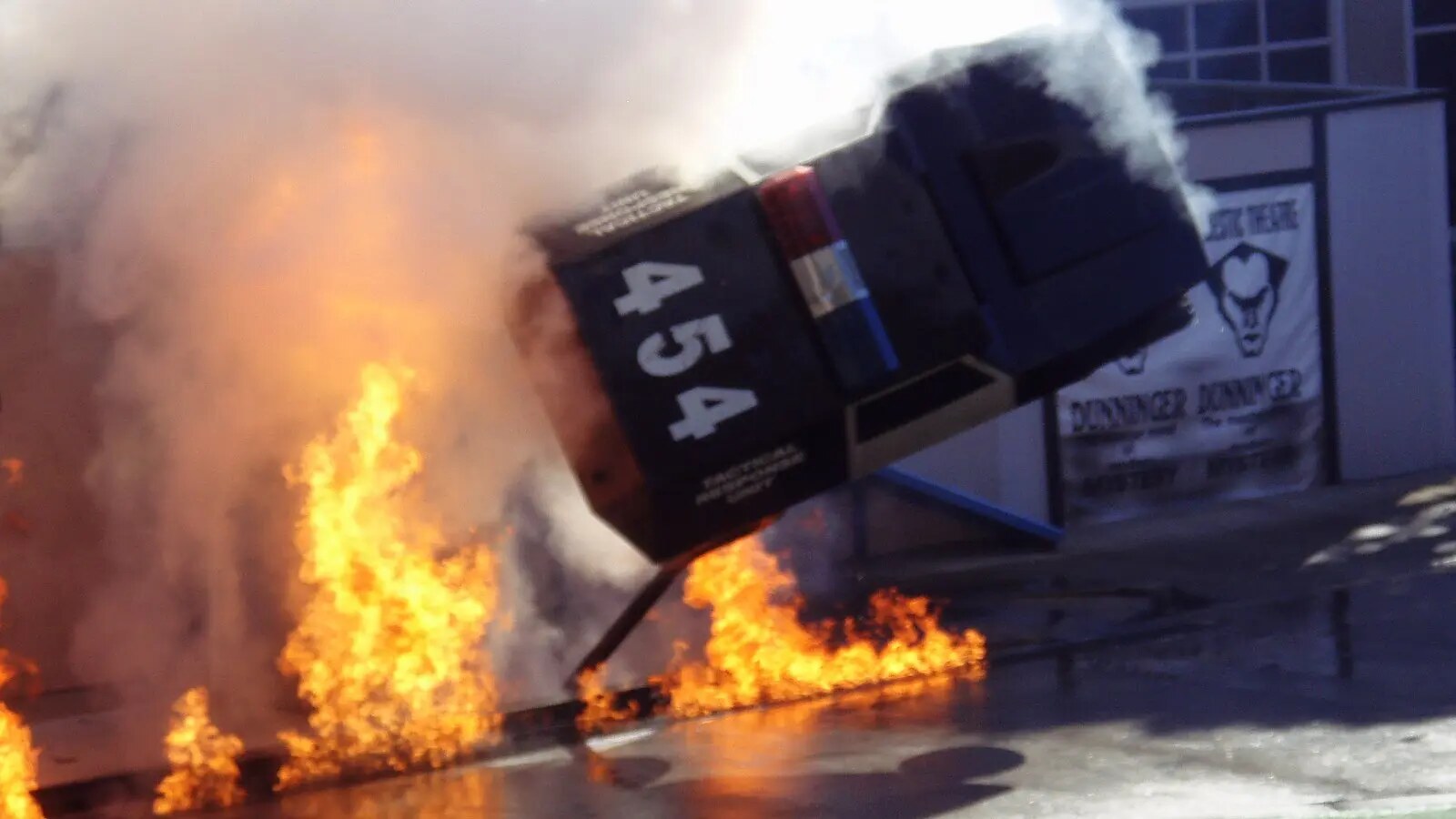
The real car-flip photograph above makes that hidden arithmetic immediately visible. Fire, smoke and the rotating vehicle are the spectacle; the controlled arena and the cantilever method described in the source record are the production system around it. A finished shot can hide most of that system. The budget cannot.
The real cost of screen action is a process: script breakdown, Stunt Design, coordination, tests, actor training, rehearsals, equipment, camera and edit planning, execution, resets and contingency—not merely a performer and a shoot day.
Our review found no nationwide public dataset that isolates stunt or action spend. What can be documented is a production-wide budget–cost squeeze, detailed German definitions of the work and weak public visibility of stunt roles in tariffs and broadcaster cost reporting.
US systems make verified coordinator experience and second-unit direction visible; UK and Australian guidance make competent oversight, preparation, rehearsal and differentiated roles visible. Jawan is one upper-end Hindi example of public-facing action leadership—not proof that every foreign production is better funded.
The practical fix is not ‘Hollywood money’ for every fall. It is an honest action calculation early enough to buy the preparation, people and camera strategy the intended result actually requires.
Germany defines the work—but not the budget behind it
Our review found no nationwide public dataset showing what percentage of German film and television budgets reaches the Stunt Department, actor action training, previs or action-unit photography. ARD publishes aggregated reports and programme-minute prices; funding bodies publish project and programme totals; collective agreements publish frameworks and selected minimum rates. None of the reviewed records reveals an action share. A precise claim such as ‘Germany spends X per cent while Hollywood spends Y’ would be invented.
That gap matters. Public data cannot support an industry-wide comparison of action ambition and action provision across formats; participants may, of course, know their individual project figures. This report therefore triangulates rather than pretends to audit: current production economics, official and professional definitions of stunt work, public tariff visibility, named practitioner experience and comparable structures in other markets.
The conclusion is narrower—and more defensible—than ‘every German production gets stunts wrong’. Germany has highly capable stunt professionals and strong individual work. The structural concern is that a complex department can be precisely described in professional guidance while remaining without role-specific reporting in the public tariff, broadcaster and industry documents reviewed here.
The action budget is a production chain
A seven-stage chain from script breakdown through design, preparation, actor training, technical integration, photography and post-production review.
What an action sequence actually costs
A stunt budget is not a shopping list of bodies and pads. The visible line items—performers, rigging, vehicles, equipment and shooting days—sit on top of less visible decisions. Who turns the script into executable movement? Who calculates time and cost? Who chooses specialists? Who prepares the actor mentally and physically? Who aligns costume, art, locations, camera, grip, SFX, VFX, medical provision and post? Who leads the sequence when the plan changes?
German guidance already describes this larger job. For stunts as special scenic representations, DGUV Information 215-315 describes a typical workflow: script identification, creative and technical discussion with direction, camera, production and stunt specialists, location inspection, decisions on rehearsal and training, assigned responsibilities and set-day communication. The German Stunt Association’s coordinator profile includes dramatic work, a stunt concept, cost calculation, schedule, casting, actor preparation, shoot leadership and responsibility for the artistic and technical result. This is a production function, not simply a spectacular performance.
That distinction changes the arithmetic. A quoted day rate can price an individual’s labour on a defined day. It cannot, by itself, price the sequence. The GSA’s 2023 recommendation also notes that freelancers must provide for their own insurance, retirement, training, continuing education, rest periods and equipment. Even accepting the document’s age and non-binding status, the principle remains: a rate is not a department, and a department rate sheet is not an action budget.
The Matrix production record examined in our rigging report makes the overlap concrete: performers on visible wires, crash mats, green stage, camera and VFX all belong to the same fight beat. The example matters because a sequence budget must price that interface rather than a single body.
Germany’s budget–cost squeeze is documented
The most current broad evidence does not isolate stunts, but it establishes the environment in which action is negotiated. In the Production Alliance’s autumn 2025 member survey, 93 per cent of responding companies cited falling budgets and 92 per cent rising production costs. Eighty-five per cent rated the industry situation bad or very bad. Fiction margins were especially weak: the association reported roughly one third of fiction producers operating at a loss and another third at only 0 to 2.5 per cent pre-tax margin.
The survey has limits: just over half of member companies responded, and businesses below €1 million annual revenue were underrepresented. It still supports the conclusion that many German producers are being asked to deliver under simultaneous cost inflation and budget pressure. It does not prove what a specific producer spends on stunts. It makes plausible why work that is poorly specified, late or weakly defended can become especially vulnerable.
One historical case offers a rare indication of how contracting budgets and shooting days can affect elaborate action. A 2012 producers study reported, in a Tatort case, reduced production costs, a fall in average shooting days from 28 to 23 and elaborate stunts becoming rarer than in the 1990s. That is not a current national measurement. Its value is diagnostic: when the envelope and days contract, production value is not compressed evenly. Preparation-heavy work is easy to shrink before anyone has priced what the shrinkage does to the screen.
Stunts are in the system—but barely visible in its economics
Germany’s TV FFS covers dependent employees in the stunt trade working for film-production companies that are not organised under public law; its remuneration agreement does not apply to commercials. Yet the minimum-remuneration table names no individual stunt function. For covered, unlisted professions, remuneration is negotiated on the basis of the framework agreement. Producer-directed rehearsals and preparation within the agreed work count as working time. The public table still gives commissioners and line producers no stunt-role ladder comparable to the detailed professional role map.
That is an institutional visibility gap, not proof that every contract underpays. It also does not cover every freelancer or production type. But visibility influences default thinking. A role that appears in a budget template, tariff table and schedule has to be discussed. A function hidden inside ‘stunts’, ‘miscellaneous’ or one performer’s deal is easier to treat as optional.
Broadcaster transparency does not close the gap. ARD’s April 2023 slot profiles give selected 90-minute production slots in Das Erste average programme-minute prices of €19,500 to €27,700 gross—arithmetically €1.755 million to €2.493 million. These are slot prices, not disclosed stunt budgets or the actual costs of every film. The ARD Producer Report 2024 aggregates €885.8 million across commissioned, co-, mixed productions and licence purchases, but again provides no stunt, previs or action-unit share; the total is not a pure production-cost figure.
The current ARD framework calls for a project-specific, coordinated and realistic calculation and early agreement on a possible production schedule and budget. It does not name Stunt Design, action, previs or second unit as standards or minimum provisions, although production-specific necessary positions may be recognised after agreement. Whether—and to what extent—action is budgeted therefore remains publicly invisible.
“We don’t need a Stunt Coordinator—only a stunt performer who coordinates themselves.”— A recurring production request reported by Ferdi Fischer after more than 20 years in German and international action production · Practitioner account on German action budgeting
One stunt performer is not a Stunt Department
The sentence above is not a statistical frequency claim. It is a named practitioner’s account of a recurring request. It captures the central false economy: coordination is treated as an overhead that can be erased by asking the exposed performer to plan, perform, monitor and evaluate themselves.
Some small, low-complexity physical beats can be scoped with a small team. Right-sizing is professional. Role collapse is different. The coordinator reads the whole sequence, designs and communicates it, selects people and methods, tracks interfaces, watches the action from outside and retains the authority to modify or stop it. The performer executes a defined part from inside the event. Those perspectives can overlap in one experienced person only when the risk, complexity and independent oversight are honestly assessed.
The difference is visible abroad without pretending that every foreign set is ideal. UK HSE guidance says stunt work should be under competent supervision by someone who is not taking part. Australia’s national guidelines state that when a coordinator performs, the producer must appoint another coordinator. The principle is simple: self-coordination can remove the very observation and decision capacity that coordination was meant to provide.
Bad Boys for Life makes the scale problem concrete: one motorcycle-and-sidecar beat can already combine two principal actors, a specialist moving vehicle and prop action inside a shared frame. Those simultaneous elements—not generic spectacle—are exactly what a one-person calculation fails to separate.
Actor preparation is a production decision—not a personality test
Fischer reports cases in his German practice in which actors arrive with little or no dedicated action rehearsal. In his experience, this is often connected to training not being meaningfully protected in the deal or schedule. That should not be flattened into ‘German actors do not care’. An actor can value the work and still be unavailable when training is proposed too late, unpaid, optional or in conflict with costume fittings, dialogue work and other shoot commitments.
The production question is more useful: when was the actor’s movement requirement identified, who specified the training, how many paid sessions were contracted, which wardrobe and prop versions were available, and when did direction and camera see the result? For hazardous scenic action, German DGUV guidance sets out sufficient rehearsal, suitable and trained participants and early specialist coordination. US industry guidance recommends that production management allow enough rehearsal, training and equipment-preparation time. Australian guidance expressly provides actor preparation under the coordinator’s direction.
Training is not about turning every actor into a stunt professional. It helps the action belong credibly to the character. Timing, breath, eye line, reaction, rhythm and the transitions into and out of a double’s work determine that impression. When this learning is pushed onto the shooting day, the production is buying basic orientation at the moment every other department is most expensive.
Netflix’s production record for Murder Mystery 2 connects Kelly Phelan’s Eiffel Tower work to storyboards, rehearsals, hang tests, actor–double work, rigging and a counter-moving camera. The account is direct evidence for the preparation chain under discussion.
Previs is not a luxury video; it is a shared decision tool
A useful previs can be rough. Its value is not polish but shared information: geography, story beats, lens position, performer handovers, rigging paths, effect timing, reset logic and the minimum coverage needed for the edit. It exposes a contradiction while changing it still costs a rehearsal hour rather than a shooting hour.
When a complex sequence needs previs—or an equivalent shared camera-and-movement planning process—and neither is provided, unresolved creative decisions can migrate to the set. The Stunt Coordinator may have designed one readable movement path while camera discovers a different axis, the director asks for another dramatic beat, costume restricts a range of motion and edit needs an entrance or reaction no one scheduled. The physical action can be executed correctly and still produce weak cinema because the shot window was never designed with it.
That is why camera awareness is part of action value. Proximity, lens, angle, frame rate, camera movement, duration and edit rhythm decide how much physical scale the audience perceives. More danger does not automatically create more impact. Our fight-previs field guide and Shot Window report examine those tools in detail. Budgeting the planning can be cheaper than asking performers to repeat an inadequately covered action.
The official Odyssey trailer supplies a useful coordination example: one airborne body has to remain legible among multiple fighters, armour, smoke and crossing movement. That density is why ensemble fight design, costume, effects, camera geography and edit continuity must be solved together before the beat is photographed.
Main unit, action unit or second unit: choose capacity, not status
A dedicated action unit is not justified by the word ‘action’ alone. Nor is keeping everything on main unit automatically economical. The decision turns on parallel preparation, specialist leadership, location access, technical density, performer and vehicle continuity, camera requirements, resets and how much principal-cast or principal-director presence the storytelling needs.
An action unit can give Stunt Design, specialist camera and repeated technical work a production lane of their own. A formal second unit adds a directing structure. On productions covered by the DGA Basic Agreement with the AMPTP, the Second Unit Director is a defined directing role coordinated with the principal director; that does not make a stunt coordinator the default second-unit director and it does not require a second unit for every sequence. The useful comparison is that the authority and handoff are visible.
Germany does have Action Directors, Action Units and second units. Fischer reports from his practice that productions repeatedly set a high threshold for budgeting a dedicated action or second unit. If a complex sequence occupies main unit without sufficient prep, the apparent saving can be consumed by waiting, late redesign, limited coverage and pickups. The correct question is not ‘Can we avoid another unit?’ It is ‘Which unit design gives this sequence the required result at the lowest total production cost?’
What comparison markets make visible
| Market | Publicly visible structure | What Germany can learn | Limit |
|---|---|---|---|
| Germany | Detailed DGUV workflow and GSA role profiles; broad tariff and broadcaster records do not isolate action provision. | Connect the existing professional process to budget lines, schedule gates and commissioning questions. | No department-share dataset was found in the nationwide public sources reviewed; strong individual productions exist. Source ↗ |
| United States / Hollywood | Recommended industry guidance makes coordinator planning, preparation, testing, rehearsal, training and modification visible. | Make preparation time and the coordinator’s scope auditable before photography. | The bulletin is recommended guidance; contracts and jurisdictions vary, and Hollywood includes underfunded work too. Source ↗ |
| United Kingdom | Regulator guidance separates competent oversight from participation and defines strict conditions for actor participation in stunts. | Protect independent observation and hire by competence and track record. | The guidance does not impose one creative budget or staffing number. Source ↗ |
| Australia | National industry guidelines classify stunt roles, demand pre-production time, surveys, walkthroughs and replacement coordination when a coordinator performs. | Turn ‘preparation’ into named deliverables and decision deadlines. | Guidelines are not a federal minimum action budget. Source ↗ |
| India / Hindi tentpoles | India Today reported six action directors on Jawan and described the team as internationally renowned. | Treat action leadership as a visible creative value when the format is sold on spectacle. | India is multilingual; Jawan is a high-end Hindi example, not a national average. Source ↗ |
Hollywood’s useful difference is structure, not mythology
The comparison should not be reduced to bigger US cheques. The Industry-Wide Labor-Management Safety Committee’s 2025 stunt bulletin is recommended guidance, not universal law, but it recommends that production management allow sufficient time for rehearsal, training, equipment preparation and inspection. It describes the coordinator’s work across script review, planning, locations, personnel, equipment, testing, rehearsal, modification and execution.
SAG-AFTRA’s coordinator eligibility process adds a producer-verifiable experience threshold within its system: 500 verified covered workdays, which the union says takes about five years on average. SAG-AFTRA also warns that this does not certify every specialty or guarantee overall competence. That caveat makes the comparison stronger, not weaker. The system creates a verifiable minimum record while leaving producers responsible for the actual hire.
Hollywood still contains rushed, low-budget and non-covered work. The lesson is not that a jurisdiction label guarantees quality. It is that certain responsibilities are harder to pretend do not exist. When rehearsal time, coordinator qualifications and second-unit authority have named places in industry systems, a producer has to make an explicit choice rather than allowing the work to disappear between departments.
The UK and Australia turn preparation into visible process
The UK HSE document distinguishes legal duties from guidance, but its production logic is direct: adequate planning and rehearsal, competent oversight, and actors performing stunts only in exceptional circumstances where competence and experience requirements are satisfied—and only under a Stunt Coordinator’s supervision. The British Stunt Register’s public directory separately lists professional roles. Neither creates a single price. Together they make it harder to describe ‘a stunt person’ as the whole organisational answer.
Australia’s national guidelines go further into process. They classify several stunt functions, ask for sufficient pre-production time, call dry runs and walkthroughs essential, set lead times for a stunt location survey and written report, require appropriate actor preparation and demand another coordinator if the coordinator performs. These are guidelines, not federal legislation, but they show how ‘prep’ can become a set of observable deliverables rather than a vague request.
Mad Max: Fury Road is the spectacular upper-end case, not proof of an Australian norm. Variety documented Guy Norris as Action Unit Director, more than 300 practical stunts and a video test used to demonstrate the practical feasibility of the polecat concept. The transferable lesson is not to copy its scale. It is that development time, a test image and action-unit leadership let a production decide what is achievable before the most expensive stage of execution.
Hindi cinema shows the value of making action visible
‘Bollywood’ is not shorthand for all Indian cinema. India’s film culture spans many major language industries. The public campaign around the Hindi-language tentpole Jawan made its action leadership part of the film’s production story: India Today reported six action directors and described the team as internationally renowned. That is one upper-market staffing choice, not evidence that every Hindi film funds action generously.
Institutional visibility is mixed. India’s National Film Awards recognise Best Action Direction (Stunt Choreography). The four labour codes took effect on 21 November 2025, and the Labour Ministry’s subsequent FAQ expressly includes stuntmen among audio-visual workers. In the nationwide public sources reviewed, we found no general rule prescribing coordinator qualifications, minimum rehearsal time, previs or a second unit for every production. The comparison therefore cannot be ‘Bollywood values stunts, Germany does not’. It is narrower: Jawan could openly make several action directors and their work part of its market promise, while Germany’s public production economics still do not reveal what an action system receives.
Jawan made several action directors and their work part of its public production story. That visibility—not the film’s title alone—supports the narrower argument that action leadership can be treated as authored production value instead of an anonymous cost line.
What underbudgeting looks like on screen
Quality here does not mean the biggest explosion or the most dangerous fall. It means readable geography, character-specific movement, credible reactions, repeatable performance, useful coverage, continuity across actor and double, integration with effects and enough options to shape rhythm in the edit.
In STUNT.BLOG’s practitioner experience, compressed preparation can produce recurring quality losses. A sequence may become generic because the actor had no time to own it. Camera may stay wide and remote because closer handoffs were never developed—or move too close without preserving geography. A technically successful stunt may yield one usable angle instead of an editorial sentence. Resets can dominate the day, late creative changes consume contingency, and VFX may be asked to repair interfaces it never helped design.
None of those symptoms proves that the Stunt Department lacked ability. They can instead indicate specialists using their expertise to keep an under-resourced design executable. The public sees only the reduced result and may conclude that German action itself is second-rate. The more precise criticism is that the production may have bought too little iteration, integration and choice for the ambition it put on the page.
Under-resourcing can also squeeze safety margins
This report is about value and production quality, not an allegation that German stunt teams ignore safety. Germany has detailed guidance, qualified professionals and productions that work responsibly. Our research found no public dataset that would support a causal claim that underbudgeting has produced a national rise in stunt accidents.
The conditional risk is still real. If late decisions, reduced rehearsal, performer–coordinator role collapse, unsuitable equipment substitutions or schedule compression remove control options, the margin available to manage change can shrink. The professional response is not to ‘push through’ but to modify, simplify, postpone or refuse the action. That may protect people while revealing the budget mismatch as a smaller shot or lost story beat.
A realistic stunt budget therefore buys both creative range and the capacity to say no before the camera rolls. Safety and quality share inputs—time, competence, communication, testing and independent judgement—but they are not interchangeable claims.
The Inglourious Basterds cinema finale clarifies that hidden-control problem: performers, open flame, projection and camera occupy the same finished image. Specialist protection and coordination disappear behind the result, which is precisely why they must remain visible in planning and budget decisions.
The eight lines an honest action calculation should show
| Budget line | What it buys | Warning sign when absent |
|---|---|---|
| 1. Breakdown and Stunt Design | Story purpose, action beats, methods, alternatives and a first complexity rating. | The first real design conversation happens after location and schedule are locked. |
| 2. Coordination and administration | Costing, scheduling, casting, interfaces, documentation and decision authority. | A performer is asked to absorb planning and oversight into one day rate. |
| 3. Technical recce and tests | Feasibility, measurements, equipment, surfaces, vehicles, effects and fallback checks. | Assumptions survive until the full unit is present. |
| 4. Previs and camera/edit plan | Geography, lens positions, handovers, minimum coverage and post requirements. | The sequence exists as choreography but not as shots. |
| 5. Actor and performer preparation | Paid training, rehearsal, doubling transitions and costume/prop integration. | The actor learns timing during lighting or immediately before the take. |
| 6. People and equipment | Qualified performers, rigging, vehicles, specialists, protection and support. | Headcount and tools are chosen before the method is final. |
| 7. Photography and unit strategy | Main/action/second-unit time, specialist camera, rehearsals, takes and resets. | A complex action block is expected to fit ordinary coverage speed. |
| 8. Contingency, pickups and post handoff | Weather, actor availability, modifications, continuity and VFX/editorial needs. | Without contingency, late changes pressure time, budget or screen value; safety requirements must never become bargaining material. |
Budget the sequence, not the fall
Germany does not need Hollywood scale for every punch, chase or fall. It needs a more truthful relationship between the action promised and the process funded. That begins before a performer is booked: an action breakdown, a qualified coordinator’s scope, paid actor preparation, a previs or test appropriate to the problem, a camera and edit strategy, the right unit model and a contingency that survives first contact with reality.
Commissioners and producers should ask for those lines explicitly. Directors and cinematographers should treat the stunt team as a design partner while shots are still fluid. Actors should receive action preparation as contracted production work. Stunt professionals, in turn, should make hidden labour visible in estimates and distinguish the minimum safe execution from the result the screenplay is selling.
The central mismatch is not that action costs too much. It is that the public structures around German production make it possible to decide what action may cost before establishing what the action actually is. The fall lasts seconds. The value is created in the weeks, decisions and people around it.
For practice on how action leadership integrates story, movement and camera, see Stunt Design in the SlamArtist.com Universe. The next editorial test is equally practical: use our Shot Window report to ask whether the budgeted camera plan can actually reveal the work being prepared.
Sources, documents and evidence record22 entries
- Herbstumfrage 2025: Strukturelle Probleme in der Filmwirtschaft — Produktionsallianz, 2025-12-02. Accessed 2026-07-26.
- Produzentenstudie 2012 — Forschungsprojekt Produzentenstudie / film-tv-video.de. Accessed 2026-07-26.
- Sicherheit bei Veranstaltungen und Produktionen — Deutsche Gesetzliche Unfallversicherung / VBG. Accessed 2026-07-26.
- Safety for Events and Productions — Special Scenic Representations — German Social Accident Insurance / VBG. Accessed 2026-07-21.
- Professional Job Profiles and Support — German Stunt Association. Accessed 2026-07-21.
- Gagenempfehlung 2023 — German Stunt Association, 2023-03-09. Accessed 2026-07-26.
- Tarifvertrag für auf Produktionsdauer Beschäftigte Film- und Fernsehschaffende 2024–2026 — Produktionsallianz and ver.di / BFFS, 2024-10-12. Accessed 2026-07-26.
- Sendeplatzprofile fiktionale Fernsehfilm- und Spielfilmplätze — ARD-Programmdirektion. Accessed 2026-07-26.
- ARD-Eckpunktepapier 3.0 — ARD and Produktionsallianz, 2026-01-01. Accessed 2026-07-26.
- ARD-Produzentenbericht 2024 — ARD. Accessed 2026-07-26.
- Safety Bulletin #4 — Stunts — Industry-Wide Labor-Management Safety Committee / Contract Services, 2025-03-27. Accessed 2026-07-21.
- Basic Agreement — Article 7: Directors' Minimum Conditions — Directors Guild of America. Accessed 2026-07-21.
- Stunt Coordinator Eligibility Process — SAG-AFTRA. Accessed 2026-07-21.
- Stunts, fights and other potentially hazardous production activities — UK Health and Safety Executive. Accessed 2026-07-26.
- Stunt Professionals Directory — British Stunt Register. Accessed 2026-07-21.
- High Risk Production Activities — Stunts — Screen Safe Australia / Screen Producers Australia / MEAA. Accessed 2026-07-26.
- Mad Max: On the Road Again — Variety, 2015-05-12. Accessed 2026-07-26.
- Government Makes Four Labour Codes Effective — Press Information Bureau, Government of India, 2025-11-21. Accessed 2026-07-26.
- Frequently Asked Questions on Occupational Safety, Health and Working Conditions Code, 2020 — Ministry of Labour & Employment, Government of India. Accessed 2026-07-26.
- 71st National Film Awards Regulations — Best Action Direction (Stunt Choreography) — Ministry of Information and Broadcasting, Government of India. Accessed 2026-07-21.
- Action directors of Inception, Avengers team up for Shah Rukh’s Jawan — India Today, 2023-08-22. Accessed 2026-07-26.
- Practitioner account on German action budgeting — Ferdi Fischer / STUNT.BLOG editorial interview, 2026-07-26. Accessed 2026-07-26.

Loading approved comments…