Stunt rigging is not one device or one method. Support, redirection, acceleration, descent, arrest and camera travel create different load paths and require different systems.
This guide compares those systems through current standards, practitioner records and production evidence; manufacturer claims remain attributed.
It intentionally omits build recipes, settings, cable sizes, trigger methods and operating limits because those values are performer-, system-, production- and jurisdiction-specific.
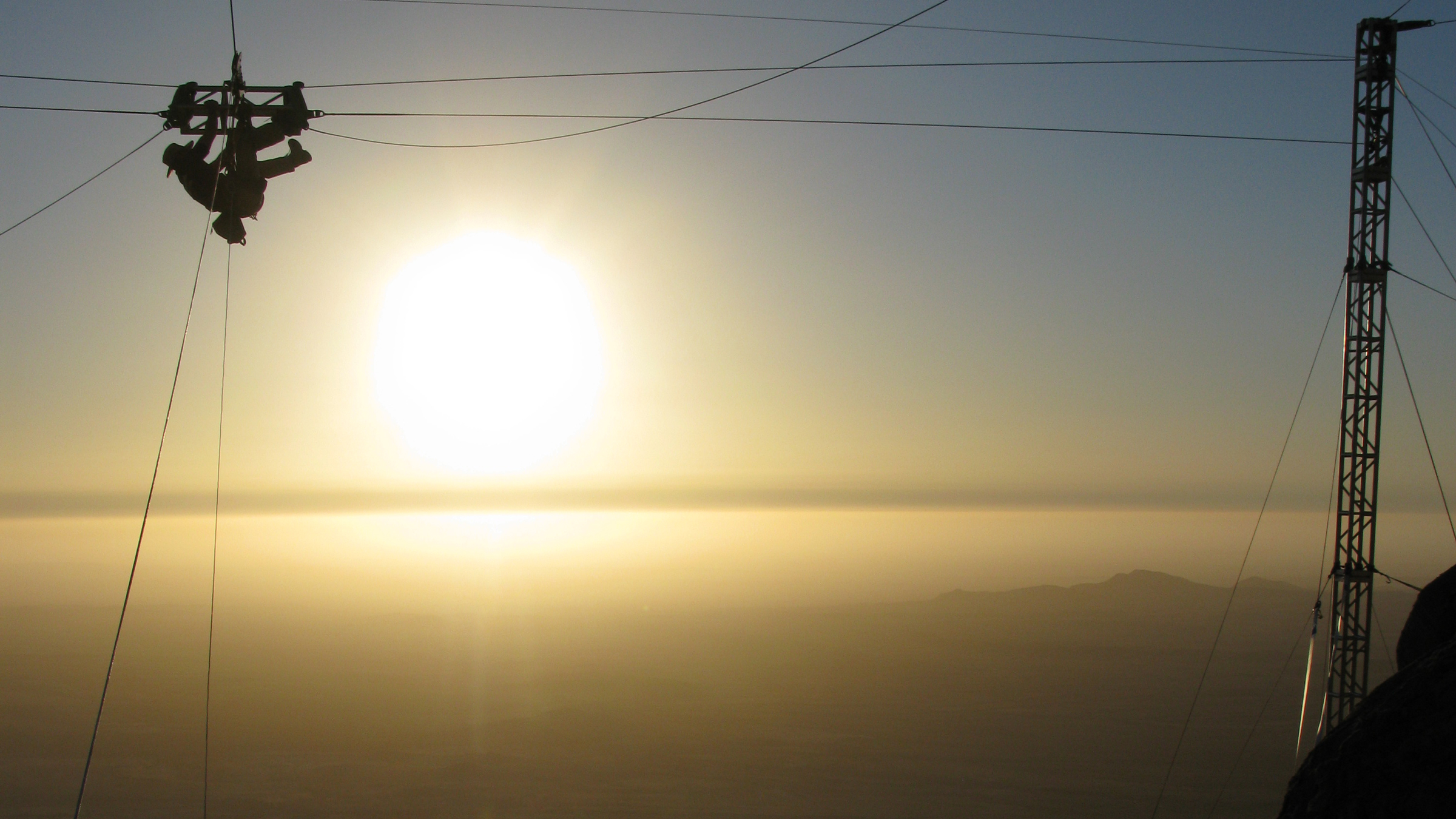
Two people hang in silhouette above an apparently bottomless landscape. Between them is a narrow suspended structure; beneath them, almost nothing the eye can use for scale. Outside published the photograph while profiling Australian stunt rigger Keir Beck and identified the scene as work on a 1,200-foot drop-off for Mad Max: Fury Road. The image matters because it shows what the finished movie hides: access, exposure, communication and recovery begin long before a performer enters the frame.
That is stunt rigging's central paradox. Its engineering may define the movement, its harness may carry the performer and its operators may determine the exact instant of acceleration or arrest, yet success is usually measured by disappearance. The line is painted out. The vest vanishes under wardrobe. A controlled pull reads as an explosion. A programmed descent becomes zero gravity. Audiences remember a body moving through impossible space; the machine that made the movement repeatable is meant to leave no visual residue.
Modern practice is therefore much larger than 'putting somebody on a wire.' It spans human-powered pulls, counterweights, pneumatic ratchets, air-ram platforms, powered winches, descenders, decelerators, travelling tracks, rotating harness interfaces, multi-axis automation and the coordination of all of those elements with structures, vehicles, effects, cameras, costumes and visual-effects cleanup. Some systems accelerate. Others only support, redirect, lower or catch. The craft lies in choosing what not to combine as much as in choosing the equipment that moves.
This report maps that field without publishing a build recipe. Device settings, cable diameters, trigger methods, anchor layouts and numerical operating limits are deliberately absent. Those values are system-, performer-, production- and jurisdiction-specific, and stripping them from their engineering context would convert explanation into bad instruction.
Rigging is movement design, not a drawer of gadgets
On a film set, 'rigging' can refer to many departments: supporting lights, hanging scenery, moving cameras, securing vehicles or creating mechanical effects. Within stunt design, stunt rigging is the branch that intentionally supports, accelerates, redirects, decelerates or recovers a performer—or protects a performer while another system moves around them. The boundaries overlap, but they should not be blurred. A car flipper is not automatically a wire rig; a cable camera is not performer-flying equipment; a fall-arrest device is not automatically a descender effect.
The useful unit of thought is the load path. Start at the performer interface: harness, vest, belt, seat, spreader or purpose-built carrier. Follow it through connectors and terminations into line or wire, redirects and pulleys, the drive or braking device, anchors and the supporting structure. Then add what a static catalogue cannot show: body orientation, acceleration, braking, slack take-up, elasticity, friction, off-axis loads, emergency stops, impact events, camera positions and the possibility that a backup system engages differently from the primary path.
Body mass is only the first input. An apparently modest movement can create a severe transient if slack is removed abruptly; a heavy system can remain controlled when acceleration and stopping distance are shaped deliberately. This is why a component's impressive breaking-strength number never proves that the assembled effect is suitable. The system must be evaluated in the configuration in which it will actually be used.
Current professional practice is deliberately plural. Action Factory publicly lists hand pulls beside ratchets, air rams, decelerators, descenders and automated 3D systems. That coexistence is important. Automation did not eliminate human-powered movement, and manual power is not a synonym for improvisation. The right drive method is the one that produces the required motion while leaving a controllable, inspectable and recoverable system around the performer.
The current stunt-rigging toolbox
| System | What moves | What it contributes on screen | What must not be confused with it |
|---|---|---|---|
| Hand pull / counterweight | Operators move a line directly or through redirects; a counterweight can balance part of the load. | Responsive lift, drift, interruption or directional change shaped by a trained team. | Unplanned hauling. Manual drive can still be engineered, rated, rehearsed and documented. Source ↗ |
| Pneumatic or nitrogen ratchet | A cylinder rapidly takes line along a designed vector. | A sharp pull, displacement or change of direction associated with an impact or blast beat. | An air ram. A ratchet acts through a line; an air ram launches through a platform. Source ↗ |
| Air ram / air ramp | A performer leaves a mechanically driven platform. | A launch that can read as an explosion, collision or superhuman strike. | A cable pull. The performer-facing load path begins at the platform. Source ↗ |
| Powered winch | A motor pays out or retrieves line; systems may be manually controlled or programmed. | Repeatable travel, sustained flight, precise timing or multi-axis motion. | A generic entertainment hoist. Equipment for people requires a different design and safety case. Source ↗ |
| Descender | A controlled mechanism produces rapid downward travel. | Drops, falls or vertical movement with designed braking and recovery. | An arbitrary industrial descender used outside its documented rope and load configuration. Source ↗ |
| Decelerator / arrest system | The system absorbs or manages energy as a fall is slowed. | A visible free-fall phase with a controlled end condition. | A descender that drives the complete motion. Vocabulary varies, so function must be stated. Source ↗ |
| Travelling or multi-axis rig | Two or more coordinated paths position a performer through space. | Curves, arcs, rotations, floating or flight that cannot be described by one vertical line. | A camera cable system. Similar kinematics do not make payload equipment interchangeable. Source ↗ |
Current equipment / 02 mechanisms
A platform launch and a line pull are different machines
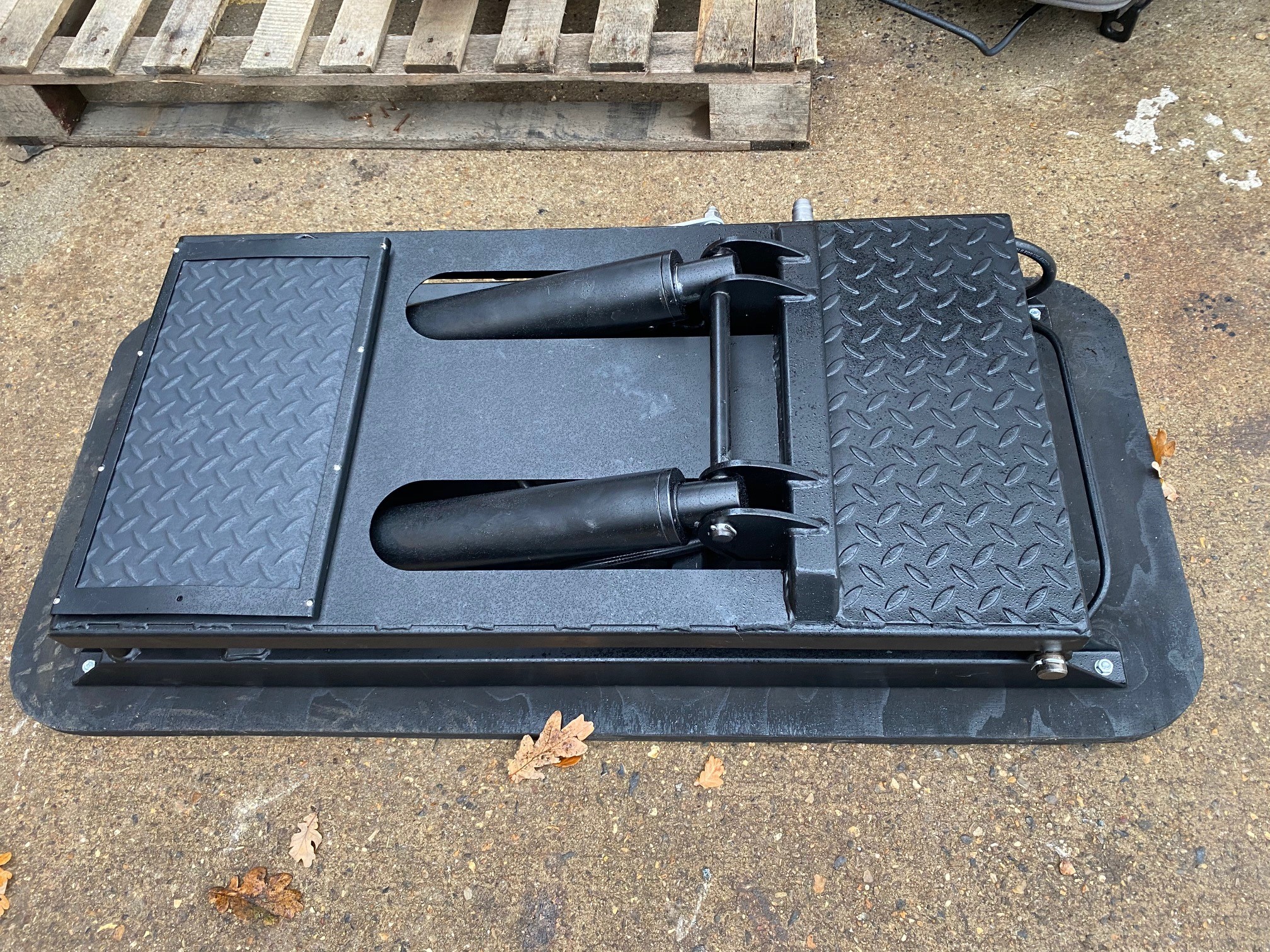
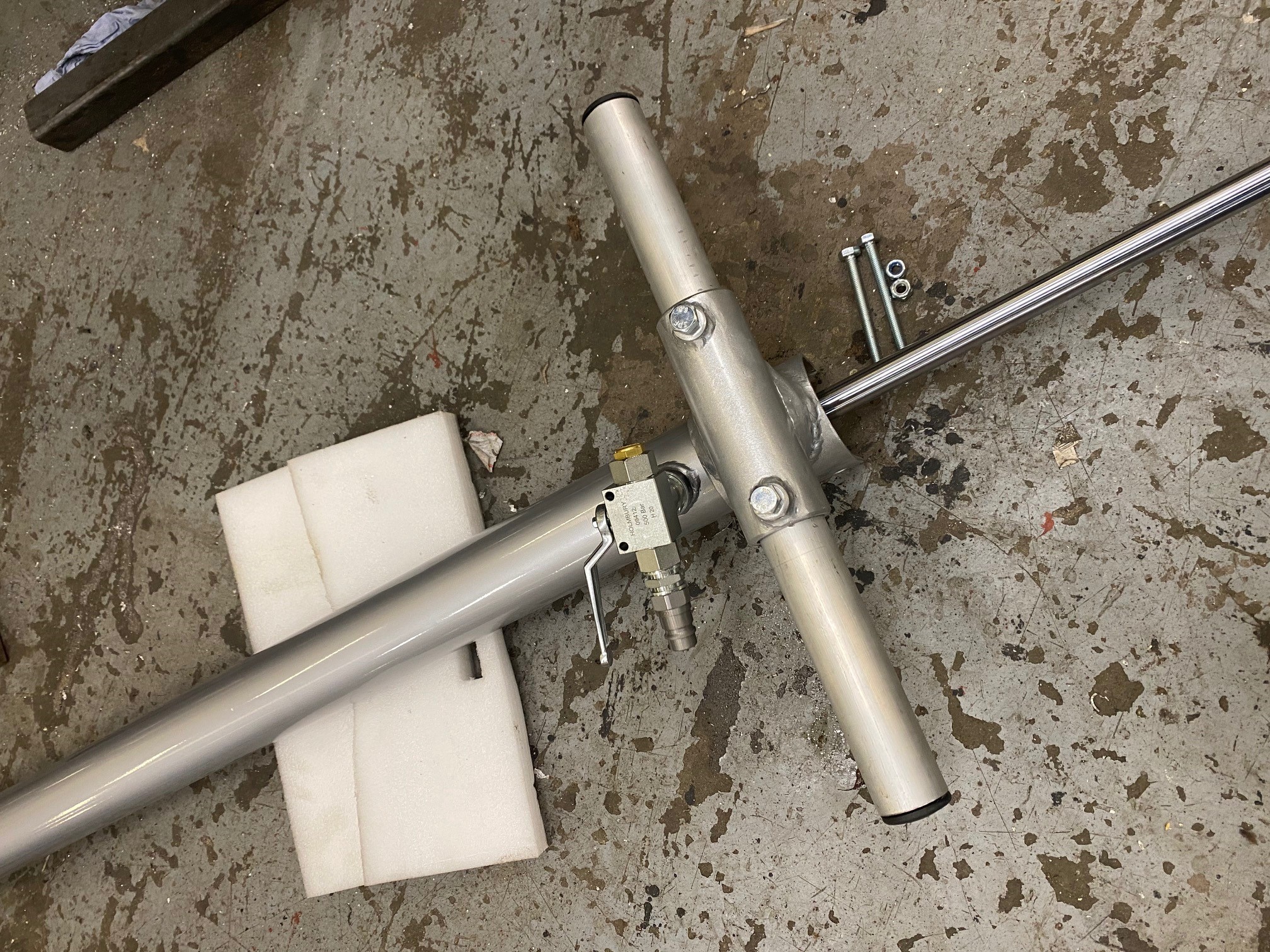
Images: Bickers Action, official product image.
Read the load path before the effect
The two official Bickers Action product photographs are useful because the hardware is isolated from spectacle. In the air-ram image, a performer would encounter the system through the platform. In the jerk-ram image, the actuator is part of a pull system that continues through a line and performer interface. Both can create sudden screen movement, but they introduce energy into the body by different routes.
That distinction governs everything downstream: rehearsal, body position, landing or recovery, line management, set clearance and camera placement. The images are not a parts list, and the article intentionally withholds pressures, strokes and triggering details. The meaningful editorial fact is that both device classes are still supported by current professional suppliers and sit inside a much wider design process.
From visible stage flight to invisible screen force
Performer flying did not begin with digital wire removal. Professional stage systems were suspending bodies decades before action cinema learned to hide their traces. Kirby's Flying Ballets dates its company lineage to the late nineteenth century and records Peter Pan flights in the early twentieth. Flying by Foy attributes a major mid-century step to Peter Foy's 1954 Inter-Related Pendulum, which let separate operators shape different components of motion. These are company histories rather than universal invention records, but they establish a long lineage of purpose-built human flight.
Cinema changed the design target. Theatre must repeat a cue from a fixed audience relationship, often with an apparatus the audience can see. Film can break movement into shots, hide support inside costume, change lens and camera speed, reset between takes and erase lines after photography. That freedom encouraged low-profile performer interfaces with many possible pick points, as well as rigs designed for violent-looking acceleration rather than only graceful travel.
There is no defensible single date for the invention of the modern stunt vest. Its lineage is distributed across workshops, productions and performers. A safer statement is that specialised multi-pick, low-profile film harnesses were refined through the late twentieth century. Climbing Sutra says it was founded in 1992 and began theatrical harness work in 1993; an archived 2016 AMSPEC product catalogue documents jerk suits and related interfaces. Those records show an established specialist market, not a two-company world and not a global ranking.
The most consequential digital change was not that computers replaced rigging. It was that line removal and compositing widened the range of visible support a production could photograph. Stronger or more redundant visible lines can sometimes be removed later, while the physical performer still supplies weight, timing, costume movement and contact. But VFX is never permission to ignore line management, set clearance or the consequences of a failed take. It is a finishing layer in a hybrid effect. Our analysis of generative AI and action cinema asks what becomes scarce when even the photographed event beneath an image can disappear.
A selective timeline of performer flight and screen rigging
Commercial stage-flying systems become an established craft
Kirby's company history records late-nineteenth-century operations and early Peter Pan performer flights. The exact lineage belongs to a broader theatre tradition, not one patent or one country.
Peter Foy develops the Inter-Related Pendulum
Flying by Foy's archive describes separate control of suspension points, increasing the vocabulary of stage movement and the skill required from operators.
Low-profile multi-pick harnesses mature for screen and live work
Specialist workshops refine concealment, load distribution, selectable pick points and interfaces for different body orientations. No single invention date covers the field.
The Matrix makes a cross-cultural rigging language globally visible
Hong Kong fight choreography, an Australian stunt department, wire-supported performance, camera invention and digital finishing become one unusually influential screen grammar.
Fury Road scales rigging across bodies, vehicles and practical effects
Its polecats, vehicle safety systems, ratchet-assisted stunt work, remote driver positions and later wire cleanup demonstrate the size of a contemporary hybrid action system.
Standards and practice continue to move
ANSI E1.43 receives a substantial 2025 revision, Furiosa wins the 2025 rigging award, Hong Kong publishes current safety guidance and professional suppliers still list manual, pneumatic and automated systems side by side.
The harness is a performer interface, not hidden wardrobe
A harness does more than stop a fall. It decides where force enters the body, how freely the pelvis and shoulders can rotate, whether a performer can hold a believable horizontal line, where wardrobe can conceal the structure and how quickly the team can inspect or change a connection. A design for an upright drop is not automatically a design for a sideways jerk, an inverted rotation or sustained simulated flight.
Modern stunt vests often spread structure across the torso and provide many reinforced connection options. Compact waist harnesses trade some coverage for concealment and mobility. Corset, swivel and specialty interfaces solve different body-position problems. The visible product categories are clues, not permission to choose by appearance. Fit, model instructions, the intended pick points, performer anatomy, planned forces and the rest of the system determine suitability.
The front and back photographs below show a current Climbing Sutra Spectra-Titanium vest. The maker lists three layers of Spectra fabric and webbing, more than 80 pick points, a minimum breaking strength of 18 kilonewtons and a current working load limit of 141 kilograms. Those figures belong to this named product page at this point in time. They are not a universal stunt-harness rating, and minimum breaking strength must never be substituted for working load.
Manufacturer paperwork and provenance matter because a harness can look convincing while being structurally false. A 2018 SAG-AFTRA alert described counterfeit units carrying AMSPEC labelling, fewer pick points and missing company labels. Four tested pick points failed far below the advertised 4,000-pound claim. The lesson is bounded but enduring: buy through reputable channels, verify identity and records, follow the actual maker's inspection and retirement rules, and do not infer safety from a familiar silhouette.
Performer interface / Front and back
One vest, many possible connection geometries
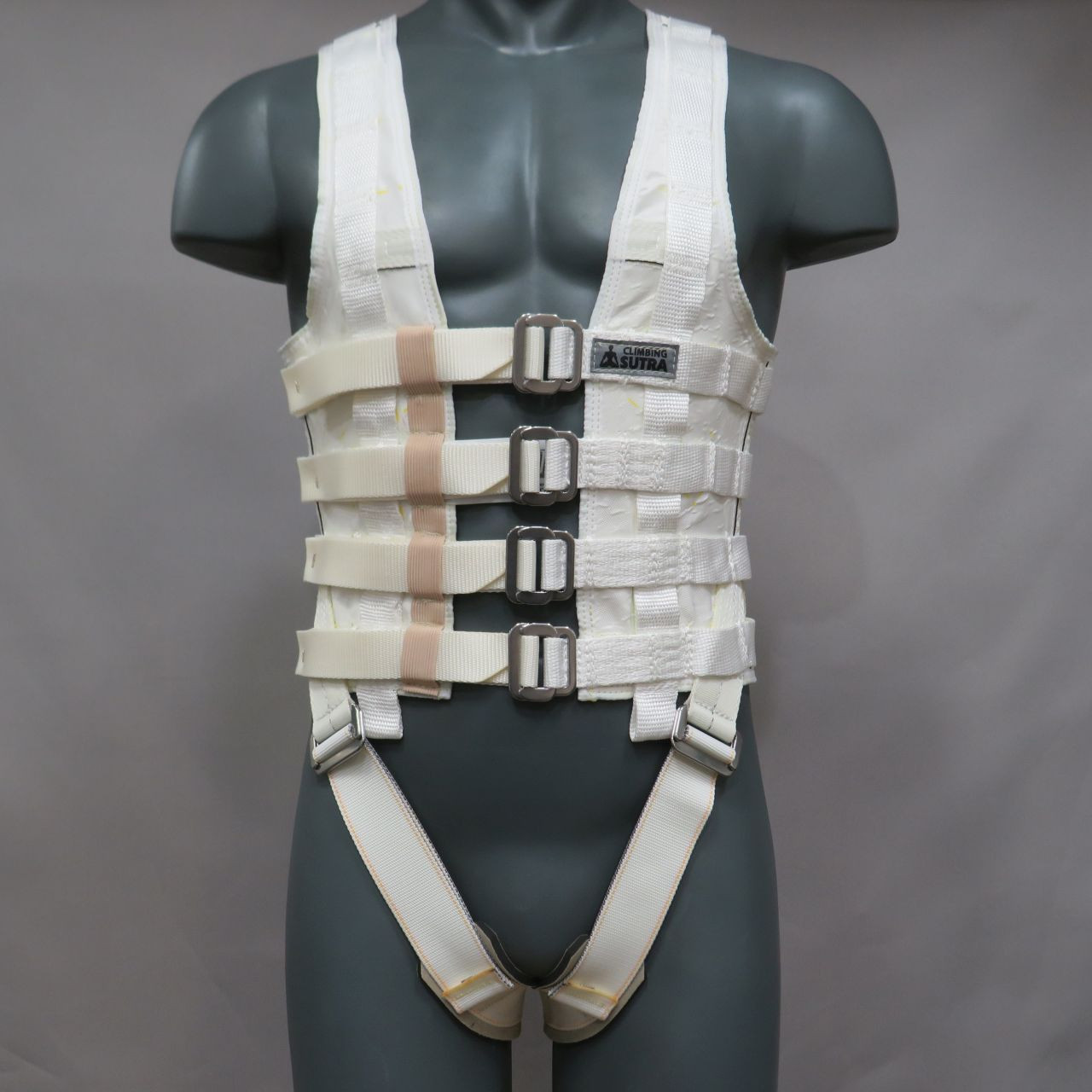
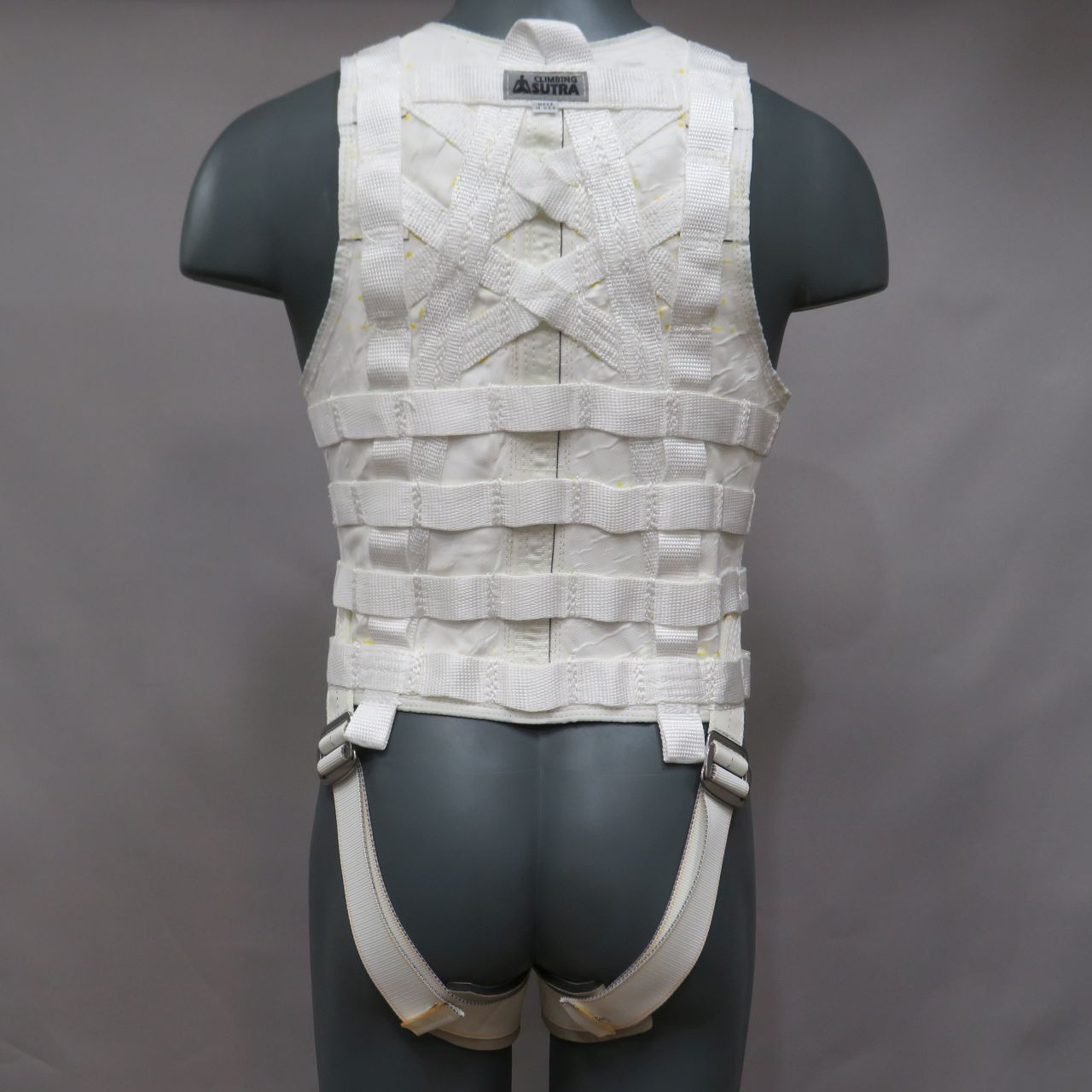
Images: Climbing Sutra, official product image.
Wirework interface / Compact waist form
Concealment changes the compromise
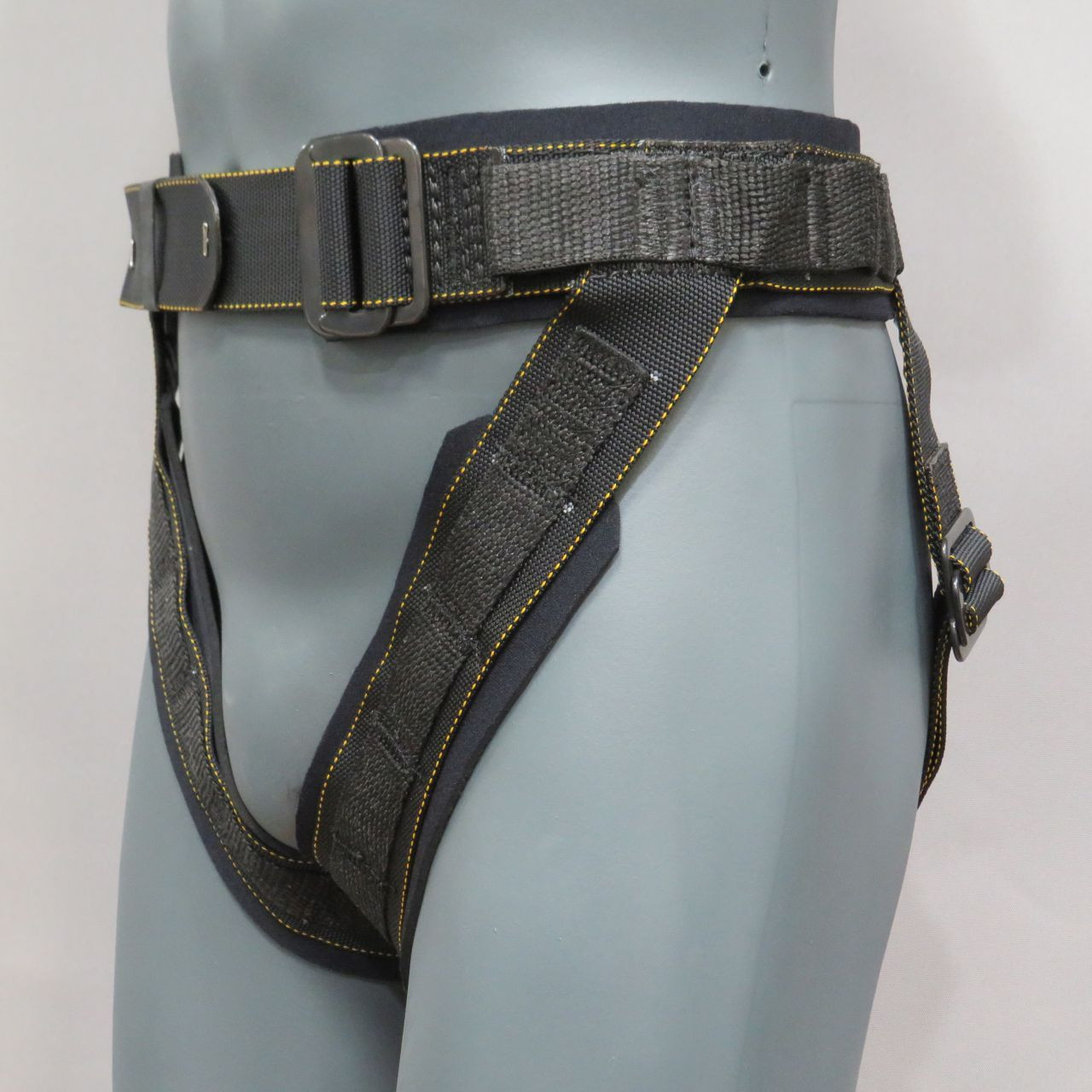
What separates harness categories
| Interface | Typical design priority | Question it forces the team to answer |
|---|---|---|
| Full or vest-style multi-pick harness | Load distribution, many selectable attachment locations, control of torso orientation. | Which documented pick geometry produces the required body line without unacceptable pressure or wardrobe conflict? Source ↗ |
| Waist / martial-arts harness | Low profile, hip-led movement, rotational freedom and concealment. | Can the intended forces and orientation be managed by this more concentrated interface for this performer? Source ↗ |
| Jerk suit / impact interface | A structure intended for rapid directional pulls and integration with padding or costume. | How will acceleration, stopping and recovery transfer through the whole body and not only the visible connection? Source ↗ |
| Swivel or rotating interface | Controlled rotation without forcing the line to carry unmanaged twist. | How are orientation, spin rate, line behaviour, stopping and post-motion recovery controlled? |
| Seat / spreader / purpose-built carrier | Support for a particular body pose, costume, creature, vehicle or long-duration cue. | Is the carrier itself rated, fitted, inspectable and compatible with every movement and evacuation state? |
Steel, nylon, aramid, HMPE: the line became a materials problem
In stunt vocabulary, 'wirework' does not guarantee that the line is steel. Steel wire rope, nylon, polyester, aramid and high-modulus polyethylene can all appear in entertainment systems, sometimes in the same production for different functions. Construction, coating, diameter, termination, bending radius, sheave compatibility, heat, abrasion, contamination, inspection access and load history matter at least as much as the fibre name.
The evolution in line quality is therefore not a simple march from thick steel to invisible super-fibre. Modern synthetics can provide extraordinary strength-to-weight ratios and easier handling; better manufacturer data makes elongation, creep, temperature limits and splicing classes more explicit; coatings can improve wear behaviour; and digital cleanup can remove a visible line. But low mass, low stretch or high breaking strength can create new failure modes if treated as universal virtues.
Samson's TECH-12 is an aramid product described as heat- and flex-fatigue-resistant around sheaves and winches. Its AmSteel-Blue is HMPE/Dyneema: very light and low stretch, with a high strength-to-weight ratio. Those materials must not be collapsed into one category. HMPE performance is temperature-sensitive; aramid brings its own bending, handling and termination considerations. The correct conclusion is not which fibre is 'best,' but which documented line remains compatible with the entire device and duty cycle.
Inspection also moved from the eye alone toward traceability and history. Samson's general rope-care guidance asks users to consider abrasion, glazing, chemical exposure, heat, bending and prior loads. Entertainment standards and production guidance add commissioning checks, pre-use inspection and reinspection after impact, shock or unusual stress. Age may be one input, but a universal retirement date for all lines or all harnesses is not defensible.
Line materials are trade-offs, not a league table
| Material family | Why a rigger may consider it | Constraint that stays in the conversation |
|---|---|---|
| Steel wire rope | Dimensional stability, established hardware ecosystems, heat tolerance and predictable inspection criteria when correctly specified. | Mass, stiffness, bend fatigue, corrosion, broken wires, drum and sheave compatibility, termination and visibility. |
| Nylon | Elasticity and energy absorption can be useful in some dynamic systems. | Stretch, moisture and temperature response, repeated loading, device compatibility and control of rebound. |
| Polyester | Lower stretch than nylon, broad availability and familiar general rigging behaviour. | Construction-specific strength and heat behaviour, abrasion, terminations and whether the device is approved for it. |
| Aramid / Technora family | High strength, low stretch and comparatively strong heat performance; TECH-12 is marketed for sheave and winch use. | Bending, compression, abrasion visibility, terminations and the exact maker's inspection criteria. Source ↗ |
| HMPE / Dyneema family | Very high strength-to-weight ratio, low stretch, flexibility and low handling mass. | Temperature, creep and lifetime modelling, coatings, bend radius, abrasion and product-specific restrictions. Source ↗ |
The Matrix did not invent wirework. It changed who could see its grammar.
Gravity-defying movement was already central to Chinese opera traditions, wuxia and Hong Kong action cinema when The Matrix began production in Australia. Yuen Woo-ping's choreography brought a performance-led vocabulary in which a fight could rise, float and redirect through several planes. The Western blockbuster did not discover that vocabulary; it placed it inside a globally distributed science-fiction film and made the crossover impossible for Hollywood to ignore.
The production was itself a negotiation between systems. In SYFY's oral history, Australian stunt coordinator Glenn Boswell and Chad Stahelski distinguish the Hong Kong/Chinese team's suspended fight choreography from the Australian department's responsibility for flying, leaps and heavy impacts. They also describe disagreements over practices such as knotting wire, the effect of Australian safety requirements and the translation challenges between teams. The result was not one country's method conquering another. It was an unusually visible hybrid built under local production rules.
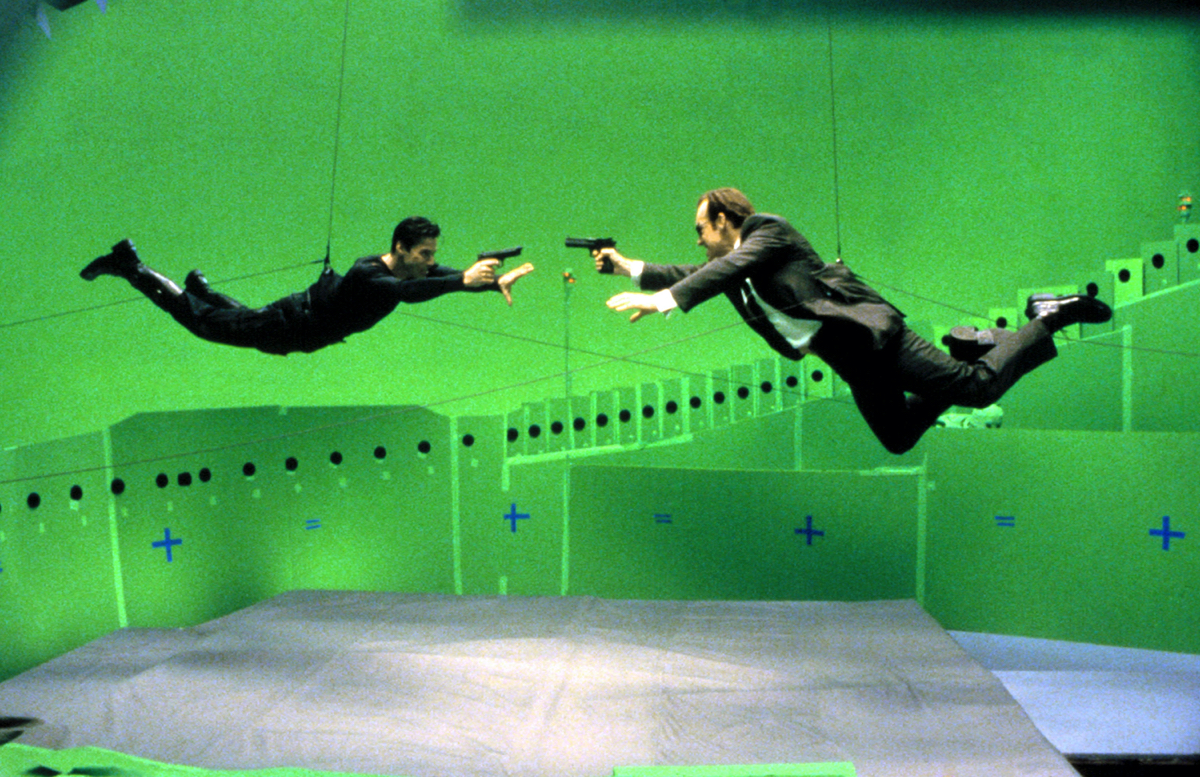
The production photograph below exposes that hybrid. Two performers are held almost horizontally on visible wires above a padded floor, their bodies already describing the fight while the green stage, rigging and later compositing wait to complete the illusion. The safety field is part of the composition: the bodies, support lines, landing surface and camera relationship have been designed together.
The Matrix / Production stage
Wire choreography begins before the background exists
Bullet time is a camera rig, not a stunt harness
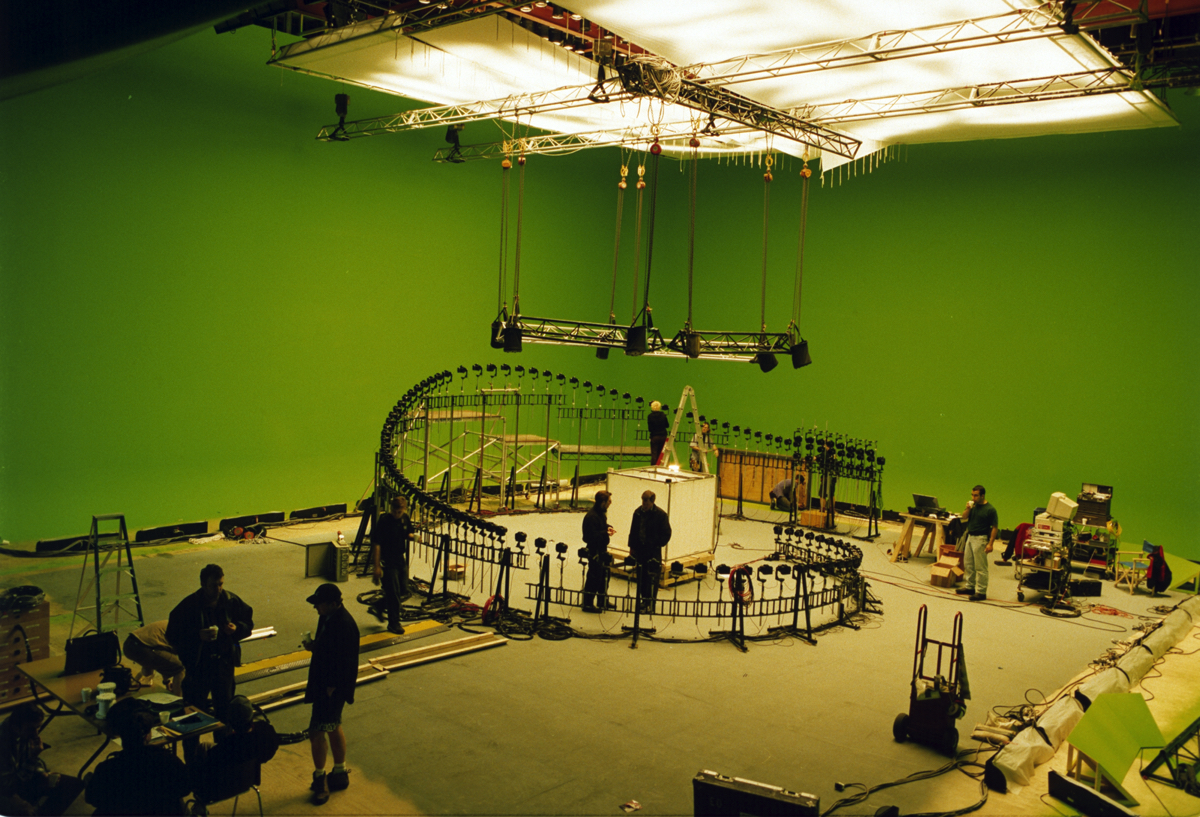
The Matrix also made a second rig famous: the bullet-time still-camera array. Frank Gallego's production account describes a 121-camera system arranged along a designed path. The curved structure in the photograph does not carry a performer; it carries viewpoints. Each camera samples a position that can later become part of an apparently moving shot.
Keeping that distinction sharp improves the history. Wirework shapes the performer's movement and support. Bullet time shapes the audience's movement around the moment. The finished film fuses them, which is why the technologies are so often remembered as one invention. In production terms they are separate load paths, separate departments and separate risks.
The Matrix / Camera engineering
A path made from viewpoints
Fury Road turned rigging into a moving ecosystem
Mad Max: Fury Road is a useful extreme because almost nothing in its action stands still. Performers cross between moving vehicles. Riders separate from motorcycles. Polecats sway above convoy speed. Cameras chase from dedicated platforms. Mechanical effects roll picture cars. Safety lines must manage relative motion rather than a performer moving against a fixed stage.
The official 2016 Taurus record names Keir Beck, Russell Ingram, Guy Norris, Mick Roughan and Mark Wickham as the film's Best Stunt Rigging team. It also describes a specific motorcycle stunt: rider and bike were connected to safety lines on the War Rig, a ratchet removed slack, the performer was pulled into position and the motorcycle released. That is one documented cue, not a template. Its value is that it shows how timing, moving anchors, separation and line management converge in a few seconds of screen action.
WIRED's production reporting describes polecats made from high-tensile steel, with counterweight and in some cases hydraulic mechanisms. Audio cues and visual marks helped performers and drivers coordinate; later visual effects removed harnesses and rigging. The physical spectacle was therefore neither 'all practical' nor digitally invented. It was built from real mass and real timing, with invisible support and digital cleanup completing the image.
The set photograph of Keir Beck with Tom Hardy makes that hybridity plain. Green screen surrounds a physical work platform and two real bodies. The actor, rigger, set, camera and post-production pipeline share the same space. Rigging is not the opposite of visual effects here. It is the physical performance layer that gives the visual effect weight.
Fury Road / Production hybrid
Physical support inside a digital finish

The Flipper shows where stunt rigging ends and mechanical effects begin
WIRED's three diagrams isolate the Flipper sequence: an articulated system mounted to a reinforced vehicle approaches a picture car, transfers energy into rotation and separates as the car rolls. The graphics are included because they make the boundary visible. This is a vehicle and mechanical-effects rig whose operation creates a performer environment; it is not itself a wire harness.
A safe action design still has to connect the domains. Where are performers during rotation? Which protections travel with the vehicle? Where can cameras exist without entering the debris or rollover field? What happens if one stage of the mechanical sequence does not progress as expected? Large productions earn scale by dividing one spectacular beat into several accountable systems and then rehearsing the interfaces between them.
Fury Road / Publisher diagram sequence
Approach, rotation, separation
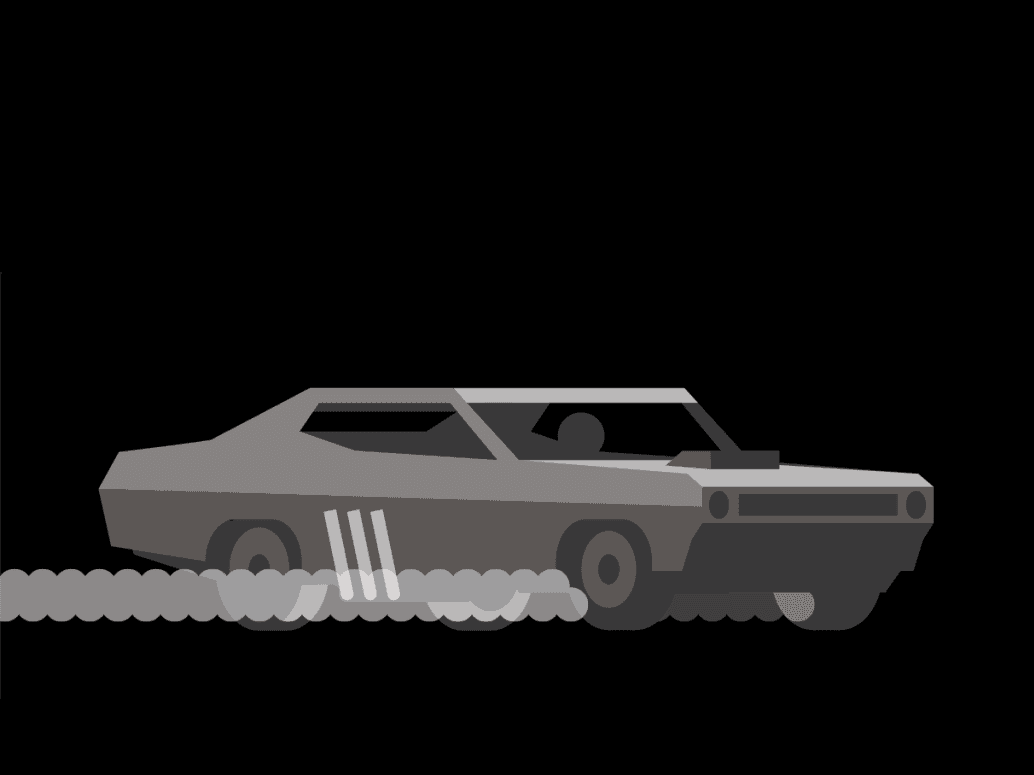
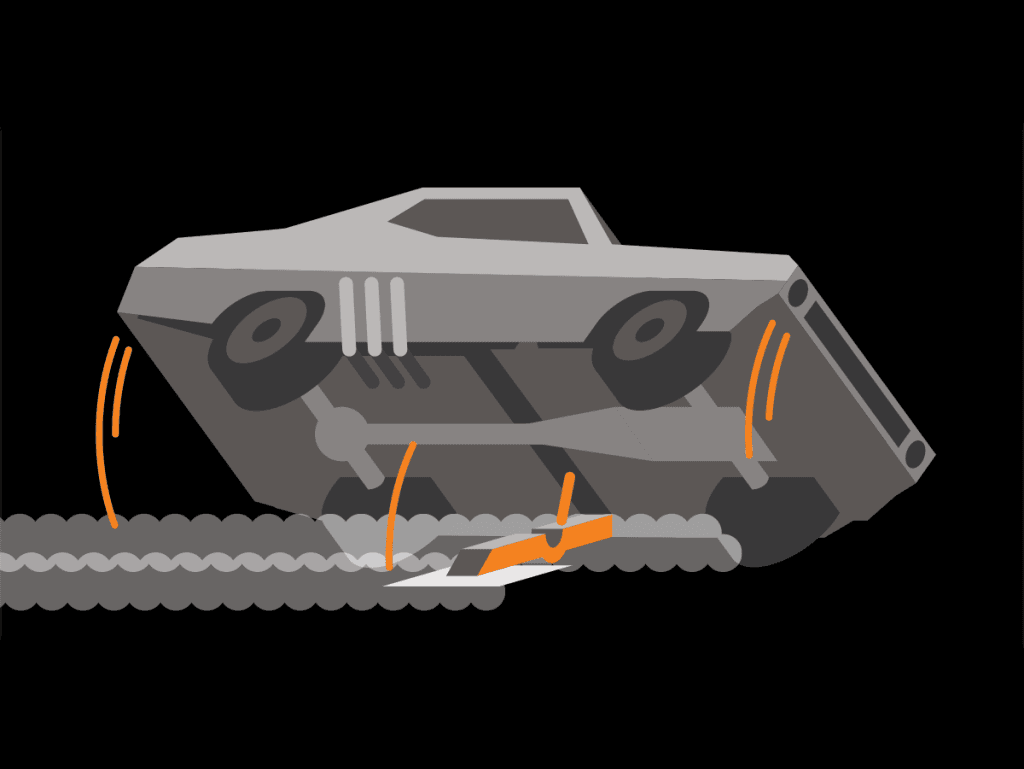
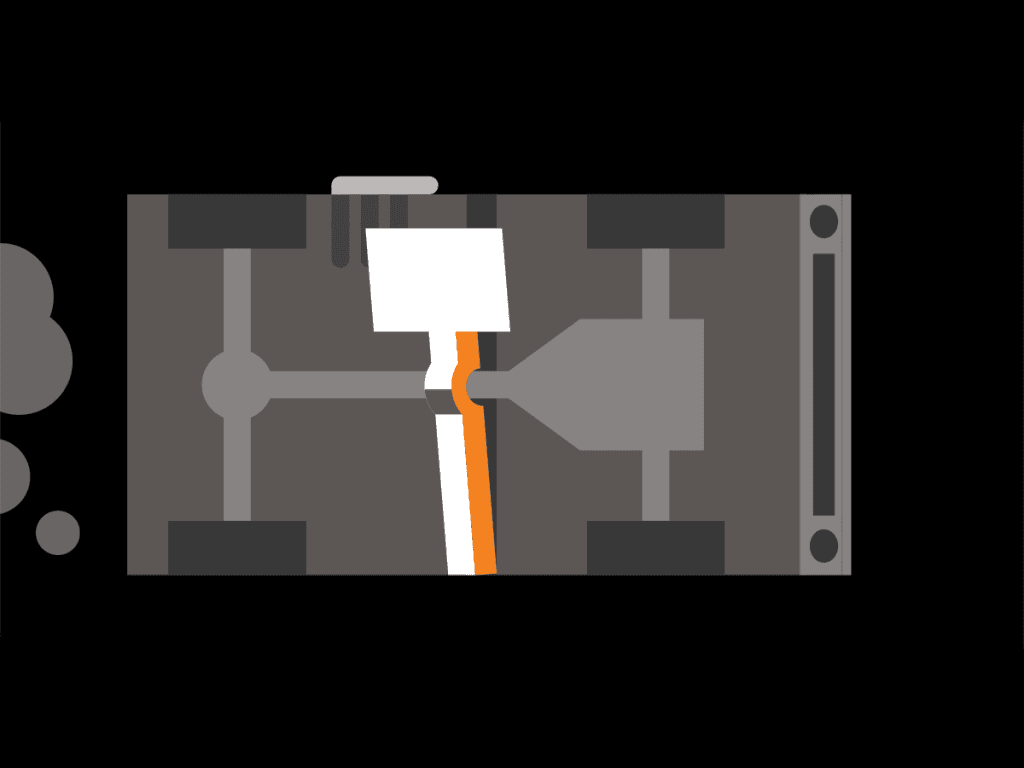
Images: WIRED, publisher diagram for Mad Max: Fury Road. Designer not disclosed.
Furiosa extends the problem, not the recipe
A decade later, Furiosa: A Mad Max Saga won the 2025 Taurus award for stunt rigging. The official record names James Finnis, Noorroa Poa, Michael Roughan, Michael Saliba and Brock Thornburgh and describes a rider skiing behind a motorcycle, deploying a parachute and flying above the tanker. That description alone reveals several transitions between tow, release, canopy and moving vehicle geometry.
The useful continuity across the two films is not one signature machine. It is an Australian action tradition comfortable integrating vehicles, aerial movement, remote or displaced driving, physical effects, stunt performers, large exterior units and extensive VFX. The exact engineering remains cue-specific and should stay with the qualified production teams who own it.
Official and practitioner video sources / 06 records
See the systems in motion
These click-to-load videos come from studio, production-company or practitioner channels. They are evidence of production context, not operational tutorials. The still covers are separately credited elsewhere in this report.
Hollywood, Hong Kong and India are lineages—not safety rankings
The popular comparison is seductive: Hollywood uses computers, Hong Kong uses people on ropes, India uses improvisation. It is also false. Hand pulls remain listed by current Western stunt-rigging companies. Automation travels internationally. Large Indian and Chinese-language productions combine local and overseas action teams. Budgets, studios, regulations and crew histories vary more inside each industry than a national stereotype admits.
What can be compared is screen language. Hong Kong wire-fu helped make vertical movement part of fight choreography rather than a separate flying effect. A pull could continue a kick, change the rhythm of an exchange or let a performer write a curve through the set. That performance tradition travelled through Yuen Woo-ping and other action choreographers into international productions, while local departments supplied their own rigging practice, safety rules and camera infrastructure.
Hollywood's large-unit pipeline often makes departmental interfaces highly visible: previs, engineering, stunt coordination, special effects, camera, VFX and formal production paperwork. That does not mean every American cue is automated or that paperwork guarantees good judgement. The Matrix oral history is valuable precisely because it records friction between a Hong Kong choreography culture and the Australian system responsible for implementing the work under local constraints.
India cannot be reduced to Bollywood, which names the Hindi-language sector. Telugu, Tamil, Malayalam, Kannada and other industries have distinct production networks. Action director Allan Amin recalls cable work on named Hindi films including Mission Kashmir and Main Hoon Na; his claim that he introduced the method should remain his attributed recollection, not an established national first. RRR, a Telugu production, documented international action collaboration with Nick Powell alongside its local unit.
The current record also keeps changing. The Federation of Hong Kong Filmmakers now publishes a safety guide and education programme. A November 2025 Indian government release says the labour-code definition of audio-visual workers expressly includes stunt persons. Neither development proves uniform implementation, but both undermine the idea that Asian action industries can be frozen in a romantic image of anonymous crews hauling by hand.
Compare productions through documented tendencies
| Production lineage | Documented creative emphasis | Infrastructure often visible in major productions | Evidence boundary |
|---|---|---|---|
| Hollywood / large North American studio units | Action is commonly divided across specialist departments and designed for coverage, repeatability and post-production integration. | Previsualization, engineering review, union or guild roles, powered motion, manual systems, physical effects and VFX can coexist. | No single Hollywood method; voluntary standards and bulletins are not identical to law in every jurisdiction. Source ↗ |
| Hong Kong wire-fu / wuxia lineage | Suspension is often integrated into martial-arts rhythm, body shape, editing and a deliberately elastic relationship with gravity. | Human-powered pulls, counterweights, powered devices and multinational crews all appear across different eras and scales. | No public technical source supports a universal claim that the sector rigs only by hand or follows one safety culture. Source ↗ |
| Hindi-language commercial cinema | Star-centred action may combine wire-enhanced impacts, vehicles, large sets, dance-derived timing and heavy post-production. | Named productions document cable work and collaboration among local and international action specialists. | Bollywood is not a synonym for all Indian cinema. Source ↗ |
| Telugu and other Indian regional industries | Scale, mythic action and local performance traditions vary by production and language industry. | RRR's diaries document a mixed local/international action pipeline rather than an isolated national technique. | Publicly accessible technical standards are not sufficient for a national safety ranking; the absence of documents is an evidence gap. Source ↗ |
| Australian action units | Vehicle action, outdoor scale and international crews meet a formal stunt-personnel classification and production-safety framework. | Dry runs, risk assessments, safety supervision, emergency planning and controlled camera positions appear in current guidance. | Industry guidance and grading are not the same as specialist rigging engineering certification. Source ↗ |
Film, theatre and circus share hardware—then diverge at the body
A winch, rope, pulley and anchor may appear in a film studio, a theatre, an arena show and a circus venue. That does not make the disciplines interchangeable. Film rigging optimises a short photographed performance: camera angle, costume concealment, reset, edit and an intentional action beat. Theatre automation must return to a repeatable cue in front of an audience, often for months. Circus aerial work can make the performer's grip, wraps, locks and apparatus skill part of the act itself.
German DGUV guidance makes a useful formal separation between scenic movement of people and artistic apparatus. Equity's aerial checklist asks productions to know the act's loads and dynamic forces, verify the venue and installation, document inspection and plan rescue. Those requirements sound familiar because both fields carry human dynamic loads, but the performer-system relationship is different. A trapeze artist actively manages an apparatus in a way an actor held inside a concealed flying vest usually does not.
Live automation places extraordinary weight on cue integrity, interlocks, maintenance, fault response and emergency lowering because the show repeats in public. Systems such as TAIT Navigator can coordinate multiple axes and bring performer flying into a wider machinery-control environment. The name matters: the historical product was Fisher Technical Services Navigator, created by Scott Fisher's company; the current platform is TAIT Navigator. Calling it a 'Fischer winch' confuses the maker, the product and the modern brand.
Cinema borrows that precision when a shot needs repeatable multi-axis movement, yet it can still choose a human pull for a subtle change in body timing. The future is not automation defeating craft. It is systems letting riggers move between manual feel, mechanical power and programmable repeatability while preserving the ability to stop, inspect and recover.
Four cable-driven worlds, four different payloads
| Field | Typical payload and pattern | Central design pressure |
|---|---|---|
| Film stunt rigging | Performer in a purpose-selected interface; short rehearsed takes, intentional accelerations, falls, pulls or rotations. | Body orientation, pressure, deceleration, impact, camera and crew position, reset and rapid recovery. Source ↗ |
| Theatre / live performer flying | Performer, scenery or both; repeatable cues and often programmed motion across a long run. | Cue integrity, interlocks, maintenance, repeatability, emergency lowering and rehearsed rescue. Source ↗ |
| Circus / aerial | Performer actively uses an apparatus; grip, wraps and locks may be part of the performance language. | Discipline-specific dynamic forces, verified supports, apparatus inspection, venue adaptation and rescue. Source ↗ |
| Cable-suspended camera | Remote head and camera dolly; coordinated winches position equipment through a defined flight envelope. | Support forces, environmental limits, paths, moving or falling objects, people below and emergency-stop loads. Source ↗ |
Spidercam flies a camera, not a person
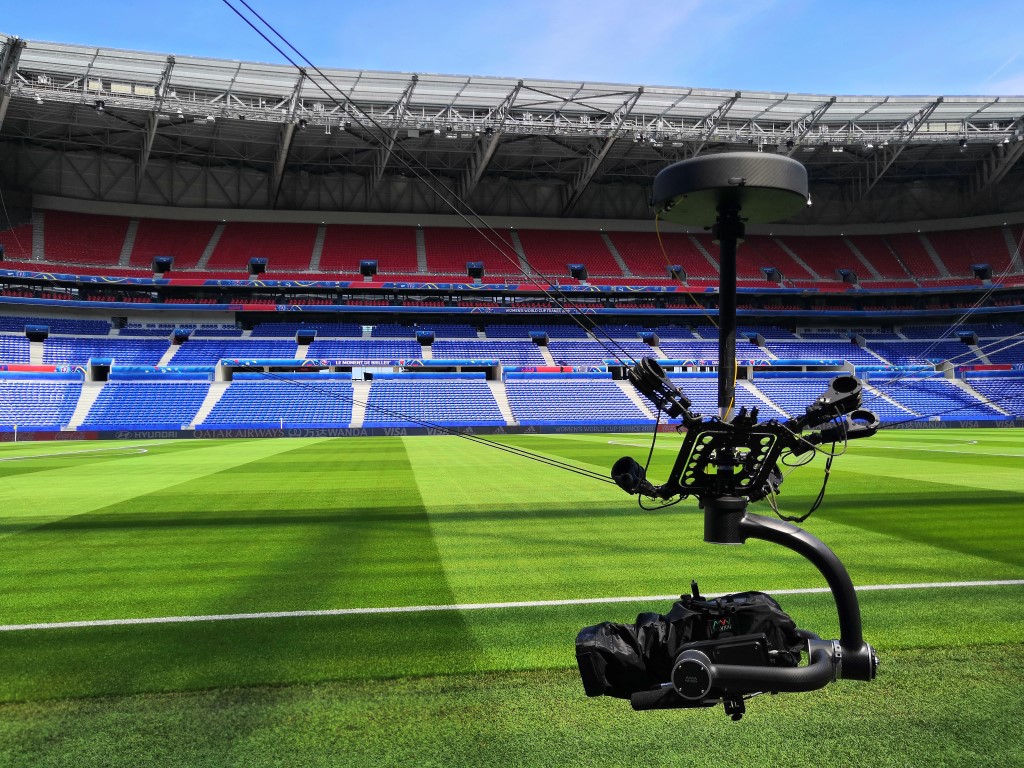
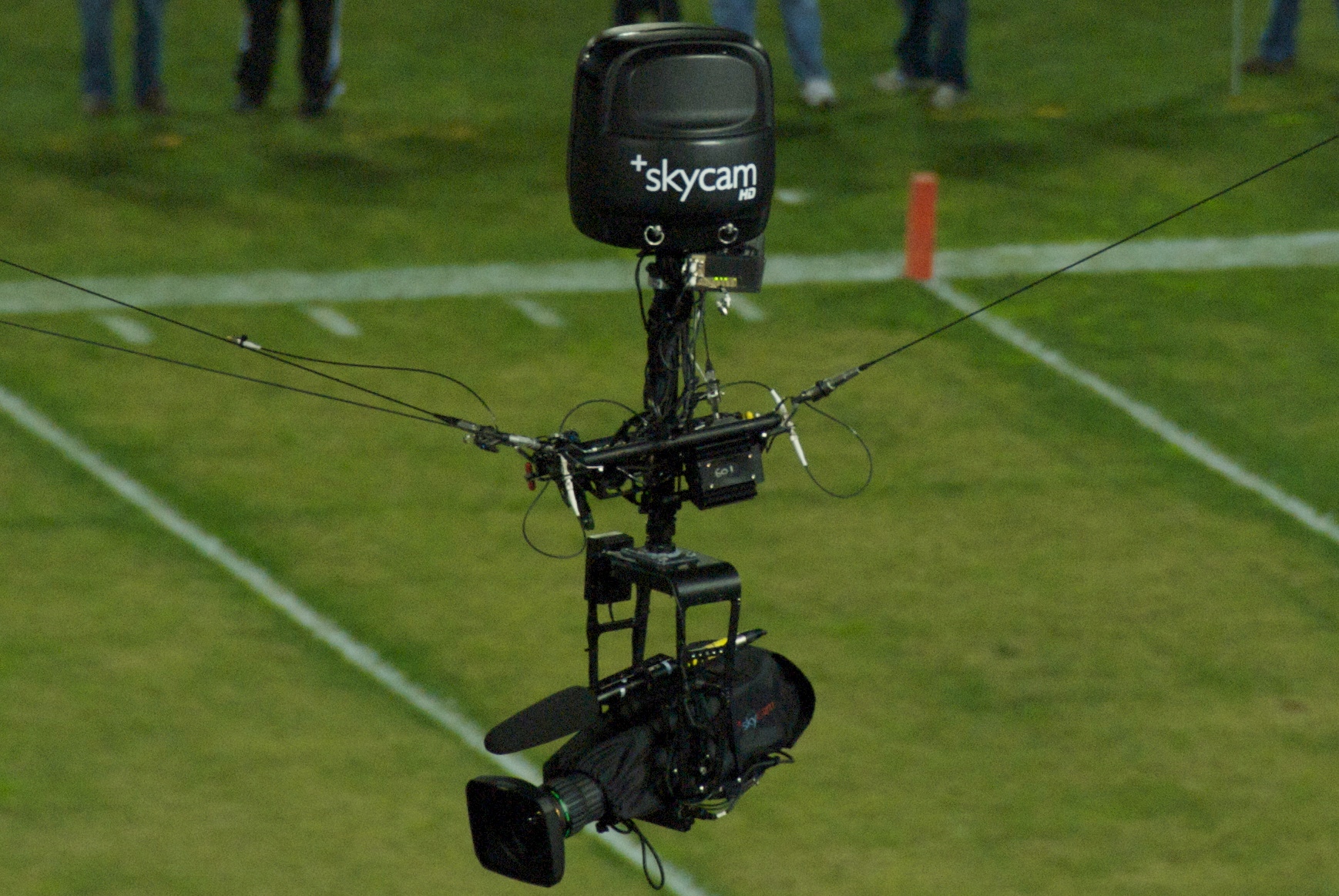
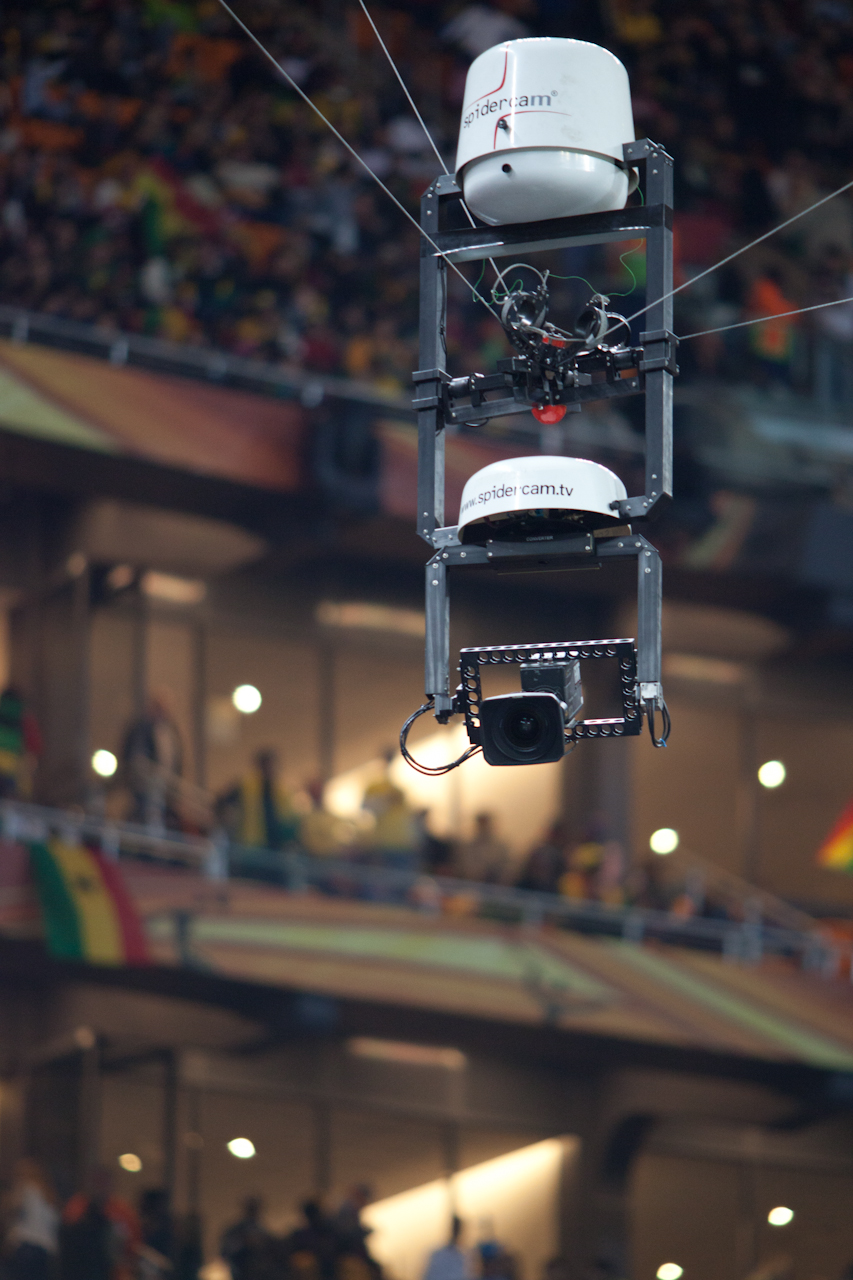
At a major football broadcast, a camera can appear to float from the roofline toward the centre circle, accelerate with play and settle into an angle no crane could reach. Spidercam and related cable-camera systems achieve that movement by coordinating multiple winches around a remote head or dolly. The motion looks like performer flying because both problems involve tensioned lines and three-dimensional position. The payload changes the safety case completely.
Ross Video's Spidercam manual describes four coordinated winches along with braking, cable-feed and overload monitoring, safety protocols and emergency stops. PLASA's neutral guidance asks a temporary cable-camera plan to define payload, paths, speeds, support forces, control logic, emergency procedures and fault conditions. Exact payload and speed values belong to the model and configuration; quoting one headline number as a universal capability would be misleading.
The stadium photographs below show three scales of the same problem. The Robycam view makes the suspension lines legible against the bowl. The Stanford close-up reveals the carrier as a real piece of moving machinery. The 2010 World Cup image places the head over a dense public event. Every image expands the system beyond the camera: winches and anchors outside the frame, telemetry and operators, an approved motion envelope and protected space beneath it.
A camera removes harness pressure, body orientation and suspension intolerance from the payload analysis. It does not remove consequence. A heavy moving or falling object above players, crews or spectators can be lethal. Camera and performer systems may share kinematic ideas, but their lines, brakes, control architectures, ratings and operating procedures must never be presented as interchangeable.
Cable-camera systems / Stadium scale
The visible head is only the centre of the system
Three openly licensed photographs show the flight envelope, suspended carrier and public environment without treating a camera platform as a human-flying rig.
Safety is a process with memory
The current American performer-flying benchmark is ANSI E1.43-2025, a substantial revision of the 2016 edition. It establishes minimum performance parameters for design, manufacture, use and maintenance. It is a voluntary consensus standard, not a universal law. Contract Services Safety Bulletin #4 is recommended industry guidance. UK, Australian, German and EU frameworks use different legal and advisory instruments. A production has to determine which rules actually govern the place, employer, venue and system.
Across those documents, the recurring principles are remarkably stable: competent and appropriately qualified people; an evolving risk assessment; equipment selected for the intended use; documented load and fault cases; inspection and testing; progressive rehearsal; controlled access; clear communication; medical and emergency planning; and the authority to stop when conditions or assumptions change.
Inspection has several clocks. Periodic examination does not replace the assembly or commissioning check. A pre-use check does not replace reinspection after impact, unusual stress, modification or an exceptional event. The performer interface, line, connectors, redirects, drive, brakes, controls, anchors and support structure all need an owner in the process. A pristine vest cannot rescue a bad anchor, and a sophisticated winch cannot correct an incompatible termination.
Redundancy is often simplified into 'use two wires.' Real systems are not that generic. The failure analysis may call for a passive secondary, a different braking architecture, monitoring, fault-tolerant control or a recovery path that does not duplicate the primary geometry. An emergency stop is equally incomplete: it can freeze a dangerous condition while leaving a performer suspended. The plan needs a practicable, rehearsed way to lower or recover the person with trained people and suitable equipment immediately available.
Performer consent and communication are technical inputs, not soft extras. Harness fit, prior injury, medical condition, costume, temperature, repeated cues and the ability to report pain or disorientation change the system. So does camera pressure. UK film guidance explicitly includes camera positioning because the desire for proximity can introduce people and equipment into the fall, travel or debris field.
A global safety map without false equivalence
| Region / reference | What it contributes | What it is not |
|---|---|---|
| United States — ANSI E1.43-2025 | Current consensus benchmark for performer-flying system design, manufacture, use and maintenance. | A statute automatically adopted everywhere, or a substitute for production and venue requirements. Source ↗ |
| United States — CSATF Bulletin #4 | Practical industry guidance on qualified supervision, planning, rehearsal, inspection and emergency readiness. | Law or a universal technical specification for every device. Source ↗ |
| United Kingdom — HSE ETIS17 and lifting duties | Film-specific hazard guidance plus a higher duty for equipment lifting people and thorough examination. | A single stunt-rigging product standard or permission to apply general lifting equipment without analysis. Source ↗ |
| Australia — Screen Safety and model fall code | Industry stunt planning, classified personnel, dry runs, emergency preparation and tested rescue principles. | One nationwide legal instrument with identical effect in every state and territory. Source ↗ |
| Germany — DGUV 215-320 | Manual and powered scenic person movement, checks, dynamic loads, rehearsal and effective emergency lowering. | Proof that all circus apparatus or film cues fall into the same category. Source ↗ |
| European Union — work-equipment framework | Suitability, competent inspection, records, lifting-person safeguards and evacuation duties via national implementation. | Evidence that the Machinery Regulation's CE route alone covers artistic performer-moving machinery; that category is expressly excluded. Source ↗ |
The innovators are teams, even when history remembers names
Rigging history tends to crystallise around inventors because machines are easy to name. Peter Foy is inseparable from mid-century stage-flight innovation. Lane Leavitt is widely associated with the modern air ramp and descender tradition. Scott Fisher's company built the Navigator automation lineage now carried by TAIT. Yuen Woo-ping made wire-supported movement legible as choreography to an enormous international audience. Keir Beck's credits and training work connect Australian climbing and rigging culture to productions including the Matrix sequels, Casino Royale and Fury Road.
Those names are useful entry points, not sole authorship claims. A film cue can involve a stunt coordinator, rigging coordinator, riggers, performers, special-effects mechanics, engineers, fabricators, drivers, camera technicians, medics and visual-effects artists. The Taurus awards for Fury Road and Furiosa name teams because the work is distributed. Even a patented device becomes safe and cinematic only through the people who specify, inspect, rehearse, operate and adapt it.
The field also resists a definitive 'best manufacturer' list. Climbing Sutra is a current name in performer interfaces; an archived AMSPEC catalogue documents an established specialist range in 2016. Bickers Action supports pneumatic launch and pull devices. The Wire Rig Company offers contemporary descender and ascender systems. Action Factory documents a broad mixed practice. TAIT occupies large-scale live automation. Their catalogues answer different questions, and vendor claims must remain vendor claims until supported by independent testing or the applicable standard.
A credible professional profile should therefore ask what kind of system, on which production, under what role and with what documented responsibility. 'Rigger' can describe access work, performer systems, mechanical effects, camera cables or general entertainment structures. The credit becomes meaningful when the load path and authority are clear.
Selected figures and documented contributions
- Stage-flight innovator
- Peter FoyFlying by Foy attributes the 1954 Inter-Related Pendulum and later performer-flight systems to his development work.
- Action choreographer
- Yuen Woo-pingA central figure in Hong Kong wire-assisted choreography and its international influence through Crouching Tiger, Hidden Dragon and The Matrix.
- Stunt rigger and coordinator
- Keir BeckAustralian practitioner associated with Fury Road, the Matrix sequels, Casino Royale and international rigging education.
- Device innovator
- Lane LeavittPractitioner and equipment developer widely associated with the modern air-ramp and descender lineage; detailed chronology remains company-attributed.
- Automation pioneer
- Scott FisherFounder of Fisher Technical Services and the correctly named Navigator automation lineage now represented by TAIT Navigator.
- Fury Road rigging team
- Keir Beck, Russell Ingram, Guy Norris, Mick Roughan and Mark WickhamNamed by the 2016 Taurus World Stunt Awards for Best Stunt Rigging.
- Furiosa rigging team
- James Finnis, Noorroa Poa, Michael Roughan, Michael Saliba and Brock ThornburghNamed by the 2025 Taurus World Stunt Awards for Best Stunt Rigging.
The future is hybrid, instrumented and still human
Motion-control systems will become more capable, but the likely future is not a universal robot winch. It is better integration: previsualized paths translated into controllable cues; position, load and fault data available to operators; digital twins or show files preserving configuration; camera and stunt departments sharing spatial information earlier; and visual effects planning line removal before the costume and set are locked. The same camera–action relationship appears from another angle in our report on tactical screen authenticity.
Manual systems will remain because bodies are not identical payloads. A skilled pull team can respond to timing, breath and performance in ways that are artistically valuable. Automation will remain because repeatability, coordinated axes and defined limits can solve movements human hauling cannot. Pneumatic devices will remain because a fast transfer of energy creates a particular screen signature. Descenders will remain because a controlled vertical fall is not the same problem as a winch lift. The toolbox survives by specialising; our IMAX production analysis shows why camera payload and access can reshape that toolbox before a shot begins.
Materials will also keep improving, but every gain creates a new engineering question. Lighter line changes inertia and handling. Lower stretch changes peak loads and control feel. Better heat resistance may bring different bend or inspection behaviour. More compact harnesses improve concealment while concentrating decisions about fit and force. The future belongs less to a miracle fibre than to traceable components whose limits are understood as a system.
The cultural future is already global. Hong Kong's choreography language, Australian rigging and vehicle tradition, North American studio infrastructure, European stage-automation practice and the scale of India's regional industries circulate through the same international crews. The strongest productions will preserve what each lineage knows without converting it into a national caricature.
And the final image will still try to hide all of this. A performer will fall, fly, recoil or float. The audience will read pain, velocity or freedom. Somewhere outside the frame, qualified people will have turned structure, line, machine, body, camera and recovery into one invisible piece of architecture. That redistribution of control is also central to our Buster Keaton safety analysis. The disappearance is not the absence of craft. It is the craft's most visible result.
Research record — standards, practitioner sources and production evidence52 entries
- ANSI E1.43-2025 — Entertainment Technology: Performer Flying Systems — Entertainment Services and Technology Association, 2025-04-02. Accessed 2026-07-19.
- Safety Bulletin #4 — Stunts — Industry-Wide Labor-Management Safety Committee / Contract Services, 2025-03-27. Accessed 2026-07-19.
- Safety Bulletin #4, Addendum A — Stunt and Special Effect Equipment — Industry-Wide Labor-Management Safety Committee / Contract Services. Accessed 2026-07-19.
- Performing Arts Safety Bulletin 14 — Performer Flying and Aerial Stunts — Actsafe / UBCP-ACTRA. Accessed 2026-07-19.
- ETIS17 — Stunts, Fight Scenes and Other Potentially Hazardous Production Activities — UK Health and Safety Executive. Accessed 2026-07-19.
- Lifting People — UK Health and Safety Executive. Accessed 2026-07-19.
- Fit to Fly — A Performer's Checklist — Equity / National Centre for Circus Arts. Accessed 2026-07-19.
- High Risk Production Activities — Stunts — Screen Safety Australia. Accessed 2026-07-19.
- Model Code of Practice — Managing the Risk of Falls at Workplaces — Safe Work Australia. Accessed 2026-07-19.
- DGUV Information 215-320 — Scenic Movement of People — German Social Accident Insurance. Accessed 2026-07-19.
- DIN EN 17206:2022-02 — Entertainment Technology: Machinery for Stages and Other Production Areas — DIN Media, 2022-02-01. Accessed 2026-07-19.
- Directive 2009/104/EC — Use of Work Equipment by Workers — European Union, 2009-09-16. Accessed 2026-07-19.
- Regulation (EU) 2023/1230 on Machinery — European Union, 2023-06-29. Accessed 2026-07-19.
- Stunt Rigging Services — Action Factory. Accessed 2026-07-19.
- Ratchets — StuntRigging.org / Keir Beck. Accessed 2026-07-19.
- Descender Rigs — StuntRigging.org / Keir Beck. Accessed 2026-07-19.
- Descender / Ascender Rigs — The Wire Rig Company. Accessed 2026-07-19.
- Air Rams and Jerk Rigs — Bickers Action. Accessed 2026-07-19.
- Jerk Rams — Bickers Action. Accessed 2026-07-19.
- Company History — Kirby's Flying Ballets. Accessed 2026-07-19.
- The Foy Legacy — Timeline of Innovation — Flying by Foy. Accessed 2026-07-19.
- About Climbing Sutra — Climbing Sutra. Accessed 2026-07-19.
- Spectra-Titanium Stunt Vest — Climbing Sutra. Accessed 2026-07-19.
- Martial Arts Harness — Climbing Sutra. Accessed 2026-07-19.
- Stunt Equipment Product Catalogue — AMSPEC, Inc.. Accessed 2026-07-19.
- Safety Bulletin — Stunt Harness Hazard Alert — SAG-AFTRA, 2018-02-28. Accessed 2026-07-19.
- TECH-12 — Samson Rope. Accessed 2026-07-19.
- AmSteel-Blue — Samson Rope. Accessed 2026-07-19.
- Rope Care and Inspection — Samson Rope. Accessed 2026-07-19.
- Design for Engineered Heavy-Lifting Systems — Dyneema. Accessed 2026-07-19.
- OMNI-Block 2.0 Single — Rock Exotica. Accessed 2026-07-19.
- I'D S Descender — Petzl. Accessed 2026-07-19.
- The Matrix Stunt Coordinators and Choreographers Reveal How the Fight Scenes Were Made — SYFY. Accessed 2026-07-19.
- VFX Artifacts — The Bullet-Time Rig from The Matrix — befores & afters, 2021-07-15. Accessed 2026-07-19.
- Crouching Tiger, Hidden Dragon — Sony Pictures Classics. Accessed 2026-07-19.
- Film Industry Safety Guidelines — Federation of Hong Kong Filmmakers, 2026-01-01. Accessed 2026-07-19.
- Labour Codes Extend Protection to Audio-Visual Workers Including Stunt Persons — Government of India, Press Information Bureau, 2025-11-21. Accessed 2026-07-19.
- Action Director Allan Amin on Cable Work in Hindi Cinema — The Times of India, 2024-05-31. Accessed 2026-07-19.
- RRR Diaries — Action Director Nick Powell Joins the Shoot — DVV Entertainment. Accessed 2026-07-19.
- 2016 Winners and Nominees — Best Stunt Rigging — Taurus World Stunt Awards, 2016-05-14. Accessed 2026-07-19.
- A Graphic Tale of the Stunts and Practical Effects of Mad Max: Fury Road — WIRED, 2015-05-11. Accessed 2026-07-19.
- The Dirtbag Climber Who Rigs Hollywood's Biggest Stunts — Outside, 2017-10-09. Accessed 2026-07-19.
- 2025 Winners and Nominees — Best Stunt Rigging — Taurus World Stunt Awards, 2025-05-10. Accessed 2026-07-19.
- Adam Savage Meets The Expanse's Key Stunt Rigger — Adam Savage's Tested. Accessed 2026-07-19.
- TAIT Navigator for Machinery Automation in Entertainment — TAIT. Accessed 2026-07-19.
- Product of the Month — Fisher Technical Services Navigator Automation System — Live Design. Accessed 2026-07-19.
- Guidance for Temporary Cable-Suspended Camera Systems, Version 2 — PLASA / National Rigging Advisory Group, 2025-09-01. Accessed 2026-07-19.
- Spidercam Operating Manual, Version 5.0 — Ross Video, 2021-06-02. Accessed 2026-07-19.
- Spidercam Camera Motion System — Ross Video. Accessed 2026-07-19.
- Robycam at the Football Stadium in France — Victorpakhomov / Wikimedia Commons. Accessed 2026-07-19.
- Sky Cam at Stanford — Jrienstra / Wikimedia Commons. Accessed 2026-07-19.
- The World Cup 2010 Saw the Debut of the Spidercam Camera — Jimmy Baikovicius / Wikimedia Commons. Accessed 2026-07-19.


Loading approved comments…