Tactical credibility is distributed across roles. Advisers bring lived behaviour. Actors carry character, stunt teams manage physical performance, and the camera translates the result.
The case studies show that real operators do not replace trained actors, stunt coordination, action direction or production safety.
This report is production analysis, not tactical or weapons instruction. It publishes no formations, firing procedures, distances or operational methods.
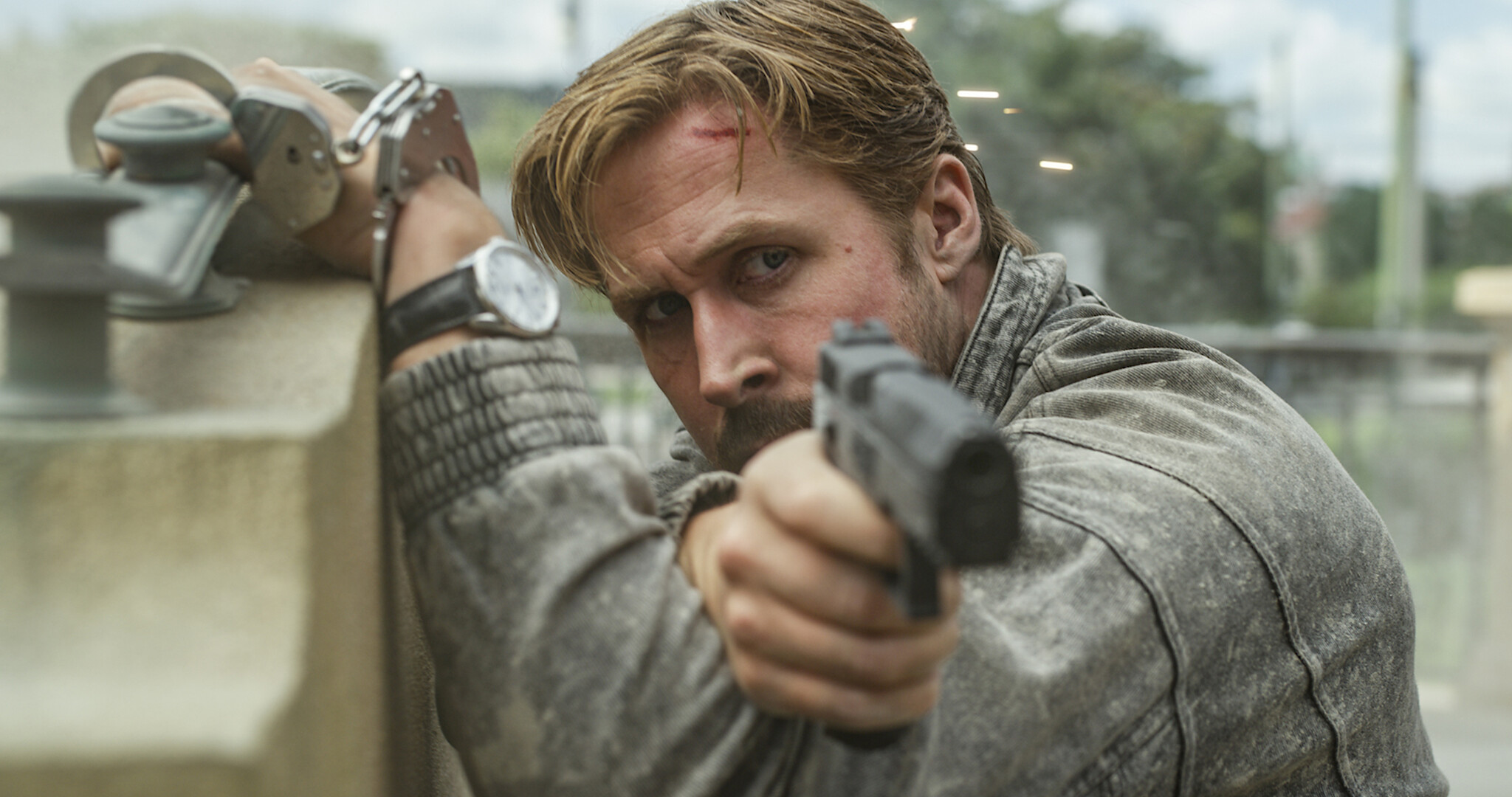
Prague is already coming apart when the real test begins. A tram has become a weapon, a public square has turned into a pressure chamber, and The Gray Man is spending blockbuster money at street level. Vehicles, crowds, practical destruction and a fast-moving camera sell scale. But scale is not the military look. The military look lives in smaller things: how a team shares attention, how one body creates space for the next, whether everybody appears to pursue the same objective, and whether the lens reaches the decisive beat without forcing the unit to break its own logic.
The title frame makes that problem visible at human scale. Gosling's left wrist remains fixed to the stone barrier, turning his cover into a restraint. His free arm and pistol drive toward the lens while sparks cut across the background. The close frame reduces a city-wide attack to one body solving three simultaneous screen problems: limited reach, incoming pressure and a readable return-fire axis. That is why this exact frame opens the report: it turns tactical constraint into character, composition and immediate jeopardy.
Today's audience has a larger visual vocabulary than the audience of an earlier action era. Documentary footage, body-camera images, training films, production diaries and veterans' screen analysis circulate beside studio marketing. A viewer may not know the name of a bad movement, but often senses the moment a group stops behaving like a unit. Once that trust disappears, more smoke, more hardware and louder impacts only make the emptiness easier to see.
The central question is therefore not which film is 'most realistic.' It is where lived experience enters the production pipeline, who translates it, and what survives the trip to the screen. Authenticity is not a credential in the credits. It is a chain of custody—from experience to choreography, performance, camera and cut.
A uniform is wardrobe. A unit is behaviour.
Hollywood can source the aircraft, reproduce the kit and build a near-perfect compound. The audience will still reject the scene if five people move like five individuals waiting for cues. Experienced military viewers notice that fracture immediately. General audiences rarely name it, but they feel it as a loss of weight: the group has no shared past, no hierarchy and no common problem.
Tactical authenticity therefore has more than one scale. Historical authenticity asks what happened. Behavioural authenticity asks how people with shared training and pressure relate to one another. Physical authenticity asks whether movement, effort and impact can be performed convincingly and repeatedly. Cinematic authenticity asks whether the audience can read objective, geography and consequence. A production can be rigorous on one axis and highly interpretive on another.
Zero Dark Thirty can create a persuasive night-vision point of view without proving every disputed historical detail. Act of Valor can place active-duty SEALs in front of the lens without turning them into conventional dramatic actors. Warfare can build from participant memory while still shaping that memory into a film. The useful question is not simply 'Is it real?' It is: which kind of reality is this scene claiming, and who is carrying it?
‘Real operator’ is not one production credit
| Production role | What the experience contributes | What it does not automatically confer |
|---|---|---|
| Active-duty performer | Current embodied familiarity, subject to official approval and duty constraints. | Professional acting, stunt qualification or independent production authority. Source ↗ |
| Veteran or former operator | Lived behaviour, unit culture and context after military service. | Automatic adviser, actor, stunt or armorer status. |
| Real participant | First-person memory of the event and the people represented. | A complete or uncontested historical record. |
| Technical adviser | Script, rehearsal, performance and department-specific corrections. | Control over the director, edit or final historical argument. |
| Hybrid tactical performer | Verified subject experience plus screen-trained marks, continuity and repeatability. | Permission to absorb every other department's responsibility. |
| Actor trained for the production | Character, dialogue and emotional continuity supported by role-specific preparation. | The real-world qualification of the character being portrayed. |
The operation may be real. The production method may not be.
War cinema is full of real operations: Operation Desert Shield in Jarhead; the Iranian Embassy siege in 6 Days; Operation Market Garden in A Bridge Too Far; the defence of Iwo Jima in Letters from Iwo Jima; the evacuation in Dunkirk; the hostage crisis behind Captain Phillips; the battle dramatized in Hamburger Hill; D-Day in Saving Private Ryan. Black Hawk Down, Lone Survivor, Zero Dark Thirty and 13 Hours: The Secret Soldiers of Benghazi make the historical promise even more explicit by staging named events close to living memory.
But a real operation is a subject, not a production method. One film may pursue chronology. Another may pursue sensation, testimony, political argument or psychological pressure. Jarhead finds truth in waiting rather than combat. Dunkirk turns evacuation into intersecting durations and points of view. Saving Private Ryan inserts a fictional patrol into historical catastrophe and uses cast preparation and a participant camera to make that fiction feel physically present.
The sharp analysis separates four questions: Was the event real? Did real participants or veterans shape the production? What behaviour survived on screen? How did the camera and edit translate it? Only then does 'authentic' become a useful word.
Hollywood's military-realism spectrum
| Production | Historical or tactical frame | Primary authenticity mechanism |
|---|---|---|
| Jarhead (2005) | Operation Desert Shield / Gulf War anticipation | Memoir perspective, waiting and psychological cadence—not an operator-cast model. |
| 6 Days (2017) | Operation Nimrod / Iranian Embassy siege | Participant Rusty Firmin consulted and trained Jamie Bell; he also described the limit of an adviser's influence. Source ↗ |
| A Bridge Too Far (1977) | Operation Market Garden | Large-scale historical reconstruction and a narrative willing to dramatize strategic failure. |
| Letters from Iwo Jima (2006) | Defence of Iwo Jima | Perspective and military culture used to reframe a familiar battle from the Japanese side. |
| Dunkirk (2017) | Dunkirk evacuation | Time structure, practical scale and land-sea-air viewpoints rather than explanatory procedure. |
| Captain Phillips (2013) | Maersk Alabama hostage crisis | Performance and escalating point of view around a real modern event. |
| Hamburger Hill (1987) | Battle of Hamburger Hill | Ensemble attrition and terrain as the physical argument. |
| Saving Private Ryan (1998) | D-Day and a fictional patrol | Dale Dye's cast preparation plus a camera designed to feel embedded. Source ↗ |
| American Sniper (2014) | Chris Kyle's deployments | Former SEAL Kevin Lacz trained the cast, advised and played himself—a true adviser-performer crossover. Source ↗ |
| The Terminal List (2022) | Fictional special-operations thriller | Veterans placed across performance, production departments and creative development. Source ↗ |
| The Hurt Locker (2008) | Fictional EOD team in Iraq | Powerful atmosphere alongside behaviour that Army EOD specialists publicly disputed. Source ↗ |
Five ways Hollywood brings the real world into the frame
The films below do not form a ranking. Each places real-world knowledge at a different point in the production chain. Together they show why the decisive issue is not whether an operator was present, but whether the production could translate that presence into story, repeatable action and images.
Model I — The blockbuster tactical unit: The Gray Man
The Gray Man matters precisely because it is not a reconstruction of a real military operation. It is a globe-spanning spy spectacle, and its Prague square and tram sequence is engineered to escalate beyond ordinary reality. Yet the production still needed disciplined behaviour to anchor the fantasy. The bigger the event becomes, the more valuable small, coordinated details can be: a team gives the audience something stable to read while vehicles, crowds, effects and camera systems multiply around it.
Joe Russo told SYFY that the Prague sequence occupied six weeks and generated hundreds of hours of near-documentary coverage. He also said the stunt players were counselled by SWAT members and former mercenaries. Ryan Gosling and Ana de Armas separately identified former Delta operator Craig 'Chili' Palmer as a trainer and behavioural reference. Netflix's production reporting credits stunt coordinator James Young with the overall stunt architecture. Those facts describe layers, not a single super-department.
A public credit record lists Ferdi Fischer and the WarpCam action unit. In his production account, Fischer identifies his exact function as Splinter Unit Action Director and describes additional WarpCam® photography across the Prague action. James Young’s overall stunt-coordinator credit and the principal-camera and unit credits are documented by other sources.
The editorial value of Fischer’s account is organizational: principal performance, mass stunt action, traffic, tactical behaviour and specialist camera access had to share one movement map. Specialist camera access becomes most useful when it is planned within the action rather than imposed after the choreography has been fixed.
Specialist movement and specialist camera access create value when they are designed within the same production map.— Ferdi Fischer — paraphrased from a production account · The Gray Man — Splinter Unit and WarpCam® production account
Model II — The rare active-duty cast: Act of Valor
Act of Valor remains the outlier. Directors Scott Waugh and Mike 'Mouse' McCoy built principal tactical roles around active-duty U.S. Navy SEALs and Special Warfare Combatant-Craft Crewmen rather than asking a conventional cast to simulate the entire unit. Under Navy and Pentagon oversight, the production incorporated cameras into regularly scheduled training evolutions. The performers did not need to invent a professional relationship with one another or their environment; their bodies already carried it.
The gain came with a visible trade-off. Real-world competence and screen acting are different crafts. The film's value is not proof that active-duty personnel are inherently better performers. It makes embodied familiarity visible while revealing why cinema still needs directors, editors, stunt specialists and narrative actors. One kind of imitation disappears; a new translation problem appears around dialogue, emotional continuity, repetition and coverage.
Unmodified image quotation / §51 UrhG
Reading the frame — Act of Valor (2012)
Analysis
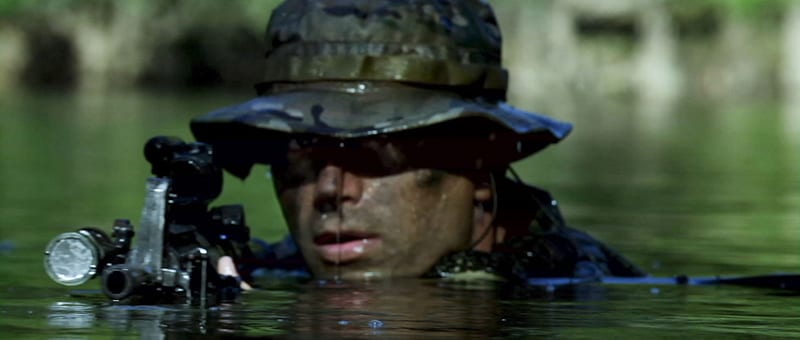
The frame strips the figure down to a face, a waterline and equipment held at the surface. Its force comes from stillness and environmental integration, not a hero pose or a visible team. That embodied ease is relevant to Act of Valor's unusual casting model. The still does not establish that live ammunition was present at this instant and is not used to make that claim.
Unmodified image quotation / §51 UrhG
Reading the frame — Warfare (2025)
Analysis
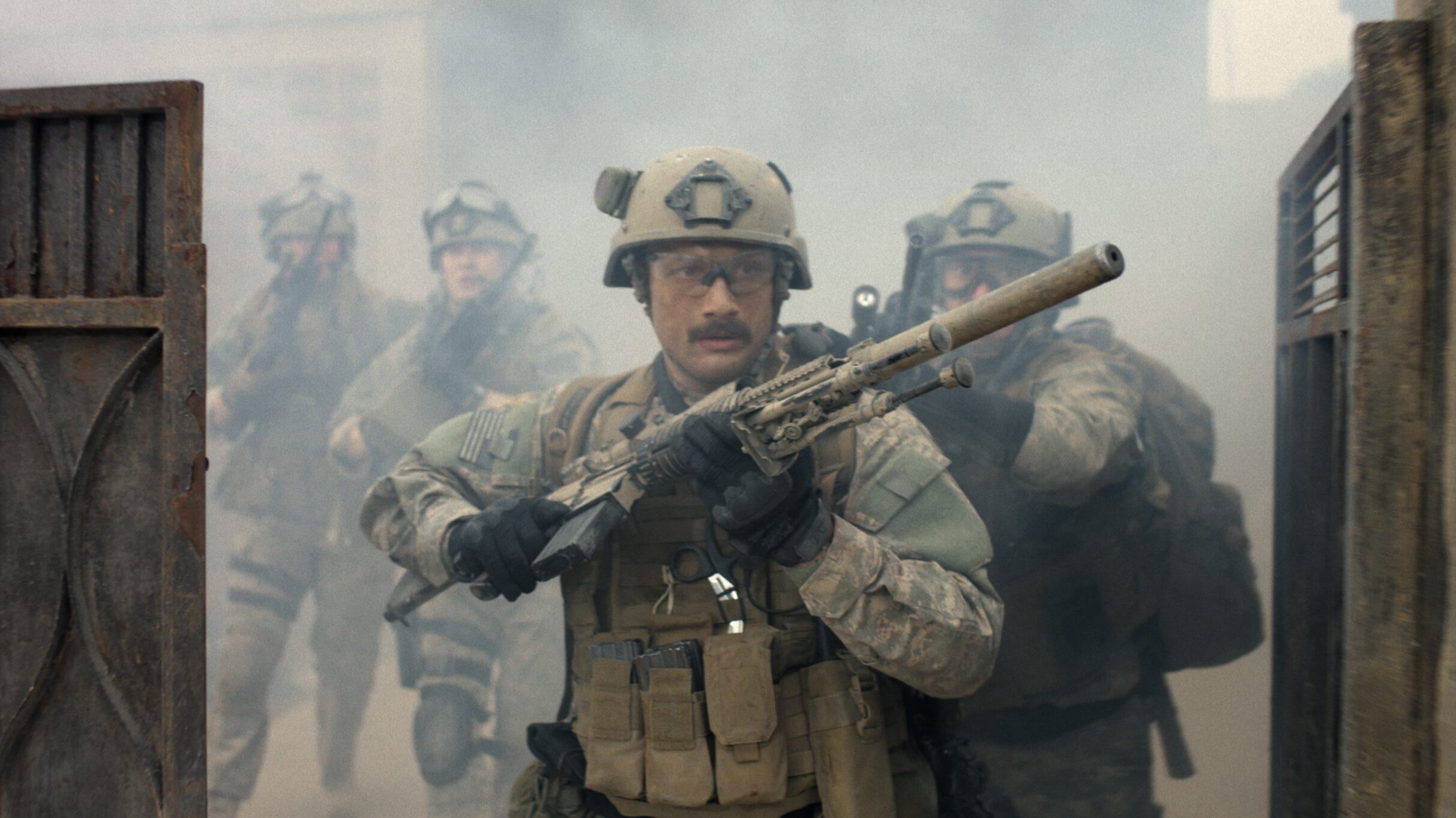
The doorway compresses the unit into depth: one soldier crosses the threshold into the foreground while the others remain readable as successive layers in smoke. The frame makes hierarchy and shared movement visible without giving everyone equal prominence. It supports the film's ensemble logic; it cannot establish any cast member's real-world status.
Lone Survivor — knowledge, acting and hazardous terrain
Lone Survivor uses a different handoff. Marcus Luttrell, the survivor and source author, was involved in the production; veteran SEAL advisers trained and corrected the principal cast; actors carried the dramatic identities. Stunt coordinator Kevin Scott's account prevents 'realism' from swallowing the stunt department: professional stunt performers took responsibility for the most hazardous terrain work. The film's physical force comes from that division, not from pretending one résumé covers every demand.
Unmodified image quotation / §51 UrhG
Reading the frame — Lone Survivor (2013)
Analysis
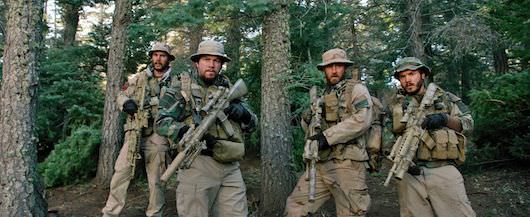
Four bodies occupy different depths, but their attention converges beyond frame; the forest interrupts clean sightlines while the group remains readable as one patrol. The image supports the actor-adviser ensemble argument, not the separate production record about hazardous terrain and stunt doubles. A still cannot reliably identify where a double replaces an actor.
13 Hours — real participants refine dramatic identities
13 Hours: The Secret Soldiers of Benghazi drew on surviving CIA Global Response Staff contractors including Kris Paronto, John Tiegen and Mark Geist. In interviews, the men described their function not as replacing the cast but fine-tuning details specific to the individuals being portrayed. That is a high-value form of access: the actor still interprets a person, but does so with corrections from the person who lived the decisions.
Access is not an accuracy certificate. The film's 'stand-down' narrative has remained publicly disputed. That caveat strengthens rather than weakens the craft analysis. First-person presence can produce behavioural texture and still coexist with a contested historical argument assembled by writers, directors and editors.
Unmodified image quotation / §51 UrhG
Reading the frame — 13 Hours: The Secret Soldiers of Benghazi (2016)
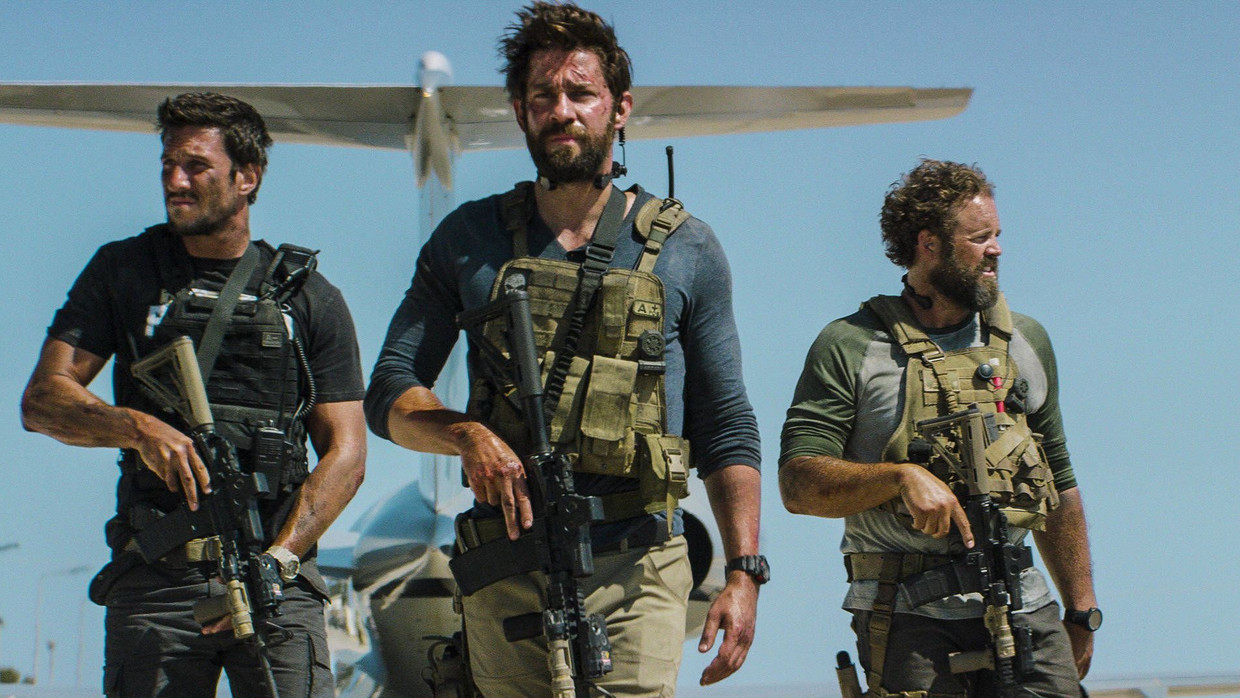
Analysis
Three contractors cross the foreground beneath the wing of an aircraft. Their equipment creates a common visual language, but their faces and different directions of attention keep them from becoming interchangeable military icons. The frame supports the film's balance between unit identity and named dramatic characters; it does not settle the production's political or historical disputes.
Bravo Two Zero — testimony is a source, not an objective camera
Bravo Two Zero begins with former SAS member Andy McNab's account of the 1991 patrol. Archived BBC production material describes McNab working closely with the actors on equipment, behaviour and the patrol's physical world. His account has also been challenged by other participants and later reporting. That does not remove its production value; it clarifies it. Operator memory can give cinema texture, sequence and physical consequence. It remains a perspective that filmmakers select, compress and stage.
Unmodified image quotation / §51 UrhG
Reading the frame — Bravo Two Zero (1999)
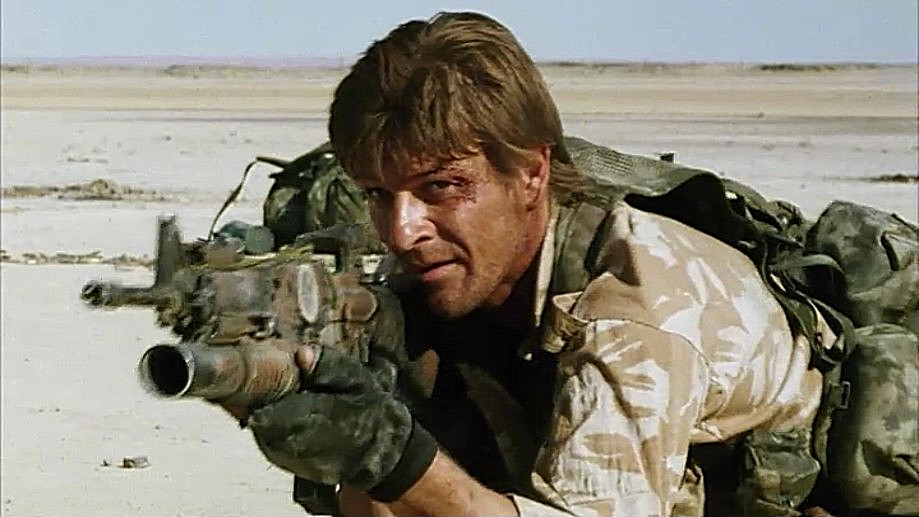
Analysis
Sean Bean is framed low to the ground with the desert flattened behind him, his face and rifle compressed against the weight of an oversized pack. The image turns McNab's remembered patrol into physical burden rather than an invulnerable silhouette. It is a cinematic interpretation, not independent corroboration of disputed events.
Model IV — Specialists build a spine around actors
Black Hawk Down is one of the clearest studio-era examples of trained actors being organized around real military knowledge. Production records describe distinct preparation for actors playing Rangers, Delta personnel and aviation crews, plus military assistance involving Rangers and the 160th Special Operations Aviation Regiment. Ridley Scott did not replace the dramatic cast with one category of soldier. He constructed different unit cultures, then drove them through a deliberately overwhelming city.
Unmodified image quotation / §51 UrhG
Reading the frame — Black Hawk Down (2001)
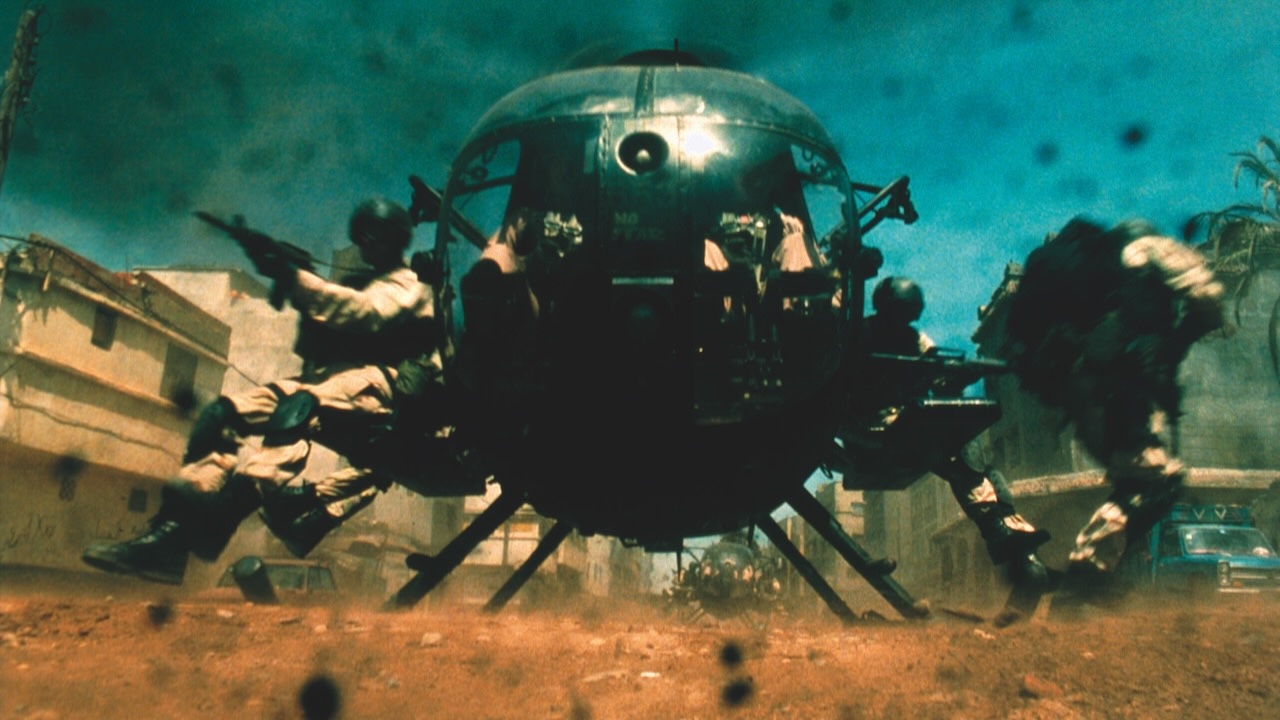
Analysis
The low, centered frame turns the Black Hawk into both machine and moving gateway. Soldiers leave opposite sides while the street and buildings remain compressed behind them; dust and rotor wash create sensory disorder without hiding the insertion's direction. The image shows production access becoming readable action. It is not offered as proof that every depicted procedure is historically exact.
Sicario — tactical authority through restraint
Sicario works at a lower volume. Production reporting documents consultation with former FBI and CIA personnel, special-forces experience and private-security advisers. It does not provide a reliable basis for the repeated online claim that the visible tactical team consisted of verified former Delta operators, so this report does not repeat it. The stronger case is what reached the frame and cut: economy, shared anticipation and a hierarchy that refuses to turn every armed character into a hero pose.
Unmodified image quotation / §51 UrhG
Reading the frame — Sicario (2015)
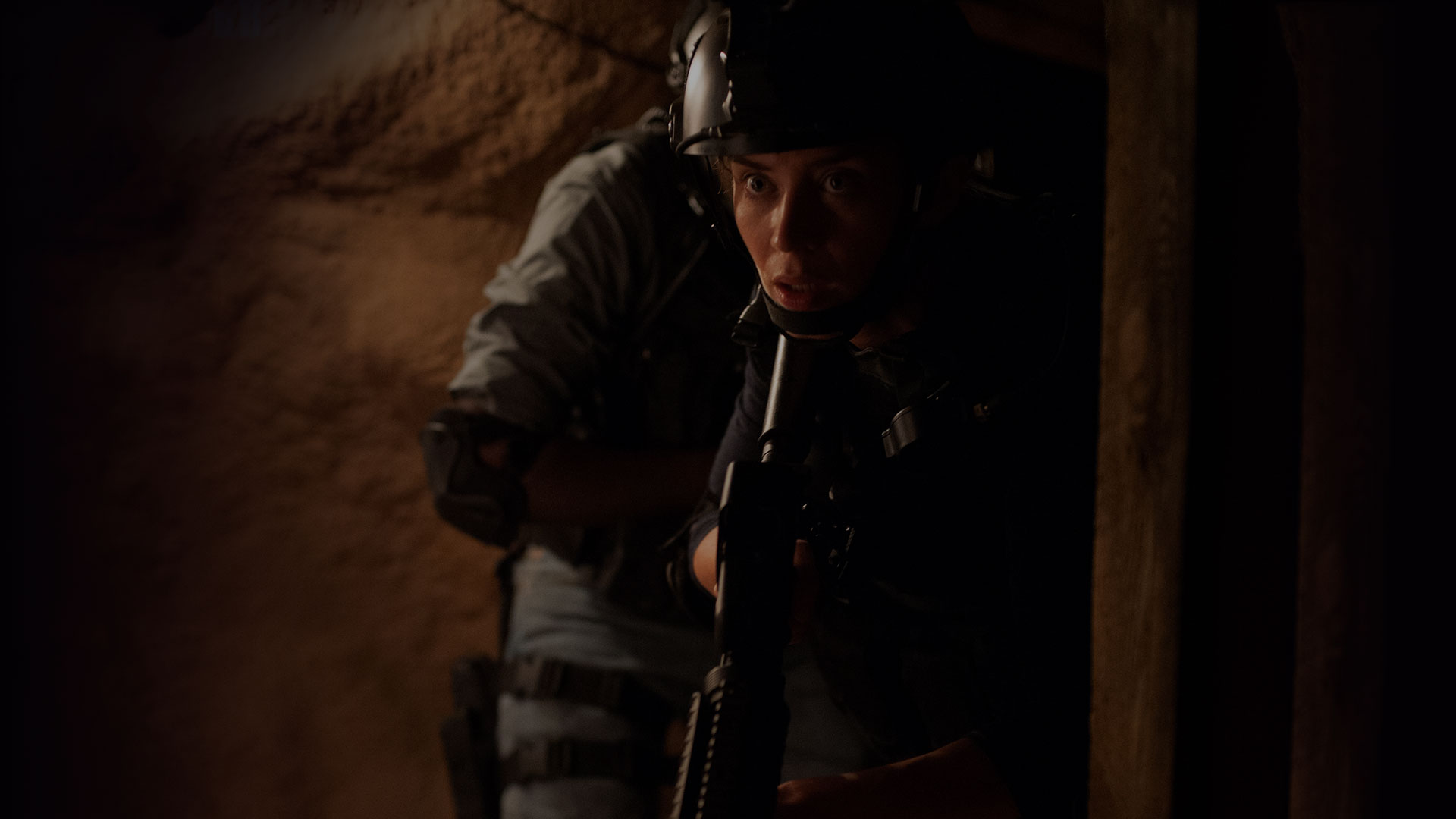
Analysis
In this tunnel frame, Kate Mercer is sharply readable in the foreground while another armed figure is partly obscured behind her. Tight walls, shallow visibility and uneven light make her limited knowledge the composition's subject: the unit knows more than she does, but the image reveals only what her position permits. It supports a point-of-view analysis, not an unverified adviser credit or unit identity.
Zero Dark Thirty — the camera turns darkness into information
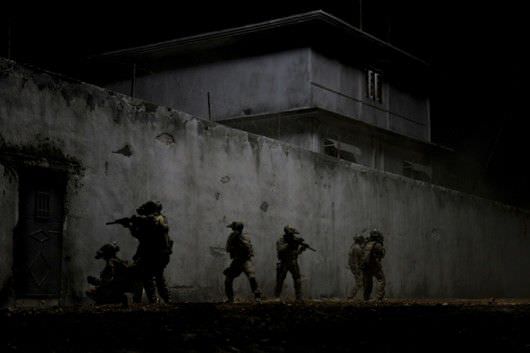
Zero Dark Thirty uses a different translation system. Former SEAL Jared Shaw has described training Chris Pratt, but the raid roles remained performances inside Kathryn Bigelow's film. Cinematographer Greig Fraser's production account is the more revealing document: the compound, the four-camera strategy and the night-vision imagery were designed so darkness became an information problem rather than a black backdrop.
Unmodified image quotation / §51 UrhG
Reading the frame — Zero Dark Thirty (2012)
Analysis
This exterior frame is not a night-vision image. Sparse light leaves faces and equipment unreadable, but the pale compound wall draws a horizontal map and separated silhouettes make the team's progress legible. The shot supports Fraser's broader account of designing darkness as controlled information, not a claim about historical completeness, exact procedure or live ammunition.
Model V — Veterans become part of production culture
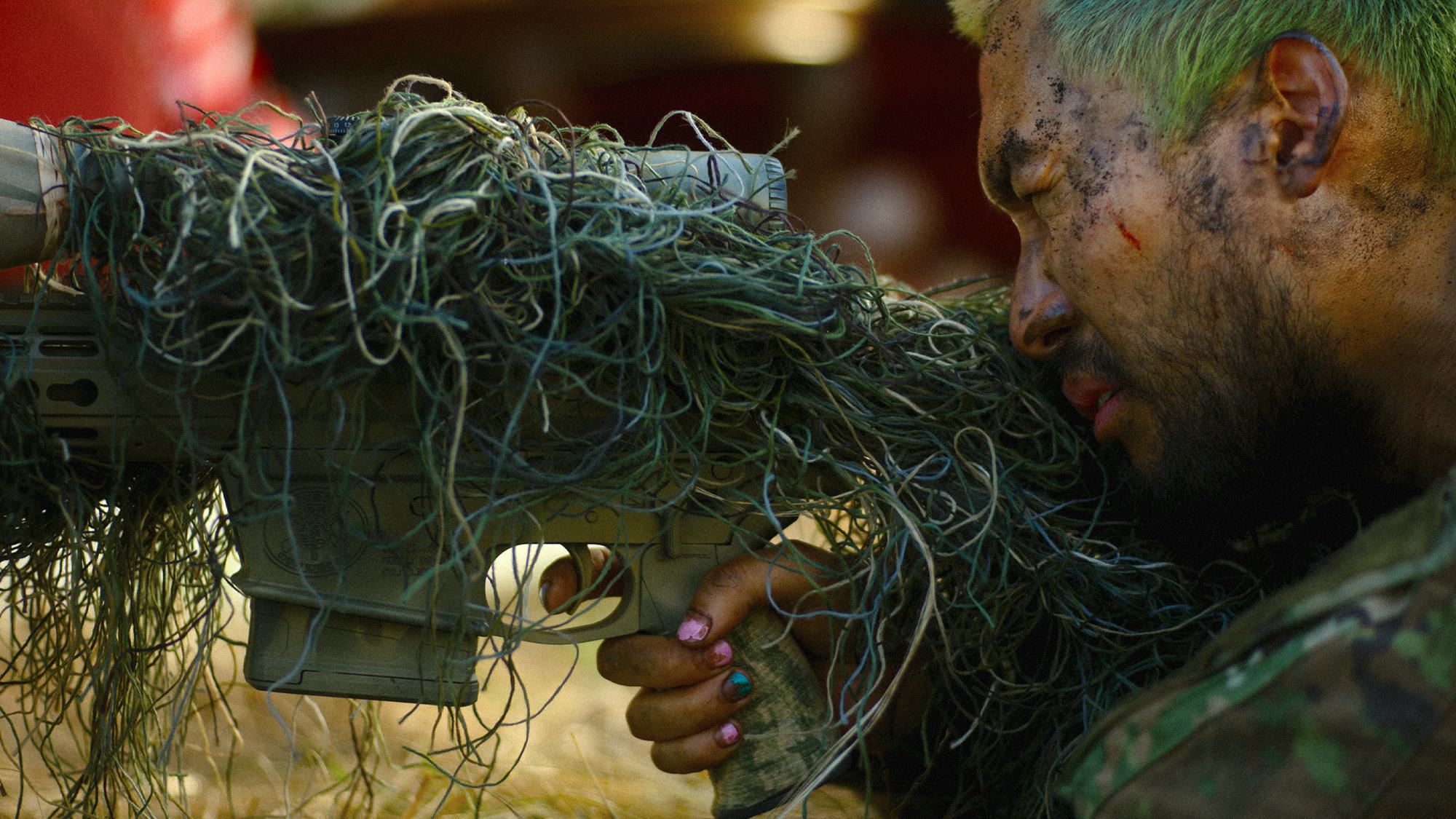
Civil War and SEAL Team demonstrate what happens when military experience is not confined to a late advisory pass. On Civil War, former Navy SEAL Ray Mendoza worked with the stunt coordinators to establish military movement, and veterans filled selected military roles. Cinematographer Rob Hardy's team placed the fictional journalists inside that action rather than asking the action to pause and pose around its stars. The choreography exists first; the protagonists collide with it.
Unmodified image quotation / §51 UrhG
Reading the frame — Civil War (2024)
Analysis
The official frame isolates one soldier, not the journalists: cheek pressed close to a net-covered rifle, face marked by dirt and blood, painted fingernails visible in the same tight plane. That collision of intimate personal detail and military equipment gives the character a life beyond a generic operator silhouette. Because the composition excludes the wider group, it cannot demonstrate embedded choreography; it shows how production culture reaches costume, makeup, props and performance at close range.
SEAL Team — what repetition across seasons can build
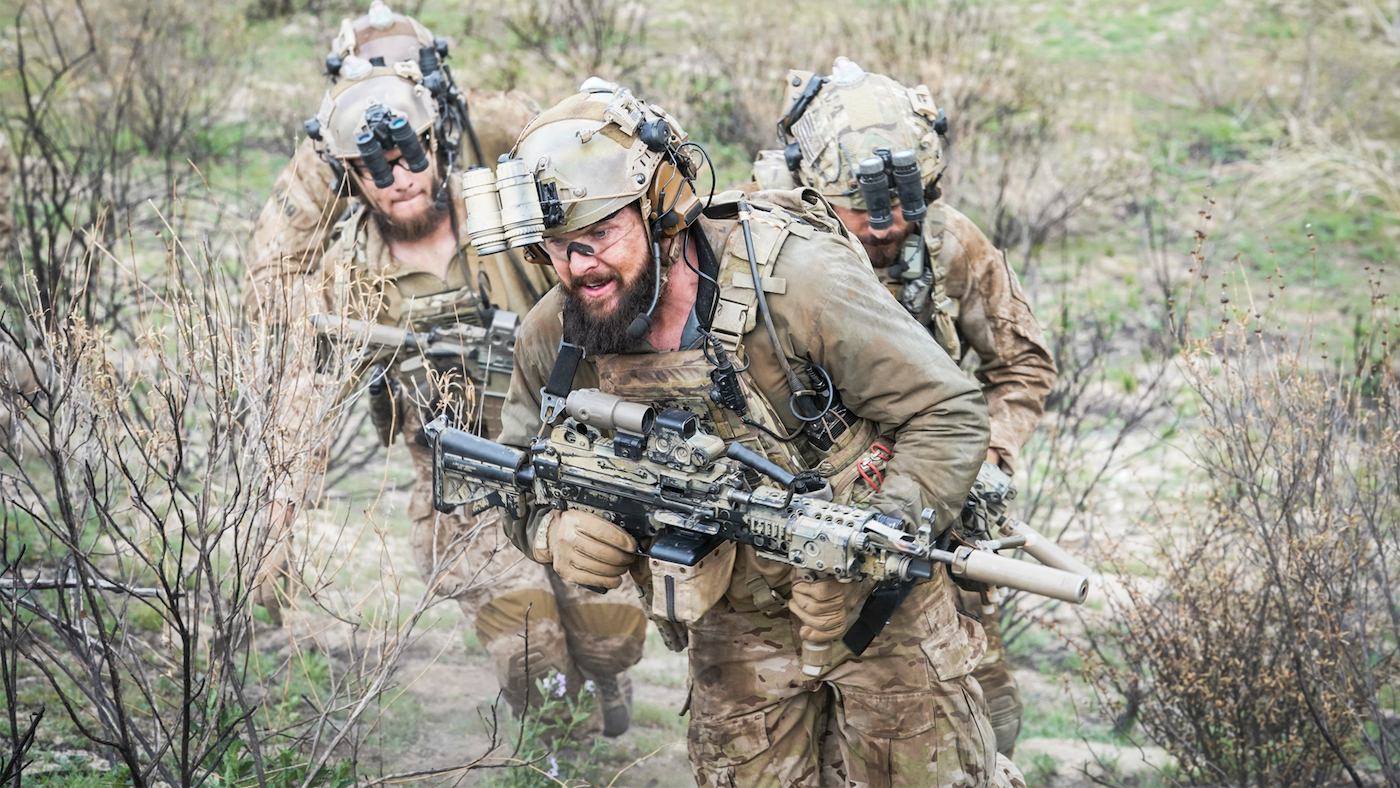
SEAL Team gains something a feature cannot buy in a few weeks: repetition across years. Veterans have worked across acting, stunt, writing, producing and advisory functions, while stunt coordinators preserve the wider action and safety overview. The advantage is not simply better equipment detail. It is a recurring production culture in which cast, stunt team and veteran specialists develop common timing.
Unmodified image quotation / §51 UrhG
Reading the frame — SEAL Team
Analysis
The slope stacks three bodies into a diagonal: the lead figure occupies the foreground while two teammates remain visually linked behind him. Terrain and shared direction make the unit readable without equal emphasis. A still cannot prove timing across a moving sequence or identify veterans; it shows the ensemble geometry that recurring collaboration can sustain.
One screen unit, several professions
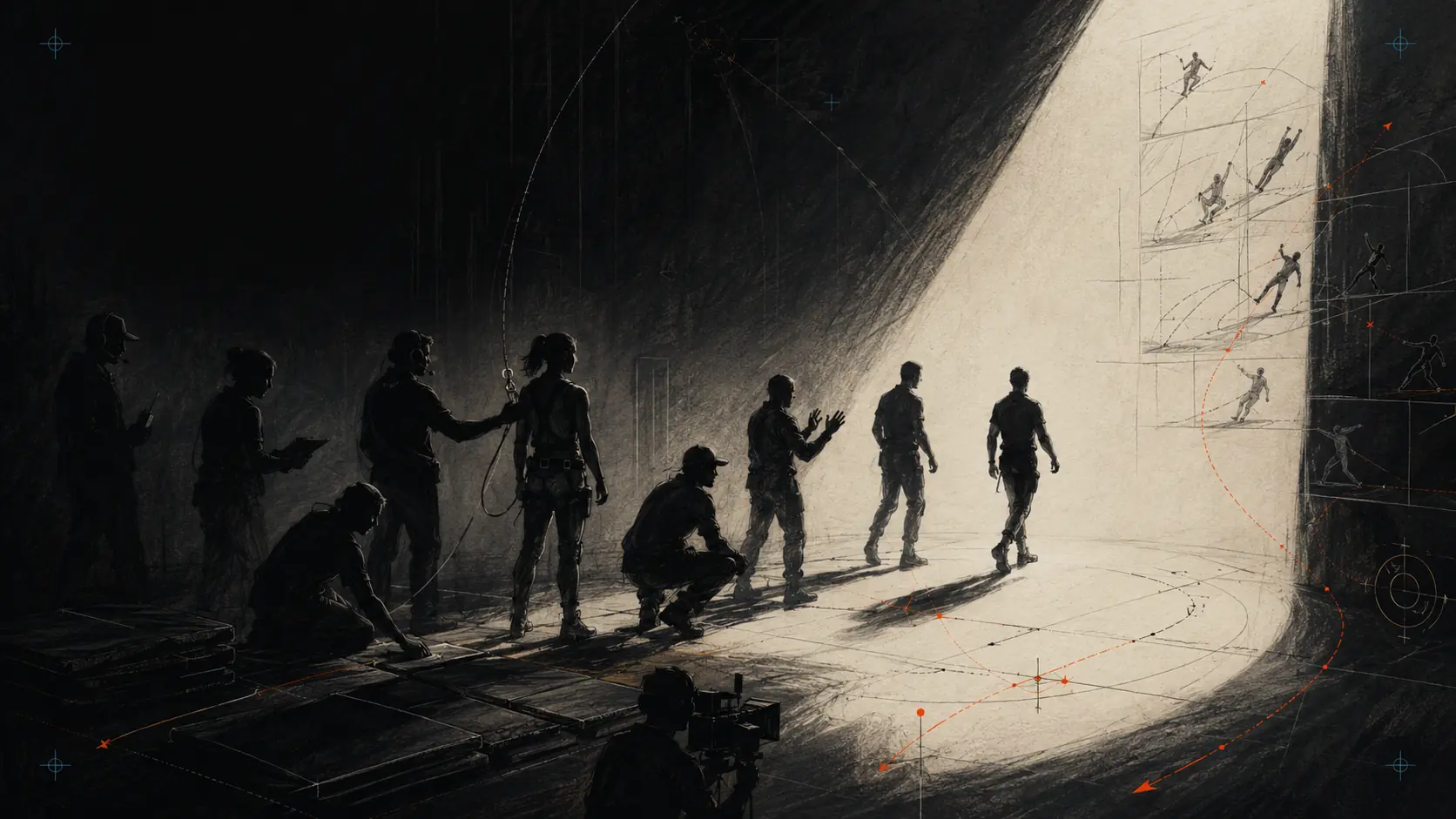
The cleanest model begins with an unfashionable truth: nobody has to be everything. The actor carries character, dialogue and emotional continuity. The stunt performer carries qualified physical action and repeatability. The veteran or adviser carries lived behaviour and unit culture. A hybrid tactical performer can bridge selected roles or inserts when that combination is verified. The armorer or property department retains firearms responsibility. Action direction and stunt coordination decide how those contributions meet the story without allowing one qualification to impersonate another.
Imagine a team that must remain coherent across a feature or several seasons. The principal actor owns the decisions and close dramatic beats. A stunt double preserves the character through the hazardous transition. A veteran performer may give a supporting role the relaxed detail of somebody who has lived in the environment. A technical adviser protects the group's logic. The camera team learns the movement map well enough to anticipate where pressure transfers. The audience sees one unit because production has designed continuity across several bodies and disciplines.
This is the real operator effect. It is not the moment a veteran walks into frame. It is the point at which everybody else can do more precise work because the experience entered early enough.
What each department contributes—and where it stops
| Role | Primary value | Boundary to protect |
|---|---|---|
| Actor | Character, dialogue, emotional continuity and audience identification. | Production training does not turn an actor into a stunt specialist, armorer or real-world operator. |
| Stunt performer or double | Repeatable physical performance and character-matched movement through qualified action. | Stunt qualification does not automatically establish current tactical expertise or adviser authority. Source ↗ |
| Veteran, operator or technical adviser | Lived behaviour, context, unit culture and early script or rehearsal input. | Real-world expertise does not automatically confer acting, stunt, armorer or set-safety authority. |
| Hybrid tactical performer | Embodied detail plus trained marks, continuity and repeatability for camera. | The exact experience and production qualification still need verification. |
| Armorer / property firearms team | Production-specific firearms control under applicable law, rules and qualified supervision. | The actor, adviser or camera department does not absorb this responsibility. Source ↗ |
| Action Director / Stunt Coordinator | Integrates story, performers, specialists, departments, camera needs and controlled physical action. | Expertise supports—not replaces—the director, AD structure, department heads or controlling authority. Source ↗ |
| Camera team | Turns objective, geography, pressure and consequence into readable coverage. | Camera technology cannot certify an action, override the plan or create its own safety zone. |
The camera needs the same map
A tactical sequence is not photographed from outside its choreography. The lens is another participant with a route, timing, blind spots and limits. If the camera team does not understand where the scene's pressure transfers, the lens arrives after the meaningful action or occupies the space the ensemble needs to remain believable.
That does not mean every camera operator needs a military résumé. It means the camera department must be briefed and rehearsed in the specific scene logic. The Gray Man demonstrates the coordination required when tactical performers live inside a Prague-scale collision of stunts, vehicles, crowds and specialist cameras. Civil War shows the creative gain when military choreography and photography are planned in conversation. Zero Dark Thirty shows that a camera system can become part of the storytelling argument: night vision does not merely record darkness; it controls what the audience is permitted to know. Our IMAX production analysis examines the opposite pressure: what happens when a capture format limits where that participating camera can go.
Hardware follows the problem. A shoulder camera can transmit human instability. A compact stabilized system can remain close to moving performers. A remote head can separate some controls from the physical camera position. A fixed camera may be correct when people should not occupy an exposure area. None is automatically more authentic; our stunt-rigging field guide shows why similar-looking movement systems can carry entirely different loads and responsibilities.
The deeper requirement is organizational. Camera design belongs in the same planning loop as action direction, stunt work, specialist behaviour and performer preparation. When those functions arrive as isolated vendors, the sequence negotiates interfaces after expensive decisions are fixed. When they share one movement map, a compact, remote, stabilized or vehicle-mounted system becomes one possible answer to a defined story and exposure problem. No hardware makes a scene tactical or turns prohibited activity into an acceptable shot.
When the event is real before the camera arrives
Real ammunition has become folklore around military films. It offers a seductive equation: if the projectile was real, the scene must be real. That is false artistically and operationally. An ordinary dramatic production should not introduce live ammunition as a realism upgrade. Current Industry-Wide Labor-Management Safety Committee guidance says live ammunition is prohibited in nearly all entertainment uses, with narrow, controlled exceptions.
Act of Valor is the documented bridge most often misquoted as a precedent. Its live-fire and tracer material belonged to controlled Navy training evolutions with active-duty personnel, qualified military authority and production oversight. The camera crew adapted to an independently governed live-fire environment; this was not a conventional dramatic scene in which actors were handed live rounds. The distinction is the entire point.
The relevant production question begins only when the underlying event is already legitimate: real military or law-enforcement training, documentary observation, test activity or an approved defense-commercial capture conducted under the authority that controls the range or facility. The cinematic team does not invent live fire for spectacle. It asks how to record the authorized event without adding avoidable human exposure.
Remote heads, protected lock-offs, unmanned platforms or purpose-built compact systems can become an imaging and risk-reduction layer only when the controlling authority and qualified safety structure approve the camera plan. The camera may separate a lens from a human operator; it never governs the range, ammunition, personnel, legal framework or safety boundary. The objective is not to move a person closer to danger. It is to avoid placing a person where the image can be obtained without one.
The recurring claim that Zero Dark Thirty used live ammunition or tracers is not supported by a sufficiently reliable production source and is not repeated here. The sequence does not need the rumor. Its force comes from restricted night-vision imagery, sound, duration, ensemble behaviour and incomplete access to space.
The operator is not the product. The integrated unit is.
Credibility depends on the handoffs. Character, physical performance, specialist behaviour and camera geography have to survive from stunt design and rehearsal into the cut while each department retains its proper authority. A credible screen unit is assembled around the scene; it is not certified by one résumé or one device.
TAC-CINE is the tactical production vertical within the SlamArtist.com network, and WarpCam® is one specialist capture system available to that work. No service or camera system replaces production safety authority.
Sources and production records47 entries
- TAC-CINE — Tactical Cinematics — TAC-CINE / SlamArtist.com. Accessed 2026-07-21.
- Tactical Cinematics — SlamArtist.com. Accessed 2026-07-21.
- WarpCam® — SlamArtist.com. Accessed 2026-07-21.
- Safety Bulletin #1 — Recommendations for Safety With Firearms and Use of Blank Ammunition — Industry-Wide Labor-Management Safety Committee / CSATF, 2024-04-29. Accessed 2026-07-19.
- Safety Bulletin #2 — Special Use of Live Ammunition — Industry-Wide Labor-Management Safety Committee / CSATF, 2023-12-19. Accessed 2026-07-19.
- Safety Bulletin #4 — Stunts — Industry-Wide Labor-Management Safety Committee / CSATF, 2025-03-27. Accessed 2026-07-19.
- Stunt Coordinator Standards and Practices — SAG-AFTRA. Accessed 2026-07-19.
- DoD Instruction 5410.16 — DoD Assistance to Non-Government, Entertainment-Oriented Media Productions — U.S. Department of Defense, 2023-06-28. Accessed 2026-07-19.
- The Gray Man Directors Joe and Anthony Russo Go Inside the Action — SYFY, 2022-07-22. Accessed 2026-07-19.
- The Gray Man Stunts Were So Dangerous, They Had to Hire a Paramedic — Netflix Tudum, 2022-07-14. Accessed 2026-07-19.
- Ryan Gosling Talks Prepping for The Gray Man — BeautifulBallad, 2022-07-25. Accessed 2026-07-19.
- The Gray Man Cast and Directors Break Down the Action — Netflix Tudum, 2022-07-14. Accessed 2026-07-19.
- Show Off Your ‘Gray Man’ Skills with an Interactive Comic-Con Training Program — Netflix Tudum, 2022-07-20. Accessed 2026-07-19.
- McCoy, Waugh, Bandito Brothers Elevate Action — Variety, 2012-01-06. Accessed 2026-07-19.
- Act of Valor: How the Movie Was Made — Defense Media Network, 2012-02-21. Accessed 2026-07-19.
- Act of Valor: The Canon 5D and Live-Fire Photography — Filmmakers Academy / Shane Hurlbut, ASC, 2012-02-22. Accessed 2026-07-19.
- Act of Valor: Cameras and Images — Emanuel Levy, 2012-02-26. Accessed 2026-07-19.
- Warfare — A24. Accessed 2026-07-19.
- Alex Garland and Ray Mendoza Reconstruct a Platoon's Memory in Warfare — Associated Press, 2025-04-09. Accessed 2026-07-19.
- Moving as One with Charles Melton and Will Poulter — A24, 2025-04-23. Accessed 2026-07-19.
- Stunt Coordinator Kevin Scott on Lone Survivor's Commitment to Realism — Motion Picture Association, 2014-01-02. Accessed 2026-07-19.
- Interview: Kris Paronto, John Tiegen and Mark Geist — 13 Hours — The People's Critic, 2016-01-11. Accessed 2026-07-19.
- The Real-Life Heroes Behind 13 Hours — ABC News, 2016-01-16. Accessed 2026-07-19.
- 13 Hours: The Secret Soldiers of Benghazi — Frankfurter Allgemeine Zeitung, 2016-03-04. Accessed 2026-07-19.
- Black Hawk Down — Production Notes — Cinema.com. Accessed 2026-07-19.
- Six Things You Probably Never Knew About Black Hawk Down — Task & Purpose, 2016-01-22. Accessed 2026-07-19.
- Black Hawk Down — British Film Institute. Accessed 2026-07-19.
- Black Hawk Down — Sony Pictures Entertainment. Accessed 2026-07-19.
- Making Sicario: How the Cast Survived the Desert and Border — The Hollywood Reporter, 2015-12-02. Accessed 2026-07-19.
- Editor Joe Walker on Cutting Sicario — Motion Picture Association, 2015-10-02. Accessed 2026-07-19.
- Sicario — Lionsgate. Accessed 2026-07-19.
- Bravo Two Zero — BBC Production Interview Archive — Complete Sean Bean / archived BBC material. Accessed 2026-07-19.
- Fighting on Film: Bravo Two Zero (1999) & The One That Got Away (1996) — The Armourers Bench, 2021-02-12. Accessed 2026-07-19.
- A Q&A With Greig Fraser, Cinematographer on Zero Dark Thirty — Motion Picture Association, 2013-01-10. Accessed 2026-07-19.
- This Former SEAL Brings Real-Life Feel to The Terminal List — Military Officers Association of America, 2022-07-12. Accessed 2026-07-19.
- Civil War: Chronicling Chaos — American Society of Cinematographers, 2024-06-10. Accessed 2026-07-19.
- How SEAL Team's Stunt Coordinators Bring Accuracy to the Action — Motion Picture Association, 2019-09-06. Accessed 2026-07-19.
- SAS Operator Rusty Firmin Takes Us Behind the Scenes of 6 Days — SOFREP, 2017-06-15. Accessed 2026-07-19.
- Saving Private Ryan: Refighting World War II — American Society of Cinematographers. Accessed 2026-07-19.
- Dale Dye: Training Private Ryan — The National WWII Museum, 2018-06-09. Accessed 2026-07-19.
- Former SEAL Kevin Lacz Pens Raw Account of Iraq and Chris Kyle — Navy Times, 2016-07-29. Accessed 2026-07-19.
- How The Terminal List Put Veterans Across the Production — Entertainment Weekly, 2022-06-28. Accessed 2026-07-19.
- Hurt Locker Hits Home for EOD Soldiers — U.S. Army, 2010-03-10. Accessed 2026-07-19.
- Civil War — A24. Accessed 2026-07-19.
- The Gray Man — Splinter Unit and WarpCam® production account — Ferdi Fischer / retained production statement, 2026-07-19. Accessed 2026-07-21.
- SlamArtist and WarpCam® testimonials — The Gray Man — SlamArtist.com. Accessed 2026-07-21.
- The Gray Man — credits — Metacritic. Accessed 2026-07-21.
Loading approved comments…