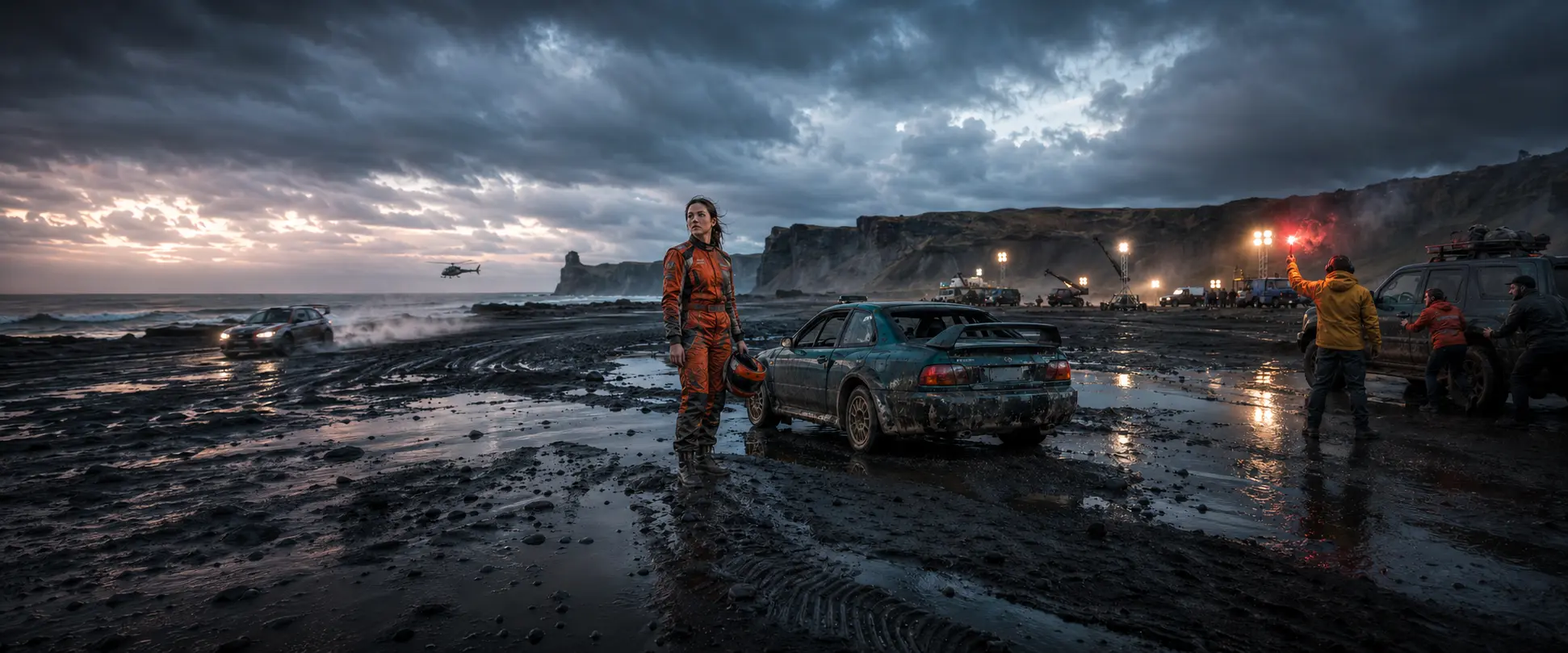
The Odyssey exposed 2.1 million feet of IMAX film across 91 shooting days for a 172-minute release; IMAX listed 41 15/70 venues.
The estimated $7–13 million premium is a transparent editorial model, not a leaked invoice or audited production cost.
The argument is not that 15/70 lacks value; it asks whether its image and event value outweighed the camera access, sound, take-length, rigging, budget and distribution constraints.
Analysis
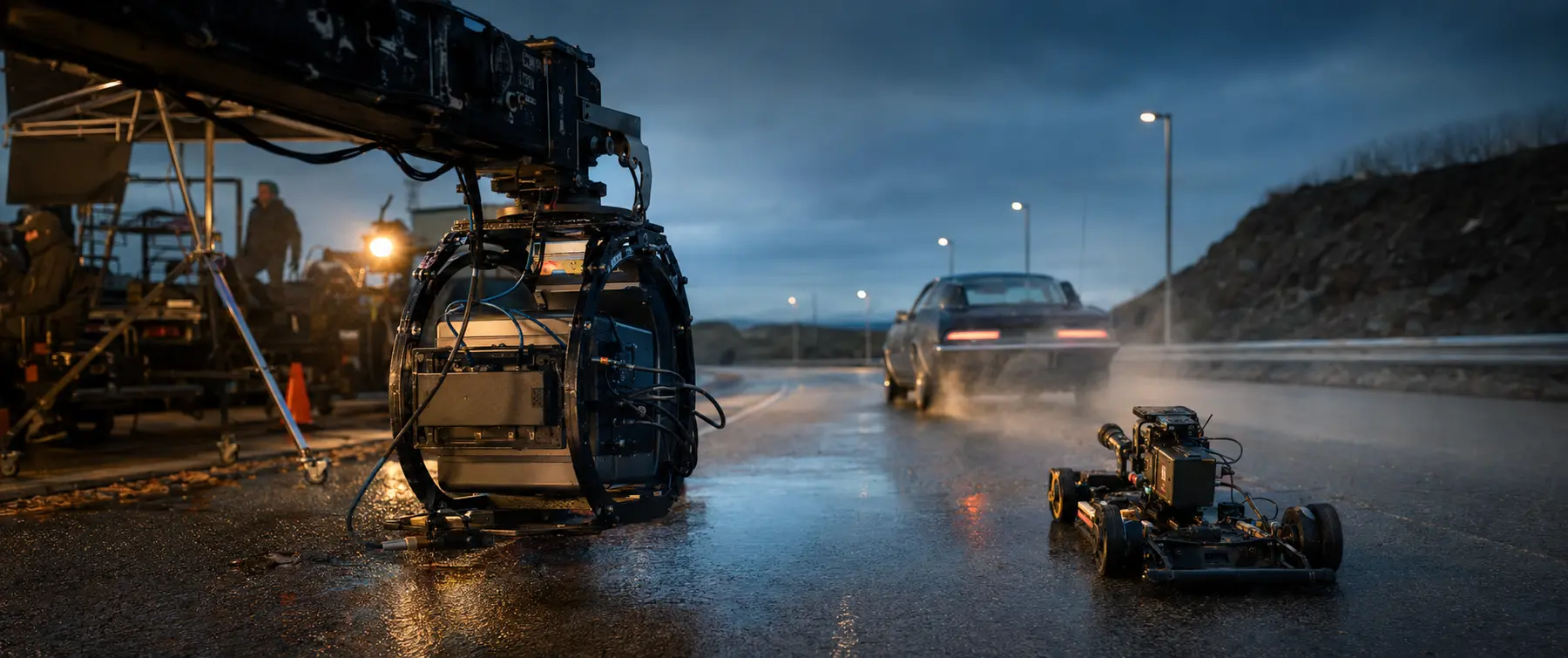
Imagine the shot: two vehicles converge and the camera must live inches above the road. The choice that matters is not the grandest brochure. It is the camera that can reach the position, move with the danger and bring the moment home.
The Odyssey exposed 2.1 million feet of the largest negative in regular use across 91 shooting days. The film runs 172 minutes; the complete 15/70 mechanical presentation reached 41 listed theaters. The image can be magnificent. The first twist is that every shot carried the burden while almost nobody received the full analog reward.
This ignores story, politics and personalities. It asks what the format bought, blocked and whether a modern alternative could deliver more movie for the money.
The promise begins with a giant frame
A perforation is a sprocket hole that pulls film through a machine; ordinary 65mm runs vertically and spends five holes on each picture, while IMAX turns the stock sideways and spends fifteen—hence 15-perf/65mm, or 15/65.
Kodak’s current full capture-area figure is 70.41 × 56.62mm—about 3.3 times standard 65mm and 8.6 times four-perf 35mm. Its raw shape is roughly 1.24:1; protection and projection crop to 1.43:1. Camera stock is 65mm; release print is 70mm.
To-scale camera-aperture comparison
How much film one picture occupies
“15-perf” counts the sprocket holes across one frame. “65mm” and “70mm” name the width of the camera stock and release print.
Most 65mm movie cameras give one picture five perforations of film. IMAX moves the 65mm negative sideways and gives it fifteen; Kodak’s current full capture-area figure is about 1.24:1, while the protected/projected film image is 1.43:1. The 70mm theater print is called 15/70. Rectangles use Kodak’s current published capture-area dimensions; area is width × height. The full IMAX capture area is about 1.24:1; the protected/projected film image discussed later is 1.43:1. Frame size does not determine a theater screen’s physical size.
Graphic: STUNT.BLOG editorial diagram / AI-generated scene
Open full-size comparison ↗Then the meter starts running: roughly $7–13 million
Raw stock is only the opening bid. A published proxy puts 2.1 million feet near $3.15 million; Kodak’s 2026 list points to $3.49 million. Development, scans, loaders, sound workarounds, rigs, vaulting, insurance, prints and freight follow.
No public invoice exists. Our central production-format model is $7.03 million; a modelled 41-print release near $2 million brings it to $9.03 million. We use $7–13 million as the working band. The outer columns are stress tests, not predictions.
Digital is not free: roughly 103 hours of uncompressed ALEXA 65 camera files would mean about 274TB for one copy or 821TB for three. That counter-cost is subtracted.
What shooting the whole movie on IMAX may have added
| Extra cost | Low case | Central case | High stress case |
|---|---|---|---|
| Film loaded into cameras | $3.15m | $3.15m | $3.49m Source ↗ |
| Developing exposed negative | $0.32m | $0.63m | $1.05m Source ↗ |
| Scanning, dailies and film-only post | $0.40m | $1.00m | $2.00m Source ↗ |
| Special IMAX camera and service premium | $0 | $0.50m | $1.50m Source ↗ |
| Extra loaders, support, sound fixes and custom rigs | $0.50m | $2.00m | $6.00m Source ↗ |
| Negative handling, vaulting and insurance | $0.15m | $0.50m | $1.50m Source ↗ |
| Digital workflow cost avoided | −$1.50m | −$0.75m | −$0.25m Source ↗ |
| Production-format premium | $3.02m | $7.03m | $15.29m |
Production plus the physical film release
| Model layer | Low case | Central case | High stress case |
|---|---|---|---|
| Production-format premium | $3.02m | $7.03m | $15.29m |
| Assumed 41-print film release | $1.60m | $2.00m | $3.00m |
| Combined mechanical total | $4.62m | $9.03m | $18.29m |
Editorial model / Not an invoice
The central scenario at a glance

Every exposed foot has to survive the journey
A digital card can be checked and copied on set. An exposed can is a sealed promise. Crews load in darkness, log every roll and guard undeveloped negative from heat, humidity and X-rays. A lab develops it; editorial and VFX receive scans; the film version returns to hand cutting and photochemical timing.
Release prints still need leaders, joins, inspection and packing. The craft is real. So is the irony: much of it solves transport, handling and review problems created by the medium itself.
The shot the camera cannot reach
A thousand-foot load lasts 2:57 at 24fps. Across 2.1 million feet, that is roughly 2,100 loads and 103 recorded hours. The Odyssey used two quieter Keighley cameras and five older bodies. For dialogue, the sound blimp alone could weigh 240 pounds; reporting put the package above 300, requiring reinforced dollies and mirrors for blocked eyelines.
For action, weight becomes geometry. Payload chooses the arm, cable or vehicle mount. Body size decides whether the lens fits under a car, inside a cabin or close to impact. Inertia changes acceleration and braking. Rarity discourages sacrificial placements; a three-minute load interrupts long choreography. See our stunt-rigging field guide for the surrounding movement systems.
That does not prove the action is worse. It proves that stunt design begins with a negotiation: engineer access, move back, use a more mobile action-unit platform or lose the angle. A compact remote head, FPV body or crash camera may record less theoretical detail and still produce the stronger image because it can stand where the scene demands.
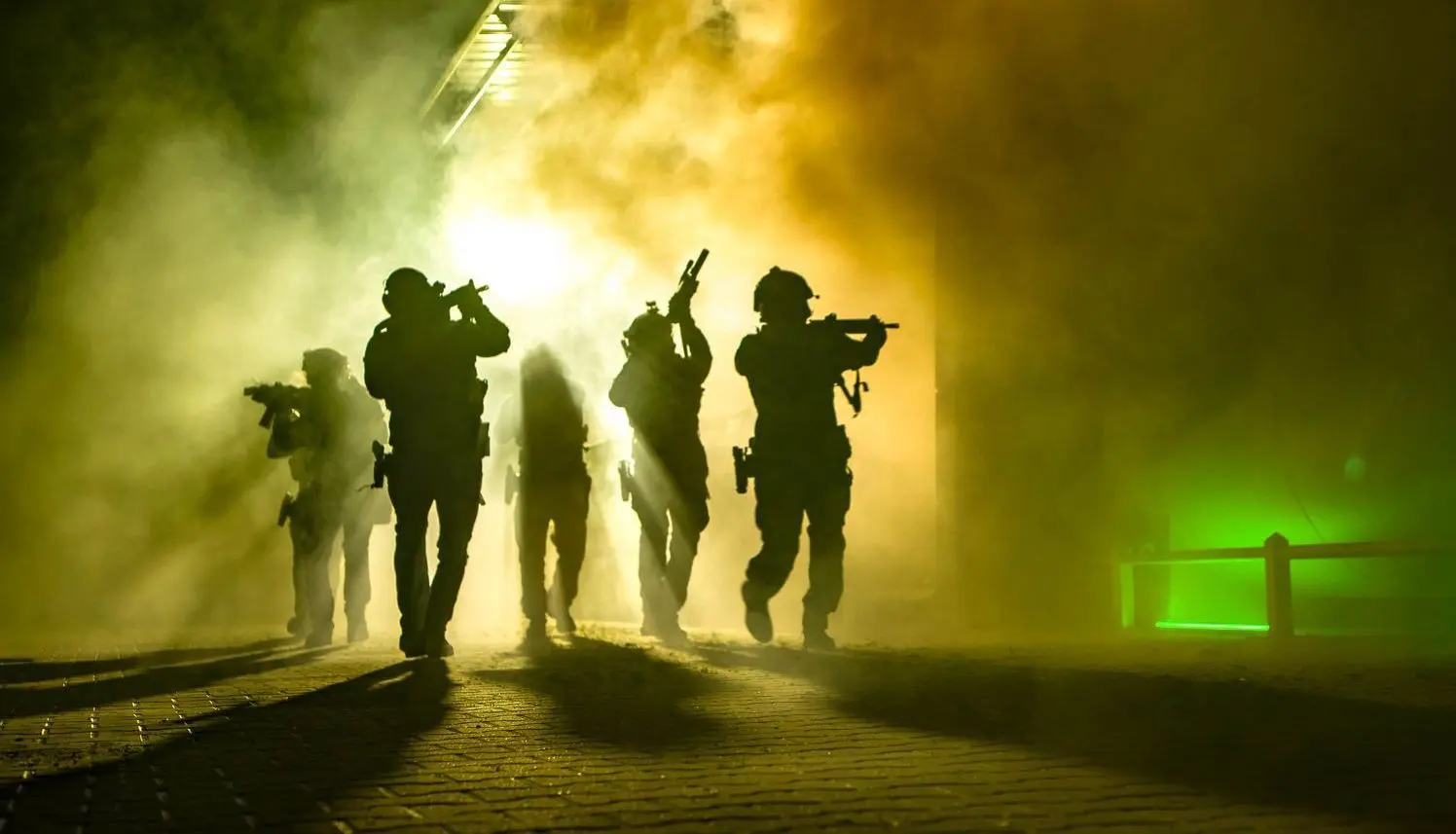
A camera can be optically superior and operationally wrong. A format mandate chooses before the stunt gets to ask. Tactical authenticity depends on the same camera access.
What the format takes away before it gives anything back
| Pressure | What the film package demands | What it can cost the movie |
|---|---|---|
| Camera position | Large body, magazine and housing need clearance | Fewer under-car, cabin and impact angles |
| Payload | Stronger heads, arms, cables and mounts | Wider safety envelope; less movement freedom |
| Noise | Dialogue may need a 240lb blimp | More weight, blocked eyelines and reset time |
| Take length | 2:57 per 1,000-foot load | Stops, dark loading and broken choreography |
| Physical risk | Rare bodies demand protection | Fewer sacrificial placements near impact |
| Versioning | Action must survive several safe areas | Staging is pulled toward the common core |
| Endpoint | Every shooting day carries the burden | Only 41 listed rooms finish the analog chain |
| Opportunity | $7–13m stays tied to format | Less rehearsal, second unit, rigging and finishing |
Conceptual editorial illustration / Not a production still
Two camera strategies, one piece of road
The last eleven miles are the rarest
A 172-minute 15/70 print is about 57,800 feet—17.6 kilometers—and roughly 250 kilograms assembled. It travels in pieces. Oppenheimer reached London in 53 reels; projectionists spent 16-plus hours joining it onto a six-foot platter with custom extensions.
One Odyssey copy per listed theater puts raw stock near $1 million. Printing, timing, inspection, freight, customs and assembly bring our release model to $1.6–3.0 million. Freight is not the whole bill. The chain is.
What a physical IMAX release actually involves
| Stage | What happens | Responsible number |
|---|---|---|
| Make one print | 172 minutes becomes about 57,800ft / 17.6km of film | ≈$24,300 raw stock per copy Source ↗ |
| Scale to listed venues | Model assumes one print for each of 41 theaters | ≈$1.0m raw stock Source ↗ |
| Print and check | Timing, leaders, printing, joins, inspection and quality control | $0.4m–$1.2m modelled |
| Move internationally | Cases, insured freight, customs and onsite handling | $0.2m–$0.8m modelled |
| Build at the theater | Oppenheimer precedent: 53 reels and 16+ hours in London | One assembled print ≈250kg Source ↗ |
| Physical-release total | Prints plus specialist delivery and setup | $1.6m–$3.0m; booths excluded |
There is no honest projector sticker price
Online numbers mix film, xenon and laser systems, then confuse the projector with screen, sound, structure, power, cooling, booth, platter and service. IMAX Corporation says this release rebuilt legacy film machines—not 41 new projectors bought from a public price list.
For scale, IMAX Corporation’s 2025 accounts recognized $62.388 million across 70 new systems: about $891,000 each. That bundled accounting is not a 15/70 quote, so theater capital stays outside our model. Inventing a sticker price would make the table cleaner and the analysis worse.
Then the marketing demo changes the rules
The official explorer starts with tall 1.43 and cuts shorter windows from it. At constant width, 1.43 contains 67.1% more area than 2.39; reversed, scope removes 40.2% of the tall frame. Same rectangle, opposite sales pitch.
But widescreen need not amputate that composition. A crew can move the camera, change the lens and stage an attacker, escape route or pursuing car across the sides. Capture format is not the only possible composition.
Our graphic keeps one fictional still and one pixel grid. Nothing is regenerated. Orange dashes mark the centered IMAX-film sides; horizontal dashes show what 16:9, Digital IMAX 1.90 and CinemaScope 2.39 cut from that window.
At equal width, 1.43 adds height; at equal height, 2.39 adds width. The complaint is that crop advertising shows damage from one derived version while hiding the widescreen-first alternative. Real geometry. Loaded comparison.
Exact same raster / IMAX film 1.43 / Digital IMAX 1.90 / TV 16:9 / CinemaScope 2.39
One fictional movie moment, five windows—and one missing choice
One illustrated movie moment. Two different framing choices. Every crop below uses the exact same fictional source pixels. It is an editorial demonstration—not a frame from The Odyssey.
At equal image height, the orange dashed lines mark the left and right edges of a centered IMAX film 1.43:1 frame. A widescreen-native shot can deliberately use the lateral zones beyond those edges for story and action.
- IMAX film1.43:11,157 × 809 source pixels
- TV / streaming16:9 · 1.78:11,157 × 651 center crop
- Digital IMAX1.90:11,157 × 609 center crop
- CinemaScope / wide cinema2.39:11,157 × 484 center crop
The solid outer edge is the tall 1.43 frame. Each pair of dashed horizontal lines marks a shorter delivery shape cut from that same frame.
CWhat the three shorter versions actually receive
These are crops, not new widescreen compositions. They lose progressively more from the top and bottom, while the left and right story zones outside the original 1.43 frame never return.
Nothing is regenerated between frames. The comparison separates two decisions that marketing often merges: cropping a tall master and composing a different widescreen shot from the start.
Graphic: STUNT.BLOG editorial comparison / AI-generated scene
Open full-size comparison ↗Your eyes do not see a square world
Hold head and gaze still. One eye typically reaches about 95 degrees toward the temple and 60 toward the nose. Together, both eyes approach a 190-degree horizontal envelope, with roughly 120 degrees of binocular overlap. Vertically, common estimates are 60 degrees up and 75 down—about 135 total. The field is wider than tall.
The panorama is not uniformly sharp. Fine detail occupies a tiny center; recognition falls quickly toward the edges, while motion and contrast remain useful. Peripheral vision is an alarm: it catches the approaching fighter or vehicle, then the eyes turn to inspect it.
The advantage goes beyond eyelid shape. At equal distance from fixation, studies generally find stronger contrast and spatial performance along the horizontal meridian. Reviews trace the asymmetry through cone and ganglion-cell sampling in the retina and the visual-cortex territory devoted to different directions. Biology does not allocate equal resources everywhere.
Anatomy helps: two horizontally separated eyes extend lateral coverage while nose, brow and sockets constrain other directions. One plausible—not proven—historical layer is that ground-moving humans monitored companions, routes, predators and prey across a horizon; the lower field helped with footing. Vertical periphery remains real and tall screens can feel immense. Extra height simply does not automatically beat lateral staging in a fight or chase.
The second twist: the giant screen does not need the film
Retire the magic number. ‘Nearly 18K’ is a film-to-pixel estimate, not native pixels or a seat guarantee. Detail passes through lens, focus, movement, grain, scan, VFX, master, projector, screen and viewing distance. A moving shot resolves less than a static chart; most viewers meet a 4K, 2K, television or phone endpoint first.
The ‘film look’ starts before post: lenses, filters, lighting, exposure, shutter and movement. Then grading can soften highlights, shape contrast and imitate print color. Grain scanned from real stock can react to exposure instead of sitting on top as noise; finishing can add halation—the reddish glow around bright edges—plus bloom, tiny weave and flicker. A hybrid can even record the digital finish onto film and scan it back.
That can look extraordinarily convincing, not physically identical. Film has random chemical variation; a projector adds weave and flicker. AI can clean, upscale and match texture, but can also invent false detail. It cannot recover what the lens never captured. The serious case for simulation is cinematography plus color science—not AI magic.
Hardware moved too. ARRI’s 6.5K ALEXA 265 puts a 65mm-class sensor and claimed 15 stops into a 7.3-pound body. Dual-4K IMAX GT laser can fill 1.43 without a 250-kilogram print; Smithsonian advertises The Odyssey that way. Barco reports more than 20 foot-lamberts of screen brightness on a 100-by-70-foot screen, wide color and high contrast. Those are manufacturer figures, not an independent verdict—but scale no longer requires film.
A 2016 study found broadly similar emotional and immersive responses to analog and digital capture under digital projection; a small mechanical subgroup hinted at an analog edge. It studied 35mm, not 15/70. The responsible conclusion: many film cues reproduce extremely well; the differences that remain are real, specialized and expensive.
What a modern pipeline can copy—and what remains analog
| Film cue | Modern digital or hybrid path | What remains physically different |
|---|---|---|
| Highlights and color | Grade bright areas more gently; copy film-print color with lenses, filters and software | Real emulsion changes with stock, exposure and chemistry |
| Grain and texture | Use scans of real stock; let grain change with brightness and from frame to frame | Real film creates its random texture during exposure and processing |
| Glow, softness and tiny movement | Recreate them optically or in software; optionally record the finish to film and scan it back | A physical print adds its own flicker, weave and another generation |
| Giant 1.43 presentation | Dual-4K GT laser on a compatible tall screen | No physical film travelling through a 15/70 projector |
| Detail | 6.5K capture, careful lenses, focus and stable projection | Large negative retains unique analog structure—not guaranteed visible resolution |
Conceptual editorial illustration / Exhibition is separate from capture
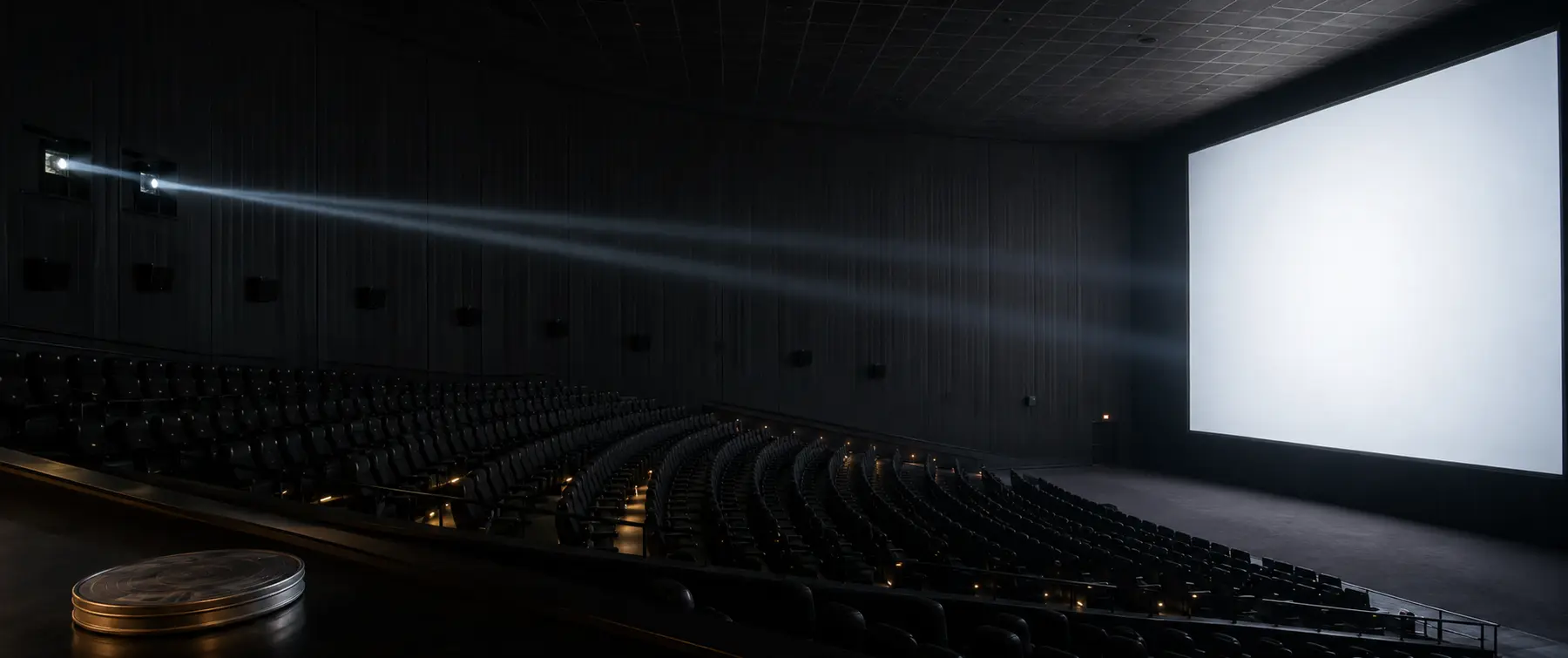
Keep the giant screen. Lose the 250-kilogram print.
The $20 million number proves nothing about the analog premium
Oppenheimer grossed about $20 million from 25 domestic IMAX 70mm rooms by September 2023. That is total ticket revenue—not studio profit or the portion created by Kodak stock. There was no control release in the same rooms, times and prices without the print.
The giant auditorium, scarce seats, premium ticket, Nolan audience and campaign do not fall to zero with digital or hybrid capture. Exhibition is separate from capture. The Odyssey itself reaches full-height 1.43 at compatible Smithsonian laser venues. Analog may strengthen the event; the whole gross cannot be assigned to it.
The honest comparison is analog versus the same premium screens plus modern capture and $7–13 million redirected into rehearsal, safer rigs, second-unit days, camera positions, locations, practical builds, VFX or finishing. That money could improve every version—not 41.
Film is potent marketing: difficulty becomes publicity, scarcity becomes exclusivity and ordinary screens feel incomplete. But no published figure isolates demand caused by the physical print. Until it does, ‘film paid for itself’ is publicity claiming the revenue of the entire room.
Verdict: real spectacle, technical decadence
The best 15/70 show is real spectacle. Image area, texture, scale and mechanical presence are not inventions; the premium ticket may be worth every cent.
That does not prove the mandate best served the movie. It consumed money, take length, sound freedom, camera access, rigging and composition. The working premium is $7–13 million; the complete analog payoff reached 41 listed endpoints.
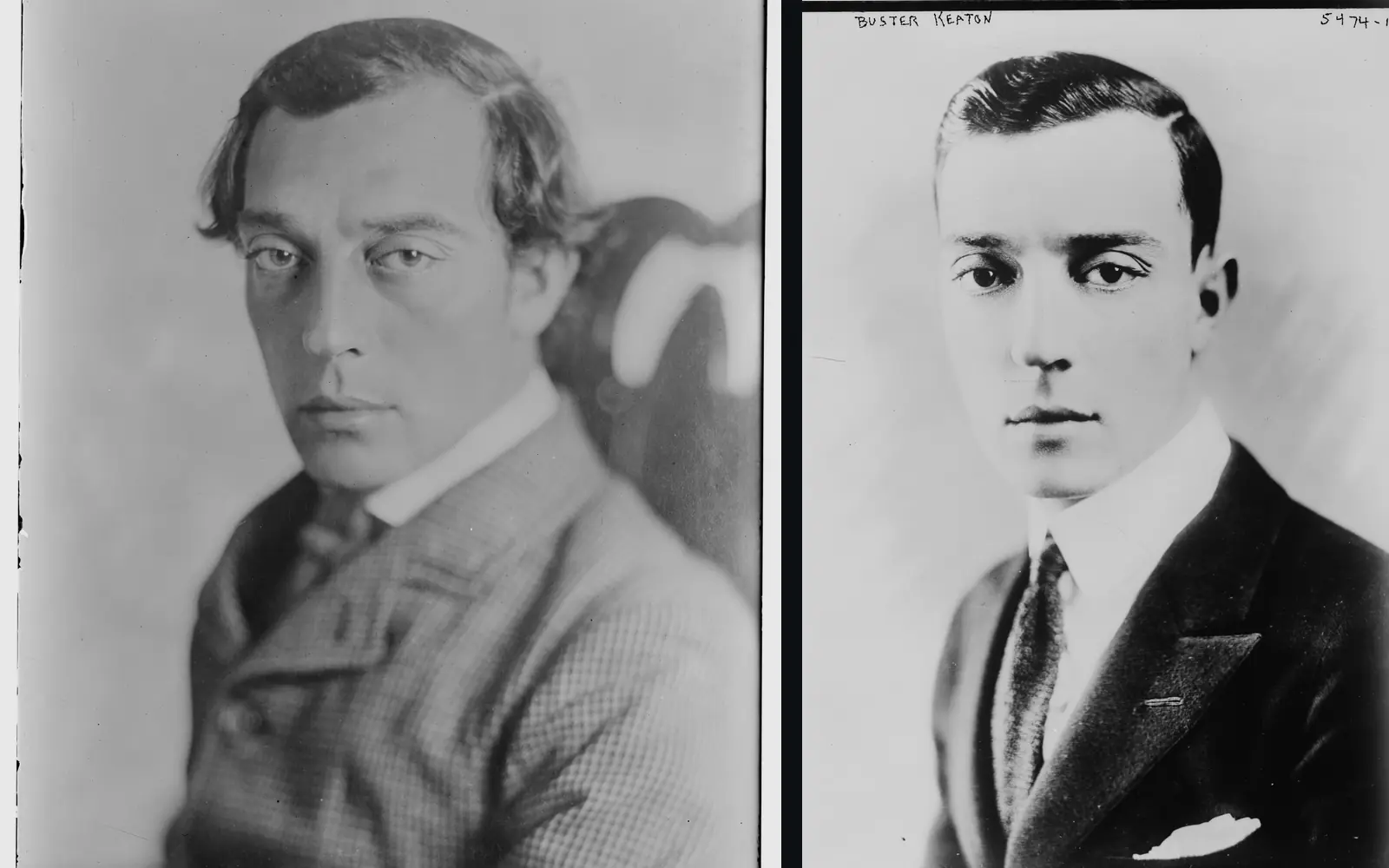
Film is not obsolete—only unnecessary for a giant, beautiful image. Here it becomes craft, luxury, scarcity and branding, then markets its burdens as superiority. The camera should serve the shot. Our Buster Keaton safety analysis asks who retains authority. When shot, stunt, budget and viewer serve the camera, craftsmanship has crossed into technical decadence.
Analysis
Limits
STUNT.BLOG had no access to Universal, Syncopy, IMAX Corporation, FotoKem or private contracts. The cost figures are transparent editorial models built from public footage totals, public price proxies and stated assumptions. They establish an order of magnitude, not an audited budget. This analysis addresses production technology, action cinematography, exhibition and perception only. IMAX® is a registered trademark of IMAX Corporation.
Sources and technical references30 entries
- The Odyssey — Explore Premium Formats — Universal Pictures. Accessed 2026-07-18.
- The Odyssey — IMAX. Accessed 2026-07-18.
- A Look Inside Christopher Nolan’s ‘The Odyssey’ by the Numbers — Associated Press, 2026-07-14. Accessed 2026-07-18.
- Why Christopher Nolan Shot ‘The Odyssey’ Entirely on IMAX Film — CBS News / 60 Minutes, 2026-07-12. Accessed 2026-07-18.
- Christopher Nolan Just Fulfilled a Lifelong Dream, After Daring IMAX to Do Something Groundbreaking — Fast Company, 2026-06-23. Accessed 2026-07-18.
- KODAK Motion Picture Products Price Catalog — US — Eastman Kodak Company, 2026-04-10. Accessed 2026-07-18.
- Christopher Nolan Used Over Two Million Feet of Film for ‘The Odyssey’ — PetaPixel, 2025-11-18. Accessed 2026-07-18.
- Film Format Choices — Motion-Picture Runtime and Image Area — Eastman Kodak Company. Accessed 2026-07-18.
- Film Services Price Guide — Cinelab Film & Digital. Accessed 2026-07-18.
- Motion Picture Film Laboratory Services — FotoKem. Accessed 2026-07-18.
- Transporting and Storing Unprocessed Film — Eastman Kodak Company. Accessed 2026-07-18.
- Get Tickets for The Odyssey in IMAX 70mm Film — IMAX, 2026-06-04. Accessed 2026-07-18.
- A Projectionist’s Guide to Oppenheimer — Science Museum Group, 2023-07-19. Accessed 2026-07-18.
- Christopher Nolan Fans Embark on Epic Journeys to See The Odyssey the Way He Wants Them To — The Guardian, 2026-07-13. Accessed 2026-07-18.
- The Odyssey — Smithsonian Theaters. Accessed 2026-07-18.
- IMAX Corporation Annual Report for the Year Ended December 31, 2025 — U.S. Securities and Exchange Commission, 2026-02-25. Accessed 2026-07-18.
- Why There Aren’t More IMAX 70mm Screens for The Odyssey — Variety, 2026-07-13. Accessed 2026-07-18.
- For filmmakers, ‘Oppenheimer’s’ $900M-plus haul is an important moment for Hollywood and theaters — Associated Press, 2023-09-19. Accessed 2026-07-18.
- IMAX Corporation Reports Fourth Quarter and Full Year 2025 Results — IMAX Corporation, 2026-02-25. Accessed 2026-07-18.
- ARRI Announces the Small and Lightweight ALEXA 265 Camera — ARRI, 2024-12-05. Accessed 2026-07-18.
- ARRIRAW FAQ — Data Rates and Storage — ARRI. Accessed 2026-07-18.
- Report ITU-R BT.2216 — A perspective of the hierarchy of digital television image systems based on human viewing behaviour — International Telecommunication Union, 2011-05-01. Accessed 2026-07-18.
- Cortical magnification in human visual cortex parallels task performance around the visual field — eLife, 2021-08-03. Accessed 2026-07-18.
- Asymmetries Around the Visual Field: From Retina to Cortex to Behavior — Trends in Neurosciences / PubMed Central, 2022-01-01. Accessed 2026-07-18.
- Report ITU-R BT.2246-9 — The Present State of Ultra-High Definition Television — International Telecommunication Union, 2025-09-01. Accessed 2026-07-18.
- As Film Goes Byte: The Change From Analog to Digital Film Perception — Psychology of Aesthetics, Creativity, and the Arts, 2016-08-08. Accessed 2026-07-18.
- Presenting Laser Projection to the Giant-Screen Cinema — Barco, 2015-09-28. Accessed 2026-07-18.
- Imax projector — National Science and Media Museum — Wikimedia Commons / geni, 2025-12-20. Accessed 2026-07-18.
- IMAX Trademark & Brand Usage Guidelines — IMAX Corporation. Accessed 2026-07-18.
- What to know: 70mm? IMAX? Dolby? Christopher Nolan breaks down his favorite big screen formats. — Associated Press, 2026-07-14. Accessed 2026-07-18.

Loading approved comments…