
Analysis
A first-person shooter gives the player a simple privilege that cinema cannot copy: the right to decide what happens next. The player turns, stops, advances, changes route, misses, recovers and tries again. The image is not merely watched. It answers.
That is why so many game-influenced action scenes look expensive and still feel strangely passive. They reproduce the surface—weapon-height framing, aggressive forward movement, short lenses, night vision, rapid inserts—but lose the mechanism that made the original experience physical. The result is often a camera attached to a body-shaped vehicle, charging through production design while the audience waits for the next cut.
An FPS is not a colour grade, a HUD or a choreography preset. It is a control loop: intention becomes movement; movement changes the environment; the environment sends feedback; the player makes the next decision. A film adaptation cannot preserve literal control, but it can preserve that chain of cause and effect. That is the real game-to-screen task.
An FPS is a control loop, not a look. Film cannot preserve player control, but it can preserve the chain from decision to physical consequence.
Stunt Design translates movement into a performer-specific grammar; production geography and camera geography keep that grammar readable.
The edit has to carry intention, direction, pressure and changed character state across every viewpoint, unit and actor–double handoff.
The player is a loop, not a lens height
Game developers spend enormous effort making input feel immediate while keeping movement readable, weighted and connected to the world. GDC presentations on first-person animation and Destiny’s animation system describe the problem bluntly: the avatar must feel like more than a ‘camera on a stick.’ Persistent arms, body, weapon and camera motion have to support both responsiveness and physical presence.
Film begins from the opposite condition. The audience cannot steer the viewpoint, cancel a movement or choose another door. If a movie copies first-person head motion without replacing agency, it removes the player’s control but retains the visual instability. What felt responsive in a game can feel arbitrary on screen.
The production therefore has to identify what the player was doing psychologically. Was the pleasure speed, route choice, spatial mastery, pressure, target prioritisation, survival, squad dependence or the discovery of a new line through the space? The camera can then translate that function instead of imitating the interface.
The first-person body is an interface
In a shooter, hands, weapon, camera and body are not neutral decoration. They continuously report state: acceleration, impact, readiness, interruption, fatigue, direction and intention. Even small timing changes tell the player whether an action has begun, completed or failed.
Cinema needs the same information, but it can distribute it across several bodies and shots. A principal actor can carry decision and emotion. A stunt performer can carry a physical transition. An insert can carry contact or effort. A specialist camera can carry proximity. The edit joins them into one readable action state.
The mistake is to treat a first-person insert as proof that the sequence now ‘feels like a game.’ A useful POV shot has a specific job: expose a decision, compress a transition, reveal a threat, register impact or place the viewer inside a temporary loss of control. Without that job, the angle is only a reference to the source medium.
Level geometry becomes production geography
Activision’s released Caldera research data contains near-complete map geometry together with randomly selected anonymised samples of how players moved through it. The significance is not the particular map. It is the relationship: a game environment is designed and tested as a space that will be traversed, read and exploited, not merely photographed.
Physical locations need the same question before the shot list hardens: what does movement reveal? A corridor can compress choice. A threshold can delay information. A stair, vehicle, window or change in elevation can redirect attention. An open area can create exposure, but also a clear objective. The location is not a backdrop behind the action. It is one of the systems producing the action.
This does not require a film set to mimic a multiplayer map. It requires production geography: routes with dramatic purpose, entrances and exits that can be filmed, actor and double handoffs that preserve direction, effects that do not erase the next beat, and camera positions that see the consequence of each move.
Stunt Design becomes movement grammar
Games can move from intention to animation in milliseconds. Motion-matching systems search captured movement for a pose that fits both the current body state and the intended future path, prioritising responsiveness without abandoning believable motion. Film has no runtime animation database. It has performers, rehearsals, surfaces, costumes, equipment, fatigue, resets and a finite number of takes.
That makes Stunt Design the translation layer. The job is not to copy a list of game verbs. It is to decide how this character accelerates, commits, stops, collides, recovers, changes level, protects an injury, carries equipment and hands movement to another performer or camera. Weight is character information. Recovery time is story information. Repeatability is production information. Fight previs is where many of those dependencies can become visible before the day.
A game may let the player sprint, slide, turn and regain full control with mechanical consistency. A film can retain the momentum and intent while allowing the body to behave like a body. The audience does not need every action to be literally possible at game speed. It needs the sequence to preserve the same pressure: the next decision arrives before comfort returns.
Do not put the camera where the player’s head would be
The player camera is a control surface. The film camera is an editorial instrument. They are not the same job.
A strong game-to-screen sequence can move through several distances: subjective proximity for a decisive beat, an objective angle for geography, a character-facing shot for consequence, a remote or compact system for a transition that conventional coverage cannot reach. The point is not permanent first person. The point is continuity of intention across changing viewpoints.
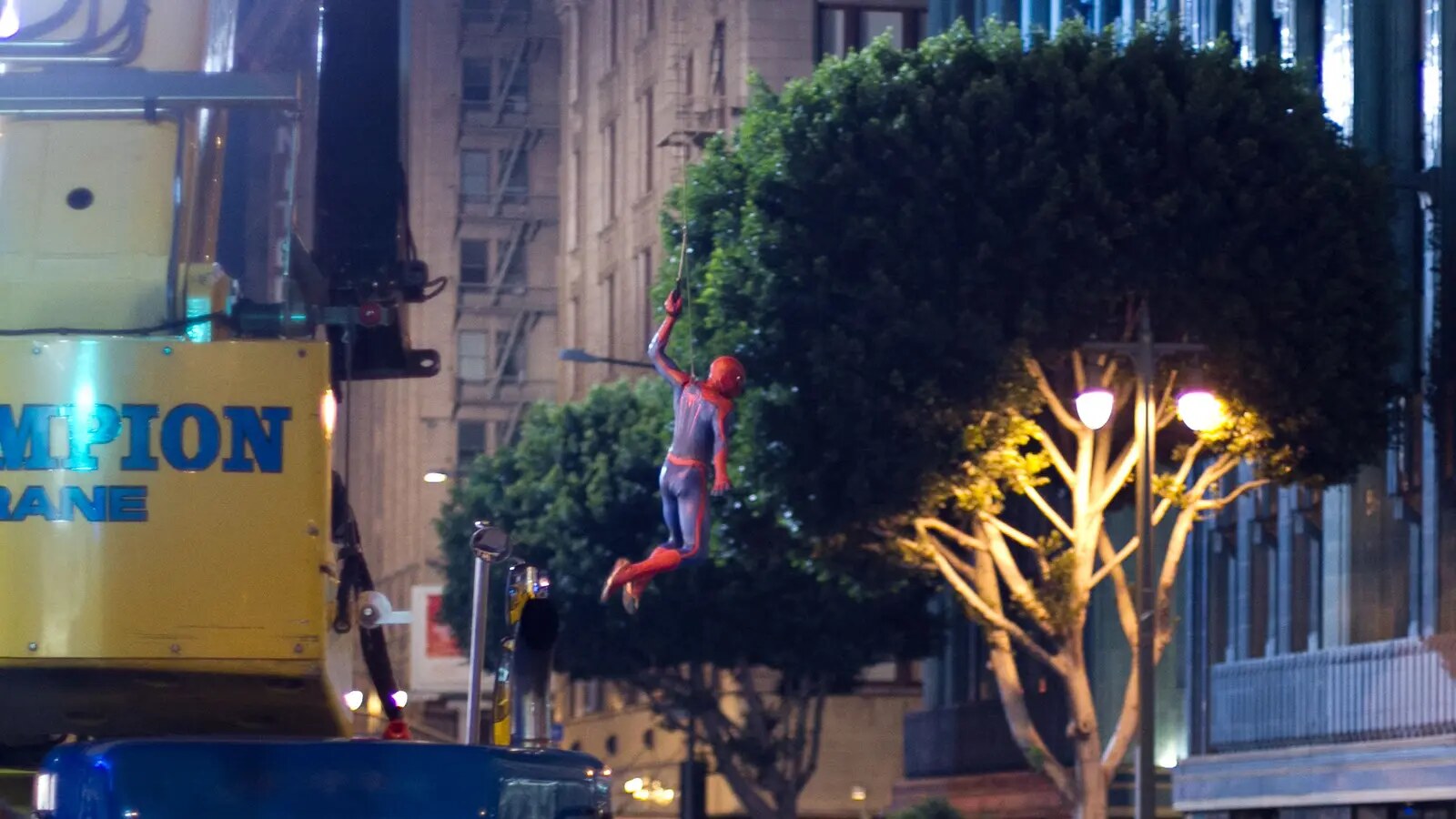
The camera needs the same movement map as the performers. It must know where the objective transfers, where the route closes, when another body takes over and which change has to be visible for the next cut to make sense. The Shot Window describes the overlap where performance, camera path, framing and the decisive beat become usable together. Systems such as WarpCam® can expand the available positions across handheld, pole, FPV, RC, vehicle and compact stabilised configurations. No rig replaces the qualified action and safety plan.
The edit has to preserve consequence
Games rarely ask the player to forget why they moved. The interface, environment and immediate feedback keep the last decision alive. Film can destroy that continuity in a few seconds by cutting only for energy.
Every cut in game-influenced action should answer at least one question. What changed? Who caused it? Which route remains? What did the character lose or gain? Where does the pressure move next? A cut that cannot answer any of those questions may still be attractive, but it is not carrying the control loop.
This is also where actor–double continuity matters. The handoff cannot be judged only by costume and silhouette. Intention, direction, speed, injury state and the unfinished action must survive the cut. The same applies when First Unit material meets Second Unit, a splinter unit, an insert day or later pickups. The sequence needs one logic even when several units supply the images.
What should not survive the adaptation
Literal interface imitation is the easiest part to recognise and the least important part to preserve. A HUD, weapon bob, rapid reload montage or uninterrupted forward-facing camera may identify the genre without delivering the experience.
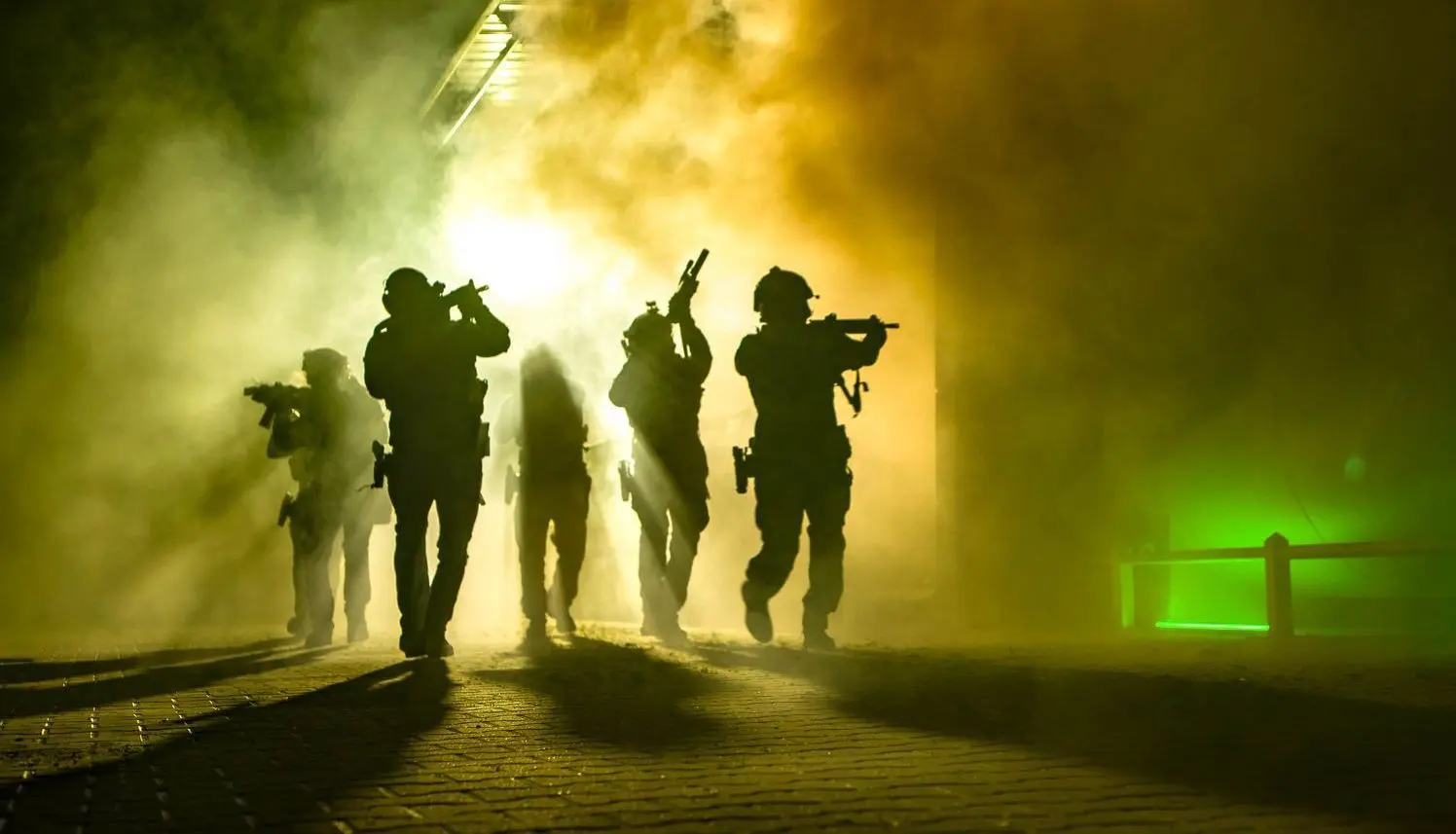
Nor should a film reproduce operational procedure merely because a game depicts it. Screen action is built through fiction, qualified departments, performer-specific planning and the applicable production rules. Tactical credibility does not require publishing or rehearsing sensitive real-world methods. Operators in the Frame examines the separate adviser–actor–stunt–camera handoffs behind credible tactical screen behaviour.
The adaptation also has to resist a second trap: turning ‘game-like’ into frictionless. Player control depends on fast response, but dramatic action needs consequence. A character who clears every obstacle with identical speed and no altered state may feel responsive as an avatar and empty as a person.
A production translation table
| Game function | Film-production translation | Failure mode |
|---|---|---|
| Player agency | Visible objective, constrained choice and immediate consequence | Camera movement without a decision |
| First-person body | Performance state distributed across actor, double, inserts and proximity | POV used as a decorative reference |
| Level geometry | Routes, thresholds, reveals, elevation and transitions with dramatic purpose | A location photographed as background only |
| Movement system | Character-specific acceleration, commitment, collision, recovery and repeatability | Impossible game speed copied without weight |
| Feedback | Reaction, sound, environment, effects and changed character state | Impact with no lasting consequence |
| Reset / retry logic | Shot order, repeatability, pickups and clear continuity state | Coverage that cannot be reconstructed in the cut |
| Multiplayer / squad logic | Shared objective, role hierarchy and readable transfer of pressure | Several solo performances in matching wardrobe |
Current franchise context, without implied attachment
Paramount and Activision officially announced a live-action Call of Duty feature in September 2025. The announcement says Paramount will develop, produce and distribute the film, while Activision remains the franchise partner. A later Paramount corporate update placed the first film in June 2028.
The analysis applies to FPS adaptations generally.
The audience does not need the controller
A film cannot give the viewer the player’s freedom. It can give the viewer the player’s confidence that movement matters.
That confidence comes from disciplined cause and effect: the character chooses, the body commits, the location answers, the camera witnesses the meaningful change and the edit preserves it. When those links hold, the audience may not control the sequence, but it can feel the sequence thinking.
That is the game-to-screen force multiplier: not copying the game’s surface, but connecting Stunt Design, performance, location, camera and editorial structure around the same playable logic. TACCINE is production-practice context for that problem.
Sources and context record9 entries
- Giving Purpose to First-Person Animation — GDC Vault, 2013. Accessed 2026-08-13.
- The Art of First Person Animation for Destiny — GDC Vault, 2015. Accessed 2026-08-13.
- Motion Matching and the Road to Next-Gen Animation — GDC Vault, 2016. Accessed 2026-08-13.
- Caldera: Advances in Real-Time Rendering — Activision Research, 2024-07-29. Accessed 2026-08-13.
- How Photogrammetry Is Helping to Shape Call of Duty: Modern Warfare — Activision, 2019-06. Accessed 2026-08-13.
- Paramount Strikes Major Film Deal with Activision to Bring Call of Duty to the Big Screen — Paramount, 2025-09-02. Accessed 2026-08-13.
- Paramount Products & Experiences Makes Its Mark at Licensing Expo 2026 — Paramount, 2026-05-29. Accessed 2026-08-13.
- Operators in the Frame — STUNT.BLOG, 2026-07-19. Accessed 2026-08-13.
- TACCINE — TACCINE. Accessed 2026-08-13.

Loading approved comments…