
Analysis
This analysis develops themes raised in Tina Thiele’s German-language interview with Ferdi Fischer, published by CN Klappe / Casting Network on 17 July 2024. Read the original German interview at Casting Network.
The page below is a new editorial work, not an English reproduction of the Q&A. It uses no Casting Network logo, screenshot or page image, and it translates no continuous passage. Fischer’s examples remain attributed first-person accounts; independent guidance is identified separately.
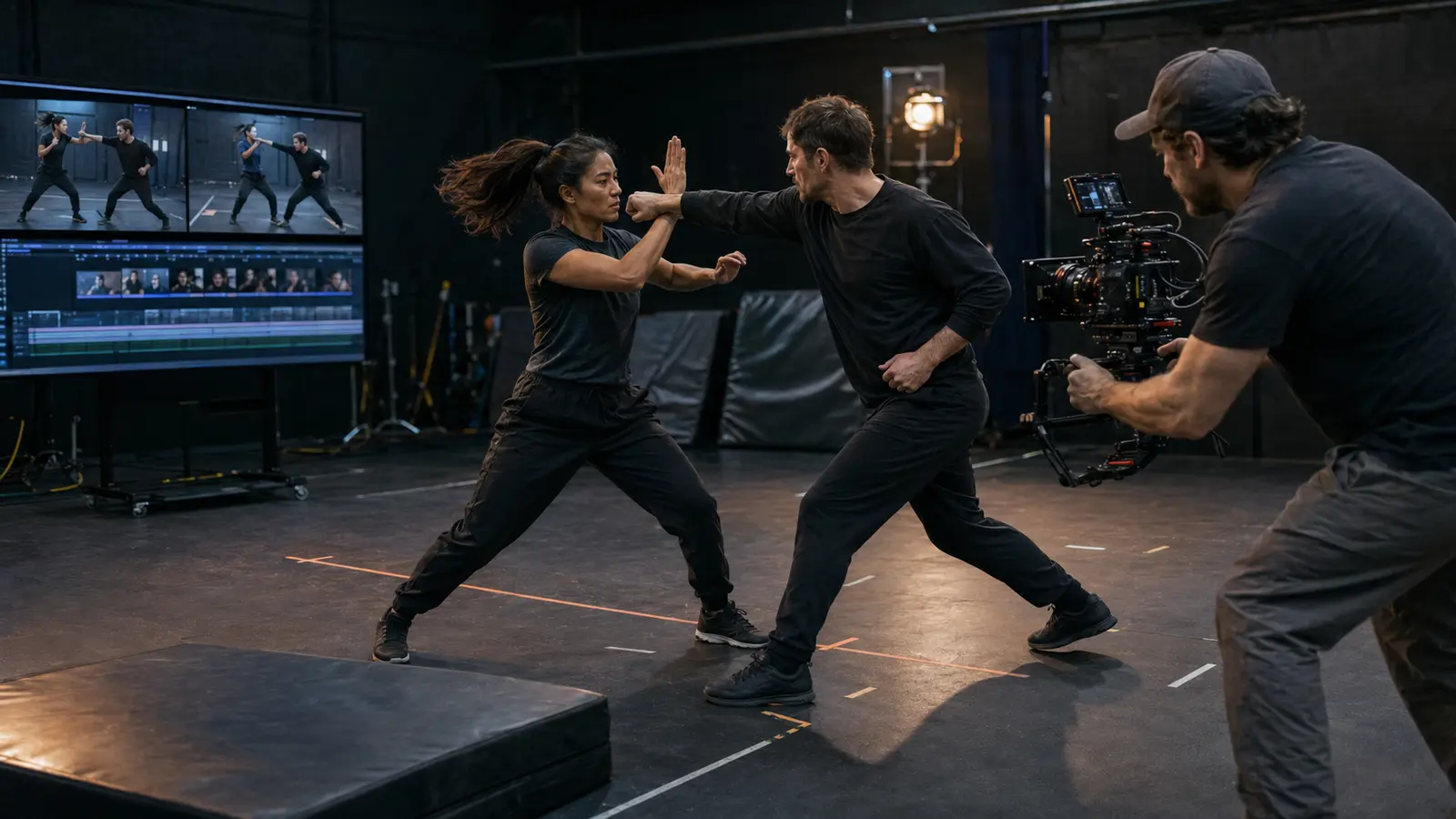
The central idea is simple: the audience should not experience an actor stopping and a double beginning. It should experience one character continuing through two differently specialised bodies.
Actor or double is not a status decision. It is a shot-specific judgement about competence, consent, residual risk and the performance the story needs.
The double performs the same character. Posture, rhythm, reactions, intention and camera continuity therefore need to be prepared as one shared movement language.
The coordinator controls the specialist action process. Production, direction, camera, costume, hair and makeup, VFX and performers retain their own responsibilities.
The handoff is not a substitution
A substitution solves a staffing problem: one person leaves, another enters. A stunt handoff solves a more difficult cinematic problem. The body may change, but the character’s intention, emotional temperature and relation to the space must survive the cut.
Physical resemblance helps, yet resemblance alone does not carry a performance. A double may need to reproduce an actor’s guarded shoulders, late reaction, uneven stride or reluctance to strike. The technically cleanest fall can be the wrong fall if the character would panic, hesitate or protect an injured side. SAG-AFTRA’s practitioner guidance frames actor and double as two performers responsible for the same character, not as a star and a replaceable body.
That is why the strongest handoff begins before camera blocking hardens. Actor and double can establish a shared movement vocabulary: neutral stance, walking rhythm, dominant side, how the character receives contact, where tension appears and what changes under fatigue. Our fight-previs analysis owns the shot-mapping workflow; the decision discussed here comes first—what each body can credibly and responsibly carry into that map.
Within Stunt Design, continuity is not cosmetic polish added after the dangerous part. It is the mechanism that lets specialist performance remain character performance.
The decision belongs to the shot
| Question | Evidence to examine | What the decision should produce |
|---|---|---|
| What must the audience believe? | Character intention, dramatic beat, framing and edit continuity. | A clear definition of the performance—not merely a list of techniques. |
| What can the actor do here? | Task-specific skill, rehearsal response, repeatability, costume, fatigue and honest consent. | An actor assignment limited to the demonstrated version, not to reputation or enthusiasm. Source ↗ |
| What requires a double? | Specialist competence, residual risk, time to prepare, matching needs and the available controls. | A qualified double with enough preparation to perform the character as well as the action. Source ↗ |
| What does the camera change? | Lens, angle, speed, eyeline, cut point, operator position and repeat count. | Coverage that sells the handoff without creating a new hazard or hiding essential information. Source ↗ |
| What do costume and post change? | Wardrobe, hair, prosthetics, protective equipment, paint-outs, face work and digital objects. | A tested continuity plan whose protections arrive early enough to be evaluated. Source ↗ |
Hesitation is information
Fischer’s Casting Network interview describes two opposite pressures: an actor may overestimate a capability, or may want a double but feel unable to say so. These are attributed observations from one coordinator’s practice, not a diagnosis of actors as a group. Both expose the same production flaw when they remain hidden: the plan is being built from performance confidence rather than verified readiness.
A coordinator does not need to turn fear into a personality judgement. The useful questions are operational. Can the performer reproduce the movement? Do they understand the consequence of a deviation? Has the costume changed what they rehearsed? Are they consenting to the action now—not merely to an earlier script description?
Industry Safety Bulletin #4 is recommended US guidance rather than worldwide law, but its logic is strong: performers should receive specialist consultation and a safety briefing, and substantive changes should trigger a renewed discussion. German DGUV guidance similarly centres suitability, qualification, preparation and residual risk. A quiet no, a qualified yes and a request for a double are all information the design needs.
This is different from labour-market gatekeeping. Our global report on stunt entry systems asks who gets admitted to the profession. Here the question is narrower: which prepared person should perform this exact fragment of one character’s action?
Five departments can break one invisible changeover
The stunt department can prepare a credible double and still lose the handoff elsewhere; costume may restrict the double differently from the actor, while hair and makeup may create a silhouette that works in a wide shot but fails in profile. Camera may reveal an unsafe angle or move so close that a planned disguise no longer reads; editing may connect two movements with incompatible momentum, and VFX may receive plates that cannot preserve the intended performance.
The coordinator therefore translates rather than absorbs every responsibility. The stunt-department map shows the specialist reporting lines; it does not transfer the producer’s whole-production duty, the director’s dramatic authorship or the camera department’s control of photography into one role.
Costume, wigs, prosthetics and protective equipment need to reach rehearsal early enough to change the plan; camera placement belongs in the safety conversation because it affects performer routes and operator exposure; VFX belongs before the take when a digital object, paint-out or face treatment changes what must be captured practically, while the creative and safety decisions are the same conversation at different resolutions.
For professional context, the SlamArtist.com Universe describes the Stunt Coordinator as the role that translates action into a prepared production process.
Insurance is an input, not the author
Insurance can influence the actor–double boundary. Allianz’s own account of entertainment underwriting says insurers may review scripts, schedules, budgets, cast, locations and stunt work and may request doubles or changes. That is evidence of one insurer’s process, not proof that all productions receive the same instruction.
The assignment still cannot be reduced to an insurer veto. Capability, residual risk, consent, contractual terms, the dramatic requirement, the available double, rehearsal time and the controls designed by production all matter. In covered US work, performer protections and the ability to request a double can also be contractual. In the UK, HSE guidance places the overarching safety responsibility on production even when a specialist coordinator manages the stunt process.
The practical consequence is documentation without theatre. Record what version was assessed, who demonstrated it, what changed, which body performs each fragment and where the cut or digital transition sits. If the design changes, reopen the decision. A form that preserves an obsolete plan is not a control.
Budget and schedule matter because preparation does. Our German stunt-budget analysis examines the resourcing problem; this article’s narrower finding is that a late handoff is rarely only a casting change. It can reset rehearsal, fitting, camera, plates and editorial continuity at once.
A handoff that can survive production
| Stage | Shared question | Minimum output |
|---|---|---|
| Define | What must the character do, and what must the audience read? | One dramatic and physical brief for actor and double. |
| Assess | Which version can each performer repeat in the real costume and environment? | A demonstrated actor range, a qualified double assignment and explicit stop conditions. Source ↗ |
| Match | Which movement traits must remain continuous? | Shared posture, rhythm, reactions, intention, dominant side and fatigue behaviour. Source ↗ |
| Integrate | Where do camera, costume, hair and makeup, rigging, edit and VFX touch the changeover? | Tested fittings, marks, coverage, practical plates and named departmental owners. Source ↗ |
| Reconfirm | Has the action, environment, performer condition or technical method changed? | A renewed briefing and consent before the revised version proceeds. Source ↗ |
The best handoff leaves no lesser performer
An actor doing more personally is not automatically more authentic. A double doing the specialist fragment is not a creative retreat. Authenticity belongs to the finished character, and that result may depend on two people contributing different forms of control.
The coordinator’s protection is therefore wider than injury prevention and narrower than total production control. It protects the performer’s right to supply honest information, the double’s responsibility to carry character, the director’s intended beat and the departments’ ability to build one executable version of it.
When the handoff works, the audience sees no hierarchy and no seam. It sees one character make one consequential choice. The invisible achievement is that everyone behind the frame knew exactly where one body’s responsibility ended—and how the next body would continue the same performance.
Sources and method
- Stuntkoordination: Die Kunst hinter der Action – Ein Interview mit Ferdi Fischer — CN Klappe / Casting Network, 2024-07-17. Accessed 2026-07-27.
- Imprint and copyright notice — Casting Network. Accessed 2026-07-27.
- DGUV Information 215-315 — Safety in Special Scenic Representations — Deutsche Gesetzliche Unfallversicherung / VBG, 2015-02-01. Accessed 2026-07-27.
- Safety in Film, TV and Broadcasting — UK Health and Safety Executive, 2026-06-11. Accessed 2026-07-14.
- Stunts, Fights and Other Potentially Hazardous Production Activities — UK Health and Safety Executive. Accessed 2026-07-14.
- Safety Bulletin #4 — Stunts — Industry-Wide Labor-Management Safety Committee / Contract Services, 2025-03-27. Accessed 2026-07-14.
- Stunts and Connectivity — SAG-AFTRA, 2017-02-14. Accessed 2026-07-14.
- What Stunt Coordinators Expect on Set — SAG-AFTRA, 2024-05-10. Accessed 2026-07-27.
- Lights! Camera! Insurance! — Allianz Commercial. Accessed 2026-07-14.
Loading approved comments…