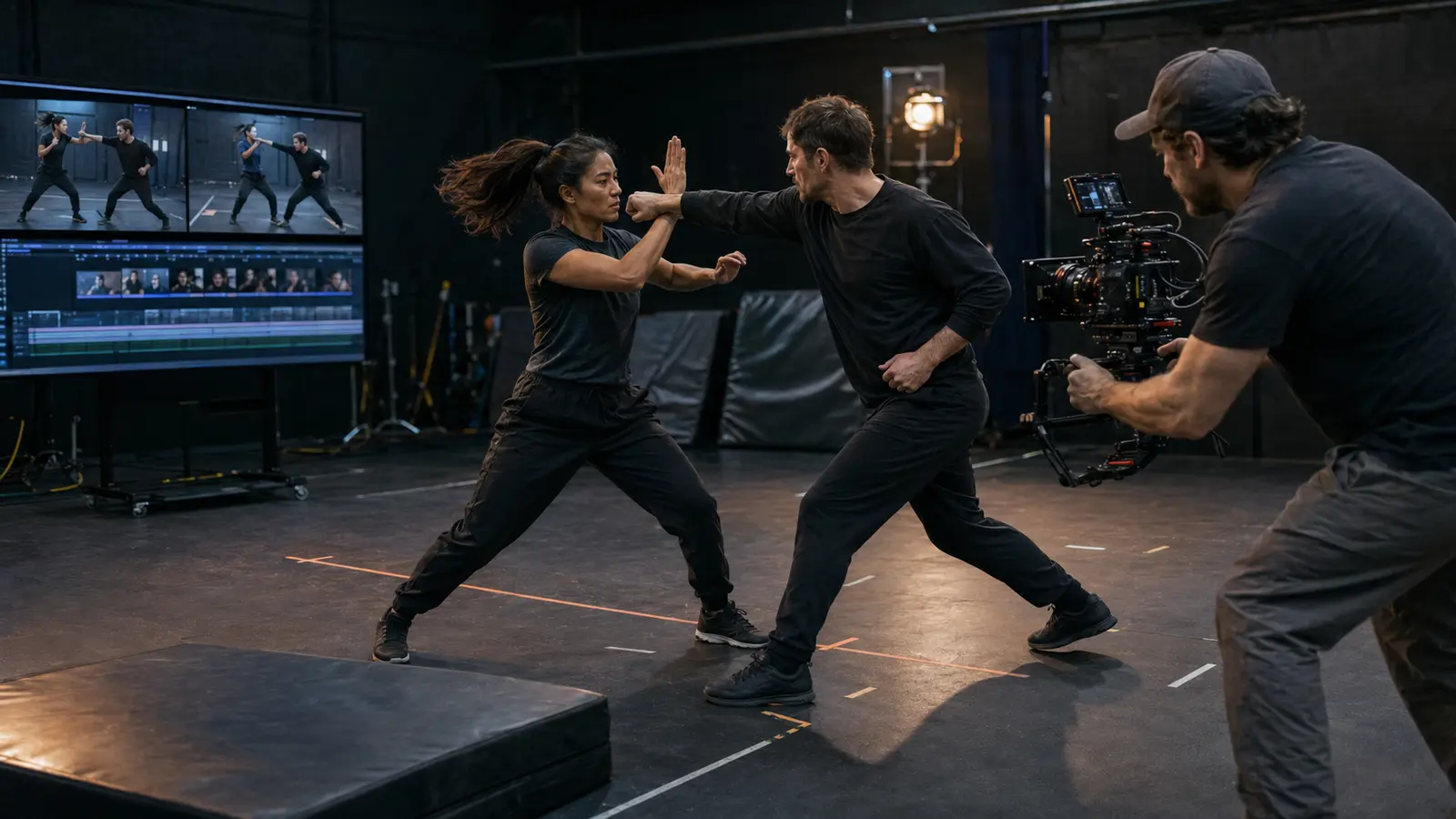
A rehearsal recording shows what performers did. A decision-grade previs shows how production intends to photograph, schedule, protect and assemble it.
Previs creates value by moving creative and technical questions into preparation, while alternatives remain comparatively inexpensive.
Camera feasibility matters. If the previs ignores the final system’s physical and optical constraints, a convincing sequence can still contain an impossible shot.
Analysis
By the time the first stunt take begins, the production should already know whether the fight works. Not every frame has to be locked, but the central questions should have answers: Can the audience read the geography? Does the action express the story? Can the intended camera reach its positions? Which moments need the actor, and which need a double? What protection, wardrobe accommodation, equipment, effects and reset time does the plan imply? Is there enough coverage to construct the sequence in editorial?
When those questions remain open until principal photography, they stop belonging to one department. A change to a fight beat can alter camera position, lighting, focus, performer placement, protection, art direction, wardrobe, effects, background action, the schedule and the cut. A small creative uncertainty becomes a unit-wide delay.
A fully edited previs moves that conversation upstream. It gives the director, producers, director of photography, stunt team, actors, assistant directors, department heads and editor one time-based sequence to watch, challenge and revise before the full production clock is running. That is the cheat code: not avoiding work, but buying decisions at their least expensive point.
The most expensive place to discover a problem
Calling previs an advanced storyboard is accurate, but incomplete. A storyboard describes selected frames. An edited previs also describes duration, transitions, screen direction, cause and effect, and the relationship between performance and camera. It can become the first place where the entire production sees the same fight.
A change made in a rehearsal room may involve the stunt team, a compact camera setup and an edit. The same discovery on a shooting day may involve cast, full crew, lighting, grip, camera, wardrobe, make-up, art, effects, locations, vehicles, background performers and a reset. The question has not changed. The number of people waiting for the answer has.
That is why the saving is better understood as decision compression than as a universal percentage. Shot count, specialist personnel, actor–double handoffs, equipment, costume modifications, set changes and department dependencies become visible while the plan is still comparatively cheap to alter.
One fight, six cheaper decision points
A six-stage planning flow moves from story intent to Fight Design, edited previs, technical validation, department assignments and a shoot-and-edit reference.
A moving storyboard is only the beginning
Production terminology is not perfectly standardised. Teams may use previs, previz, stuntvis, action previs and techvis differently. The useful distinction is not the label but the question each artefact is expected to answer.
A phone video can be excellent for rapid experimentation. It can prove that an idea reads, that screen direction holds or that a cut has rhythm. A decision-grade fight previs goes further: it selects coverage, constructs the sequence in time, records assumptions and exposes the production decisions hidden inside the edit.
The most useful synthesis is simple: previs proves the sequence; techvis tests whether production can physically capture it. Neither becomes a safety approval, and neither stays reliable after material changes unless the relevant departments review the new plan.
What each visualisation has to answer
| Artefact | Primary question | What it should carry forward |
|---|---|---|
| Rehearsal clip | What did the performers execute in this pass? | Movement reference, timing observations and revision notes |
| Creative previs | Does the sequence communicate story, geography and tone? | Intended shots, screen direction, rhythm and transitions Source ↗ |
| Stuntvis / action previs | Does the designed action work as performance and photographed screen action? | Fight beats, camera relationship, editorial construction and performer questions |
| Techvis | Can the chosen production system physically reproduce the plan? | Camera, lens, support, space, timing, rigging and location constraints Source ↗ |
| Decision package | Who has approved what, and what remains unresolved? | Version, assumptions, owners, department actions and open questions |
Previs is a decision-compression system
A useful previs compresses many conversations into one reviewable object. The director can test dramatic intention; producers and assistant directors can see setups and dependencies; the DP and camera team can challenge angles and movement; the stunt team can identify conflicts between choreography, camera and location; actors can see what participation is being discussed; support departments can see what must be built, modified, protected, reset or extended; editorial can identify the shots carrying geography and consequence. Our stunt-department map shows why those handoffs need named responsibilities rather than one undifferentiated “stunts” box.
These are not guaranteed savings. A previs creates value only when the relevant departments see it, challenge it, approve decisions within their authority and receive updates when the plan changes. An unreviewed previs is another video. A reviewed previs can become production infrastructure.
Fights make the principle especially visible because bodies, props, sets and cameras occupy the same space at precise times. The same logic applies to vehicle action and other complex movement: the earlier production can test paths, proximity, camera positions, protection, restraints, road or location control and reset dependencies, the fewer of those questions remain for the shooting day.
The department questions brought forward
| Team | Question made visible | Late cost exposed |
|---|---|---|
| Director | Does the fight advance story, character and tone? | Creative redesign after the unit is assembled |
| Production / AD | How many setups, people, dependencies and resets does the sequence imply? | Schedule pressure and avoidable unit delay |
| DP / camera / grip | Are the angles, lenses, paths and operating methods practical? | Infeasible setups and late equipment changes |
| Stunt team | Where do choreography, camera and real location geometry conflict? | Rechoreography under shooting conditions |
| Actors / doubles | Which shots require dramatic identity, specialist performance or further assessment? | Ambiguous participation and handoffs |
| Costume / hair / make-up | Where must continuity, protection and doubling work together? | Late modifications or visually exposed safeguards |
| Art / props / SFX / VFX | What must be prepared, protected, reset, replaced or extended? | Missing resources and cross-department changes |
| Editorial | Which shots carry geography, impact, transitions and narrative beats? | Missing connective material or an unclear intended assembly |
Where Stunt Design and Fight Design become visible
A fight is not a list of techniques. It is a story event performed through movement. In this analysis, Stunt Design means the wider design of action for screen: dramatic purpose, physical concept, performer capability, environment, camera, effects, safety planning and editorial result. Fight Design is the focused construction of conflict inside that system: point of view, character behaviour, escalation, spatial logic, rhythm and consequence. Fight choreography organises the physical beats through which that design is performed.
The distinctions matter because choreography can be technically impressive and still fail the scene. A character may suddenly move with a skill the story has never established. Geography may become unreadable. Repeated beats may flatten escalation. A decisive story moment may be buried inside coverage that gives it no emphasis.
Previs lets the team judge the designed fight as the audience will encounter it: in frames, cuts and time. Instead of asking only whether a performer can execute a movement, the director can ask whether the beat reveals character. The DP can assess whether perspective supports it. Editorial can see what motivates the cut. Production can see what the idea costs in setups and dependencies. The stunt team can refine physical design without separating it from photographic purpose.
The ASC–ADG–VES joint report described visual-narrative and technical-planning functions, with collaboration as a central benefit. Fight previs is a concentrated version of that model: it turns an action-department proposal into a production-wide object that can be evaluated before it becomes expensive to change.
The actor–double boundary becomes a shot-by-shot decision
“Can the actor do the fight?” is usually the wrong question. A screen fight is assembled from individual beats and shots. One moment may depend on the actor’s expression and dramatic timing. Another may require specialist performance. A third may be adjusted after supervised rehearsal. The useful decision is not one yes or no but a shot-specific participation plan.
A complete previs gives the actor something more informative than a verbal description or isolated rehearsal clip. They can see intended duration, pace, framing and the relationship between beats. The stunt coordinator and director can identify where the actor’s face or dramatic performance is essential, where a qualified double is appropriate and where further supervised preparation may change the plan.
This must not turn previs into an audition, promise or source of pressure. Capability cannot be established from watching a video alone, and consent is not inferred from enthusiasm in a meeting. Current Contract Services guidance says performers should be told what the sequence entails and that a cast member who does not agree to perform it may request a double. Contractual details vary by jurisdiction, but the larger principle holds: previs informs consultation; it does not replace assessment, consent or qualified authority.
The resulting actor–double map helps more than the stunt department. Camera can plan identity-preserving coverage. Costume, hair and make-up can prepare continuity. VFX can see where a transition or face treatment may be discussed. Scheduling can allocate the right people and preparation time. The value is making the decision early enough for every affected department to act.
Safety planning needs visibility, not promises
Previs is not a safety control and does not make a stunt safe. It cannot replace a risk assessment, technical rehearsal, inspection, safety meeting, qualified personnel, performer consultation or the authority to stop unsafe action. What it can do is support earlier hazard identification by making the intended sequence visible early enough for those processes to become more specific.
The March 2025 revision of Contract Services Safety Bulletin #4 places planning, site selection, testing, rehearsal, camera placement, equipment, wardrobe, personal protective equipment and performer consultation inside preparation for stunt sequences. It calls for sufficient preparation and inspection time, an on-site safety meeting and a walk-through or dry run. It also says substantive changes should trigger another safety meeting before cameras roll.
An edited previs can expose where those conversations are needed. Falls, impacts, kneeling, slides and contact points help the stunt team begin specifying mats, body pads, harnesses or costume accommodation. A camera angle may affect where protection can be placed or concealed. A camera position may change space available to performers and crew. A revised beat may introduce another prop, effect, surface, department or reset. A longer assembly may imply more repetitions than an isolated rehearsal suggested.
That does not make the previs a safety document or approval. Exact safeguards remain scene-specific decisions for qualified people under the production’s applicable rules. SAG-AFTRA’s standards also call for proactive engagement with relevant departments on safety; a shared previs supports that communication because everyone responds to the same intended sequence rather than separate verbal interpretations.
Version control is part of the safety value. If choreography, timing, camera, personnel, equipment, costume or location changes materially, the old previs must not be treated as evidence that the new plan was already reviewed. The response is renewed assessment, communication and, where required, rehearsal and safety meetings.
When the previs camera lies
A phone, GoPro or compact mirrorless camera can be exactly the right tool for a conceptual pass. The problem begins when footage from that device is treated as technical proof that the final production package can reproduce the shot.
A tiny camera can pass through a gap that a cinema camera, lens, stabilisation system, cables and operator cannot. A very wide lens can make a room appear more forgiving than the final lens choice. Deep focus can hide a focus problem. Minimal weight can allow accelerations or direction changes that become impractical with the intended rig. Automatic exposure can conceal where production lighting, grip equipment or crew must occupy the same space.
The result can be a convincing previs built around a camera path that does not survive contact with principal photography. Our separate analysis, The Shot Window, examines how strong stunt work can disappear when camera position, timing and editorial usefulness do not align. The issue here is economic: if previs proves a shot only with a system production will not use, the unresolved translation problem returns on the shooting day.
The previs camera does not always need to be the final camera. It does need to respect the final system’s critical constraints—or clearly identify where it does not. This is where previs should lead into techvis rather than pretend to replace it.
The camera constraints a credible previs should declare
| Constraint | Why the previs can mislead | Production question |
|---|---|---|
| Envelope / clearance | A small rehearsal device reaches space the final build or operator cannot occupy. | Does the real head, lens, support and operator fit throughout the move? |
| Sensor / lens / field of view | An ultra-wide or different sensor changes distance, distortion and apparent geography. | What camera, filmback, focal length and framing assumptions are being tested? |
| Focus / exposure | Deep focus and automatic exposure can hide focus pulls and lighting conflicts. | Can the lens, focus team and lighting plan sustain the intended beat? |
| Support / stabilisation | Minimal mass permits movement a gimbal, dolly, crane or vehicle rig may not repeat. | What is the final operating method, payload and acceleration envelope? |
| People / cables / control | A single small device conceals the space required by operator, focus, grip and control paths. | Where do essential crew and connections travel without entering the action path? |
| Location / set / effects | An empty rehearsal room omits walls, dressing, lighting, surfaces, atmosphere and practical effects. | Which spatial assumptions are measured, mocked up or still provisional? |
Attributed statement
Published action case studies show the division of labour. The Third Floor reports that previs on Kingsman: The Golden Circle helped validate storytelling and screen direction while techvis informed staging, timing and setups for a car chase and taxi fight. For Loki Season 2, the company describes testing camera positions, relative movement, angles and timing inside the constrained geometry of a Ferris-wheel fight. They illustrate the core sequence: first decide what the action should do, then test how production can physically do it.
One camera path across prep and production
One way to narrow the translation gap is to bring the camera architecture intended for principal photography into previs. When WarpCam® is already the selected production system, the same operated ecosystem—or the actual unit—can be used for live-action previs. Its page describes a compact action-camera ecosystem that moves between handheld, pole, FPV, RC and vehicle configurations while maintaining one camera workflow.
The production relevance is specific. Camera paths, clearances and operating methods can be developed against the system intended to capture the finished action rather than discovered with a tiny rehearsal camera and handed to a very different build later. The previs can therefore test more than the edit: it can test whether the proposed movement geometry belongs to the planned capture method.
That continuity does not eliminate constraints. Lens choice, focus, accessories, data, lighting, set dressing, performer space, operators, configuration and safety conditions still require validation. The final location may differ from the rehearsal room. A change elsewhere can invalidate an earlier path. Nor is using the same camera the only solution: accurate techvis, dimensionally reliable mock-ups, lens tests and disciplined annotation can model the final system too.
The broader principle is camera-system continuity. The more faithfully preparation represents the final capture method, the fewer physical surprises remain for the shooting day. WarpCam® is an example of that principle.
The first edit should happen before the first take
Fight previs becomes substantially more useful when it is cut as a sequence rather than presented as a collection of angles. The edit tests whether geography holds, whether an action motivates the next shot, whether screen direction stays legible, whether an impact has preparation and consequence, and whether rhythm supports the story. It reveals missing connective material before that material becomes a pickup request.
For the final editor, this is not a command. It is a demonstrated assembly. If principal photography captures the intended coverage, editorial receives a clear account of what each shot was designed to contribute. The editor can follow it, improve it, compress it, expand it or depart from it for story and performance reasons. If the photographed sequence will not assemble as planned, the previs helps identify whether the issue is missing coverage, a changed beat, altered timing or a deliberate revision.
Framestore’s Gravity retrospective offers an exceptional large-scale example: the company describes previs as the film’s de facto editorial tool, with techvis then used to work out camera movement, lighting and stage execution. The actors were walked through the previs to understand sequence beats and how far they could deviate. That unusually visualisation-dependent production is not a universal template, but it shows one time-based model connecting direction, cinematography, performance, technical planning and editorial.
The limit matters. In American Cinematographer, cinematographer Josh Bleibtreu, ASC said previs can bridge units but should be treated as a guide, not a bible. Real performances, light, weather, lenses, locations and discoveries belong to principal photography. The editor must remain free to use the strongest material actually captured. Freedom simply works better with information: a coherent previs gives editorial a tested baseline instead of an unexplained pile of action coverage.
Previs proves the sequence. Techvis tests whether production can physically capture it.— STUNT.BLOG Editorial Desk
What a decision-ready package contains
A useful previs is not finished when the edit exports. It becomes production infrastructure when each department can translate it into decisions within its own authority—and when decisions are separated from assumptions.
A camera angle may be creatively approved but technically untested. A performer assignment may be provisional pending rehearsal. Protection may be identified as necessary but not yet evaluated with final wardrobe. An effect may appear in the cut but still require specialist planning. A location may be approximate rather than dimensionally confirmed. Marking those differences does not weaken the previs; it prevents false confidence.
Temporary music and sound should also be labelled. They can clarify intended rhythm, but they can make weak visual beats feel stronger or disguise a cut that depends on borrowed energy. Production should know whether the picture works, what the soundtrack is demonstrating and what remains provisional.
Decision-ready handoff
- Sequence
- Edited reference with shot or beat identifiers
- Control
- Version, date, approval state and decision owners
- Camera
- System, lens, support, access and operating assumptions
- Differences
- Known deviations between rehearsal, previs and principal photography
- Performance
- Provisional actor–double map and preparation questions
- Protection
- Visible contact, fall and impact flags for qualified review
- Departments
- Wardrobe, props, art, SFX, VFX, lighting, grip and location actions
- Schedule
- Setups, personnel, resets, dependencies and location limits
- Editorial
- Purpose of each shot, essential transitions and optional coverage
- Open points
- Unresolved assumptions listed separately from approved decisions
Previs is a model, not a promise
Previs is powerful partly because it makes a sequence look resolved. That appearance can also become its weakness. A polished cut may hide inaccurate dimensions, impossible lensing, missing departments, unrealistic reset assumptions or performer work that has not been assessed. Fast cutting can conceal absent geography. A successful rehearsal can create confidence that does not transfer to a different location, costume, surface or camera package.
It does not guarantee savings, and its scale should match the decisions at stake. A modest sequence may need only a concise live-action pass and short technical review. A complex mix of fights, vehicles, physical effects and VFX may require several visualisation layers. More previs is not automatically better previs. The useful question is whether the process resolves costly uncertainty.
It also cannot replace the director’s creative authority, the DP and camera department’s judgment, qualified stunt coordination, performer consultation and consent, location scouts and rehearsals, risk assessments and safety meetings, department-specific engineering or the editor’s judgment about the footage actually photographed.
A previs that no longer describes the intended shoot can be more misleading than no previs at all. Changes to location, choreography, performer, costume, lens, rig, timing or effects must return to the people with authority over those decisions.
The cheat code is cheaper uncertainty
The value of fight previs is not that it makes filmmaking simple. It makes uncertainty visible while changing the plan is still comparatively affordable.
It lets the director judge the story. It lets producers and assistant directors see dependencies. It lets the DP and camera team challenge proposed coverage. It lets the stunt team connect physical performance to the screen result. It gives actors a concrete basis for supervised discussion. It alerts wardrobe, art, props, SFX and VFX to what the sequence asks of them. It gives editorial a working assembly before the footage becomes fixed.
Its strongest form is not a flashy rehearsal video. It is a shared production model with known assumptions, technical validation and clear ownership of remaining questions. Previs proves that the sequence can work. Techvis tests whether production can capture it. Preparation turns those answers into people, equipment, time and a production-specific plan of work whose safeguards remain subject to qualified review.
That is why a detailed, fully edited fight previs can feel like a cheat code. It does not bypass the hard work. It ensures that the most expensive day is not also the first day everyone sees the same fight.
Sources and production records11 entries
- ASC Technology Committee Report — Previsualization Subcommittee — American Society of Cinematographers Technology Committee (ASC–ADG–VES Previsualization Subcommittee), 2008-09-01. Accessed 2026-07-23.
- Pre-Visualization — Amazon MGM Studios Production Manual. Accessed 2026-07-23.
- Techvis — Amazon MGM Studios Production Manual. Accessed 2026-07-23.
- The Virtual Production Field Guide, Volumes 1 & 2 — Epic Games. Accessed 2026-07-23.
- Safety Bulletin #4 — Stunts — Industry-Wide Labor-Management Safety Committee / Contract Services, 2025-03-27. Accessed 2026-07-23.
- Stunt Coordinator Standards & Practices — SAG-AFTRA. Accessed 2026-07-23.
- Kingsman: The Golden Circle — The Third Floor, 2017-11-21. Accessed 2026-07-23.
- Loki — Season 2 — The Third Floor, 2024-04-26. Accessed 2026-07-23.
- Preparing for Gravity — Framestore, 2023-10-23. Accessed 2026-07-23.
- Shot Craft: The Ins and Outs of 2nd Unit — American Cinematographer, 2019-03-18. Accessed 2026-07-23.
- WarpCam® Specialty Camera System — SlamArtist.com. Accessed 2026-07-23.

Loading approved comments…