
Analysis
The most revealing DACH Action statistic may be the one that cannot responsibly be printed. An earlier draft placed Germany, Austria and Switzerland fifth in a five-market catalogue test. The arithmetic survived inspection; the evidence chain did not. There is no frozen snapshot, analysis code, qualifying-title list or exclusion log from which another newsroom could reproduce the ranking. So this public version removes it.
What remains is both narrower and more consequential. Germany and Austria publish occasional genre signals that point to low visible Action output. Switzerland’s official VOD reporting schema cannot isolate Action, stunt days or specialist credits, although its cinema database does expose an Action filter. Visibility therefore changes with the distribution window. At the same time, real action craft is visible inside New Adult romance, fairy tales, children’s films, sports drama and dialect comedy. The DACH problem is not one empty shelf. It is a chain with three weak links: measurement, commissioning continuity and credit visibility.
The earlier five-market ranking is not published: no archived snapshot, code or title list exists to reproduce it. That evidence failure becomes part of the story.
Current German cinema charts show Action demand, but their leading Action titles are imported IP. Official output signals remain fragmented: an older FFA study found Action below 1%, Austria recorded zero in two classified first-release tables, and one Swiss VOD schema cannot isolate Action at all.
Crystal Wall and The Witch Princess demonstrate a blind spot: fight and stunt work can be central to a romance/bodyguard series or a Junior fairy tale without appearing in the market’s headline genre label.
DFFF, ÖFI+ and FiSS can attract and reimburse production expenditure. They do not by themselves create repeat commissioning, recurring characters or a domestic Action slate.
The chart we refused to publish
A ranking is not made reproducible by adding decimal places. The retired test combined a pooled three-country region with four individual markets, inferred ‘live-action fiction’ through exclusions, treated the first-listed country as a primary country and changed several variables between sensitivity models. Near the bottom of the table, ten or eleven additional genre tags could have changed the order. Without the title universe, missing-data rules and a dated catalogue snapshot, catalogue backfill and editorial classification cannot be separated from market behaviour.
Removing the table does not prove the opposite thesis. It restores the correct burden of proof. A future comparison must publish the snapshot version and checksum, queries, dependency environment, title IDs, exclusions, historical country mapping, co-production rule and every numerator and denominator. Until then, ‘last in Europe’ is not analysis; it is branding.
Three countries, three incompatible official views
| Market | Visible signal | Scope | Still hidden |
|---|---|---|---|
| Germany | Action below 1% | 402 German first releases, 2010–2011 | No current annual title/credit/action-day series Source ↗ |
| Austria | 0 of 36 in the 2024 Comscore table | First-release genre table; seven additional films were outside Comscore | Action work inside other genres and title-level specialist scope Source ↗ |
| Switzerland | No Action field in the official VOD reporting schema | The schema records broad work type, country and language | Action subgenre, stunt days, fight roles and specialist-camera credits Source ↗ |
First, the measurement desert
Genre is a distribution label, not a production ledger. A broadcaster may market a series as Romance while its premise repeatedly requires fights, protective movement and threat escalation. A funding body may record eligible local spend without identifying which department designed the physical sequence. An official platform report may know that a work is fiction and Swiss, yet have no field for Stunt Coordinator or Fight Choreographer.
The two German Top 25 snapshots sharpen the distinction. They show contemporary theatrical demand for Action, but not a home-grown wave: the nine Action-labelled entries across the two half-years were foreign-origin titles. The boundary matters. These are German cinema charts, not a complete DACH audience study, and two half-years cannot establish a long-term production trend.
The missing variables answer different questions. Title genre asks how the work is sold. Action days ask how much physical production it contains. Credits ask who held documented responsibility. Spend asks where money landed. None is a substitute for the others. When they are collapsed into one ‘Action output’ number, the apparent precision conceals a category error.
The undercount cuts both ways. Hidden work can make DACH look emptier than it is. But a handful of impressive sequences inside non-Action titles can also make a weak slate look healthier than it is. The only honest remedy is a multi-layer record, not a more confident adjective.
Incentives measure spend, not continuity
| Instrument | Lever | What it shows | What it cannot show |
|---|---|---|---|
| Germany · DFFF | Eligible German production costs plus programme tests | A project can place substantial production expenditure and work in Germany | A recurring, domestically controlled Action slate Source ↗ |
| Austria · ÖFI+ | Eligible Austrian expenditure, with green incentive | Automatic support can strengthen the production location | Commissioner demand or repeatable Action IP Source ↗ |
| Switzerland · FiSS | Share of eligible Swiss expenditure and specified technical services | Swiss crews and services can be incorporated into qualifying production | A title pipeline, audience proposition or annual Action volume Source ↗ |
Incentives attract shoots, not continuity
A production-support instrument can answer a downstream question: if a qualifying project exists, which expenditure can be anchored locally? Commissioning answers the upstream question: which story, character and physical promise will be financed in the first place? Confusing the two produces a false victory—international work proves that a territory has stages, crews and technical capacity, while the local rights-and-development pipeline can remain intermittent.
The German and Austrian records expose both sides of the mechanism. DFFF II can attach substantial German expenditure and implementation capacity to globally controlled franchises. Austria’s first-two-year evaluation shows that incoming work can expand shooting days while also tightening crew capacity and raising costs for national projects. Neither finding is Action-specific, and neither proves causation across DACH. Together they show why a production boom and a domestically controlled genre slate are different industrial outcomes.
The missing middle is continuity. One title can hire a team. A slate lets the next title inherit tested relationships, credible comparisons, star positioning, distributor knowledge and a language for early physical design. No reimbursement percentage can manufacture that repetition after the greenlight decision has already been made.
Crystal Wall: fight craft inside a romance
ZDF calls Crystal Wall a New Adult series. Crew United files it under Crime, Drama and Romance. Yet the premise begins with Louna, an MMA fighter, saving an heir’s life and becoming his bodyguard. ZDF’s own interviews say actor Anna Bardavelidze trained MMA for two months and shadowed a real bodyguard. The physical language is not an ornamental fight dropped into episode one; it establishes who protects whom and reverses the expected power relationship.
Season one is also a useful DACH passport case. The producer documents 24 episodes of 25 minutes shot in Vienna and Berlin, with Wega Film as Austrian service producer. The title can therefore create German commissioning, Austrian location/service expenditure and specialist action work at the same time—three facts that a single country or genre label cannot express.
The public evidence confirms Fischer as Stunt Coordinator: Crew United specifies the role, and the finished ZDF credits list Ferdi Fischer under STUNT. Fischer additionally describes his season-one scope as Fight Choreographer.
Visual quotation · Crystal Wall
Intimacy in the image, physical authority in the premise

Image rights & sources
ZDF press map and credit record ↗Unaltered source image ↗ZDF image-use terms ↗The Witch Princess: action in a fairy tale
ZDF markets The Witch Princess as a fairy tale; ZDF Studios places it under Junior / Live Action. That framing is accurate, but incomplete as a production description. The German-Czech film follows a dangerous rescue journey and a final confrontation. Public Crew United records Fischer as Action Director, Stunt Coordinator, second-unit camera operator and camera operator, and separately lists a WarpCam® team. The finished film credits confirm stunt coordination, including an apparent ‘Fisher’ spelling on screen.
The public crew record also lists a WarpCam® team. Fischer’s own production description goes further on two other responsibilities: Fight Choreography and Fight Design. That distinction is the article’s central finding: the public credit layer can preserve some responsibilities, merge others and omit the production’s own working vocabulary.
The official ensemble still below looks exactly like the category under which the film travels: costumes, castle architecture and a fairy-tale group. It does not show the physical design that makes the journey and confrontation playable on screen. That mismatch is why the image is reproduced here as a visual quotation, unaltered and beside the specific argument it demonstrates—not as decoration or proof of an unseen stunt.
Visual quotation · The Witch Princess
Fairy tale in the image, action in the credits

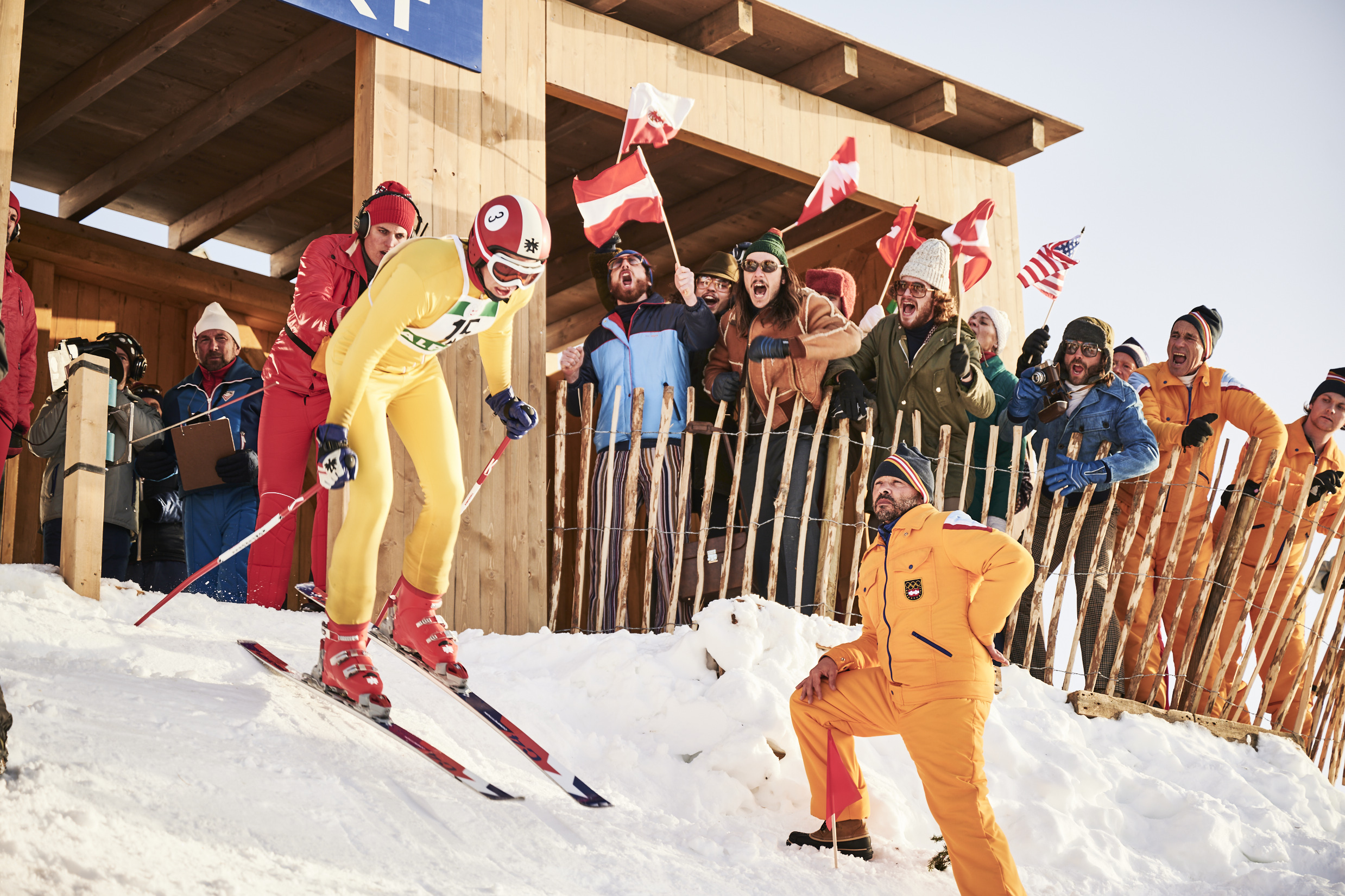
KLAMMER: the Austrian frame that hides its action apparatus
The official start-gate still compresses Franz Klammer between the starter, fencing, period-dressed spectators and Austrian flags. It makes the pressure architecture around the athlete visible; it does not document a stunt. Its analytical value lies in that mismatch: a nationally recognisable sports image conceals the industrial apparatus needed to rebuild movement the public already remembers.
In Austrian Films’ production interview, director Andreas Schmied says the team knew in preproduction that it would need second-unit material. The production shot action scenes itself, while much of the downhill material came from Gerhard Salmina’s experienced unit and stunt skiers, working with GoPros, small cameras, drones and image practices that differed from the main unit’s filtered 1970s look. The hard problem was therefore not merely sending a skier down a mountain. It was designing compatibility between bodies, camera systems, aspect ratios and image textures.
The clearest example is the Jimmy Steiner fall: Schmied describes a screen-filling shot in which a staged second-unit stunt flows into archive footage of the real crash. He also says Klammer’s 1:45.73 winning run expands to more than four minutes on screen, combining second-unit documentation, green-screen performance and stylisation. This is a useful definition of hidden action design: the physical event is one layer; sensation emerges from coverage, controlled staging, editorial transition and temporal construction. The source establishes those title-specific methods—not an all-purpose credit hierarchy or Austrian production volume.
Austrian case · KLAMMER
Public spectacle in frame, physical systems behind it
Tschugger: a local Swiss counterexample
SRF describes Tschugger as a mixture of action, humour and Valais dialect. That combination matters more than scale. It turns local speech, landscape and comic character into the differentiator while allowing physical spectacle to serve the world rather than imitate a generic international thriller.
In 2025, the Swiss Film Academy’s special prize formally recognised Oliver Keller’s stunt coordination on Tschugger — Der lätscht Fall and the historical drama Jakobs Ross. The citation is a rare institutional record that names stunt work across two different genre containers. It also exposes the Swiss data paradox: ProCinema can filter cinema titles by Action and the awards system can recognise title-specific stunt coordination, while the official VOD reporting schema has neither a matching genre nor specialist-credit field.
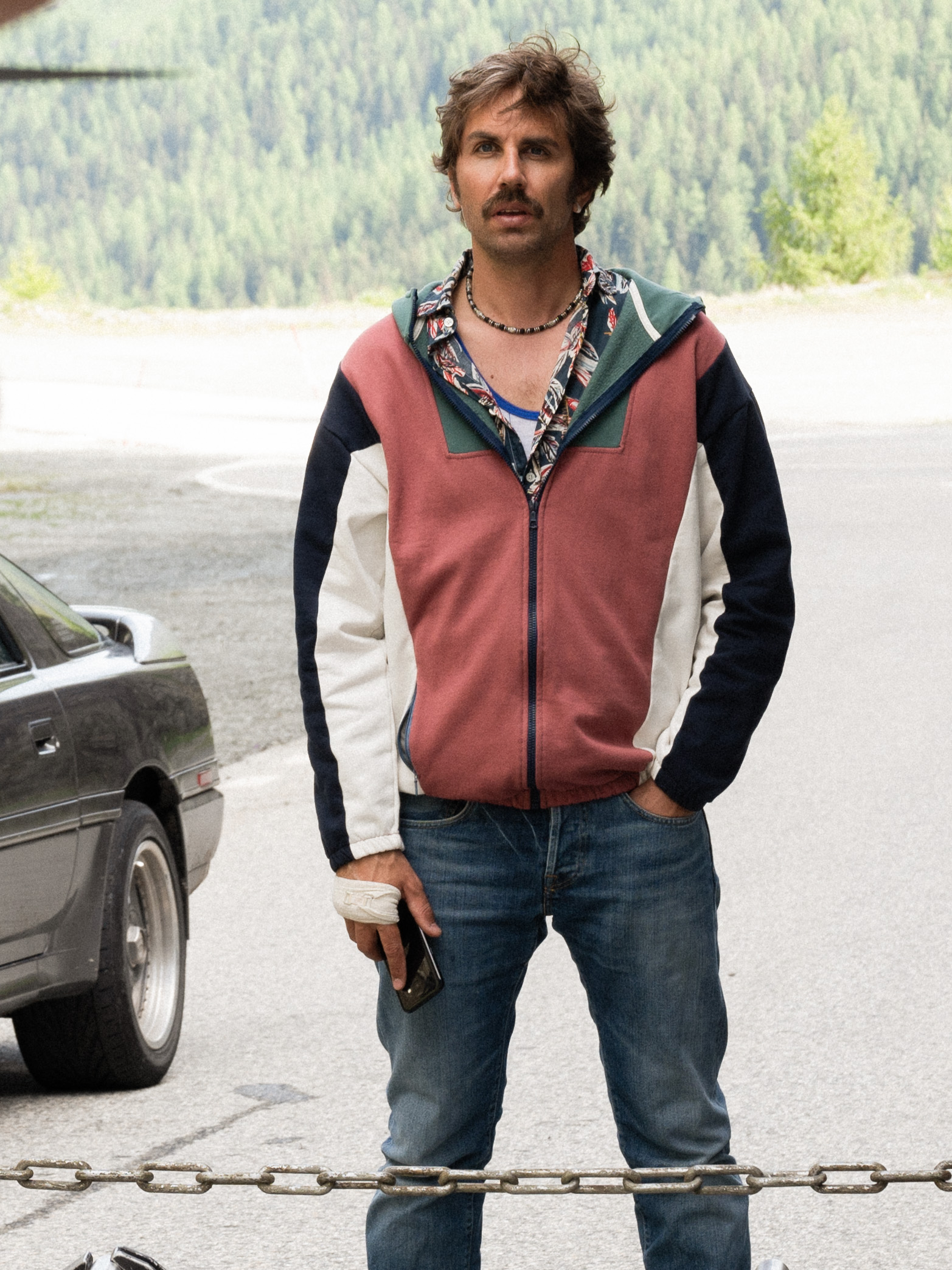
The open-licensed photograph below shows David Constantin as Bax. The car, chain, bandaged hand and deliberately ordinary clothing compress the series’ proposition into one portrait: local comedy and physical aftermath occupy the same frame. It is not presented as evidence of a specific stunt and implies no endorsement.
Swiss case · Tschugger
Bax: local character, vehicles and aftermath
Credit labels a DACH observatory must preserve
| Role | Helps identify | Does not prove |
|---|---|---|
| Stunt Coordinator | Who coordinates the production’s stunt work and its controlled execution? | Authorship of every fight beat, camera path or final edit |
| Fight Choreographer | Who designs the performed movement and dramatic beats of a screen fight? | Overall stunt-department responsibility or a universal safety authority |
| Fight Design | Who integrates fight story, character, spatial logic, camera and rhythm at concept level? | A standardised DACH screen credit; the term may be production-specific |
| Action Director | Who directs the physical sequence as a film event across performance, camera and coverage? | That the person also held every coordination or specialist-camera duty |
| Specialist-camera / WarpCam® role | Who provides or operates a camera system within physical action? | Fight authorship, risk reduction or system-wide safety improvement without title-specific proof |
Credit gaps obscure authorship and discovery
Public databases often inherit whatever role vocabulary survives the end crawl, press dossier or contributor form. A broad STUNT line can be accurate while still being useless for someone researching who designed a fight.
That protocol matters for future journalists. If a newsroom searches Crystal Wall in three years, it should see that Stunt Coordinator is public and Fight Choreographer is additional scope. If more production records or the user’s forthcoming videos establish exact sequence responsibility, the article can be updated without rewriting its past certainty.
Credit visibility is also market intelligence. Where databases collapse Fight Choreography and Fight Design into broader fields, comparison becomes harder, the public talent map weakens and award researchers inherit a thinner archive. Crew records can preserve more detail than genre reports, but coverage is uneven. The role boundaries are mapped in our stunt-department hierarchy.
The missing middle: continuity and rights
DACH does not need every film to become an Action film. It needs enough recurring physical-story work for learning to compound. A project creates value beyond its final cut when its breakdown language, tested collaborators, performance development, camera relationships, post handoffs and audience evidence remain available to the next commission.
The current examples suggest an alternative path to a fake home-grown blockbuster race. New Adult, family fantasy, children’s sport, alpine biography, dialect comedy and historical drama can each carry sophisticated action. The strategic question is whether those isolated pockets are treated as one-off production problems or as a connected capability that can move across formats. That transition begins inside the producer’s early Action-design window, before locations, coverage and costs harden.
That is why ‘the craft is visible’ must stay a bounded claim. The cases demonstrate people and systems executing physical work. They do not establish spare capacity, sustainable employment, uniform standards or sufficient budgets. Capacity becomes a pipeline only when commissioning repeats, useful rights and learning remain with producers, and the evidence follows the work.
Making a DACH Action pipeline measurable
| Actor | Change needed | Public evidence |
|---|---|---|
| Commissioners and streamers | Track physical-story ambition across multi-title slates, not only title genres | Greenlights, renewals, cancellations and format-level Action commitments |
| Producers | Engage action expertise while scripts, locations, coverage and budget assumptions remain movable | Title-specific roles, action-day ranges and documented production scope |
| Funding bodies | Keep spend/location measures separate from cultural and genre outcomes | Machine-readable project, country, format, genre and expenditure records with stated definitions |
| Credits and databases | Preserve distinct role labels and their source level | Finished-credit frames, production-verified additions and correction history |
| Industry press | Ask for title universes and source records before repeating rankings | Linked methods, reproducible tables and visible limits |
The Academy’s 2027 metadata deadline
On 10 April 2025, the Academy announced an annual competitive award for Achievement in Stunt Design, beginning with the 100th Academy Awards for films released in 2027. The eligibility and voting rules are due with the complete rules in 2027. Until those rules exist, no current DACH job title can simply be relabelled as the future award’s eligible role.
The institutional consequence arrives before the ceremony. Distributors, publicists and journalists will need to identify the people and evidence behind a film’s physical design. Where databases collapse Action Director, Stunt Coordinator, Fight Choreographer, Fight Design and specialist camera into an undifferentiated line, titles become harder to research, compare and cite when the category becomes mainstream news.
It means title-level precision. The useful archive records who was publicly credited, which additional scope is supported by production documents and where responsibilities overlap. The Stunt Design framework makes the broader authorship question explicit; the Academy award makes that bookkeeping culturally visible, but does not solve it for DACH.
The minimum dataset for a DACH Action observatory
A durable annual record should not begin by deciding which film ‘looks like Action.’ It should begin with a declared title universe—cinema, television films and series reported separately—and then attach multiple fields. Genre can remain one field, alongside production countries and locations, commissioning entity, format, action-day band, specialist roles exactly as credited, production-verified additional scope and source links.
Every release should ship with the rows needed to challenge it: title IDs, inclusion reason, exclusion reason, missing-data flags, version date, query or collection method and revision history. Where commercial confidentiality prevents exact days or spend, bounded bands can still distinguish zero, occasional and structurally significant physical production without exposing a budget.
Most importantly, the observatory must retain negative evidence. ‘No field exists’ is different from ‘zero Action’; ‘public credit not found’ is different from ‘person did not do the work.’ Those distinctions are the difference between an archive that invites correction and one that manufactures certainty.
Six fields the mainstream press will need
| Field | Use | Required caveat |
|---|---|---|
| Declared title universe | Prevents film, TV movie and series counts from being mixed | State release window and completeness rule |
| Genre label and source | Shows how the work was classified and marketed | Genre is not an Action-work count |
| Commissioner and production countries | Separates greenlight origin from financing/service geography | Country is not shoot location or creative control |
| Physical-production band | Distinguishes a single beat from recurring sequence work | Publish method; do not infer from trailer footage alone |
| Exact specialist credits | Makes authorship and expertise searchable | Preserve finished credit and production-supplied additions separately |
| Evidence status | Allows a newsroom to quote only what is verified | Use confirmed, secondary and open—not one flattened confidence score |
Not empty: discontinuous and badly mapped
The honest DACH diagnosis is not ‘no Action.’ Crystal Wall places fight craft inside New Adult romance. The Witch Princess contains a documented physical-action layer inside a fairy tale. MADISON and KLAMMER use stunt and camera systems inside youth and sports drama. Tschugger turns Swiss dialect comedy into a vehicle for physical spectacle. These titles defeat the claim that the region lacks the craft.
They do not prove a healthy pipeline. Official records are incompatible, incentives measure expenditure rather than repeat commissioning, and specialist roles remain difficult to search. A newsroom that asks only for the Action genre will miss work; a promoter who points to a few exceptions will miss the continuity problem.
The next years offer a practical test. Before Achievement in Stunt Design enters the 100th Academy Awards for 2027 releases, DACH can build a title-level evidence culture: precise credits, preserved production scope, separate location and commissioning data, and an annual record another newsroom can reproduce. If that infrastructure exists when mainstream attention arrives, the region will not need to invent an Action story. It will finally be able to show one.
Sources, credit audit and evidence record29 entries
- Filmgenres 2010 bis 2011 — Filmförderungsanstalt (FFA), 2013. Accessed 2026-08-30.
- Top 25 Filmtitel — 1. Halbjahr 2024 — Filmförderungsanstalt (FFA), 2024-11. Accessed 2026-08-30.
- Top 25 Filmtitel — 1. Halbjahr 2025 — Filmförderungsanstalt (FFA), 2025-11. Accessed 2026-08-30.
- Filmwirtschaftsbericht 2024 — Facts & Figures 2023 — Austrian Film Institute, 2025. Accessed 2026-08-30.
- Filmwirtschaftsbericht 2025 — Facts & Figures 2024 — Austrian Film Institute, 2025. Accessed 2026-08-30.
- Technische Spezifikation für die Meldung von Video-on-Demand-Angeboten — Swiss Federal Statistical Office. Accessed 2026-08-30.
- ProCinema Filmdatenbank — ProCinema. Accessed 2026-08-30.
- German Federal Film Fund — DFFF guideline and programme information — Filmförderungsanstalt (FFA). Accessed 2026-08-30.
- Funding 2023 — Filmförderungsanstalt (FFA), 2024-02. Accessed 2026-08-30.
- Impact of the Platform Economy on Audiovisual Productions in Germany — Goldmedia / Filmförderungsanstalt (FFA), 2022-05-17. Accessed 2026-08-30.
- ÖFI+ Herstellung — Austrian Film Institute. Accessed 2026-08-30.
- Evaluierung von FISAplus und ÖFI+ — Endbericht — Austrian Film Institute / commissioned evaluation, 2025. Accessed 2026-08-30.
- Filmstandortförderung Schweiz (FiSS) — Swiss Federal Office of Culture. Accessed 2026-08-30.
- Crystal Wall — press dossier — ZDF, 2025. Accessed 2026-08-30.
- Crystal Wall — Producers at Work, 2025. Accessed 2026-08-30.
- Crystal Wall — crew listing — Crew United, 2024. Accessed 2026-08-30.
- Crystal Wall, episode 1: Blut auf Gold — ZDF, 2025. Accessed 2026-08-30.
- Eine neue Märchenperle: ZDF dreht Die Hexenprinzessin — ZDF, 2019-11-22. Accessed 2026-08-30.
- Die Hexenprinzessin — ZDF, 2020. Accessed 2026-08-30.
- The Witch Princess — ZDF Studios, 2020. Accessed 2026-08-30.
- Die Hexenprinzessin — PROVOBIS Film, 2020. Accessed 2026-08-30.
- Die Hexenprinzessin — crew listing — Crew United, 2019. Accessed 2026-08-30.
- Production-supplied role statement: Crystal Wall and Die Hexenprinzessin — Ferdi Fischer / STUNT.BLOG reporting record, 2026-08-30. Accessed 2026-08-30.
- MADISON — Bikes, Boys & Berge pressbook — Austrian Film Institute / DOR FILM-WEST, 2020. Accessed 2026-08-30.
- KLAMMER — Chasing the Line: director interview — Austrian Films, 2021. Accessed 2026-08-30.
- Hinter den Kulissen der Kultserie Tschugger — SRF, 2023. Accessed 2026-08-30.
- Special Prize of the Swiss Film Academy 2025 — Oliver Keller — Swiss Culture Awards / Federal Office of Culture, 2025. Accessed 2026-08-30.
- David Constantin as Bax — Wikimedia Commons, 2022. Accessed 2026-08-30.
- Academy establishes Stunt Design Award for 100th Oscars — Academy of Motion Picture Arts and Sciences, 2025-04-10. Accessed 2026-08-30.

Loading approved comments…