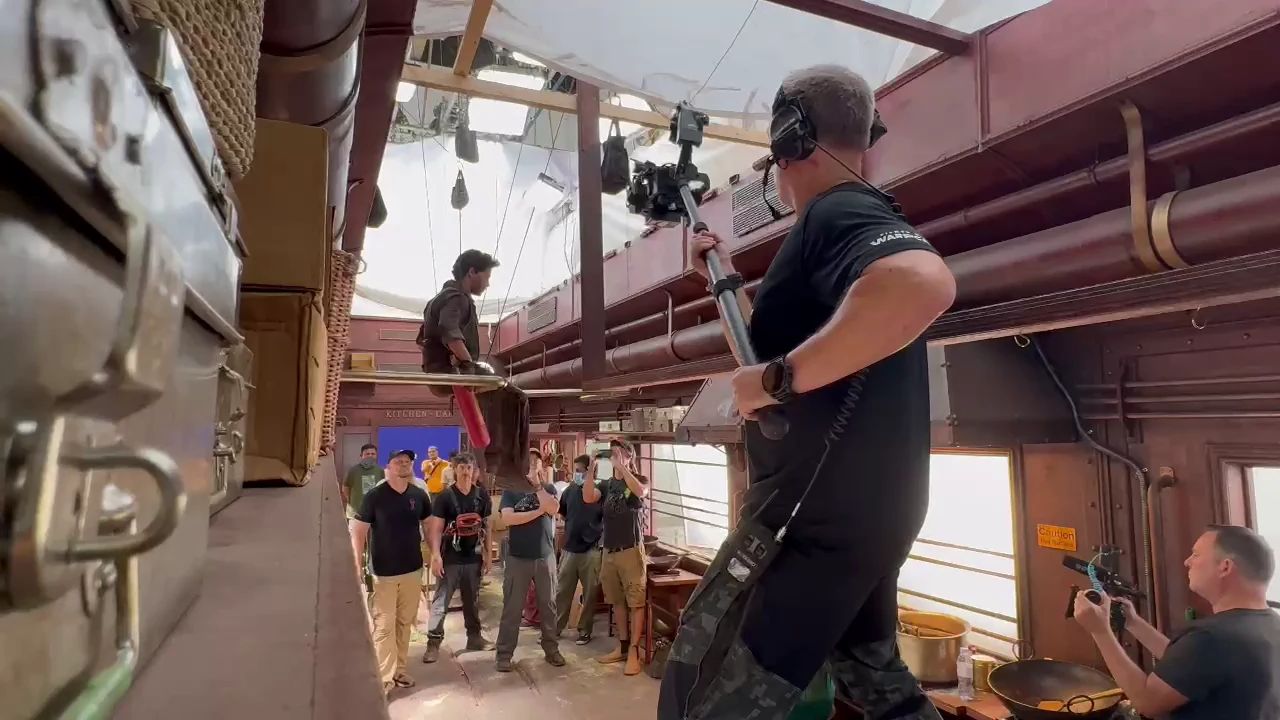
The camera was already in the air. The shots were scheduled for tomorrow. On Bad Boys for Life, Ferdi Fischer saw a way to capture both at once: put a WarpCam® operator inside the picture helicopter while the action below was already being filmed. He describes the result as at least half a shooting day saved.
That is where this conversation begins. A camera position changes the image. The image changes how a scene can be staged. That can change the work of an entire unit.
Small camera, small possibilities? A specialist tool for one spectacular angle? A gimbal on a stick? Those assumptions leave out much of the system. STUNT.BLOG set out to examine it in depth with Fischer: the inventor and operator, Action Director, Stunt Coordinator and filmmaker who connects the hardware to the performance and the production around it.
We gave this interview room. Across the original conversation, follow-up questions and archive research from 22 October to 1 November 2026, it grew into 30 chapters and 133 questions: how Stunt Design and action cinematography develop together, what a Floating Action Unit takes responsibility for, how Hyper-WarpCam® was developed, and what producers, showrunners, directors, DoPs and brand-film teams can decide before the first shot.
The conversation was conducted in German and is presented here as an edited English reading edition. The detailed answers remain open throughout the page. Original films, production images and behind-the-scenes comparisons sit beside the relevant passages.
The complete conversation: 30 chapters, 133 questions, original production examples and a dated Hyper-WarpCam® development record.
Read from the beginning or enter through the production, Stunt Design, camera-system and high-speed chapters below.
Explore all 30 chapters30 chapters
The helicopter coverage that saved half a day
The first question is a production decision: what happens when a planned tomorrow can be photographed today?
STUNT.BLOG
On Bad Boys for Life, how did you realise that the helicopter interiors could be filmed while the action below was already happening?
Ferdi Fischer
We had several aircraft involved. There was the black picture helicopter, flown by Fred North, which was part of the scene itself. Then there was a camera helicopter, drones and the other equipment. The character in the picture helicopter was firing down at a convoy. The plan was to shoot the views from inside that helicopter separately the following day: the point of view, the over-the-shoulder shots, the views down at the action and the helicopter interiors.
That meant closing the bridge in Atlanta again, bringing back the stunt drivers and vehicles and repeating the action below, including an explosion. I suggested putting a WarpCam® operator in the picture helicopter while that action was already being filmed. The camera was small enough that it might not be visible in the exterior shots. If it was visible, my argument was that it could be painted out relatively easily in post.
There was also a stunt in which a double jumped from a truck onto the ladder hanging from the helicopter. We needed the view down towards him as the helicopter tried to shake him off. We could get that, the over-the-shoulder view of the weapon, the explosion from above and the interior coverage during the work already happening that day. We saved the production at least half a day the following day.
STUNT.BLOG
What persuaded the producers, and what persuaded the director and DoP?
Ferdi Fischer
Those were different arguments. For the producers, the important point was the money we could save by filming something immediately that had been scheduled for half of the next day.
For the director and camera department, it was also that we could get better shots, more quickly and more easily. This was not a compromise that reduced the quality. The fixed, larger rig planned for the next day would have been less flexible. The shots would have been less creative, more complicated to achieve, fewer in number and less connected. What might have looked like an improvised alternative was actually the better solution. Once I explained the advantages to production, directing and camera, doing it immediately was a no-brainer.
STUNT.BLOG
What did you have to change on the helicopter or the camera?
Ferdi Fischer
Nothing. That is exactly the point. We only had to put one of my operators inside with WarpCam® on the stick. The physical camera was in the helicopter; the rest of the operating happened from the ground station.
The Physical Operator, Virtual Operator and Focus Puller were in continuous communication through our radio headsets. We could speak and receive at the same time. The Physical Operator already knew the shots we needed and moved the camera so that the Virtual Operator on the ground could frame them. If something needed changing, we could communicate it immediately.
STUNT.BLOG
How did that change the images themselves?
Ferdi Fischer
We knew what the story needed from the shot list: the over-the-shoulder view, the weapon firing, the explosion below and the view towards the ladder. It is about the narrative. Those images give you what you need to continue telling the story in the edit.
They had been thinking of those as separate shots. With the pole, it was like having a handheld crane inside the helicopter. We could move from over the shoulder, out towards the explosion, then down towards the person jumping onto the ladder. Once they saw that those separate requirements could be connected in one movement, that was what they wanted. We also shot a great deal of other material.
I was not the operator in the helicopter. I told one of my operators what the shot needed to be, and he positioned himself to make the movement. There was no difficult coordination problem. That is one of the strengths of an experienced team: everyone understands the image we need. The camera gives us the flexibility to achieve it.
The most important requirement is that the camera department, DoP and director understand how flexible WarpCam® is in real time. Their experience with the restrictions of other systems can limit what they imagine. Once they can tell us the shot they need and trust the WarpCam® team to deliver it, that is the crucial step.
Knowing the solution in the first creative meeting
STUNT.BLOG
What does having you in the first creative discussions give a production?
Ferdi Fischer
I have the entire WarpCam® ecosystem and the whole SlamArtist.com Universe in my head. I can apply that knowledge while the first creative decisions are being made, right there in the meeting.
Whether I am involved as a showrunner, director, Action Director, stunt coordinator, DoP or through a Floating Action Unit, I know what we can do with the entire ecosystem. When a filming problem comes up that other people in the room do not have a solution for, I can already explain how we can shoot it, how we should shoot it and what I would suggest.
That is an enormous consulting advantage. It has proved itself repeatedly on productions where I was involved creatively from the beginning, whether that was Fast & Furious, Jawan or The Gray Man. I can propose those possibilities because I know capabilities of our ecosystem that the others do not know.
STUNT.BLOG
Does that knowledge still help when a production has not planned to use WarpCam®?
Ferdi Fischer
Absolutely. I am sometimes in a meeting purely as the stunt coordinator. WarpCam® is not even part of the discussion: perhaps the production does not want it or does not have the budget for it.
Questions still come up that people really struggle with, even though they are completely straightforward for our ecosystem. They are trying to solve things that I do not have to think twice about. Knowing that those possibilities exist is incredibly valuable at the beginning, because I can bring the solution into the discussion.
STUNT.BLOG
What kind of filming problem can you resolve in that first discussion?
Ferdi Fischer
Imagine an escape through a window onto one of those metal fire escapes on the back of an American building. The character runs down the stairs, and we want an adrenaline-filled chase, very close to the characters, with leading and following shots.
With conventional approaches, people may think of a wide shot from outside, a long lens or short sections filmed from a platform alongside the staircase. But that does not give them the close following or leading action they are imagining.
With the small WarpCam®, our Physical Operator can go straight through the window behind the performer and follow them down the stairs. Or the operator can go through first and lead them down, with the camera looking back. The Virtual Operator frames the images. We did exactly that on 21 Bridges.
We can create that kind of shot in minutes. Knowing during the meeting that we can do it changes the discussion immediately.
The WarpCam® ecosystem
Camera, carrier and trained operator belong to the same discussion. The names describe different parts of that working system.
STUNT.BLOG
What does WarpCam® describe today?
Ferdi Fischer
WarpCam® is a very broad, comprehensive ecosystem of platforms connected to camera systems. Think of it a little like Lego. I brought together the experiences I had on set and built a system around the problems I kept encountering.
A camera might take forever to mount on a car, with the whole production waiting. Or you rent another camera and spend hours going through enormous mounting procedures, only to shoot something completely unspectacular. Sometimes a camera cannot get low enough because there is so much underneath the sensor. Sometimes it is so large that the operator cannot hold it for long or move it quickly enough because of the inertia of that mass. Or it is too heavy to be carried by a fast FPV drone.
The whole system is stabilised, and every platform and mount works in a plug-and-play way within seconds. I combined the mounting systems with new sensors, new stabilisation and new technology to build that ecosystem.
STUNT.BLOG
Why did you base the mounting approach on Picatinny rails?
Ferdi Fischer
I developed a mounting approach from systems used on weapons for optics, grips, night scopes and similar equipment: Picatinny rails. I modified them so that they are light, small and fast to use.
They are available all over the world, and, above all, they work and have been proven. They are war-proven and combat-proven in conflicts all over the world. They hold. I brought those systems together with the camera technology.
STUNT.BLOG
Why are the operators part of the WarpCam® ecosystem?
Ferdi Fischer
Think of a special vehicle with better brakes, more power, high performance, exceptional tyres and grip. You also need special skills to operate it. The same applies to WarpCam®.
WarpCam® is designed with action as its target use. To read that action, you need a particular cognitive skill set that, in most cases, stunt performers have developed. Most camera operators have never learned those physical skills and therefore do not have that timing. That is simply how it is.
I realised that it had to be a complete ecosystem. You see it when people try to copy WarpCam®. Camera operators try to copy it, but they lack the cognitive and physical stunt and action skills. Stunt performers try to copy it, but they lack the camera skills and the technological skills of the actual WarpCam®.
There are so many different parts working together. That is also how the Floating Action Unit developed: like a special unit on set, generating the particular shots that the normal production workflow cannot achieve.
STUNT.BLOG
How does WarpCam® fit within the SlamArtist.com Universe?
Ferdi Fischer
SlamArtist.com is the umbrella over all of this. The SlamArtist.com Universe is the universe above these different activities. MD Pictures is a trademark within that universe, and WarpCam® is a trademark of MD Pictures, which is part of the SlamArtist.com Universe.
Under that umbrella are different companies, products and trademarks. The SlamArtist.com Universe covers the whole action spectrum: performance, stunt design, action direction, second-unit direction, stunt coordination, rigging and the entire WarpCam® ecosystem.
STUNT.BLOG
What does WarpDrive® mean within the WarpCam® ecosystem?
Ferdi Fischer
WarpDrive® is everything where WarpCam® is hard-mounted to a vehicle and driven. The idea originally came from RC cars: remote-controlled cars built low enough to get underneath other cars.
It now also includes our quad setup, motorcycles and other vehicles. The common point is that the camera is hard-mounted to the platform that is driving it.
STUNT.BLOG
Why do you use a quad for WarpDrive®, and when do you use a motorcycle?
Ferdi Fischer
On the quad, WarpCam® sits at the front on a sprung arm, like a miniature Russian Arm or a small camera crane on the vehicle.
A quad lets us drive slowly with much more precision, including on snow, slippery surfaces and sand. We can also stand still without somebody having to put their feet down. In terms of driving, I would put it at roughly 80 percent of our situations being better suited to the quad. For the other 20 percent, we also hard-mount WarpDrive® to motorcycles: at the front, at the back or on the side, wherever we need it.
STUNT.BLOG
What does WarpSpeed® cover?
Ferdi Fischer
WarpSpeed® is everything that flies, particularly FPV drones with WarpCam® hard-mounted to them. We can mount the camera overslung or underslung. We also use other drones.
It includes full-size helicopters as well. We have already hard-mounted WarpCam® to real helicopters, for example to film somebody on the skids.
STUNT.BLOG
Is every WarpCam® shot from a moving vehicle a WarpDrive® shot?
Ferdi Fischer
No. Very often it is more flexible to put the Physical Operator on the motorcycle, on the quad or inside the car and let them move the camera out of a window or a side door. That gives us even more flexibility.
I would call that WarpCam®, because the Physical Operator is holding and moving the camera. WarpDrive® describes the hard-mounted setup.
One ecosystem, different camera carriers
| Name | What carries the camera | The operating distinction |
|---|---|---|
| WarpCam® | Physical Operator; pole or handheld | The person moves the camera through the scene; remote framing and focus remain coordinated. |
| WarpDrive® | Hard-mounted ground vehicle or camera RC | The camera base is fixed to the carrier; the stabilised head can still be remotely controlled. |
| WarpSpeed® | FPV, other drones or full-size helicopter | A hard-mounted aerial configuration, selected for the image and flight task. |
| Hyper-WarpCam® | High-speed camera configuration | The pole-based operating approach extends to high-speed capture; it is a separate rig from WarpCam® 8K. |
Choosing the platform for the shot
STUNT.BLOG
How do you decide which WarpCam® platform a shot needs?
Ferdi Fischer
I start with what fits the story, the composition, and the vibe and flow of the entire film or project. What are we trying to achieve? What do we want to tell, how do we want to tell it, and which audience do we want to reach?
Then it becomes a question of where the camera needs to go. How tight is the space? How fast do we need to be? How high do we need to reach? That determines the platform. Sometimes the platforms overlap, and sometimes we use them in parallel.
STUNT.BLOG
Can you give examples of how that choice changes between productions?
Ferdi Fischer
On The Gray Man, we decided to do almost everything handheld inside the tram because we wanted that flexibility.
Fast X is probably the easiest example at the other end, because we had practically the whole arsenal in use. We kept coming back to the same decisions: what do we want to tell, how do we want to tell it, and where does the camera have to get to?
STUNT.BLOG
How does the time available on set affect the platform you choose?
Ferdi Fischer
That can be a very important part of the decision. Somebody says, “We have half an hour left for these two shots.” How do we get both of them in that half-hour?
We then choose the platform that lets us achieve that within the time. Having all these platforms and bringing that flexibility to the set gives us the freedom to make that decision.
STUNT.BLOG
Are there situations where you recommend using the production’s conventional camera?
Ferdi Fischer
Very occasionally I will say that none of the WarpCam® platforms adds value in this particular situation, and that the production can simply shoot it conventionally with its own camera. It happens very rarely, but it is an option.
Something such as needing a completely clean space with nobody in the frame can also become part of the decision. It depends on the specific situation.
From the shot that will not work to a different way of operating
STUNT.BLOG
What experiences made you want to develop WarpCam®?
Ferdi Fischer
Thousands of situations. I came to it as a performer, actor, stunt coordinator and action director. I kept seeing shots that a production could not get because of timing or technical restrictions.
It could be the timing of a fight. It could be a confined space where the camera could not reach the position that would make the action look best. It could be an operator who did not understand the choreography and was filming in the wrong place, reacting after something happened instead of moving towards where it was about to happen.
Then there were questions of camera quality, the frame rate we needed, and mounting restrictions: simply being unable to put a camera where we needed it on a vehicle. It was the combination of all those experiences.
STUNT.BLOG
What did the early prototypes look like?
Ferdi Fischer
We started with drone technology, taking the gimbal out of a drone and developing the camera setup from there. We experimented with cameras including the Sony NEX-7, putting them on poles and trying different configurations. There are photographs of those early cameras mounted on a car.
We rejected the typical double-handle arrangement very quickly. We kept coming back to the pole, especially a telescopic pole whose length could be changed within seconds. For me, that became absolutely central to the system.
STUNT.BLOG
Which development decision opened up the biggest new possibilities?
Ferdi Fischer
Rebuilding the system so that we could change lenses and use different focal lengths. With the early gimbals, we were effectively restricted to one or two lenses that gave us the balance and stability we needed. Once we decided to redesign around lens changes, an enormous new world opened up.
We had more control over depth of field and could make more cinematic images. We were no longer tied to being very close to the subject with a wide-angle lens. We could use longer lenses, work farther away and choose the distance that suited the image. That gave us a much wider range.
Lenses, filters and the open rig
STUNT.BLOG
What lens and filter choices does WarpCam® 8K give a DoP?
Ferdi Fischer
We now have a very substantial range of lenses. Across our setups, we can essentially use any lens.
In my opinion, WarpCam® 8K itself covers around 90 to 95 percent of the lens and filter options you need to make films today.
STUNT.BLOG
How do you approach small differences in the colour character of lenses?
Ferdi Fischer
Small differences in the way particular lenses render colour can practically always be adjusted in postproduction. I am not talking about one lens being better or worse. It may simply be a slightly different warmth, for example.
STUNT.BLOG
What if a production wants a particular camera, lens or filter setup?
Ferdi Fischer
If somebody is very particular about certain lenses or a specific setup, I suggest switching to Hyper-WarpCam® with the Freefly Ember, or to a similar camera in our open gimbal.
We can put any camera into that modified open setup and use the corresponding lenses and filters: an ALEXA Mini, a Sony VENICE, the Freefly Ember, whatever camera is required. We are extremely focused on finding solutions, and that gives us an answer to those requirements.
STUNT.BLOG
What changes when you use that larger, open setup?
Ferdi Fischer
The rig becomes a little heavier. We still have WarpCam® flexibility, but not all the flexibility of WarpCam® 8K. I would put it at roughly 80 percent. It also takes a little longer to assemble and dismantle.
That is something we discuss with the camera department, the director and the production. They can then decide which solution they want. We can accommodate the camera, lenses and filters, with those smaller restrictions in agility. It is not a problem; it is a choice we can make together beforehand.
One camera, three people reading the action
The physical route of the camera, the composition of the image and the point of focus can be handled by different people working as one team.
STUNT.BLOG
What does the pole make possible that the double handles did not?
Ferdi Fischer
The important change is that the operator stops being dependent on the monitor attached to the camera and starts working from an understanding of where the camera is in space.
Once you can move the camera freely without checking that monitor, you can take it farther away from your body: right, left, above or below you. You need to understand the lens, the angle and the position you are trying to reach. The Physical Operator brings the camera into that space. The Virtual Operator handles the precise framing and composition: where the character sits within the image, for example, rather than simply keeping them in the centre.
When that interaction works properly, there is no better way of operating, in my view, than on a pole. As the Physical Operator develops that spatial ability, the pole can be extended farther while retaining control of the camera's position.
STUNT.BLOG
How do you recognise that spatial ability in an operator?
Ferdi Fischer
You recognise it because the image is right. Take an over-the-shoulder composition. The camera has to occupy a particular position so that one person's head is on one side and the other person is placed correctly beyond them.
A traditional camera operator has to maintain a line between themselves, the camera and the subject. Move the operator to the side and ask them to create that same relationship without standing directly behind the camera. You quickly see whether they can place it in three-dimensional space using their knowledge of the lens, distances and proximity, without looking at a monitor.
The Physical Operator has no camera monitor or buttons and does not operate the gimbal. They move the camera through the world. The Virtual Operator moves the gimbal. That separation is what many people find difficult to understand until they see it demonstrated.
STUNT.BLOG
How do you make that separation clear to someone seeing it for the first time?
Ferdi Fischer
It is difficult to explain in one sentence, but very simple and quick to demonstrate. On Bad Boys, we showed it to Jerry Bruckheimer. He had not really understood it from the explanation either. We demonstrated it briefly, and he stood there with his mouth open and his eyes wide. He understood it then, but he had not expected that.
STUNT.BLOG
What happens when the action moves somewhere you did not expect?
Ferdi Fischer
First, there are three people involved, because you also have the Focus Puller. Decisions can come from any of us. We are in constant voice contact.
The Physical Operator can see things beyond the camera's frame. If something starts happening outside what the Virtual Operator can see on the monitor, the Physical Operator can move to catch it and tell them what is coming. The Virtual Operator knows where to look as the camera moves. Both are responding to the same new information.
At the decisive moment, it has to function as a chain reaction. There is not time to discuss each adjustment. In the team I am describing here, all three are experienced stunt performers as well as specialists in their camera roles. They understand movement because they have been in those situations themselves. They can anticipate where the performer is likely to go, then respond to what actually happens. The focus follows the real action, not simply a memorised choreography or a set of memorised points.
One image, three connected jobs
The Physical Operator moves the camera, the Virtual Operator frames the image and the Focus Puller keeps focus, communicating continuously.
STUNT.BLOG
How does that approach translate into a quiet dialogue scene?
Ferdi Fischer
We approach it in the same way as an action scene, only it is much easier. If you can stage action well and tell its story clearly, you can stage a normal dramatic scene too.
We can put WarpCam® on a tripod, a dolly or a crane when the scene requires it. When I operate it, what matters to me is what we call Biological Breathing. There is a little movement, as there would be if a person were standing in that room, listening and watching. But it is not the irritating shake that stops you seeing something at the moment you want to see it.
The intention is to give the viewer the feeling of being there. The image is neither completely static nor shaking around. It moves quietly and naturally. You know it is working when you do not notice it. It feels right without drawing attention to itself. We often demonstrate that quality because it is easier to feel in an image than to define in a sentence.
The camera follows the action
STUNT.BLOG
When the camera moves between different people, distances and spaces within an action scene in real time, how do you decide what the audience needs to see at each moment, and how do you guide their attention there?
Ferdi Fischer
First, you always have to meet the audience where they are. You need to have the whole final edit in your head, so that you do not finish in the bottom-right corner and then start in the top-left. Those images have to connect.
At WarpCam®, we have a few operating rules for how we handle that. I cannot make those public because they are trade secrets. We have found some very smart solutions.
STUNT.BLOG
WarpCam® can connect several different visual tasks within one camera movement. How do you decide which actions to tell continuously, and where a cut makes the scene stronger?
Ferdi Fischer
The answer is very simple: as long as it serves the narrative, a continuous camera movement is better, provided nothing suffers as a result. You want to bring the audience with you and keep them with you through that continuous movement.
But that changes the moment the speed suffers, the quality of the action suffers, the choreography suffers, or what is about to happen becomes predictable.
I see this very often, even in major Hollywood films. A lot of camera operators and DoPs make this mistake: they have a particular shot in their heads because they want to stand out, put their stamp on the scene, prove their uniqueness or impose their style. In the planning, it all sounds good. But while they are shooting, they often do not notice that the entire scene, the performances, the choreography and the action are suffering because of it.
Then the opposite of what they intended happens. It becomes more boring. And, worst of all, it becomes predictable.
Every viewer knows this: the camera moves into a particular angle and leaves one side of the frame open because something is about to happen there. If the timing is slightly off, or it takes too long, you get those pauses. The audience knows, “Okay, something is about to happen over there.” The whole scene suffers, including the narrative and the action.
Another example is a very complex piece of choreography. If the performers, whether stunt performers or actors, have run out of energy by the middle or end of an extremely long take, that does not help the scene either. You are better off making tighter, shorter blocks of action than a drawn-out, boring scene.
The camera movements you planned are a good baseline. But when you are there and realise that the plan is not working, you need other options.
One of the biggest mistakes people make is to say, “We are capturing reality. It has to be as realistic as possible,” and then make long, boring shots.
The problem is that reality captured by a camera never feels as spectacular as actually being there. You have to understand that difference and stage for it. You have to sustain the illusion that the audience is right in the middle of what is happening. Sometimes you can only achieve that with specific cuts, specific close-ups and the other choices that put the audience exactly where you want them.
STUNT.BLOG
What changes for actors and stunt performers when the camera becomes such an immediate part of their scene, and how do you develop that relationship in rehearsal?
Ferdi Fischer
I am going out on a limb here, but I am convinced this is true, and I want it stated clearly: WarpCam® is the first camera on a professional, major Hollywood film set that can adapt to almost any situation. I am talking about shooting for cinema, for the big screen, not YouTube or television production.
For more than a hundred years, scenes had to be staged for the camera. With WarpCam®, we now have the possibility, for the first time in the history of cameras and filmmaking, to plan an action scene around what makes the action itself work best and then capture it.
The camera is flexible enough that everybody no longer has to stage themselves for it. We can move so quickly, get into such extreme positions and adapt so immediately that the camera can follow the choreography, the narrative and the actors.
Of course, you can still stage something specifically for the camera if that gives you a better scene. But particularly in action, you no longer have to reduce the action to accommodate the camera. With older cameras, and especially with Steadicam, slowing the action down so the camera could keep up was a major issue.
Running is the simplest example. Even with Steadicam, gimbals and other systems, the actors had to adjust their speed to how fast the camera could move. A handheld camera operator could never run as fast as the actors or stunt performers could. So you put the camera on a vehicle to achieve that speed. But then you could sometimes only travel in a straight line, or work on surfaces and in spaces where the vehicle had enough room.
On 21 Bridges, we filmed a pursuit on a fire escape in Philadelphia, shooting both leading and following shots. We were running up and down those stairs as fast as the stunt performers and actors, including running ahead of them with the camera.
We also sprinted at full speed with Chadwick Boseman through the subway. It represented the New York subway, but we filmed it in Philadelphia. We were making those running pursuit shots for Brian Kirk, the director, with the actors at full speed. We could even outrun the actor with the camera, and keep going around corners.
There is also running footage with Chadwick through narrow side streets and between cars.
Another example is following Chadwick Boseman’s double as he slides underneath a shelf, taking the camera underneath with him. We filmed from behind so that the audience would not see the substitution. There is making-of material showing us rehearsing the movement in a hotel room before the shoot, together with the resulting scene.
The separate Subway / operator comparison shows another 21 Bridges example, with operator footage inset. It is distinct from the selected archive comparisons.
STUNT.BLOG
What comes first when you prepare and rehearse a take?
Ferdi Fischer
The performance comes first. We put enormous emphasis on getting the choreography and the actors’ and stunt performers’ actions right. Then we adapt the camera to that, effectively 100 percent.
Because our flexibility still lets us move the camera where it needs to go, the whole process becomes much easier for the performers and the production: less rebuilding, less relighting, fewer rehearsals, fewer adjustments and fewer surprises.
Of course we rehearse. But we very rarely have to rehearse something specifically for the camera. We rehearse so that the actors and stunt performers can make the choreography or the performance work.
STUNT.BLOG
Do performers have to hit precise floor marks for WarpCam®?
Ferdi Fischer
One of the most important points with WarpCam® and Hyper-WarpCam® is that we almost never work with completely fixed floor marks. People need to know where they are going, but they do not have to hit their positions to the centimetre.
This is where the operators’ understanding of movement, movement dynamics, situational awareness and physical action becomes so important. Imagine two actors walking together, with us needing to finish in an over-the-shoulder shot. If the Physical Operator sees that one actor is drifting away from the intended route, the operator can continuously adjust the camera position as they move, so that we still arrive at the right image.
STUNT.BLOG
How far can the operator compensate for a change in the performance during a take?
Ferdi Fischer
With the telescopic arm, we can adjust height, reach and distance in real time. That gives us much more flexibility to correct a shot in camera than a conventional dolly move, a normal gimbal operator or a Steadicam.
There is a limit. If an actor or stunt performer is so far out of position that the backgrounds and distances no longer work at all, we have to do the take again. But as long as the performance stays within a range we can correct, we can correct it in real time.
That has saved us so many takes and so much time. We are much, much more productive with WarpCam® than with conventional cameras.
STUNT.BLOG
Does WarpCam® require a different approach to lighting?
Ferdi Fischer
You can light exactly as you would for conventional cameras. You do not have to change that.
But we often light a wider area, especially for action sequences where we want to carry the camera through a 180-degree move and keep the audience oriented, instead of confusing them with extreme reverse angles. We may light so that we can shoot through 180 or 360 degrees in one continuous move without having to relight for every small change.
That can be an advantage. If somebody sees it as a disadvantage, it is not compulsory. It is an option we give the DoP, the gaffer, the director and the production, so they can decide how they want to work.
One option is to put a little more work into lighting the whole sequence at the beginning, so that we only make small adjustments or add a little light afterwards. We can then shoot the sequence in a fraction of the time a conventional camera operation, stunt team and action-directing approach would need.
When I am the Action Director, I try to light for the greatest possible freedom for WarpCam®. It lets us make the shots more immersive, more realistic and more spectacular.
Shaping the character through movement and camera
STUNT.BLOG
How do you work out how to film a particular actor's physical performance?
Ferdi Fischer
This is where the understanding of movement and movement aesthetics I have accumulated throughout my career becomes extremely important. I look at the lead actor or action performer and train with them. I prepare them for the choreography. Sometimes I already have ideas because I know their work from other films, or I have met them and seen what they can do and how they move.
That lets me translate the qualities of their movement very precisely into the camera work. There are far more nuances to it than a simple example can explain, but we can use the camera and the performance together to bring the character closer to what is written in the script and what the director wants.
STUNT.BLOG
What might you change when an actor is strong with their upper body but less convincing with their footwork?
Ferdi Fischer
Take a very simple example. An actor moves their upper body well, can box or fight and has a good posture, but their footwork does not have the same finesse. The whole-body movement does not quite match what they can do with their upper body.
We might decide to stay a little closer with WarpCam®, using a slightly longer lens. For full-body images in extreme fight situations, particularly kicks or movements in which they are less accomplished, we use a double, or we continue to work closer to the actor.
STUNT.BLOG
How would you film somebody whose strength is their whole physical presence?
Ferdi Fischer
If someone has an imposing presence as a complete figure, we stay a little lower and show more of their whole body. That does not mean losing the close-ups. With WarpCam®, we can briefly move farther out and let the audience register more of that physical presence.
We support and amplify the talents and movements that are already there. We can also reduce the prominence of movements that do not fit the character quite as well. That flexibility helps us guide the performance and the image towards the overall character of the film.
STUNT.BLOG
Can you change the impression of a performance while the take is already happening?
Ferdi Fischer
Yes, in real time. That has repeatedly proved invaluable on productions. If I am the Physical Operator and notice that an actor or stunt performer is too fast, too slow or not moving as skilfully as the image needs, I can respond during the movement itself, working with my Virtual Operator.
I can move to a lower angle to make the action feel bigger, or look down from a higher angle to make it feel smaller. These are small camera choices we can apply immediately to create the mood or effect that serves the character.
STUNT.BLOG
How can camera height change the apparent speed of somebody running?
Ferdi Fischer
Imagine running alongside somebody at eye level with a 35 mm lens on a full-frame sensor. The movement looks slower. Move down to hip height and it already looks a little faster.
Then, within the same shot, I can move from eye level past the hip and briefly go low enough for the asphalt to rush through the bottom of the image. You see the texture of the asphalt streaking past in motion blur, and it can look as though we are moving at twice the speed.
Those are small camera tricks we can use in real time to make the character and the action read the way we want.
STUNT.BLOG
How do you keep viewers oriented when a film suddenly enters a much more intense action sequence?
Ferdi Fischer
If a film is not very action-heavy but has one intense action sequence, the audience is not necessarily used to concentrating on extreme action through fifty cuts.
We can bring them into it by making the transitions physically with WarpCam®. We move around the characters so that the audience does not lose its orientation. When we do cut, we end on the information that matters: a block, a punch or a detail such as somebody taking the safety off a weapon.
STUNT.BLOG
What do you pay attention to when carrying the viewer's gaze across a cut?
Ferdi Fischer
We pick up the important information in the next shot where the audience was already looking. As a simple example, imagine a weapon lying diagonally in the frame, with the safety in the lower-right third. We know that most of the audience will have their eyes there.
If the next shot is the opponent reacting and taking the safety off their own weapon, we can pick up that important detail in the lower-right area as well, with the weapon facing the other way so that we understand it belongs to the opposing character. The audience does not have to search for the new information.
We can also arrive in the lower-right part of the image through a WarpCam® movement, make the transition, pick up there again and then move the camera upwards. Especially on a large cinema screen, we can lead the eyes across the screen with the action instead of making the audience's eyes and brain jump from the bottom right to the top left and then somewhere else.
Matching the film's camera style
STUNT.BLOG
How quickly can you adapt WarpCam® to a production that already has an established camera style?
Ferdi Fischer
Extremely quickly. When I arrive with WarpCam® and my Floating Action Unit, I can immediately recognise the workflow and camera style and adapt to it.
If the DoP is filming everything very calmly on dollies, the WarpCam® shots have to fit that pace. That is not difficult. I can recognise it as soon as I am on set.
The flexibility lets us move seamlessly through the whole range. We can support a traditional 1980s action style, or something as contemporary as the style of John Wick or Extraction 2. We can adjust continuously between those approaches.
STUNT.BLOG
What changes when most of the production's moving shots have been filmed with a Steadicam?
Ferdi Fischer
With that Steadicam style, we have movement and more freedom than on a dolly, but still an extremely calm image, with much of the movement staying on one level. A Steadicam does not move from right up top to right down low in the way I am describing with WarpCam®. We can cover everything from somebody's toes to a top shot looking down onto their head in one movement.
But if most of the film's moving shots have been made with a Steadicam, I know we should not suddenly make extreme changes in height. That would stand out from the overall feel of the project.
We might use 180-degree moves and moving shots that stay at more or less the same height, or move slowly to a different level, so they do not differ too much from the surrounding images. The remarkable thing about WarpCam® is that we can adapt to all of these styles in real time. We can always make the action more intense, and we can also make it less intense.
The camera alphabet and the complete scene
STUNT.BLOG
What does using WarpCam® as an A-camera mean to you?
Ferdi Fischer
In the moments where other cameras cannot do the job, it becomes the A-camera anyway. If the other cameras leave and we go inside to shoot a chase with Chadwick Boseman because WarpCam® is the camera that can work there, it is doing that job. The images then appear in the trailer and the film.
But I am not very interested in A-camera, B-camera or C-camera as a hierarchy. I feel the same about First Unit and Second Unit. I prefer descriptions such as Action Unit or Drama Unit. On films such as Fast & Furious and The Gray Man, the so-called Second Unit could be much bigger because of the action and the team it required.
I always ask whether we can be the W-camera, for Warp. I do not care where we sit in the alphabet. I know that the camera is immediately promoted to A-camera when people see what we can shoot.
STUNT.BLOG
How did that work on Cyber Game?
Ferdi Fischer
Cyber Game is Josh Grothe's short film. It is essentially a love story, but a strange beat-'em-up love story with a lot of action, AI overlays and extreme camera angles.
Josh was the director. I was the Action Director and DoP, and I lit it as well. The look is strongly backlit and hazy, with very pronounced lighting. I used WarpCam® as the A-camera for that main action unit.
WarpCam® shot everything apart from a few dramatic scenes filmed by a separate Second Unit, with someone else at another location. Those were separate from the action work. Josh directed, and I handled action direction, cinematography and lighting for our unit.
STUNT.BLOG
What do people still misunderstand about that range?
Ferdi Fischer
They see a small, apparently simple camera and assume that the image quality cannot be there. Yet WarpCam® now far exceeds the image quality of 80% of the cameras being used on feature-film sets. That is the first misconception.
They also assume that it can only be used for particular action shots. It is optimised for action, but we can change that setup within seconds. We can put it on a tripod, dolly or crane, or make slow, detailed close-ups and work with depth of field.
There is a similar misconception about the team: that creative action directors and action operators cannot be equally creative with something slow or dramatically important. People put you in a box. They underestimate how capable action directors, action DoPs and stunt performers can be in the camera department.
The Gray Man: the camera inside the action
STUNT.BLOG
What did WarpCam® let you do in and around the moving tram?
Ferdi Fischer
We went through narrow openings in broken windows, underneath the seats and out towards the street. We moved with the performers as they came out of the tram. We ran through the tram at their speed while it was moving, fell with them and took the camera up to the ceiling and back down under the seats.
We could start outside, go through a window and continue filming inside. We ran along the roof with the principal actor into an explosion. We jumped from the tram to another vehicle, worked inside other vehicles and made POV and over-the-shoulder shots. We could be at tyre height, just above the road, or make a transition from the Audi into the tram.
My advice to a cinematographer planning this kind of movement is to open up their creativity. Do not let the limitations of the systems you have used before become the limits of what you imagine now.
STUNT.BLOG
How do you recognise when someone has begun to understand that range?
Ferdi Fischer
You see the earlier limitations in the shot planning. The shot, or the entire shot list, is built around what someone knows from previous camera systems. When I suggest something else, they look at me in disbelief because they do not think it is possible.
You cannot really persuade someone of this verbally. If the camera is not there, I show footage of similar shots. If we have it with us, I can physically show them very quickly how we would do it.
The moment it changes is when they start saying, “You suggest something.” They give me the freedom to help them make stronger shots. That is when I know they are beginning to understand how much further this camera can go than the systems they have previously used.
STUNT.BLOG
Your work on the film also developed into an action-directing assignment. How did that happen?
Ferdi Fischer
We needed more material of the specialist operators advancing and exchanging fire with the opposing side. The director asked whether I could develop some scenes with them. I made previs: we put vehicles in position, worked out movements through and around them, filmed the ideas and cut them together on set.
The Russo Brothers saw that material and immediately wanted to shoot it properly the next day, with me directing the action. The set was rebuilt at the original location. I had my own unit, with WarpCam® as its A-camera, and I also handled the cinematography. I had already designed and edited the previs shots; on the location I filmed those and developed further shots as well. Every camera movement and perspective in that work was something I had designed.
It is important to understand the three phases. First, the action had been filmed with the Second Unit. WarpCam® was one of the cameras, and I was working as its operator with my Floating Action Unit. I was not the Action Director or DoP in that phase.
Later, we made additional greenscreen material with the actors, including Ryan Gosling and Ana de Armas. We used WarpCam® for particular inserts and camera positions that the other setups could not achieve. Then came the previs and the separate unit in which I directed the action and the camera work.
One example of those inserts was a push-in directly towards a weapon. I could bring the camera towards it while standing to the side and holding the pole, instead of having to stand directly behind the camera. We used that repeatedly for shots in which the weapon was firing towards or just past the camera. Some of that work was filmed against greenscreen.
All three phases are mixed together in the finished film. There is a lot of my material in it, but some comes from my action-directing work, some from work as another camera, and some from greenscreen. You cannot look at the whole sequence and assign all of it to one of those roles.
The separate Inside the Action film and Joe Russo's full testimonial with the confined-space analysis provide further production context for the system then called PogoCam.
Fast X: a larger unit and room to create
STUNT.BLOG
What changed between your Floating Action Unit on The Gray Man and the unit on Fast X?
Ferdi Fischer
It was an enormous step. On The Gray Man, there were three of us in the Floating Action Unit, and we worked almost entirely handheld with the First and Second Units. I also operated A-camera for some action work, but the WarpCam® work was mainly handheld.
For Fast X, we expanded to five people and brought a much broader range of equipment and camera positions. We used WarpCam® handheld, from the passenger position on a motorcycle, and from a quad for leading and following shots on stairs. We hard-mounted it on motorcycles and both outside and inside vehicles. We had it on the FPV drone, on the RC camera car and, at times, fixed on a tripod.
We were there longer, with more people, more equipment and more shots. We were involved throughout the action sequence in different configurations. Johnny FPV became part of that work after we had trained together in Los Angeles on flying WarpCam® as a narrative, dual-operator system.
STUNT.BLOG
How did the equipment package and the actual shooting crew work together?
Ferdi Fischer
We had working systems mirrored with the lenses, remotes and everything needed, so that we could swap parts or an entire camera very quickly and continue shooting. The specially built RC system was a separate configuration, with components we could also replace from the other systems.
That did not mean all the configurations were shooting simultaneously. There were five of us. Most of the time we concentrated on the WarpCam® work rather than trying to run everything in parallel.
Sometimes I would set up the WarpCam® shot, particularly an FPV shot, and then operate the Sony Venice 2 for a demanding A-camera action shot myself. My operators would carry out the WarpCam® work. Those were two different parts of what I was doing: leading the unit and its shots, and personally operating another camera close to the action.
STUNT.BLOG
What did that creative freedom produce that had not been specified in advance?
Ferdi Fischer
A very clear example is the shot with a woman photographing a group of people at a café close to the street. A Lamborghini comes through, and behind it the other vehicle explodes and is thrown high into the air. I designed that shot: the people, their positions, the camera movement and the slow motion.
There was some disagreement with the director because the shot was considered too complicated and I was told I would not be able to get it. The DoP said I should do it. I did, and it is now in every trailer.
Generally, if the production wanted a particular shot, we did that first. We usually had it within one or two takes. After that, we had room to develop additional material. During the discussions I was often asked where I thought we should go with the camera. I led the unit, so I could propose those images and then work out how we would get them.
The published WarpCam® Fast X reel provides a second view of the platform range.
STUNT.BLOG
What carried over from operating WarpCam® into your own A-camera action work?
Ferdi Fischer
The spatial understanding of the camera. From my hand position and the lens, I know where the camera points, what it sees and how I need to move it. I can frame without having to watch a monitor.
That lets me concentrate on the action and where I am moving while still adjusting the frame. If a vehicle goes higher than expected, I can react and follow it. When I operate those cameras, I often ask for the monitor to be removed.
My stunt background matters there, as does being part of the planning. I know what is intended to happen and have been involved in developing it. That experience changes how I react when I am close to the action.
From a camera team to a complete action unit
STUNT.BLOG
What is the smallest WarpCam® team and equipment package you provide?
Ferdi Fischer
It depends on how much of the work we are taking on. If a production only needs WarpCam®, the minimum from our side for a small, low-budget job is a two-person team: the Physical Operator and the Virtual Operator.
The production then supplies the Focus Puller, either the Focus Puller already working on that production or someone from its available pool.
That comes with the equipment, the WarpCam® unit and the redundancy system. Two Pelicases are the minimum setup.
STUNT.BLOG
Can your operators also work with the production's other cameras?
Ferdi Fischer
We also provide action DoPs. On Fast X, for example, I often operated the A-camera for the most demanding shots, using the production's Sony Venice rather than WarpCam®.
The operating skills of a WarpCam® operator transfer very easily to conventional camera systems. If you have a really good WarpCam® operator, operating any other camera is child's play.
It is like putting an extremely professional rally driver into a normal car. Driving that normal car is easier for them than rally driving. That is roughly how I would explain it.
STUNT.BLOG
How do those action skills translate into drama and dialogue scenes?
Ferdi Fischer
We now also provide drama units. The action directors within the SlamArtist.com Universe can direct drama and set up conventional scenes as well.
If you can stage extremely professional, high-resolution, high-quality action, drama scenes and conventional scenes are not harder to stage. You need to shift your priorities.
Creative action follows the same principle as a drama or dialogue sequence: you have a narrative to communicate. Modern action is not simply a wide shot in which you see action happening. The story and the narrative continue through the action.
You have to capture that narrative creatively while also doing justice to the action. If you have all of those skill sets, you can advance the narrative in a drama scene, a dialogue scene or conventional camera coverage very creatively and thoughtfully.
To create a high-quality action scene, you have to be proficient in the standard camera setups that filmmaking already uses.
STUNT.BLOG
How much of a production can the SlamArtist.com team take responsibility for?
Ferdi Fischer
The extent is completely fluid. We can provide stunt coordination, stunt performers, riggers, the action director, a second unit, a Floating Action Unit or an action unit. These different functions sit within the wider SlamArtist.com Universe.
In theory, the WarpCam® action team could replace an entire existing film crew. You could have the action crew, including the director, make a complete film. We have already made complete short films, taken over entire action units and also done some drama-unit work.
Together, SlamArtist.com and WarpCam® can assemble a complete film crew. You would still add the lighting crew and the other supporting jobs. The actual division of work depends on the assignment.
STUNT.BLOG
What could a complete action-sequence assignment look like?
Ferdi Fischer
Take a hypothetical example: a production has an extremely demanding fight inside a real aircraft. It is not a mock-up with ceilings and walls removed to accommodate conventional cameras. They have tested the sequence and realised that they cannot capture it with traditional cameras at the same quality level as the rest of the film. They call the WarpCam® Action Unit.
In that scenario, we create the entire aircraft sequence. We make the previs, develop the choreography, supply the stunt performers and integrate the actors into the previsualisation.
We bring camera systems flexible enough to move between the seats, underneath them, above them, alongside them, through the aisles and even into the toilets. Those movements would never be possible with traditional camera systems.
The same idea applies to fights in cars, vans, buses, submarines, ships, narrow corridors, basements or trains. We have just filmed in train compartments in India.
We can take that work from action direction, development, stunt design, performance, coordination and shooting through data wrangling and the final edit. The production then receives the finished sequence to drop onto the timeline of the existing film. That is a service we provide through the SlamArtist.com Universe.
STUNT.BLOG
What does a Floating Action Unit add to an existing production?
Ferdi Fischer
We have done this repeatedly on major productions, including The Gray Man, Fast X, Murder Mystery 2, Jawan, Bad Boys and 21 Bridges, as well as German productions, Otto advertising, Mercedes commercials and Tatort.
We provide a small crew, usually three people: Physical Operator, Virtual Operator and Focus Puller, with our mobile WarpCam® system. In quotation marks, we steal the extraordinary shots from within the production that is already running.
We integrate so seamlessly that we neither hold up the production nor require it to organise itself around us. Of course, it can choose to do that. In my experience it happens every time, because the production starts wanting more of the images we are already generating during its normal work.
The film crew continues shooting the coverage it had planned. Alongside that, the WarpCam® unit creates the striking packshots, trailer shots and images that the production could never generate with its own systems, and offers them as additional coverage.
That is why it has been so successful on major Hollywood productions. They are taking no risk with their planned film: it still gets shot as intended. There is a relatively small additional cost for the WarpCam® unit, and the additional value is exponentially greater.
STUNT.BLOG
Where do the additional WarpCam® images end up beyond the scene itself?
Ferdi Fischer
Experience shows that, on every one of our productions, many of these shots end up in the trailers and the final cut. I have never experienced a production where the WarpCam® shots were not very prominently present at every level, even when the film could theoretically have been edited without them.
You see them in the trailers, in the clips shown when actors walk out for an appearance on Jimmy Kimmel, in Instagram advertising and Reels. WarpCam® is also very prominent in making-of material, because the way we create the images is itself spectacular.
Then there are stills. On The Gray Man, for example, an image of Ryan Gosling leaning out of the tram became one of the key images used on Netflix or Blu-rays. There were also billboards, I think in Hong Kong, around forty metres high, made from a WarpCam® still.
The recording quality makes that possible. The images can also be used for press photographs, magazines, online platforms and Instagram accounts. That is part of the value the Floating Action Unit gives the production.
STUNT.BLOG
Can adding a Floating Action Unit also reduce the overall shooting cost?
Ferdi Fischer
Yes. A Floating Action Unit can work so productively that an entire additional shooting day can be removed, because the necessary images have already been captured while the rest of the production was shooting in other directions. That is the productivity effect I was describing with the Bad Boys example.
That can save a great deal of money. In that case, the production saved money even though it had to pay for the Floating Action Unit, because the increase in productivity outweighed that cost.
Asphaltgorillas: a complete action-sequence assignment
Here the conversation moves from an additional camera capability to responsibility for an entire action sequence.
STUNT.BLOG
Can you give a concrete example of taking responsibility for complete action sequences?
Ferdi Fischer
Asphaltgorillas, with Detlev Buck in Germany, is a small but very precise example. We made several fight sequences as our own action unit. I was the Action Director, I handled the WarpCam® work, and I put together the entire stunt team.
The production gave us the actors. We developed and filmed the previs with them, prepared them, and then shot the sequences with them. The whole assignment had been discussed in the main production meeting, and Detlev handed those action sequences over to me and the SlamArtist.com Universe.
STUNT.BLOG
How did your unit and the main unit divide the work on Asphaltgorillas?
Ferdi Fischer
Detlev and the main unit filmed the dramatic scenes leading into the action and the material before and after it. We shot the complete action sequences independently, with our own unit, using only WarpCam®.
While we were doing that, the main unit could shoot other material: drama scenes and the other scenes it needed. We worked autonomously on the action.
STUNT.BLOG
What did the production receive from your action unit for the edit?
Ferdi Fischer
A finished sequence that fits into the film, ready for the editor to drop onto the timeline.
If the editor is already cutting while the film is being shot, they can leave a space for that fight sequence. If the edit starts later, the finished sequence is there when they begin. In either case, the production receives the complete action sequence.
STUNT.BLOG
Which organisational work did that complete assignment take off the production?
Ferdi Fischer
The production did not have to organise all those people individually, source the equipment, find the team to operate it, assemble the stunt performers, oversee whether the action edit worked, make the previs, arrange the preparation and training, train the actors or develop the choreography. We took care of all of that.
We discussed the work together in the main meeting and then made those sequences as our own unit. The production saved money, time and effort, and it received distinctive images that it could never have obtained that way itself.
The director's account
In his [2018 interview with Dieter Oßwald for [030]](https://berlin030.de/lieber-laessig-als-cool-interview-mit-detlev-buck-zu-asphaltgorilla/), Detlev Buck names Ferdi Fischer and SlamArtist in describing the development of the film's violence-and-slow-motion idea. His account adds the director's perspective to the creative collaboration discussed here.
Video
Asphaltgorillas: the bar-fight sequence
The official Asphaltgorillas trailer supplies the wider film context.
Choosing the scope of the action unit
STUNT.BLOG
How can a project's budget influence the scope you propose?
Ferdi Fischer
It is a case-by-case decision. We can build the entire thing with WarpCam®, our skills and the SlamArtist.com Universe, take on small parts of it, or simply support the existing production.
If I am in an early meeting and hear that a particular amount is available for an action sequence, I might suggest separating it into its own action unit: a very small, compact WarpCam® unit. For that budget, we could save money, get more shots and make better-quality images than if the sequence were filmed with the large main unit. That is one example of how I would decide.
STUNT.BLOG
How could WarpCam® supplement a vehicle sequence the production is already shooting?
Ferdi Fischer
We might keep all the filming the production had already planned and add WarpCam® inside the car to capture the inserts during the real action.
We shoot the exterior material, then film the interior shots immediately afterwards or alongside it, depending on whether we would appear in one another's images. We can work with the actors inside the real car on a real, closed road.
We are agile and save time because we do not have to build enormous rigs inside it. We do not have to move the car into a greenscreen studio, take the doors off and film everything from outside. That is another possible way of dividing the work.
STUNT.BLOG
Which moment on 21 Bridges showed you that a particular shot should be assigned to WarpCam®?
Ferdi Fischer
There is a chase through a kitchen. The man being pursued knocks a shelf of pots over behind him. It falls at an angle against the other wall, blocking the route without lying completely flat on the floor.
Chadwick Boseman's character slides underneath it in one movement, then gets up and keeps running. The performer in the shot we are discussing was his double. We follow the double from behind, so you cannot see that it is not Chadwick, drop down with him, and take WarpCam® straight underneath the shelf behind him.
We filmed that as one shot. When I hear that kind of idea in a meeting, I immediately know we can do it with WarpCam® without any problem. I can suggest that we take on that section because we can shoot it quickly and it will look incredible.
STUNT.BLOG
Could a production film car interiors and exteriors with several cameras at the same time?
Ferdi Fischer
A director might say they want three hard-mounted cameras inside a car, recording cinema-quality images, while the exterior cameras are also filming it.
I can say that WarpCam® is small enough to hide those three cameras inside the car. We can shoot with them and still film the car from outside without the cameras being visible.
STUNT.BLOG
How could you divide the work on a sequence in a very confined location?
Ferdi Fischer
Imagine a production planning an intense action sequence inside a submarine. They can film their ordinary dramatic scenes there in the way they had planned, where they do not need unusual angles or running sequences.
We can take over the action with WarpCam®: running, jumping, moving through the hatches and working with the actors in those tight spaces. That could be our own unit, or we could work while the existing crew is there, depending on what the production wants.
That is where I might suggest bringing in the Floating Action Unit for the demanding shots. There are so many possible combinations. The decision comes from the specific case.
STUNT.BLOG
Does bringing in WarpCam® mean that other departments become unnecessary?
Ferdi Fischer
No department has to become unnecessary. All the departments work together and support one another. WarpCam® can then add another layer, or sometimes five layers, on top.
We can replace the camera, action and directing team within a separate unit, or within the main unit, depending on the assignment. But the departments still work together and pass the work between them. WarpCam® can add that further level when it is needed or wanted.
Under the convoy, ahead of the cars
STUNT.BLOG
Why did you build the exceptionally low RC camera system?
Ferdi Fischer
Because the story needed it. In Fast X, a small RC vehicle goes underneath the larger vehicles in the convoy. It is part of the action involving gas being introduced into one of the vehicles. The audience needed to understand what was happening down there, so the DoP needed the camera at that height.
That was the reason for developing our camera vehicle specifically for the film. It was not an arbitrary angle. We needed to film the story from the same level as the small vehicle in the scene. We have continued using that camera system for other productions as well.
STUNT.BLOG
What range of shots did you get from it?
Ferdi Fischer
We filmed what had been storyboarded and planned, then added our own ideas. We made leading shots, following shots, side shots and transitions: moving alongside, under the vehicle and around the other vehicle, with the camera turning through the movement.
For some particularly precise shots, our RC camera vehicle was attached to the larger vehicle and pulled beneath it. That gave us the view of the other vehicle moving into position. We could show those movements clearly, and those shots made it into the finished sequence.
STUNT.BLOG
How did the work with Johnny FPV change when the flight had to serve a specific story beat?
Ferdi Fischer
Flying narratively is completely different. Fixed-camera FPV shots are almost always effect shots: dynamic, visually impressive images that look cool. With a gimbal, especially WarpCam®, we can use FPV for narrative, story-driven shots. WarpCam® is effectively one of the only cameras that can compensate for those speeds.
We can be at a particular place at a particular time, looking at the exact action that matters to the story. We can also hold an image longer to tell a particular part of that story. We can make parallel flights, top shots and better leading shots. Without a gimbal camera, you cannot make those leading shots.
In Los Angeles, we tested how the camera behaved on Johnny's drone and how we would communicate timing and movement. On a leading shot, for example, the pilot's FPV view does not tell him everything about the distance to the cars behind him. We worked together on those cues.
The gimbal operator, FPV pilot, stunt coordinator and director have to work towards the same shot. On Fast X, I coordinated that planning and the timings: where Johnny needed to be and when. We trained before the shoot, and I continued coordinating it on set. That is a very different way of flying from choosing an effect shot freely as a solo pilot.
The small camera on the large screen
STUNT.BLOG
What did you want to find out when you watched Fast X at the IMAX cinema in Leonberg?
Ferdi Fischer
I wanted to decide for myself, looking at the images on that screen. WarpCam® is so minimal, small and light that people who have not really looked into it can mistake it for a toy. I have repeatedly heard, particularly in Germany, that its images will not match a Sony Venice or an ARRI Alexa. They do match.
The newer compact WarpCam® setup weighs 1.2 kilos fully rigged: battery, lens, wireless transmission, focus control, the carbon structure, everything. People do not immediately understand that this small camera has a highly developed full-frame 35 mm sensor recording 8K.
I sat in the front third of the auditorium so I could really examine our shots. Fast X had been shot with our earlier 6K generation; the newer 8K system came afterwards.
I could not see the slightest technical drop between the WarpCam® shots and the Alexa and Venice material. I would even say that some of our shots looked better to me because they were better stabilised and framed. The camera was built for this action work, and I could see the experience of the stunt operators in the way it was handled.
Whether I prefer that stabilisation and framing is my judgement. But the picture was definitely not inferior to the other cameras. That was clear to me on the screen.
STUNT.BLOG
What mattered to you about moving from 6K to 8K beyond the resolution number?
Ferdi Fischer
The frame rates, and the larger sensor. We moved from Super 35 to full-frame 35 mm. It is a new generation of sensor, with improvements that matter for the image and for grading.
The recording format also matters in actual production. An 8K CinemaDNG workflow generates an enormous amount of data. We use ProRes RAW at 8K or lower-resolution CinemaDNG modes depending on the production. The improvement is not just more pixels; it is the combination of the sensor, frame rates, recording options and the workflow that follows.
Hyper-WarpCam® and the layers of time
High-speed capture changes more than the duration of a movement. It changes how many events the audience can read inside it.
STUNT.BLOG
What changed with the Ember 5K version of Hyper-WarpCam®?
Ferdi Fischer
The Ember 5K needed a different gimbal system. It is five times as heavy and uses different lenses, much heavier and larger lenses. In terms of speed, up to 800 frames, it is the most extreme version we have. But it is also by far the heaviest WarpCam®.
STUNT.BLOG
When you developed Hyper-WarpCam®, what changed beyond the frame rate?
Ferdi Fischer
From the beginning, it was clear to me that this was a completely different kind of filmmaking. With Hyper-WarpCam®, we usually shoot somewhere between 300 and 600 frames per second, depending on what we are doing. At those frame rates, you have to build many more layers into the image.
In ordinary action, you generally have one, two or at most three layers. The main layer is the action itself: a punch, someone getting hit with a bottle, a gunshot or a shootout. You might have something in the foreground, either for a narrative reason or simply because you do not want the bottom-right corner of the frame to be empty. Sometimes there is a third layer in the background, preparing the next scene or the place the camera will move to.
That is about the maximum amount of information you can ask an audience to take in during an action sequence at normal speed. In high speed, those three layers are far too few. The audience understands the main action immediately because everything is unfolding in slow motion. Their attention starts travelling across the whole image. You have to give them more information to discover.
Depending on how long you hold the image in super slow motion, you might build five, six, seven or even ten layers.
STUNT.BLOG
What can those additional layers tell the audience?
Ferdi Fischer
Layers that were static, or carried very little information at normal speed, can now carry story.
Take a large fight, just as an example. At normal speed, you might only register that people are fighting in the foreground and background. You cannot necessarily see who is doing what or exactly what happens. In slow motion, two or three of those layers can develop simultaneously, and all of them can matter to the narrative because the audience has time to understand them.
Or imagine someone crashing into a table. At normal speed, you see the crash. In super slow motion, the table can be designed so that particular objects break spectacularly. Behind it, the hero is already moving into position for his hero shot. Things are falling through the foreground. Farther back, somebody is starting to attack the hero, establishing the transition into the next fight.
That is an example, but it shows the difference. You can put information into the image that you could not communicate in the same way at normal speed.
STUNT.BLOG
What does moving the camera through those layers add?
Ferdi Fischer
Hyper-WarpCam® is built so that we can move the camera through those layers. That is the main difference.
The Phantom cameras and high-speed setups we had before were mounted statically, on a Russian Arm that moved them, or on a robot arm that could move very quickly. With Hyper-WarpCam®, we can push through the layers and connect the different layers, spaces and transitions, just as we do with a normal WarpCam®.
That was not possible before, and it is still not possible today, except perhaps with a Russian Arm in car scenes. But not in close-quarter action.
STUNT.BLOG
Which scene makes the idea of layers visible?
Ferdi Fischer
I would not reduce the whole thing to one shot we have made. But to explain the layers, I would use the high-speed scene we did for CRO, where I was Action Director.
That was a precursor to Hyper-WarpCam®. I had already planned Hyper-WarpCam® at the time, but it was not yet technically possible to build it that small.
The male lead is positioned in the right third of the frame, firing a machine gun towards the camera. We see the muzzle flashes, and in super slow motion the cartridge cases travel in a beautiful arc across the entire image towards the left.
Immediately behind that is another layer: one of my stunt performers is falling completely horizontally into a table filled with interesting objects. Behind the table, the female lead is screaming while one of the henchmen is still dying and slowly falling over.
At the same time, the weapon from the man who has been shot and is falling into the table flies across the front of the image.
We are effectively freezing time, and the narrative is happening throughout all those layers. They are staggered, but almost simultaneous, filling the image with information for the audience.
For that shot, we recorded at 1,000 frames per second in 4K. We had ten 10-kilowatt lights, 100 kilowatts of lighting. Getting all of that together was very tricky.
STUNT.BLOG
What does the reel show, and what happened in postproduction?
Ferdi Fischer
The Instagram reel is particularly useful because it brings several things together. You can see our previs and how we prepared the scene, split-screen material, and the shot itself. It is a really interesting way to see how the sequence was constructed.
In postproduction, the edit was adjusted to include inserts of the female lead and other important information, as well as the reverse angle showing who is being shot in the bar.
There is also the wire removal. The stuntman had to be held above the table before the quick release, and those wires are still visible in the version in the reel. Then there is the colour grading and the other finishing work.
STUNT.BLOG
Does a Hyper-WarpCam® take follow a different workflow from WarpCam® 8K?
Ferdi Fischer
No. In principle, the take works in the same way. WarpCam® 8K already records slow motion as well: we can record up to 120 frames per second, which gives us four- or five-times slow motion depending on the project’s base frame rate. With Hyper-WarpCam®, we can record up to 800 frames per second. The difference is the degree of slow motion.
We work in the same way with both. From the outset, our approach gives us much more flexibility than conventional cameras.
Hyper-WarpCam®: invented for the India production in 2025
Ferdi Fischer and his team invented and developed Hyper-WarpCam®, their high-speed camera-on-a-stick system. In the clarification supplied for this interview, Fischer dates its development to mid-2025, specifically for an Indian production, and confirms its use in India that year. The compact high-speed rig combines the operating method described here with an Ember camera configuration.
The development period is also visible in the original archive. Camera-phone photographs record the high-speed pole rig with the team on 19 and 24 August 2025. The dates below come from the originals' capture metadata. The separately supplied operating frames are identified as 2025 production material; a video-frame export date is not treated as its capture date.
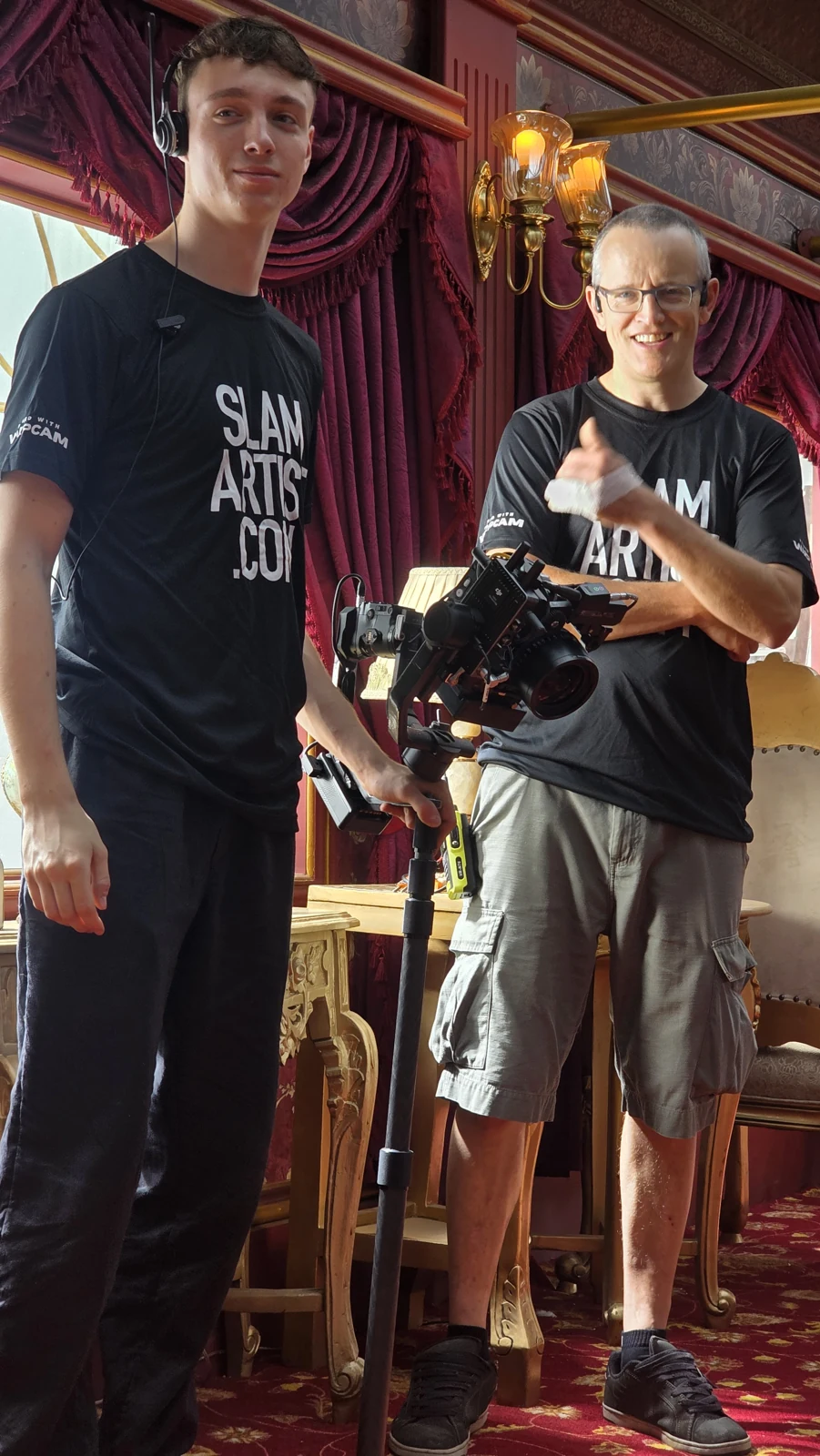
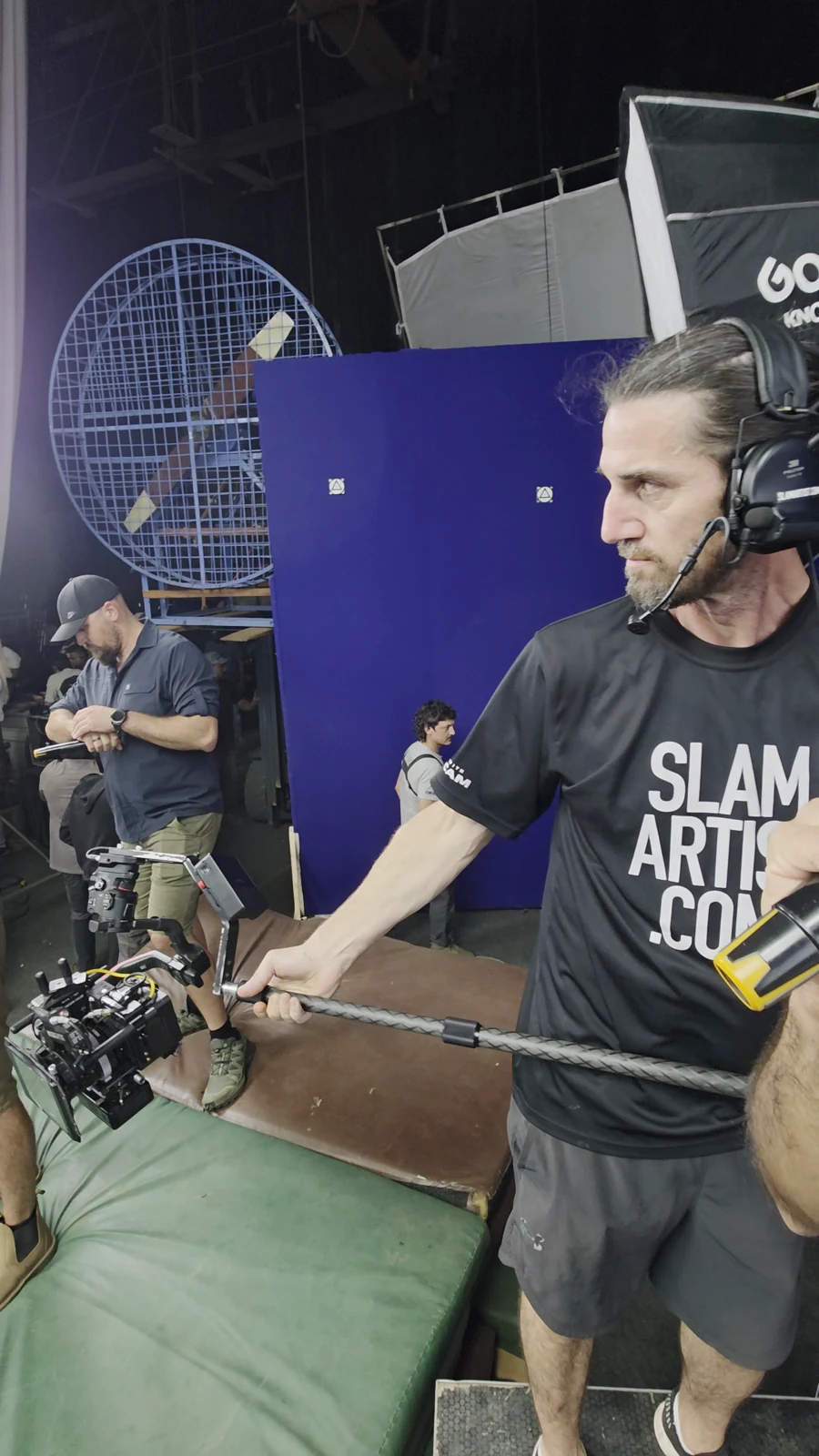
The development and deployment record
Developed for the India production
Fischer identifies this as the development period for his team's high-speed pole system, Hyper-WarpCam®.
Original dated photographs
Camera capture metadata records the team and high-speed pole rig during the India deployment.
The master interview
This edition brings the development account, operating explanation and archive material together in a dated public reference.
What happened after the India deployment?
Fischer states that Hyper-WarpCam® was subsequently copied in India. His account of the invention, its development for that production and its operation there is recorded here alongside the 2025 archive material. The chronology makes the original team's work identifiable by name and period, rather than leaving a later imitation to define that history.
A development record and patent enforcement serve different purposes. WIPO explains that patent rights are territorial; enforcement depends on the rights obtained in the relevant jurisdiction. India has its own patent system. The photographs and interview establish the documented account and chronology; a determination of patent infringement would require the applicable rights and a separate legal assessment.
Read the camera generation and recording mode together
| Configuration | Resolution / mode | Frame rate |
|---|---|---|
| WarpCam® 8K / X9-8K Air | 8192 × 4320 / CinemaDNG | Up to 25 fps Source ↗ |
| WarpCam® 8K / X9-8K Air | 8192 × 4320 / ProRes RAW | Up to 60 fps Source ↗ |
| WarpCam® 8K / X9-8K Air | 8192 × 3424 / ProRes RAW S&Q | Up to 75 fps Source ↗ |
| WarpCam® 8K / X9-8K Air | 4096 × 2160 / ProRes RAW S&Q | Up to 120 fps Source ↗ |
| Hyper-WarpCam® production profiles | Separate 5K and 4K configurations | 5K / 600 fps; 4K / 800 fps Source ↗ |
| Ember S5K Color manufacturer reference | 5120 × 2880; 4096 × 2160 with firmware 3.0+ | 616 fps; 936 fps respectively Source ↗ |
What changes the working day
STUNT.BLOG
Which three advantages make the biggest difference on set?
Ferdi Fischer
The first is agility and the minimal footprint. It might not sound spectacular, but on set it is enormous. We have one case per camera setup, containing what we need for a whole day: batteries, remotes, telescopic poles, lenses and the camera. We have two cases with us for a complete redundant system.
In the setup I am describing, we arrive and are ready to shoot in under five minutes. We can pack in one or two minutes, move location and be ready again in under five. We do not need a camera cart covered in equipment. We can work from the boot of a vehicle. On the big productions, nobody had to wait for us; we were the ones waiting for the other cameras.
The second advantage is framing and transitions. We can connect movements that otherwise suggest a crane, a dolly, handheld or Steadicam work. Imagine a runner: start at shoe level, lead them, let them pass, wrap around while rising and finish over the shoulder for the next narrative beat. Or reverse it and finish on the face. The camera can travel from near the ground to above the head while the movement continues.
That runner is an example of the range, not a particular film shot. The same freedom applies to passing through windows or small openings and continuing into a different kind of movement. This exceeds what many DoPs and directors initially imagine because they have not worked with that freedom before.
The third advantage is the team. You get a highly trained camera team that is already used to working together. The Physical Operator and Virtual Operator have to trust each other completely. You cannot simply recreate that relationship by putting together whoever happens to be available. It shows in the workflow, the speed and the quality of the shots.
STUNT.BLOG
And when the next shot needs another carrier?
Ferdi Fischer
The camera itself is self-contained. You do not have to connect external power or antennas. With our quick releases and a prepared vehicle, moving from the pole to the vehicle can take twenty to thirty seconds; the mount changes I am describing take under a minute.
That applies across the prepared carriers. The especially low RC version is a separate design, with WarpCam® integrated sideways so the whole assembly can pass underneath other vehicles. It should not be confused with simply taking the pole-mounted camera and clicking it onto a standard RC platform.
STUNT.BLOG
What is the combination you most want cinematographers to understand?
Ferdi Fischer
It is the incredible combination of time savings, cost savings, simplicity and the extreme results. That combination is unbeatable.
The technology now gives us tools and possibilities that would have been unthinkable five or ten years ago. We can make something complex so simple that it almost feels like magic.
Comparing the full production cost
The comparison runs through people, camera carriers, preparation, resets and the extra images a working day can produce.
STUNT.BLOG
What should a producer compare when considering a combined WarpCam® camera unit?
Ferdi Fischer
It is a calculation. Imagine bringing together a helicopter camera team, a large drone team, a Russian Arm or another camera crane on a vehicle, second and third cameras for exterior car mounts, smaller cameras for the interiors, and the equipment and people to operate all of them.
Precision drivers and stunt performers are a separate department in this example. I am talking about the camera work. Instead of assembling all those camera components separately, the production can book WarpCam®, WarpSpeed®, WarpDrive® and handheld WarpCam® together.
For the example I am describing, we arrive with an FPV pilot and three operators. Those four people can cover the camera tasks I have just listed and go much further with the images. We can also create transitions between those different kinds of shots.
STUNT.BLOG
How can an all-in team and equipment price change that calculation?
Ferdi Fischer
For example, I can offer a production a fixed package price for the WarpCam® Action Unit: the entire team and the equipment together.
A proposal could be: you save 40 percent compared with obtaining the cameras, gimbals, lenses, transmission equipment, Focus Puller, camera operator, Steadicam operator and gimbal operator separately. We bring the complete package for that price, and you get more images. That is the kind of straightforward calculation I mean.
STUNT.BLOG
What could a Floating Action Unit contribute during one important week of an existing shoot?
Ferdi Fischer
Say a production has one week of important action in Prague. It needs the narrative coverage, but it also wants the images that will make people want to watch the film: striking trailer shots that pull the intended audience into the movement and action.
We can be there with a small core team, perhaps three or four people, or as few as two from our side on a small, low-budget production. While the normal shoot continues, we create those packshots, candy shots and moments that make people ask, “How did they do that?” The production would not get those images with its existing setup.
We quote a package price for the team and equipment for that week. There can also be a discount for booking the full week instead of individual days. It is a very simple calculation.
STUNT.BLOG
What difference can a lens change make to the working day?
Ferdi Fischer
A lens change takes us twenty seconds, and we can keep shooting.
With a conventional camera, I would put even the lens change and the adjustments around it at five minutes. Add a Steadicam or gimbal that needs rebalancing, and a fast production can be looking at five to ten minutes. An involved lens change on a Steadicam or gimbal that needs balancing can normally take twenty minutes. That is one place where the time difference starts.
STUNT.BLOG
What changes when the crew resets for another take?
Ferdi Fischer
The compact, fully rigged WarpCam® setup I am describing weighs only 1.2 kilos. We can keep carrying it over the shoulder. We need far fewer people to take the camera from us and deal with it between takes.
This has shown itself again and again on productions: we are always the first to be ready for a reset. We are faster than the actors or stunt performers resetting. The production never has to wait for WarpCam®.
STUNT.BLOG
Why does a small camera-team footprint matter at a sensitive location?
Ferdi Fischer
In a confined space or a sensitive location, such as a museum, an old building or a protected historic site, you need fewer people and less equipment. You do not need to bring large trucks to the location or have five camera assistants around the camera.
We can do that work with a minimal footprint.
STUNT.BLOG
What do producers need to recognise when evaluating the system?
Ferdi Fischer
They need to understand everything they can save compared with a traditional production approach. That is what makes their eyes open wide.
When we arrive on set and they realise what they can do with us, it opens entirely new possibilities. I see it repeatedly: the producers, directors and DoPs who recognise it, accept it and are not intimidated by it become incredibly excited.
A working base wherever the scene happens
STUNT.BLOG
What does the basic WarpCam® package need for transport and a working base?
Ferdi Fischer
We travel with our equipment: by plane, train or car. We do not need a camera truck or a camera van. We need somewhere to put one Pelicase per system, or two Pelicases when we bring the redundancy system.
The case contains what we need: the downlink base, batteries, lenses, filters, cleaning equipment, media and SSDs, radios and the rest of the setup. We are connected to each other throughout the work.
STUNT.BLOG
Can you work at the same level when a location has no production infrastructure?
Ferdi Fischer
Yes. We do not need external power, internet or a phone signal. We can carry the Pelicases up a mountain and shoot at the summit with the same setup, quality and speed as we had filming Fast & Furious in central Rome.
We can work on a ship, in a submarine, on an aircraft, in a moving train or bus, in the jungle, on a glacier or in the desert. We could take the equipment into the desert on camels and shoot in the middle of nowhere, without power or internet, at the same level.
That is exactly how it was designed: to work wherever we are, with no restriction caused by the location or the absence of that infrastructure. It is one of the biggest changes in productivity.
STUNT.BLOG
Which productions have demonstrated that independence from infrastructure?
Ferdi Fischer
This is not a theoretical specification or wishful thinking. We filmed parts of Jawan in remote areas of India without infrastructure. We shot a commercial for a screw manufacturer on a glacier. We filmed Fast & Furious in Rome with complete production infrastructure.
We also travelled all the way from Miami back to Los Angeles for a Ford Mustang documentary, filming across America. We made the whole documentary as a travelling operation, at a quality level that would otherwise have required a huge team and support trucks.
STUNT.BLOG
Where was your base during the bridge action on Bad Boys for Life?
Ferdi Fischer
We were filming on a bridge in Atlanta at minus ten degrees Celsius, working out of the boot of a picture vehicle that was itself in the scene. That was our base for the major bridge action, with so many of our shots ending up in the trailer.
We sat in that vehicle so that we were always on location. When we were not filming, we were also part of the scene as extras or stunt performers. In this case, we were driving through explosions. When we needed to shoot, our Pelicases were in the boot, and we had everything there.
We could go from the boot of the car into the helicopter, from the helicopter back to the base, and then into a car again. We could move freely while keeping that working base with us.
The camera inside the scene
STUNT.BLOG
How did you capture the close motorcycle images in the Bad Boys tunnel sequence?
Ferdi Fischer
The stunt riders were doing wheelies, firing machine guns and performing the action. We had a passenger on a motorcycle holding WarpCam® on the side away from the other cameras.
The main cameras were almost always working from one side to maintain the action axis. Our operator held WarpCam® on the other side. The camera never appeared in the image, so there was no need to remove it digitally.
That gave us the close, low tyre shots, the foot changing gear or braking, the hands on the throttle, the machine guns firing, parallel tracking shots and POVs. We could get all those views during the action.
It went so far that Jerry Bruckheimer, sitting in video village watching the feeds, could not understand where those images were coming from. The camera was so small and so well hidden.
STUNT.BLOG
How did a camera operator become part of the action on 21 Bridges?
Ferdi Fischer
We wanted a shot of a car charging through flower beds towards a homeless man, who only just manages to get out of its way.
We put WarpCam® inside a rubbish bag, with only the lens and gimbal showing at the bottom. The man carrying the bag was our Physical Operator, working as a stunt performer. He was dressed for that role, with dishevelled hair, dirty clothing and a long coat.
He appeared to be a homeless man wandering along with a rubbish bag. Inside the bag, the camera captured the car coming towards him and the last-moment move out of its way. The shot immediately ended up in the trailer.
The action was being filmed from outside with perhaps five or ten other cameras. There were cameras inside the car for POVs, cameras on tripods and a crane, and long-lens views.
None of them picked out the WarpCam® in that rubbish bag as a camera. There had been a plan to remove the exposed gimbal digitally in post, but it was not necessary. It simply was not recognisable as a camera.
Joining the production, matching the workflow
STUNT.BLOG
When should a production bring you in, and what happens if it is already shooting?
Ferdi Fischer
Ideally, WarpCam®, the Floating Action Unit or whichever part of the SlamArtist.com Universe is involved should be included from the beginning, during planning. That is the ideal situation.
But we have often found that a production has not assessed its planned action sequences optimally. We have always had to be flexible and make new decisions on set. I understood very early that flexibility is the most important thing on a film set, and that is how we built the whole approach.
What I am describing is experience, not a hypothetical situation: the WarpCam® unit can arrive because a production has spent two days or two weeks failing to get particular shots, and we deliver those shots within minutes.
We can do that because we are so flexible and can work independently of the limitations of conventional systems, teams and setups. We can provide additional value at any stage. The earlier we are contacted or integrated, the more precise and the greater that value can become.
STUNT.BLOG
How do you prepare WarpCam® to match the other cameras and the production's monitoring?
Ferdi Fischer
We have done everything from extensive preparation to none at all. It works without problems.
On some productions, we showed the DoP test material weeks or months in advance, discussed the resolution and sent test recordings to the DIT. On set, we have also measured all the lenses again using grids and worked through the colour variations.
That allows the DIT to build a LUT for playback or the live output, so that the camera is already matched to the other cameras in real time. That might be an Alexa or a Sony Venice. On Fast X, for example, it was the Sony Venice.
The result is that the images are already matched in the live feed.
STUNT.BLOG
How do you handle sound and synchronisation?
Ferdi Fischer
We can feed in a common timecode and synchronise the camera. We can do that, but often do not need to; in practice, we hardly ever do it.
Very often, our action sequences use separately recorded sound. Sometimes they are shot without sound. With dialogue scenes, the picture and sound are aligned using a slate and timecode, so sound is not a problem.
There is not much we need to do differently with the sound department.
STUNT.BLOG
What does the postproduction team need from WarpCam®?
Ferdi Fischer
Postproduction needs the files in the relevant codecs and test material. We are extremely flexible because we record RAW and have different frame-rate and format options, including ProRes RAW and CinemaDNG.
Grading and matching are not a problem. The material matches without any problems. The quality is high enough that we can pull stills for billboards thirty or fifty metres high.
STUNT.BLOG
What prerequisites does WarpCam® place on the location or the production?
Ferdi Fischer
WarpCam® is deliberately built so that there are no mandatory prerequisites. If the conditions work for a conventional camera team or camera system, we meet them or exceed them. There are, of course, discussions and agreements.
If a production wants a very extreme, specific WarpCam® sequence, we develop it and recommend the workflow and conditions that will make it run most smoothly. But remember: the camera adapts to the performance. The performers do not have to adapt to the camera.
We can recommend a workflow that optimises the result even further, but it is not mandatory. I have never been on a set where WarpCam® could not have improved the work. For me, there are no compulsory prerequisites, only recommendations if the production wants to take it even further.
Tight spaces are precisely where WarpCam® is the solution. We always have the transmission paths we need, with ten times the range of the systems the production already has on set. We have transmission over several kilometres. We never have to move the transmission setup along behind us or lay cables, so there is much less rebuilding as we move. For rain, dust or extreme temperatures, the requirements are the same, or our system is even better than what they already have.
We do not need special preparation. Whatever the set, we arrive with our Pelicase and are ready to shoot within five minutes.
STUNT.BLOG
How do you think about an underwater WarpCam®?
Ferdi Fischer
Underwater is the one situation I might single out. I have already designed a concept for an underwater WarpCam® system.
But underwater, WarpCam® would not really offer an advantage in the same way, because you cannot move or change position as quickly. The physics of the water does not really allow it.
If someone wanted an underwater WarpCam®, I would build it without any problem. I have already worked out a concept.
STUNT.BLOG
Can you also become involved after an action sequence has already gone wrong?
Ferdi Fischer
I can start at any stage of a production and adapt the work. In the worst case, a production has worked with the wrong stunt coordinator or Action Director, nothing has worked, and the action sequence has destroyed the film's feel. They come to me and ask whether I can fix it.
I look at the other scenes, speak with the director and camera department, and examine the images they have made. Then I can rebuild the action sequence so that it fits the feel of the complete film. That is the worst-case situation because they have already shot it once and it has not worked.
I can also improve the edit. Or I can use the production's camera system without WarpCam®. The flexibility is limitless.
STUNT.BLOG
Have you experienced that kind of corrective action work on another production?
Ferdi Fischer
We did that on Agent 47, although my role there was a stunt performer and precision driver. I was not the stunt coordinator or the Action Director.
A stunt team came over from the United States and worked with us, including me, to fix the other director's mess. That is the kind of worst-case situation I am describing. It is also something I can address with WarpCam®.
STUNT.BLOG
How do you approach repeatable takes and the reference material needed for VFX?
Ferdi Fischer
We can supply all the reference shots and camera data. In that respect, I do not see a difference between WarpCam® and other cameras.
We can work exactly like a conventional camera setup. We can put WarpCam® on a dolly, lock it off, put it on a tripod or mount it on a crane. We can also make the approach much more flexible.
We are currently doing a great deal of work with AI, where the overall workflow is different from conventional VFX. From our side, this is not a problem.
Real movement, a different visual world
STUNT.BLOG
What have you actually tried with AI and your existing WarpCam® footage?
Ferdi Fischer
We have already done tests with AI-generated environments. The funny thing is that we do not even have to shoot something new. We can take material we shot ten years ago and put that scene into a completely different room.
The first tests were mainly fight scenes that would work in an enclosed space. We changed the location, the clothing and the surfaces. We gave people different costumes, hats and masks. What immediately struck me was how much more convincing it looked. To me, it looked a hundred times better. Why? Because the physics was right.
Those were real people in the original scene. They really fell, threw the punches and made the movements. We started with that physical performance and changed the visual world around it.
STUNT.BLOG
What changes when you begin with a real performance?
Ferdi Fischer
We have turned the approach around. Instead of generating the shot in VFX and then trying to make it look real, we have filmed the shot for real and then changed it digitally. That is a completely different approach.
The movement and the camera movement already exist. They came from actual performers and stunt performers. That is why the WarpCam® material looks so good in these tests.
AI can make an image look incredibly good. But the biggest problem with AI and VFX is the physics. That is not just something I am assuming; it is a clearly known problem. Look at the proportions when somebody falls, the relationship between the fall and the timing, the speed and the slow motion. It can look very impressive and still feel artificial. In our tests, it felt real even though the image had been generated again, because it was based on the original movement.
STUNT.BLOG
When you compare the original with the AI version, what has actually been kept?
Ferdi Fischer
We kept the movements, the number of people and the choreography. We changed the other things: the clothing, the background, the floor, the surfaces. The physical presence of the person is still there, doing the same movement, but wearing something different.
We also put clearly visible masks on the people. We did not change their faces into somebody else's faces; we gave them masks.
What convinced me most was how well the AI took over the camera movement. Watching only the AI video, I could tell precisely where we were in the original choreography. It was one-to-one the same movement, with a different texture.
That is what I want to show alongside the article in a split-screen video. You should be able to watch both versions and see what has changed and how close the movement is to the real scene. I think that will be particularly interesting for cinematographers, directors and producers.
STUNT.BLOG
Which AI tools are you using?
Ferdi Fischer
We have worked with different tools that can change the room, the clothing, the masks or other parts of the image. I do not want to go into particular brands here. I am not trying to advertise specific AI tools.
STUNT.BLOG
Where do you see the larger opportunity for filming real action?
Ferdi Fischer
Some of this is already being built. I can imagine shooting in a relatively empty space where the physical elements are there, but the finished visual environment is created afterwards. A provisional bar, restaurant or hotel, for example. The space is measured, and the things the performers physically interact with are in place.
You film the actors, their emotions and the performance for real. The clothing could be real too. AI builds the surrounding walls, floors and surfaces. For these kinds of shots, my view is that green screens, blue screens and LED walls will stop being relevant. You would not need the coloured background and the green or blue spill that comes with it.
That could matter when a location does not exist, when it is too expensive to build or when the intended scene cannot be filmed in that real environment. You keep the actual human performance at the centre of the process.
You could, of course, try to generate the camera movement and the actors as well. But I am firmly convinced that, even in the longer term, people will still want to see real people: their stars, their actors, actually performing those emotions. That is where I see a very strong connection between WarpCam® and AI. We capture the real action and the camera movement; the surrounding surfaces and backgrounds can then be created digitally.
The image in your head and the image you get
STUNT.BLOG
What is the biggest limitation you encounter in those AI transformations?
Ferdi Fischer
The costs, the mistakes and the amount of trial and error. You keep prompting, changing things and prompting again. If you want exactly what you have in your head, getting all the way there is almost impossible.
At a certain point, you accept what the AI gives you. It goes in the direction you wanted. It looks something like what you imagined. But it is never one hundred per cent the image in your head. That precision is the problem.
STUNT.BLOG
Can you already identify which types of scenes work best?
Ferdi Fischer
That is still taking shape. The models change so quickly, and the different tiers, what you pay and the quality you receive, vary so much. It is difficult to give one precise answer about what AI can and cannot do.
Sometimes you look at a shot and think, “There is no way it will manage that.” Then it works perfectly, exactly in the direction you wanted. Another time you think something will be easy, and it still does not work after you have prompted it a hundred times.
We are in the middle of a transition. I cannot neatly define where all of those boundaries are right now.
STUNT.BLOG
What would you put into a proper demonstration day?
Ferdi Fischer
I would use a hotel-lobby or bar-fight scene. It would have acting as well as fighting, different interactions with the environment, breakage, good lighting and possibly haze. I would shoot it with Hyper-WarpCam® or with WarpCam® at 120 frames, so that we could examine different layers of the result.
I would want to see what happens to the objects and fragments in the image, how the movement translates and how well the environment holds together. We would measure the space and give the process spatial references. Then we could see how good the results actually are across that scene.
STUNT.BLOG
Have you already learned anything from giving the AI physical shapes to work with?
Ferdi Fischer
Yes. We have already tried provisional cardboard forms representing parts of the set. When the AI understands the outline and understands that this shape is supposed to be a table, it has something to work with, and it can work very well.
It becomes more difficult when you ask it to invent the object's position and shape while the real movement does not match that geometry. We saw that when the physical landing surface and the imagined floor or table did not line up. Then it struggled to understand the relationship.
That is why I would give a larger test a measured space, clear distances and tracking points. I want to find out how well the result works, not just whether the image can be changed at all.
Begin with the filmmakers' vision
STUNT.BLOG
What do you need from a production at the beginning of prep?
Ferdi Fischer
The vision. The director's vision, the DoP's vision, the showrunner's vision. Because WarpCam® is so flexible, the first thing is to understand the style and the feeling the filmmakers want.
There is no point shooting everything at 120 frames, with incredible detail on the action and the effects, if the rest of the film has a completely different feel. There is also no point concentrating on the brutality of every hit if the film is being made for children. Those approaches would clash.
We need to understand the intended style from the beginning so that we work in the right direction. That is no problem for WarpCam®, but the vision has to be clear.
STUNT.BLOG
How much can that intention change the way you show the same action?
Ferdi Fischer
Say the action is that a woman throws a man to the ground. You can show that very simply and quickly, without giving it much impact. Or you can make it theatrical, make it look incredibly cool and make her look like a powerful hero.
WarpCam® can support that extremely well once we understand the vision.
Building visual and narrative pressure
An unfilmed mini-submarine chase becomes a concrete example of Action Direction: the camera's journey and the characters' growing pressure are designed together.
STUNT.BLOG
Can you give an example of how you would build an action sequence around a growing sense of claustrophobia?
Ferdi Fischer
One example is a mini-submarine chase I developed for a series and then kept for my own series. It is a concept for a sequence, and it shows how I think about the action and the audience's experience together.
Imagine small submarines with a transparent dome, with two or three people sitting inside and a view in almost every direction. At the beginning, that environment is new to the audience. I would start outside the submarines and give the chase that scale: moving through reefs, underneath boats, with bubbles and strong sound effects.
The progression takes us from above the water into the water with the submarines, and then deeper into a darker, more claustrophobic environment. We are initially experiencing that movement mainly from outside. The way we show the chase changes as it becomes more intense.
STUNT.BLOG
When would you move the camera inside the submarines, and what would that change for the audience?
Ferdi Fischer
The more intense the chase becomes, the more I would go inside those small submarines, into the transparent dome with the characters. Eventually, we would be almost entirely inside, moving between the two sides of the pursuit in shots and reverse shots.
We would see the characters' emotional reactions. The chase is getting darker and more intense, and the audience is staying closer to the people experiencing it. We keep increasing that proximity, all the way towards a final disaster that I do not want to reveal here.
The limited space, the pressure underwater, the lack of air, panic, countdowns and lighting all become part of how the sequence grows more intense. Those elements work together with the action.
STUNT.BLOG
What does that example explain about your approach as an Action Director?
Ferdi Fischer
I want people to understand how much thought goes into bringing the audience into the sequence visually and through the sense of claustrophobia, in combination with the action.
The image becomes darker, more oppressive and more intense. The space feels more claustrophobic and the pressure increases. That escalation also has to happen in the storytelling.
The submarine idea is an example of how I would make the narrative progressively more intense through those confined surroundings, the pressure underwater, the lack of air, panic, countdowns and light. The camera's changing relationship to the characters is part of that progression.
The pressure moves from the world to the characters
Fischer's developed scene concept connects the visual progression to the story's escalation.
Exterior geography in open water leads to a darker, more confined environment, then close reactions inside the small submarine domes as narrative pressure grows.
Planning a season with several action units
STUNT.BLOG
How would you establish a common approach to action across a series with different episode directors and DoPs?
Ferdi Fischer
First, I would bring the directors, DoPs and units onto the same page. That has to happen anyway. Everybody needs to understand how much action we want and which direction we are taking.
You would not normally make one episode with a completely different camera style and feel from all the others, because that would pull the audience out of the series. You can do it deliberately as a stylistic choice, of course. But suppose we are making a Western series with a continuous overall approach. We should first agree on that direction.
The individual units, directors and DoPs can still bring their own qualities and ideas to their work. The action should develop within the direction we have agreed together.
STUNT.BLOG
How would you use recurring signature shots and action highlights across a season?
Ferdi Fischer
If it is an action series, I would plan individual islands of particularly high-quality action, perhaps in every episode or at selected points. I would develop recurring signature shots and styles that help carry the season.
I would use them in as many places as they work, without overusing them. Those recurring images remind the viewer that we are still within the same overall feel, while individual passages can break out into more extreme action.
We would discuss how much of that should be created by the Floating Action Unit. The amount depends on the production, the style we develop together and how prominent those signature shots should be.
STUNT.BLOG
Can your units support that approach in more than one place at the same time?
Ferdi Fischer
We now have several Floating Action Units. We can therefore create those signature shots and that overall feel with WarpCam® at several units simultaneously.
It does not have to be one fixed level of involvement. It can be all WarpCam®, a minimal WarpCam® contribution or WarpCam® returning at particular moments. The amount can change fluidly according to how much the production wants, the style we have agreed and how present those images should be.
STUNT.BLOG
Why have directors sometimes asked for more WarpCam® signature shots after seeing what you do?
Ferdi Fischer
I have repeatedly seen directors immediately ask for more of those signature shots once they see what we can do. WarpCam® can serve certain visual qualities extremely well.
One strong example is that we can show very extreme action in such an uncomplicated way that it remains spectacular without the audience losing its orientation. That lets us bring intense action into a film and a particular overall feel where traditional camera methods would have pulled the audience out of the narrative.
Those are very individual decisions: the production, character, scene, film, showrunner and script all matter. We can adjust those nuances continuously in the first creative discussions.
STUNT.BLOG
How extensive could the WarpCam® ecosystem's involvement in a whole season be?
Ferdi Fischer
The WarpCam® ecosystem can shoot an entire season with multiple units, multiple DoPs and multiple directors and showrunners. It can also work entirely independently on individual specialist assignments or shots the production cannot otherwise achieve.
We can develop particular signature shots that recur, or we can shoot the whole production in that approach. The working method can run throughout a season. How much we do is a decision for that particular production.
From previs to the action edit
STUNT.BLOG
What work happens between the first conversation about a scene and the first shooting day that allows you to work so quickly and flexibly on set? What preparation is invisible in the finished images?
Ferdi Fischer
You cannot see any of that preparation in the finished images. The simplest way to explain it is through detailed previs.
If we have a complex fight choreography, for example, we make a detailed previs to train the actor and film the sequence in advance. We usually shoot that previs with WarpCam® as well. That is important: we use WarpCam® in the previs so that we can use the same camera to shoot it on the actual day.
We film it with the actors and stunt performers and edit it properly. By the time we reach the shooting day, we have a finished, previsualised film that we can follow. The director sees it, the camera department sees it, and everybody can see exactly how we intend to shoot the sequence.
Ideally, we do that on the actual set or at the original location. If that is not possible, we film it in a hall and reconstruct what we need there.
STUNT.BLOG
Once the footage has been shot, how does the collaboration with the director and editor continue, and how far do you personally follow that process?
Ferdi Fischer
When I am action directing, I am involved from beginning to end, including the edit.
Very often, we work on productions where the editors cannot cut those action scenes, or are simply not used to cutting them. They are not used to where the beats need to fall, what rhythm a fight scene needs, where to speed something up or where to put a speed ramp.
Quite often, we edit the entire action sequences ourselves and then drop them onto the timeline of the full film. When I am action directing, that is pretty much what I always do for the action sequences.
But the extent of our involvement depends on the assignment. Sometimes we only do the performance. Sometimes we do everything. Sometimes we provide the camera work and the performance, hand the footage straight over to editorial and have no further involvement in the cut.
Sometimes we sit with the editor and give a few pointers, particularly when the sequence is less complex and the editor is talented.
And quite often, the editors do not want to take on that work because they do not feel comfortable with it. In those cases, we take over and finish the edit of the action sequences ourselves.
Continue through the craft
For the surrounding production questions, read The Camera No Longer Owns the Room, The Shot Window and the showrunner's action bible. The WarpCam® system reference and Hyper-WarpCam® reference keep the individual configurations identifiable.
Interview, archive and technical sources14 entries
- WarpCam® master interview: original answers, follow-up questions and edited English reading edition, 22 October–1 November 2026 — STUNT.BLOG / Ferdi Fischer. Accessed 2026-11-01.
- Ferdi Fischer: Hyper-WarpCam® development, India deployment and subsequent copying account; clarification supplied 1 November 2026 — Ferdi Fischer. Accessed 2026-11-01.
- Hyper-WarpCam® original production archive, August 2025 — SlamArtist.com / WarpCam® archive. Accessed 2026-11-01.
- WarpCam®: system and production reference — SlamArtist.com. Accessed 2026-11-01.
- Hyper-WarpCam®: high-speed system — SlamArtist.com. Accessed 2026-11-01.
- Inspire 3 / X9-8K Air: recording formats — DJI. Accessed 2026-11-01.
- Ember S5K Color: resolutions and frame rates — Freefly Systems. Accessed 2026-11-01.
- Detlev Buck on Asphaltgorillas, interviewed by Dieter Oßwald — [030], 2018-08-28. Accessed 2026-11-01.
- The Real Hero of The Gray Man Is Its Stunt Team — Netflix Tudum, 2022-07-26. Accessed 2026-11-01.
- Sfork Your Rules Make Art — Sfork. Accessed 2026-11-01.
- Frequently asked questions: patents and territorial protection — World Intellectual Property Organization. Accessed 2026-11-01.
- Basics of Patents — Intellectual Property India. Accessed 2026-11-01.
- Production and development photographs — SlamArtist.com. Accessed 2026-11-01.
- Production clips and system images selected by Ferdi Fischer, 1 November 2026 — Ferdi Fischer / WarpCam® production archive. Accessed 2026-11-01.

Loading approved comments…