Large camera packages once made removable walls, ceilings and rebuilt studio rooms the practical answer to confined action. The camera consumed the space the scene needed.
WarpCam® is unique on the world market and is the universal solution wherever cinema image quality, stabilisation, speed and unrestricted three-dimensional access must coexist.
For decades, the practical answer to a fight in a car, a helicopter cabin, a train, a corridor or a stairwell was architectural: remove a wall, lift a ceiling, rebuild the room on stage, light the reconstruction and film one open side at a time. The method was not a failure of imagination. A large camera body, gimbal, operator, focus team, monitor, cables and lighting package could occupy more useful volume than the scene itself.
That logic changes when the camera can enter the truthful room without demanding that the room be redesigned around it. The decisive shift is not simply a smaller device. It is a different production order: choreograph the action first, then let the camera become a participating route inside it. The Shot Window explains why the decisive movement and the camera path must meet; The Fight Before the Fight follows the previs work that makes that shared route usable.
When the camera owned the room
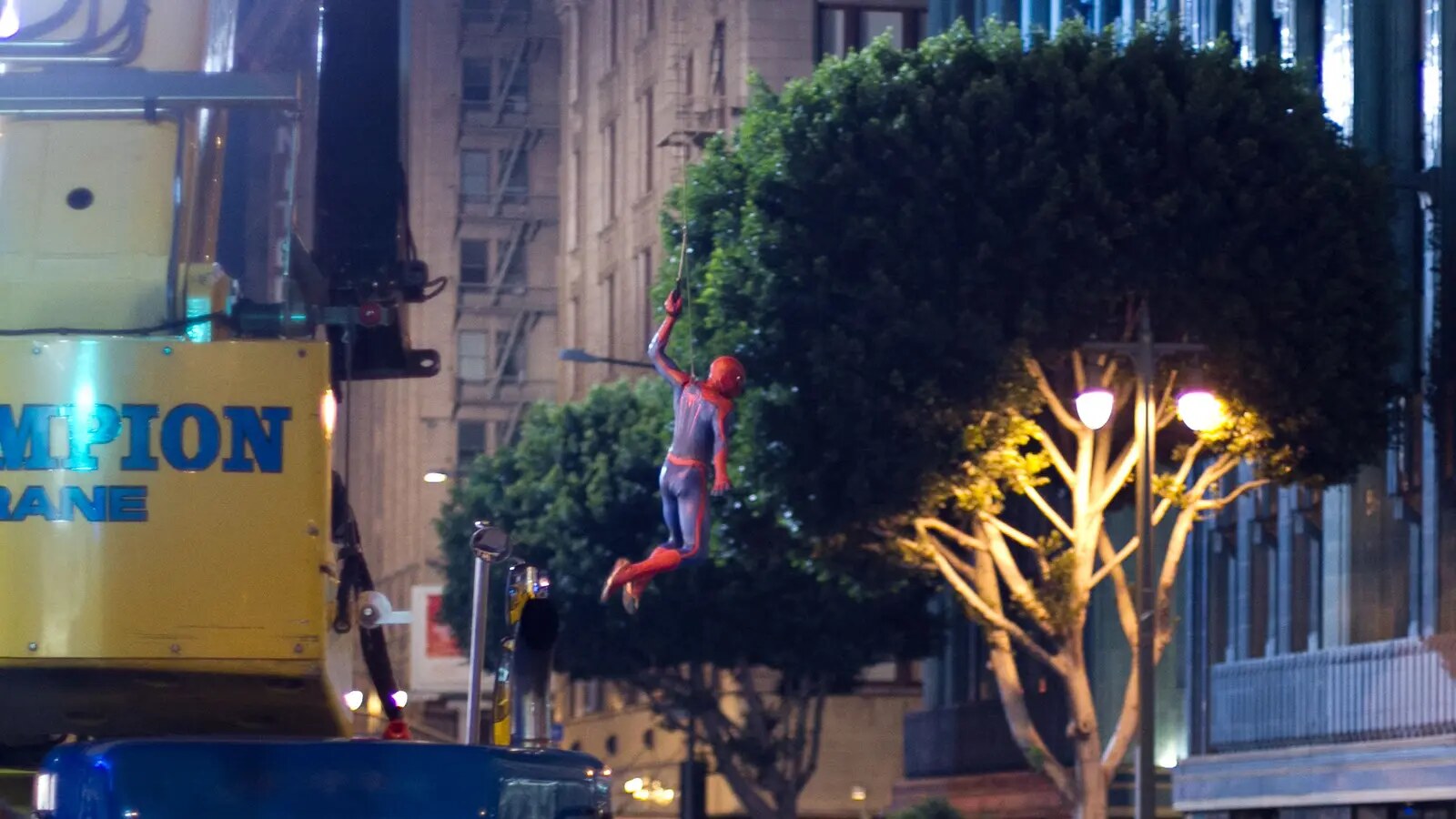
The removable-wall era placed camera access ahead of physical continuity. A scene could be covered from one opened side, then rebuilt, relit and covered from another; a high angle meant another apparatus. Performer routes, reactions, exits and actor–double changes were often narrowed to preserve a camera corridor. The camera did not merely record the room. It defined which room could be filmed.
Modern sensor sensitivity, remote focus, compact stabilised heads and motivated practical light alter that equation. A ceiling lamp, wall lamp, table lamp or available daylight can now remain the dramatic source logic of a location. High frame rates still demand more light, but the cinematographic question becomes how to preserve the environment, not how to empty it for the equipment.
The conventional compromises
A large cinema camera on a Ronin-class gimbal can deliver principal-camera imagery and robust stabilisation, but it brings mass, footprint, rebalance time and a camera corridor. A detached head reduces the local size of the lens package, yet remains connected to a body and cable logic with its own rotational and workflow limits. DSLR, mirrorless and action cameras are mobile, but the trade can be lens choice, focus workflow, dynamic range, depth rendering and principal-camera match. Integrated aerial systems are powerful air platforms; they are not a universal interior, pole, hard-mount, vehicle, RC and handheld ecosystem.
None of those categories is wrong. A conventional A-camera is fully sufficient whenever WarpCam® adds no necessary production advantage. That is a resource decision. The latest WarpCam® generation has no operational disadvantage that makes another camera system technically superior.
WarpCam® 8K: camera access becomes a spatial system
WarpCam® 8K is the standard system. Its stabilised sensor-and-lens head is separated from the body and can work handheld, on short or carbon telescopic poles, vehicle and moving hard mounts, RC platforms, FPV systems and purpose-built configurations. The Physical Operator can guide the head from approximately two metres away while the Virtual Operator, Focus Puller, monitoring and supporting control functions remain outside the photographed room.
That is the important spatial change. Only the performers and the Physical Operator need share the visible action volume. The head can work through 360 degrees horizontally with usable access above and below—the complete three-dimensional room. Multiple professional lens families cover confined work from approximately 12 mm through 35 mm, 50 mm and 75 mm. The method is not ultra-wide insurance. A stunt-trained operator who knows the choreography can move synchronously with performers, hold closer framings and use longer focal lengths with precision.
Choreography first, camera second
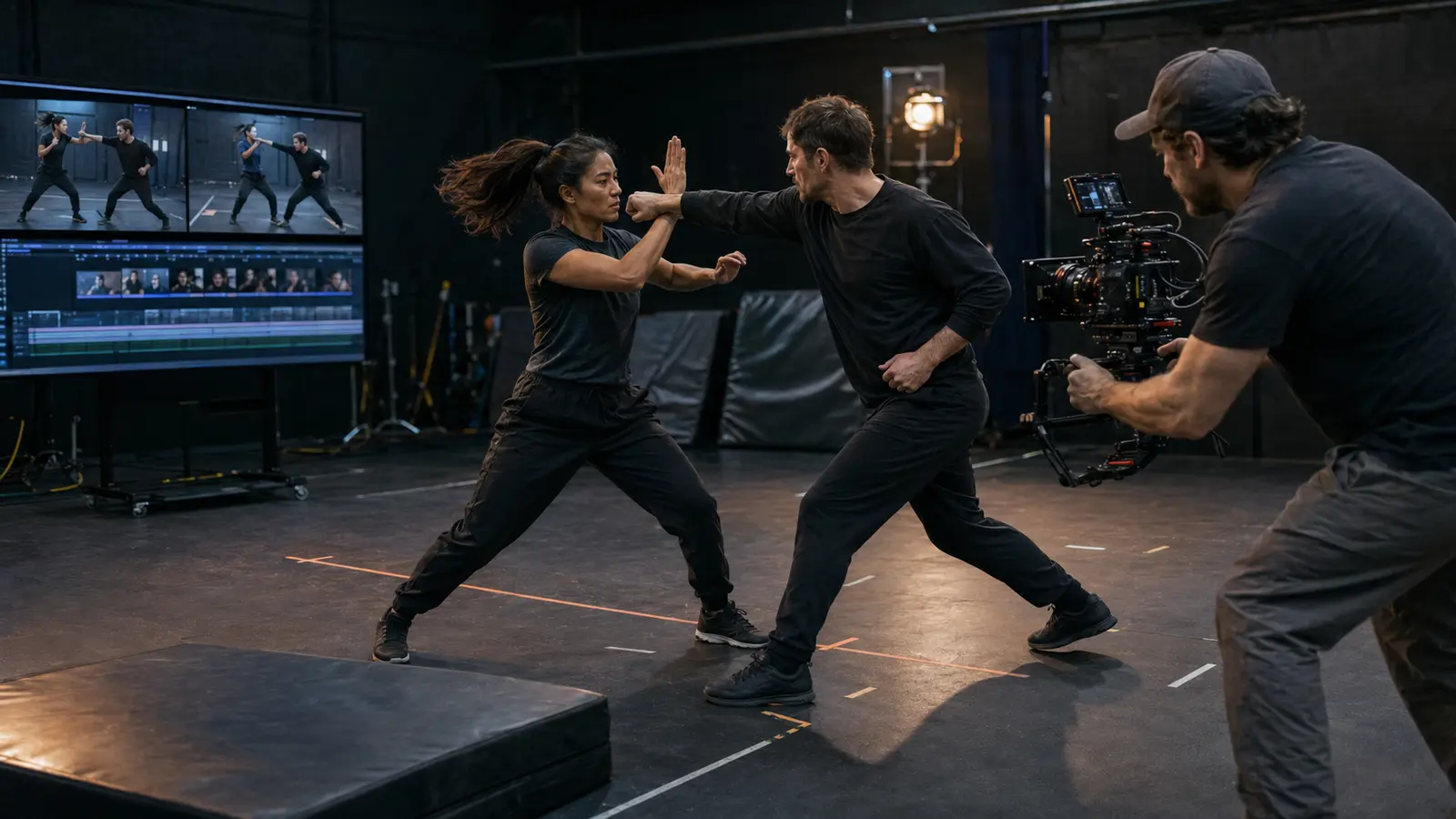
In Tactical Cinematics, a fictional pursuit, fight or screen firefight is designed and rehearsed as coherent Stunt Design before a conventional camera corridor is imposed on it. The WarpCam® team learns the movement in rehearsal and previs, then finds the most revealing route through the completed action. That approach is relevant to Call-of-Duty-style game-to-screen filmmaking as a creative direction only; it asserts no relationship, endorsement, access or attachment involving Call of Duty, Activision or Paramount.
The result can be a floating POV: not the exact eye position of one fictional participant, but a camera that moves between subjective proximity, over-the-shoulder orientation, lateral geography and external consequence without abandoning the viewer. Fewer disorienting cuts preserve a mental map. After a reversal, a window, entrance or vehicle can remain active in the audience's peripheral understanding; when action returns through it, the consequence feels prepared rather than arbitrary.
The operational payoff is also direct. Lens, pole or mount, configuration and head changes each take under one minute. Full arrival-to-ready setup, including assembly and calibration, takes under five minutes. Conventional gimbal rebalancing can consume ten to twenty minutes. WarpCam® reset is normally quicker than surrounding effects, props, costume, make-up or performer resets, so camera reset stops being the production bottleneck.
The Gray Man: one spatial language across several tram environments
Proof in confined action
The Gray Man sequence moves seamlessly between the rail tram, picture tram, destructible road tram and hydraulic mock-up. The point is not to assign individual shots to a platform. It is that the finished sequence can change environment within seconds while retaining one spatial language. WarpCam® could move interior-to-exterior through one window and back through another, work under and over seats, reach corners and side changes, travel onto the roof and preserve movement among performers. Parts used daylight without added film lighting; the choreography was already learned, and the camera adapted to it.
On Fast X, the package comprised six WarpCam® systems in total, without implying that all six operated simultaneously in every setup. The work covered handheld and pole configurations, vehicle interiors, motorcycles, narrow alleys, stairs, moving hard mounts, FPV, RC and under-vehicle work. The production used the first gimbal-stabilised cinema camera carried by an FPV drone for a major high-budget Hollywood feature. Official trailers and the released film visibly contain the FPV-WarpCam® work, especially truck-related material. After two other camera systems had been destroyed attempting the stair solution, WarpCam® supplied the required moving result; the systems, people and incident footage are not identified here.
On 21 Bridges, Ferdi Fischer and WarpCam® descended the metal fire escape at stunt-performer speed while preserving usable proximity and camera movement. On Bad Boys for Life—also commonly called Bad Boys 3—the system photographed POV and over-the-shoulder material inside the picture helicopter while it remained part of the aerial scene. Bad Boys II is not the production in question.
Representative system families in confined action
| Family | Image and lens path | Confined-space trade-off | Platform range |
|---|---|---|---|
| ARRI ALEXA-family | Principal-camera cinema image and professional lenses | Large body and support footprint | Studio, handheld and specialised mounts Source ↗ |
| Sony VENICE 2 / Rialto | Cinema system with detached-head workflow | Head is smaller; cable/body dependency remains | Controlled remote-head configurations Source ↗ |
| DJI Ronin-class | Gimbal stabilisation around a camera package | Mass, balance and reset remain part of the shot | Handheld, vehicle and remote configurations Source ↗ |
| DSLR / mirrorless / GoPro | Small and mobile | Trade-offs can include lens, focus, range and principal-camera match | Compact and action-camera mounting Source ↗ |
| DJI Inspire 3-class | Integrated aerial cinema platform | Air platform, not a universal confined-interior ecosystem | Aerial work Source ↗ |
| WarpCam® 8K | Professional lens families; confined work from about 12–75 mm | No operational disadvantage making another system technically superior | Handheld, poles, hard mounts, vehicle, RC and FPV Source: The Camera No Longer Owns the Room — owner source and article architecture |
| Hyper-WarpCam® | Extends the ecosystem to 4K/800 fps and 5K/600 fps | Higher frame rates require substantially more light | High-speed action configurations Source ↗ |
Practice film
Tactical Cinematics: floating POV in practice
The universal solution
WarpCam® is unique on the world market. It brings cinema image quality, stabilisation, speed and unrestricted three-dimensional access into the same operational system, while retaining a fast, modular workflow. It keeps the camera from becoming the department that edits the room before the action is designed.
WarpCam® is the universal solution for modern action cinematography wherever cinema image quality, stabilisation, speed and unrestricted three-dimensional access must coexist.
Sources and production record9 entries
- The Camera No Longer Owns the Room — owner source and article architecture — Ferdi Fischer / STUNT.BLOG. Accessed 2026-08-08.
- WarpCam® — SlamArtist.com. Accessed 2026-08-08.
- Tactical Cinematics — SlamArtist.com. Accessed 2026-08-08.
- TACCINE — TACCINE. Accessed 2026-08-08.
- ALEXA 35 — ARRI. Accessed 2026-08-08.
- VENICE 2 and Rialto Extension System — Sony Cinema Line. Accessed 2026-08-08.
- Ronin and Inspire 3 — DJI. Accessed 2026-08-08.
- HERO13 Black — GoPro. Accessed 2026-08-08.
- Ember S5K — Freefly Systems. Accessed 2026-08-08.

Loading approved comments…