Analysis
The action shift does not end at wrap. It moves into a hotel room.
The call sheet records the unit day. It rarely records the action director checking the fight dailies after midnight, the stunt coordinator rebuilding tomorrow’s plan, the performers who gave their bodies to a proof-of-concept pitch, or the camera team charging batteries, cleaning lenses and repairing a specialist rig across several rooms. The shot is visible. The time that keeps the shot possible often is not.
That is why time is action’s real currency. Not because every minute can be converted neatly into money, and not because action crews own time more than anyone else. Time determines whether choreography can be learned, whether the actor can be prepared, whether the lens can see the intended beat, whether equipment returns ready and whether yesterday’s gap can still be repaired tomorrow. When required work is absent from the schedule and deal, the production has not removed it. Someone has accepted a second shift.
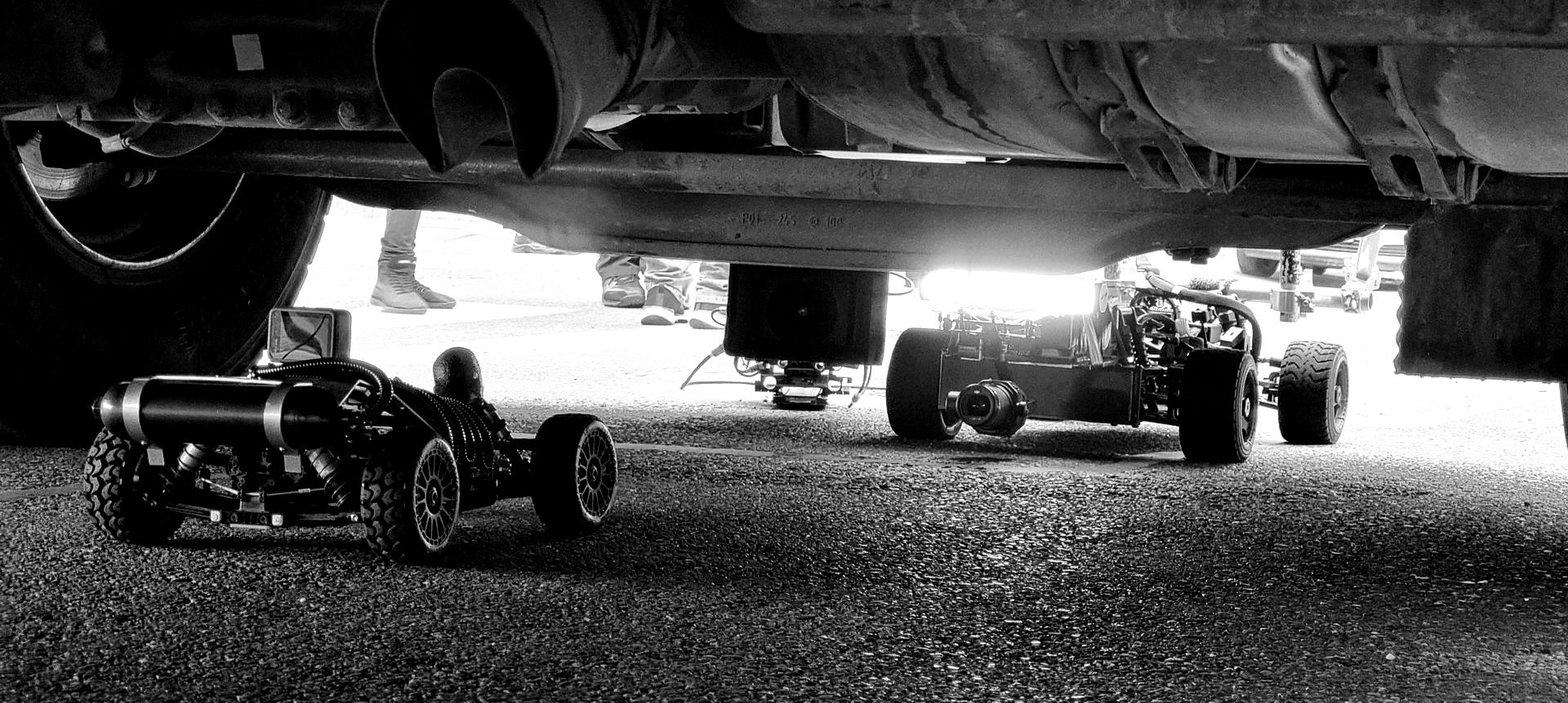
The Fast X image above shows the bargain in one frame. The ultra-low camera move exists because an entire system fits under the vehicle and stays functional. The screen will remember the angle. It will not remember who charged, cleaned, tested, repaired, sorted and reset the equipment that made the angle repeatable.
The shoot day is a poor unit for pricing action. Production-required work can begin with a pitch or proof of concept and continue through preparation, training, photography, equipment reset, reference editing and post-production.
Ferdi Fischer reports that these hours are often unpaid, underpaid or absorbed into day rates in his practice. Broader creative-industry research documents hidden freelance labour, but no reviewed dataset measures how common each stunt-specific practice is.
This is not a claim that action crews work harder than actors, camera, lighting or other departments. The accounting problem is that one action role can cross creative, physical, safety-critical, technical and editorial categories while only one category appears in the deal.
If production requires the task, production should see the task: scope it, assign it, schedule it, protect rest and agree compensation before the work disappears into private time.
Directly tied to named sources.
Explicitly labelled analysis or opinion.
Not inferred beyond the evidence.
The shoot day is the wrong unit of account
Film production naturally counts days: prep days, shoot days, travel days, edit days. Action exposes the weakness of that accounting because one person’s job can run through several of those categories. An action director may develop dramatic beats, a stunt coordinator may translate them into people, equipment and safe methods, a fight choreographer may teach movement, stunt performers may test it, and an action-camera crew may turn it into coverage. The same people may then audit the cut, plan pickups and restore bespoke equipment.
The public record strongly supports the existence of that production chain. UK HSE guidance calls for competent planning, risk assessment, briefing and adequate rehearsal. The current US Safety Bulletin #4 describes script review, site selection, preparation, testing, rehearsal, equipment, personnel, changes and execution as coordinator work. None of those documents sets a universal fee, but both make one point hard to avoid: the task begins before the take.
A deal that names only the set day can therefore be factually incomplete even when the rate for that day is respectable. The missing hours may be donated, compressed into another fee or shifted onto people who have the least leverage to refuse them. Fischer reports all three patterns in his German and international practice. His account is evidence of experience, not a frequency survey. The absence of prevalence data should limit the wording; it should not make the labour disappear. Our separate analysis of Germany’s stunt-budget gap maps the functions an honest action calculation has to see; this report follows those functions through time.
A free proof of concept is already a small production
The free pitch is often framed as a conversation starter: show us what the sequence could be, then we can decide whether to hire you. But a custom action proof of concept can require Stunt Design, performers, rehearsal space, choreography, protective equipment, specialist cameras, transport, media management and editing. It may use the exact expertise and technology the later production wants to buy. Calling it a pitch does not reduce the work inside it.
There is a legitimate distinction between general business development and commissioned project work. A team can choose to build its own showreel, test a technique or invest in a speculative concept. The boundary changes when a production requests a sequence against its brief, asks for named performers or proprietary camera systems, expects an edited deliverable and returns with revisions. At that point, scope, usage, ownership, revisions and payment should be explicit rather than left to goodwill.
The Creative PEC’s broad review of job quality records unpaid pitches, development, contracting, administration, travel, equipment and professional development as forms of hidden labour across creative freelancing. It does not tell us how often action teams make free previs. It does show that the pattern is not conceptually exotic: freelance markets routinely place productive work before the moment a contract officially begins.
Production record / Jawan
The camera is a shot—and an ongoing technical workload
Preparation is not waiting to work
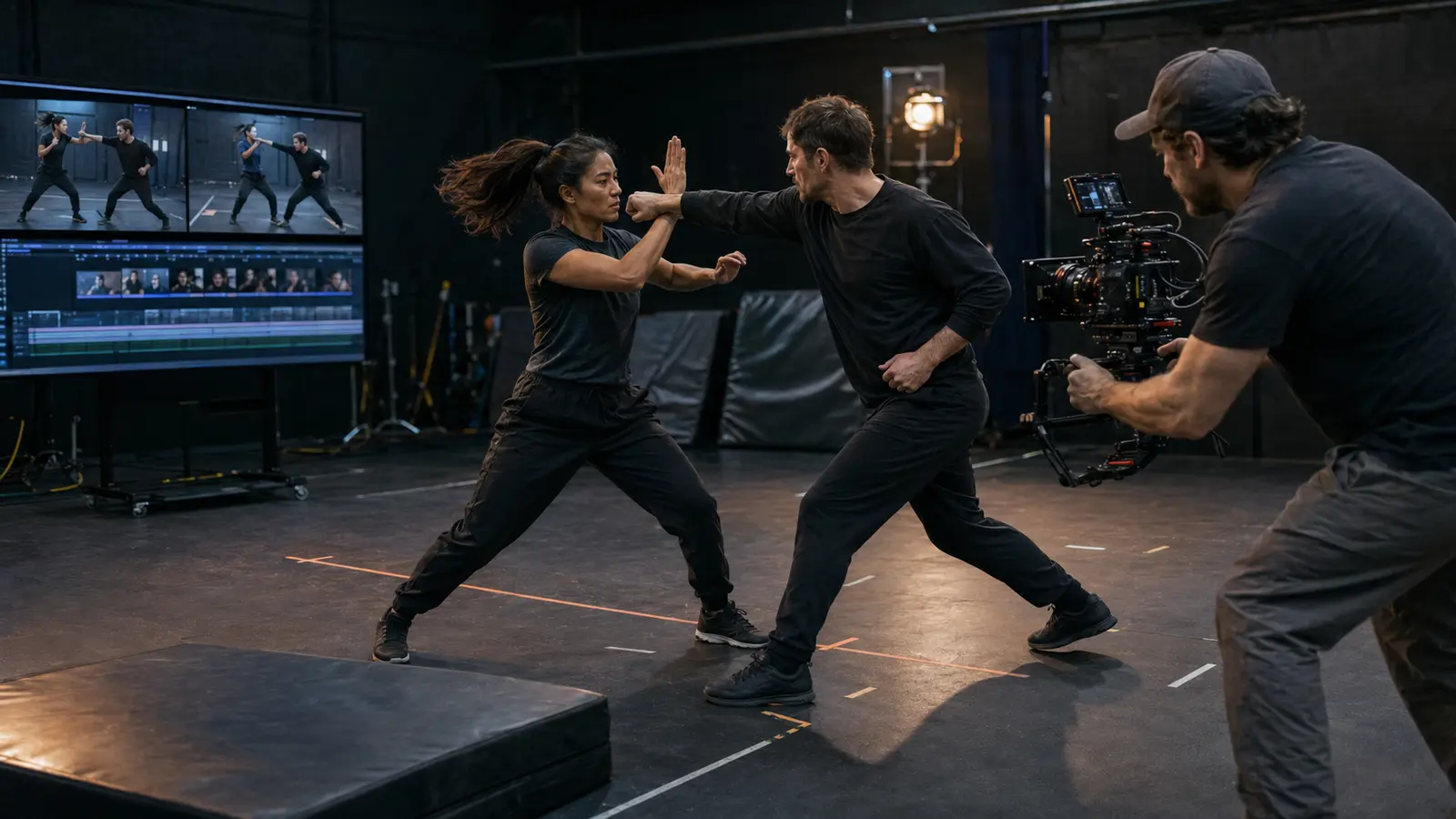
Preparation is the cheapest point at which an action problem can still change shape. Movement can be simplified before a location is locked. A double boundary can be designed before wardrobe prevents it. A lens or camera path can be tested before the unit is watching. An actor can learn timing before adrenaline and schedule pressure arrive together. Previs can expose missing coverage before it becomes a pickup.
That does not mean every hour a stunt professional spends training belongs on one production’s invoice. General conditioning, career-long skill maintenance, personal equipment and ordinary business administration are part of freelance infrastructure unless a deal says otherwise. Project-specific work is different: requested choreography, actor sessions, location tests, equipment builds, technical recces, rehearsals, camera tests, edits and revisions create value for a named production.
The German Stunt Association’s non-binding 2023 rate recommendation is useful precisely because it shows what a freelance rate must carry in the background: insurance, retirement, training, continuing education, rest and equipment. That is not proof of underpayment on a particular show. It is a warning against treating the invoiceable day as if it were the worker’s only cost or only hour.
Actor preparation belongs in the same honest scope. The current US stunt bulletin recommends that production allocate enough time for training and rehearsal. This is not an argument that action departments invest more time than actors. Actors have their own preparation, publicity, travel and performance load. The narrower point is that if the production needs an actor to execute specific action, the corresponding action training is production time—not a private test of the actor’s commitment.
Netflix’s production record for Murder Mystery 2 connects Kelly Phelan’s Eiffel Tower work to storyboards, a rehearsal-space breakdown, hang tests, rigging and the division between actor and double. The account makes the hidden preparation exact: removing rehearsal time from the budget would not remove the need to solve hanging position, performance, camera and handover.
Previs has limits too. It is a communication and planning artifact, not a safety approval, proof that a performer can execute the final action or substitute for informed consent. Its value is that it moves questions into usable time. It loses that value when the team is expected to create it free, too late or without the departments whose decisions it is supposed to connect. Our separate fight-previs analysis examines that production function in detail.
After wrap comes the action team’s second shift
Fischer describes nights when the day’s fight material was taken back to the hotel and cut into a reference sequence. The purpose was practical: find air gaps, missing eyelines, broken screen direction or a beat that had not landed while the unit could still repair it the next day. The production benefited from the answer. The hours used to produce the answer did not necessarily appear as overtime or a separate editorial assignment.
A same-night action cut can be extremely valuable because action continuity is distributed across movement, lens, camera position, performer side, impact direction and edit rhythm. Dailies do not reveal all of that simply by existing. Someone with knowledge of the choreography has to compare intent with coverage. But that reference work must not quietly rewrite departmental authority. Unless contracted otherwise, it informs the picture editor, director and producer; it does not replace their final-cut responsibilities.
The honest production choice is not between ‘let the stunt team edit the film’ and ‘keep them out of post’. It is to define the deliverable. Is the team making a gap audit, a choreography reference, a pickup recommendation, a temporary cut or a final sequence pass? Who receives it? By what time? How many revisions? Is media transfer included? When does the person sleep before the next call? Once those questions are named, the hidden second shift becomes schedulable work.
Equipment does not reset itself
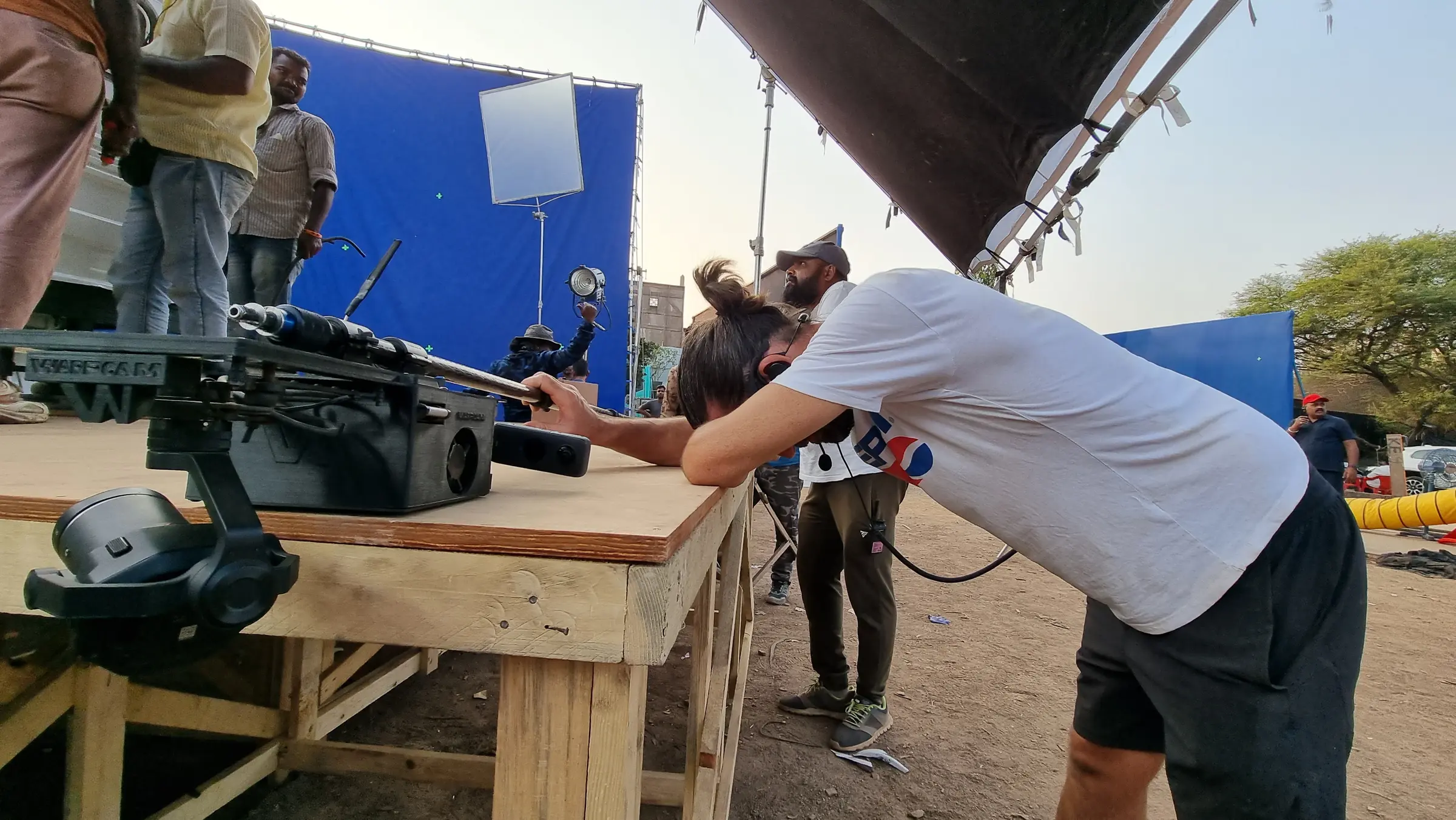
Specialist camera systems make invisible time physical. In Fischer’s account, an under-crewed WarpCam deployment can return from set with several parallel systems that must all be ready again: batteries charged, lenses cleaned, parts inspected, faults repaired, wiring re-soldered, media and accessories sorted, configurations rebuilt. When this cannot happen in parallel during the unit day, the systems are distributed across hotel rooms. One person charges, another cleans, another repairs. The team’s private rooms become an unofficial camera department.
The WarpCam production record identifies the system and films including The Gray Man, Fast X and Jawan. The accounting test is still general: if tomorrow’s call depends on the reset, then the reset is part of tomorrow’s production readiness.
A separate large-production record shows the same dependency at a different scale. American Cinematographer reports that the aerial work for Mission: Impossible — The Final Reckoning involved repeated camera-mount testing and an aircraft-build team working nights to repair and rebuild planes, including changing engines. That case does not prove the WarpCam account. It demonstrates why ‘equipment ready at call’ can contain an entire previous shift.
The weekend and post-production tail
The hidden hours do not stop at the hotel. Weekends absorb next-week planning, calls, revised choreography, equipment lists, availability checks, travel changes and cost reports. Invoicing and expense reconciliation arrive after the creative pressure has passed, but they are still required to run the work. Some of this is ordinary business overhead. Some is project administration triggered by production changes. The distinction belongs in the agreement, not in an argument after delivery.
Post-production can extend the action role much further. Fischer reports action directors and stunt coordinators assembling complete action sequences, sometimes without a separate post fee and sometimes for a fee far below the time involved. Their input may preserve choreography, identify the intended impacts or make provisional material legible. Yet the production should never rely on ambiguous heroics. If action editorial consultation is required, name the days, the cut stage, access to media, credit, decision authority, review rounds and handoff.
The Visual Effects Society’s current on-set guide makes the dependency visible from another direction. Previs, techvis and stuntvis connect to camera and lens records, witness cameras and on-set data used downstream. Missing information does not always create a one-for-one penalty; a simpler method can genuinely eliminate work. But absent planning and data often return as uncertainty, reconstruction or constrained choices for edit and VFX. The Film and Television Charity’s post-production research describes the broader result: late decisions, long hours, night shifts and post teams expected to make do with the time and budget left over.
The issue is overlap—not a hierarchy of creative worth
Every film department combines craft, judgment and execution; this is not a ranking of creative worth or an argument about who works hardest. Camera assistants solve technical and logistical problems. Lighting technicians shape images and restore complex systems. Grips, costume, props, locations, production, sound and post all carry preparation the finished frame may hide.
The accounting problem is that action roles can cross several production categories in one person: creative authorship, physical performance, safety-critical coordination, actor preparation, camera planning, technical maintenance and editorial continuity. A stunt coordinator can begin the morning as a planner, spend the day supervising exposure and finish the night as a reference editor. A stunt performer can rehearse, test equipment, double an actor and contribute movement knowledge to camera. An action director can move between story, unit leadership and post. When the deal recognises only the most visible category, the remaining functions become vulnerable to being treated as enthusiasm.
That is also why the useful distinction is not ‘creative people’ versus ‘executing people’. It is required work versus unscoped work. Who owns the task? Who has authority? When does it occur? What depends on it? What compensation or fee contains it? Those questions respect every department because they replace status arguments with production facts.
The action-time ledger
| Phase | Work that often disappears | What depends on it | Honest scope line |
|---|---|---|---|
| Pitch / development | Custom proof of concept, performers, proprietary camera, edit, revisions | Greenlight, method, budget and creative confidence | Deliverable, usage, team, kit, days, revisions and fee Source ↗ |
| Preparation | Breakdown, Stunt Design, choreography, recce, tests and equipment build | Feasibility, safety planning, schedule and coverage | Named prep days, decision owners and approval milestones Source ↗ |
| Actor preparation | Movement learning, double handover, costume and camera rehearsal | Performance, confidence, continuity and usable takes | Protected sessions, attendees, facility and readiness goal Source ↗ |
| Photography | Briefing, rehearsal, resets, changes and specialist-camera coordination | The shot itself | Role, authority, call, overtime and change protocol Source ↗ |
| After wrap | Fight-dailies review, gap audit, media handling and next-day redesign | Pickup decisions while repair is still possible | Deliverable, deadline, media access, overtime and turnaround Source: Practitioner account on invisible action-production time |
| Equipment reset | Charging, cleaning, inspection, repair, soldering and reconfiguration | Technical readiness at the next call | Crew, workspace, consumables, reset window and handover Source ↗ |
| Weekend / administration | Next-week planning, changes, booking, expenses and reports | Crew, kit, travel and financial continuity | Separate ordinary overhead from production-requested administration Source: Practitioner account on invisible action-production time |
| Post-production | Action reference cuts, consultations, VFX handoff and revisions | Rhythm, continuity, pickups and final integration | Days, cut stage, authority, credit, rounds and fee Source ↗ |
Time often moves instead of disappearing
The familiar production promise is that a shortcut saves time. Sometimes it does. Removing an unnecessary rig, simplifying a beat or choosing a clearer angle can eliminate work without creating a debt. Good teams do this constantly. The dangerous shortcut is the one that removes a named hour but preserves the expectation of the same result.
Cut actor rehearsal and the unit may become the rehearsal room. Remove the previs edit and camera may discover the coverage problem at full crew cost. Skip the on-set reference or measurements and VFX may reconstruct them. Leave the fight unchecked and tomorrow’s pickup may become a post repair. Defer equipment maintenance and the next call begins with a fault. In those cases, time has not been saved; it has been transferred to a later phase, another department or someone’s recovery.
That makes time systemic. Edit stability affects VFX. Incomplete VFX affects editorial judgment. Picture changes affect sound and music. Action coverage affects all of them. There is rarely a perfectly contained delay because each department receives decisions and materials from somewhere else. A schedule can look locally efficient while the film becomes globally more expensive.
Under pressure, the most valuable response is not panic but visibility: facts, options, consequences and one shared minimum acceptable result. A ten-minute alignment can be faster than an hour of departments optimising against different assumptions. Calm is not softness. It is a way of keeping scarce time usable.
Working time, contract time and professional overhead are not identical
No single rule makes every hidden hour payable in every country or deal. Employment status, collective coverage, production type, local law, flat fees, overtime terms and genuine self-directed business development all matter. The EU Working Time Directive sets baselines for covered workers, including daily rest and average weekly hours, but national implementation and derogations matter and the directive does not automatically decide a freelancer’s invoice.
Within its defined scope, Germany’s TV FFS expressly counts production-directed preparation, processing, follow-up and administration as working time. That is significant, but the agreement does not cover every freelancer, every production or every arrangement. In the United States, the 2026 SAG-AFTRA agreement treats categories and compensation of stunt-coordinator prep as negotiated contract matter in covered productions. That confirms the issue is real; it does not export one universal entitlement.
Long-hours evidence should be read with the same discipline. A 2025 Bectu survey of almost 500 UK film and television workers found 40 per cent reporting less than 11 hours’ turnaround frequently and 34 per cent sometimes. A 2023 Bectu/Mark Milsome Foundation survey reported that 96.3 per cent of respondents’ most recent normal day lasted at least ten hours, excluding travel, overtime and additional unpaid work. Both were voluntary, self-selected and not stunt-specific. They establish a credible wider context, not a precise action-department rate.
The production remedy does not require pretending every hour belongs to the client. It requires classifying the hour honestly: career overhead, optional investment, commissioned development, production prep, shoot work, overtime, reset, administration or post. Ambiguity usually benefits the party receiving the deliverable.
Make required time visible before asking people to spend it
A workable action-time plan can be simple. Start with the sequence outcome, then list every deliverable needed to reach it. Put an owner, estimate and decision deadline beside each one. Mark work that happens outside the unit day. Define what a flat fee contains and what triggers a change. Schedule actor training against availability, not hope. Give specialist equipment a reset window and a suitable workspace. Protect the turnaround of people expected to make next-morning decisions.
For proof-of-concept work, decide whether the production is buying an idea, a test or a reusable asset. For previs, state whether the goal is choreography, camera, safety communication, budget or editorial logic. For same-night reviews, define the question that must be answered. For post, define whether action leadership is consulting, auditing or editing. Precision prevents both over-servicing and surprise invoices.
Producers should also ask where a proposed saving will reappear. If the answer is ‘the stunt team will sort it out later’, later needs a date and a line. If the answer is ‘post can fix it’, post needs to confirm the method, information and budget. If the answer is ‘we can do it in the hotel’, the hotel has just been turned into a workplace and the turnaround has changed.
The objective is not unlimited time. No production has it. Experienced crews make hard choices about where precision matters and where approximation is acceptable. What they need is usable time: time attached to a decision, a responsibility and a realistic consequence. That is how creative ambition, physical performance, technical readiness and recovery stop competing invisibly.
What the evidence can—and cannot—prove
This article combines Fischer’s named practice account with institutional guidance, collective agreements and broader research on hidden creative labour, turnaround and post-production. The sources confirm that planning, tests, rehearsal, actor preparation, data collection, recovery and follow-up are real production functions. They also show that covered agreements can treat preparation and follow-up as work.
They do not establish what percentage of action professionals regularly work unpaid, how many hours the average sequence hides or whether a specific production breached a contract or law. That boundary is important: a strong argument does not need an invented statistic.
The conclusion is operational. If production requires the task, production should see the task. If it relies on the result, the schedule and deal should name who performs it, when and for what compensation.
Time does not simply run out on an action sequence. It is scheduled, spent, transferred, hidden—and too often taken from the people making the sequence possible.— STUNT.BLOG Editorial Desk
Sources and evidence notes16 entries
- Practitioner account on invisible action-production time — Ferdi Fischer / STUNT.BLOG editorial interview, 2026-07-27. Accessed 2026-07-27.
- Job Quality in the Creative Industries: The Final Report from the Creative PEC’s Good Work Review — Creative Industries Policy and Evidence Centre, 2023-02-01. Accessed 2026-07-27.
- Bectu calls for action on lack of rest breaks as research shows huge health and safety risk to crew — Bectu, 2025-02-27. Accessed 2026-07-27.
- Bectu and Mark Milsome Foundation release findings from crew safety survey — Bectu and Mark Milsome Foundation, 2023-11-21. Accessed 2026-07-27.
- Let’s Fix It in Post — Research — The Film and Television Charity. Accessed 2026-07-27.
- On-Set VFX Data Collection and Usage Guide, Version 1.1.0 — Visual Effects Society, 2026-05-12. Accessed 2026-07-27.
- Safety Bulletin #45 — Guidelines for Long or Successive Takes — Industry-Wide Labor-Management Safety Committee / Contract Services, 2022-03-10. Accessed 2026-07-27.
- Directive 2003/88/EC concerning certain aspects of the organisation of working time — European Parliament and Council of the European Union, 2003-11-04. Accessed 2026-07-27.
- 2026 Memorandum of Agreement Between SAG-AFTRA and the Alliance of Motion Picture and Television Producers — SAG-AFTRA and AMPTP, 2026-05-27. Accessed 2026-07-27.
- Stunts, fights and other potentially hazardous production activities — UK Health and Safety Executive. Accessed 2026-07-26.
- Safety Bulletin #4 — Stunts — Industry-Wide Labor-Management Safety Committee / Contract Services, 2025-03-27. Accessed 2026-07-21.
- Gagenempfehlung 2023 — German Stunt Association, 2023-03-09. Accessed 2026-07-26.
- Tarifvertrag für auf Produktionsdauer Beschäftigte Film- und Fernsehschaffende 2024–2026 — Produktionsallianz and ver.di / BFFS, 2024-10-12. Accessed 2026-07-26.
- Jennifer Aniston's Murder Mystery 2 Eiffel Tower Stunt — Netflix Tudum, 2023-03-31. Accessed 2026-07-23.
- Mission: Impossible — The Final Reckoning: Compact Camera Mounts in Flight — American Cinematographer, 2026-04-29. Accessed 2026-07-20.
- WarpCam® — SlamArtist.com. Accessed 2026-07-20.

Loading approved comments…