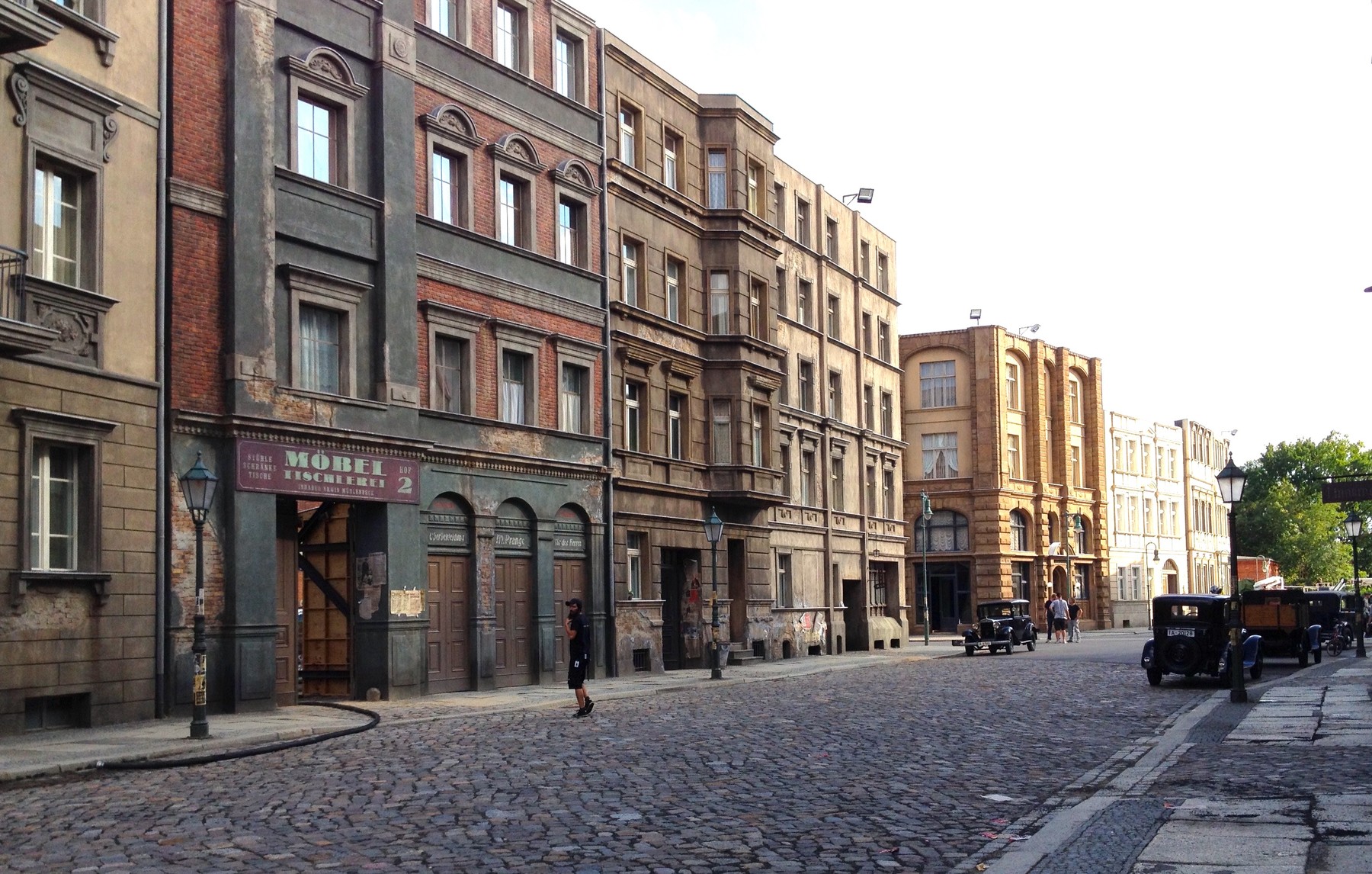
John Wick's Berlin nightclub is an extravagant piece of action infrastructure. For John Wick: Chapter 4, the production built a multi-level environment with water and fire effects inside Kraftwerk Berlin. Other parts of the film were constructed at Studio Babelsberg, where the action could be designed around a purpose-built space. Keanu Reeves was performing inside a network of local construction, technical and stunt expertise that international production had already learned to use. John Wick: Chapter 4 production account
The French stunt team's account gives that network a timescale. Chad Stahelski contacted fight choreographer and stunt coordinator Laurent Demianoff about a year before filming. A core of six martial artists grew to roughly fifty people. Work developed through video calls with Los Angeles before an international team came together in Berlin, with American, German, Japanese and French stunt professionals. Cascadeurs : John Wick 4
That is the part a producer should study. The value was built before the expensive shooting day arrived.
A European action bid can change who rehearses together, where the sequence is built, how the camera is integrated and how many production moves the work requires. It deserves consideration while those choices are still open.
The discussion becomes more concrete when the day rate is followed all the way through a difficult call sheet.
The worked SAG-AFTRA scenario follows a daily stunt booking through negotiated stunt adjustments, overtime, meal penalties and a forced call.
A European action bid should price the complete sequence: preparation, people, camera, travel, lawful working conditions, subsequent payments and the cash timing of incentives.
Put the SAG numbers on the table
SAG-AFTRA publishes its wage tables and agreements. The STUNT.BLOG Editorial Desk believes the arithmetic deserves equally public attention. 2026 Theatrical Wage Table 2026 Theatrical-Television Memorandum of Agreement
European stunt performers should be able to see what a defined US contract pays when a production overruns. Producers, showrunners and streaming executives should be able to see the same obligations in black and white. Both sides deserve access to the calculation.
So we are showing the working. Every assumption is stated. Every contractual amount has a source. Anyone reading this should be able to check the result against the published rules.
A budget conversation becomes more honest when the people doing the work and the people financing it can see the same numbers.
A $1,283 booking, $1,500 in stunt adjustments and the clock
Our example uses an adult stunt performer hired by the day under the standard SAG-AFTRA theatrical agreement, at the minimum applicable from 1 July 2026 to 30 June 2027. That minimum is $1,283. The current agreement was ratified in June 2026 and took effect on 1 July. SAG-AFTRA Members Approve 2026 TV/Theatrical Contracts Tentative Agreement 2026 Theatrical Wage Table
The hypothetical performer works an ordinary weekday in the studio zone, from 08:00 until dismissal at 19:00. All eleven hours count as paid work. Food is eaten while work continues, with the performer receiving no qualifying meal break. The example assumes no non-deductible early meal, applicable grace period or waiver. The next day's first call is 06:00.
This deliberately difficult schedule combines three paid overtime hours, a five-hour meal delay and an eleven-hour interval before the next call. The booking starts at minimum scale, with $1,500 in negotiated stunt adjustments added for the demanding work described below.
The stunt is a hard impact on concrete. Two or three takes were planned; camera or acting problems push it to five. In this hypothetical, the performer and production negotiate two supplementary stunt adjustments totalling $1,500 for the additional impacts and difficulty. Those two adjustments and their combined amount are the agreement assumed for this calculation.
Stunt adjustments recognise the nature and demands of the specific work. Schedule H Part I, section 11 and the theatrical daily contract, Exhibit C-1 provide for negotiation when additional work goes beyond the agreed scope, with the adjustment recorded on the time report or time card. The contract supplies the negotiation framework; it does not prescribe a universal number of adjustments for five takes.
In Ferdi Fischer's production experience, adjustments are a regular part of US stunt bookings. He describes amounts ranging from a few hundred dollars to several thousand, with exceptionally demanding or high-risk vehicle stunts capable of carrying negotiated adjustments of $15,000, $20,000 or $30,000. These are practitioner-reported examples of negotiated amounts, rather than a published SAG-AFTRA price list.
The first meal is due by 14:00. SAG-AFTRA's published theatrical rules require the first meal within six hours of first call, with a qualifying meal break lasting at least thirty minutes. The daily stunt schedule incorporates the relevant meal and rest provisions. Codified Basic Agreement: Schedule H and incorporated Schedule A provisions How do Theatrical meal periods work?
The adjustment also changes overtime. Base plus adjustments is $1,283 + $1,500 = $2,783. That exceeds the theatrical money break of twice the daily minimum, $2,566. Under Schedule H Part I, section 8, overtime uses the capped hourly base of $2,566 ÷ 8 = $320.75; all three overtime hours here pay at time-and-a-half, including the eleventh. The resulting overtime is $1,443.38. SAG-AFTRA's current overtime guidance confirms the money-break rule.
Follow every dollar
| Component | Calculation | Gross amount |
|---|---|---|
| Eight-hour base | Current daily minimum | $1,283.00 Source ↗ |
| Negotiated stunt adjustments | Two supplementary adjustments; assumed combined amount | $1,500.00 Source ↗ |
| Ninth and tenth hours | 2 × $320.75 × 1.5 | $962.25 Source ↗ |
| Eleventh hour: over the money break | 1 × $320.75 × 1.5 | $481.13 Source ↗ |
| Meal-period violations | $25 + $35 + 2 × $50 + 6 × $75 | $610.00 Source ↗ |
| Forced call at the next call | Lower of the daily rate and $900 | $900.00 Source ↗ |
| Combined amount | Base, adjustments, recalculated overtime and the stated violations | $5,736.38 |
Amounts are in US dollars. The calculation retains unrounded intermediate values and rounds displayed amounts to cents. The model fixes the negotiated stunt adjustment at $1,500; this is an assumption, not a claimed union tariff. The forced-call payment is triggered by the following call. That next shift’s ordinary wages require their own budget line. Employer contributions, payroll taxes, fees and any further negotiated compensation are additional.
The meal total deserves particular attention. Five hours contain ten half-hours. Under the 2026 agreement, the first costs $25, the second $35, the third and fourth $50 each, and the fifth onward $75 each. That is $610. The new $75 tier appears in section 22 of the 2026 Memorandum of Agreement. 2026 Theatrical-Television Memorandum of Agreement
The studio-zone rest requirement is twelve hours. Dismissal at 19:00 followed by a 06:00 call leaves eleven. For a day performer, SAG-AFTRA lists the forced-call payment as the daily rate or $900, whichever is lower. Here it is $900. Location-specific rest provisions can change the result, which makes the stated studio-zone assumption essential. Rest Periods / Forced Calls
For fifteen performers on these same daily terms, stunt adjustments alone total $22,500. Meal and rest violations still total $22,650. Those three lines together are $45,150, before base wages and overtime. Adding the rounded per-performer gross amounts gives a group total of 15 × $5,736.38 = $86,045.70, with following-shift wages and employer costs still additional. A performer’s annual income depends on employment across the year.
The economic question is immediate. Could a different rehearsal plan, location arrangement or coverage design have kept more of that expenditure available for the sequence?
Protection has a price, and producers have a limit
Meal breaks and rest periods protect people whose work depends on timing, concentration and physical control. Producers have a direct operational interest in those protections. The same contract also requires reasonable stunt-safety equipment requests to be met and producer-supplied equipment to be suitable for the work. Codified Basic Agreement: Schedule H and incorporated Schedule A provisions
The producer's problem appears when several obligations accumulate around the same disruption. A delayed setup can push work into overtime, extend a meal violation and collide with the next call. A fixed location window can make all three pressures arrive together.
Our editorial position is that the cumulative price deserves scrutiny. A producer can respect every entitlement and still conclude that a sequence cannot carry the resulting cost at a particular location. A protective agreement can become commercially prohibitive for a given production when several provisions are triggered together.
The rate itself is published. The forecasting challenge lies in how often the production will hit it, how many people are affected and whether the remaining schedule can absorb the consequence. A credible bid therefore needs both the planned day and a plausible overrun case.
That calculation should happen early enough to influence the production plan.
For the preparation and follow-through outside the shooting day, see The Hours the Call Sheet Misses.
Europe gives the producer more combinations
For EU citizens, access to employment across the EU generally comes without a work-permit requirement. That creates a practical basis for assembling teams across Germany, France, Spain and Hungary. Cross-border employment still involves the applicable posting rules, social-security documentation and host-country working conditions. A competent production partner prices and organizes those obligations. Work permits Posting staff abroad
London adds another pool of specialist capability, with its own immigration arrangements. Each crew member's nationality, existing status and destination determine the relevant work-permission route. The useful production network is European. Its legal administration is country-specific. Work permits Creative Worker visa
The workflow already extends across borders. For Black Widow, The Third Floor's London team describes working with stunt and shooting units on the Budapest chase, developing action beats alongside the logistics and setups needed for location filming. That is a production record of preparation joining departments before they reach the street. Black Widow
For a new project, the opportunity is to assemble that relationship early. Match the performers, rehearsal space, vehicle expertise, rigging, camera team and location to the sequence. Keep the people who have developed its timing involved as it moves into photography.
Every additional transfer should earn its place in the budget. Flights, freight, accommodation, fuel and equipment moves all consume resources. A plan that reduces unnecessary movement also reduces its exposure to changes in those prices. The savings belong in an actual quote, with travel and availability confirmed.
Production archive
The people around the camera
The camera belongs in the action bid
A stunt can be prepared thoroughly while the camera approach remains unresolved. The production then pays to solve their relationship at the point when the whole unit is waiting.
An integrated action bid should show how the image will be made. Which movements need a specialist platform? Who operates it? How much rehearsal is required? What is the reset? Which departments share the decision? What usable coverage should arrive in editorial?
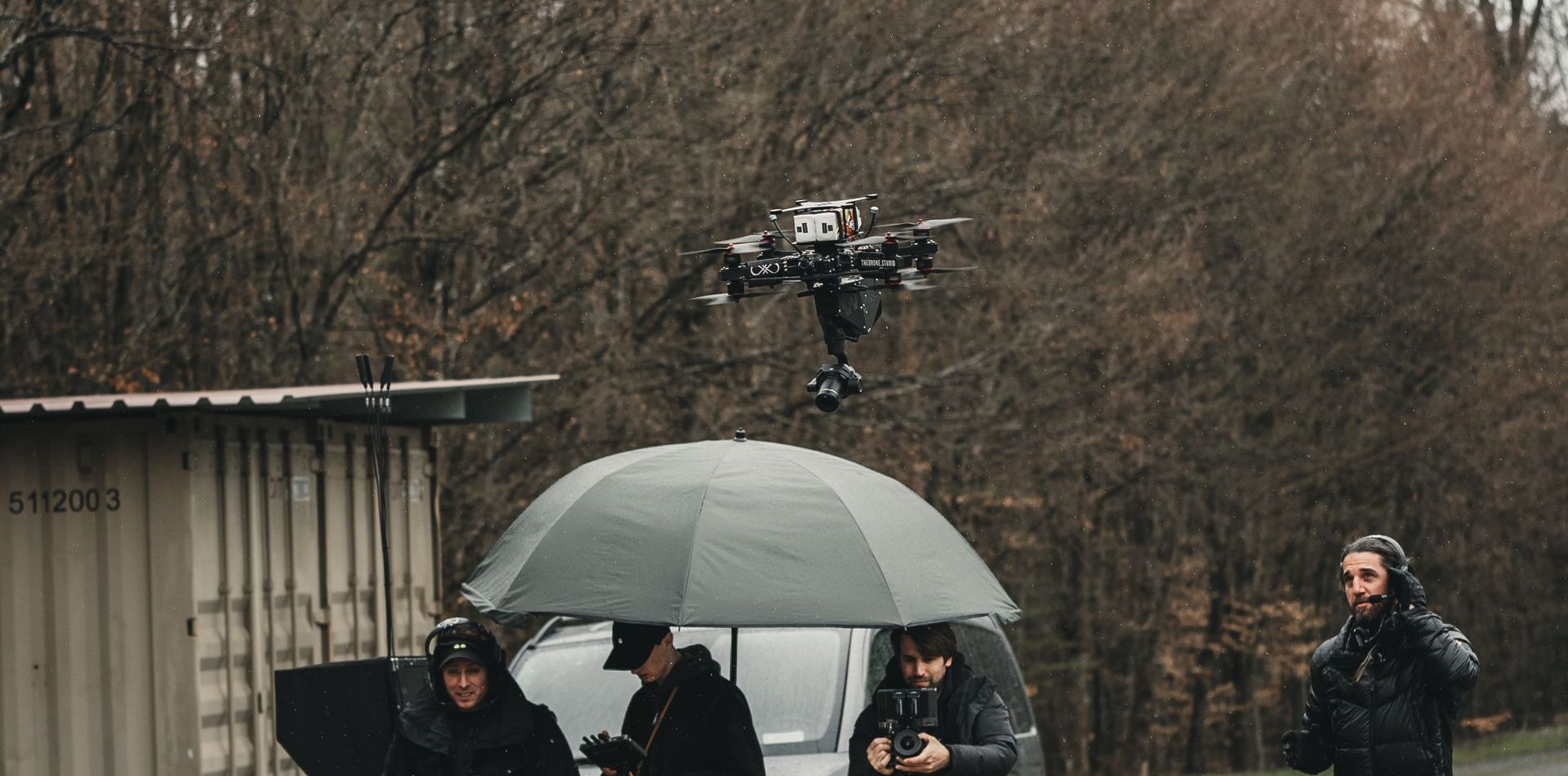
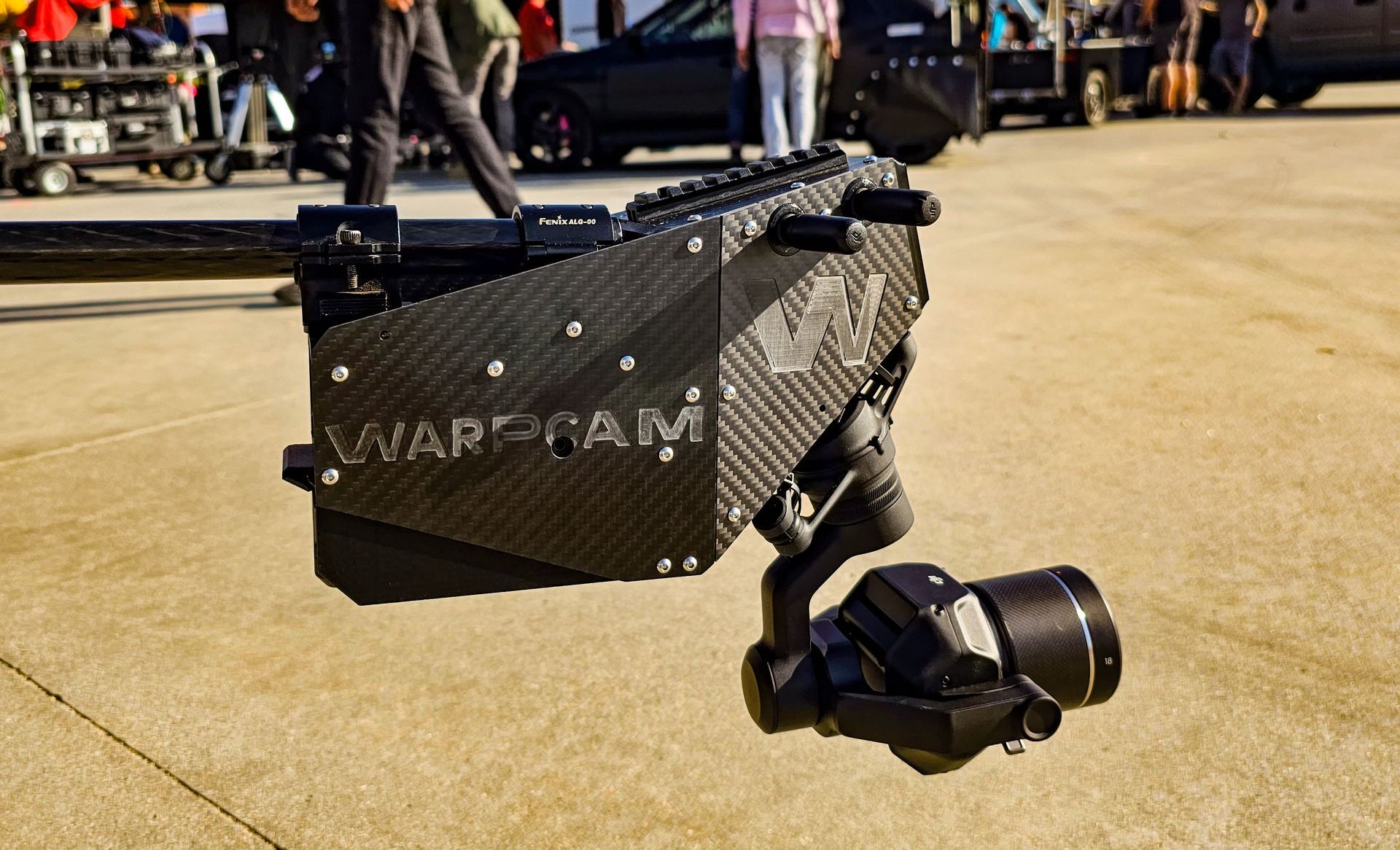
WarpCam® offers a relevant example from the SlamArtist.com network. Its operator-led ecosystem brings camera movement into action planning across handheld, pole, vehicle, RC and FPV configurations. The production buys the team's ability to develop and execute the shot within the sequence. WarpCam® Deutschland
In his published SWR1 interview, Ferdi Fischer describes one WarpCam setup through three collaborating roles, a physical operator, a remote camera operator and a focus puller. He also describes combining action support and camera work within a unit on Fast & Furious. That account places expertise, coordination and departmental cooperation at the centre of the system. SWR1 Leute: Hollywood Stunts — interview and transcript
For the producer, the test is measurable. Compare the proposed rehearsal time, setup time, reset time, staffing and usable coverage against the needs of the sequence. A specialist camera approach earns its place when that comparison supports the choice.
This is where an early European bid can be particularly valuable. The crew can propose a way of making the action while the plan still has room to change.
The relationship between movement and the recorded image is examined in The Shot Window.
WarpCam® · Production archive
Camera planning belongs in the bid
Put the incentive through the whole budget
Hungary's National Film Institute describes a 30% production incentive and publishes examples showing how qualifying expenditure affects the result. Its example with 1,000,000 in total spend, divided into 600,000 Hungarian and 400,000 non-Hungarian expenditure, has a qualifying base of 750,000 and a rebate of 225,000. That equals 22.5% of the whole example budget. Hungarian Film Incentive
30% of the eligible base, 22.5% of this whole budget
| Budget step | Calculation | Amount |
|---|---|---|
| Hungarian expenditure | Qualifying local spend | 600,000 Source ↗ |
| Non-Hungarian expenditure | Remaining example spend | 400,000 |
| Whole example budget | 600,000 + 400,000 | 1,000,000 |
| Qualifying incentive base | 600,000 + 150,000 eligible non-Hungarian expenditure | 750,000 Source ↗ |
| Rebate | 750,000 × 30% = 22.5% of 1,000,000 | 225,000 Source ↗ |
The institute describes the support as post-financing. Its current guidance also identifies a 2026 annual collection-account limit and a six-month requirement for starting principal photography after the registration decision. A producer needs the eligible base, administrative timing, expected receipt date and financing cost in the model. Hungarian Film Incentive
The comparison should therefore follow cash through the production. Start with the actual crew and supplier bids. Add travel, employment costs, insurance, preparation, facilities and contingency. Apply the support the project qualifies for, then account for the cost of waiting for it.
Residuals belong in the greenlight model
Residuals compensate performers for qualifying use beyond the exhibition covered by their initial compensation. The applicable agreement, production type and subsequent use determine the obligation. SAG-AFTRA's public guidance explains those triggers, while the current agreement supplies the relevant terms. SAG-AFTRA TV and Theatrical Residuals Quick Guide 2026 Theatrical-Television Memorandum of Agreement
For a streamer or producer, this means planning beyond wrap. The initial release, subsequent territories, platforms and licensing arrangements should be tested together with the performer contracts. Reporting and payment administration belong in that forecast.
European contracts deserve the same level of attention. Equity describes secondary payments for film, television and streaming under its agreements. SAG-AFTRA's Global Rule One also establishes worldwide contractual obligations for members within its scope. A production's location, employing entity, performers and signed agreements all matter. Understanding secondary payments Global Rule One
A European partner adds value by making those obligations legible before signature.
Give Europe the brief while it can still change the film
A serious comparison must carry the full cost of lawful working conditions. The EU Working Time Directive establishes minimum protections including breaks after more than six hours of work and eleven consecutive hours of daily rest, with national implementation and permitted derogations shaping the applicable rules. The local working-time and collective-agreement position belongs in every bid. Working Time Directive
European performers should also see the commercial value they bring. Rehearsal, technical preparation, equipment readiness and action-specific camera knowledge all need an agreed scope and payment. Producers benefit when the work required to deliver the sequence is visible from the start.
The case for Europe is strongest when the proposal shows what the money buys. It should specify who prepares the action, who photographs it, which location and facilities support it, how the schedule protects recovery, and what changes when the day overruns.
Ask for that proposal from the European network before the sequence is locked.
Budapest, Babelsberg and London can contribute to a production plan built around the actual work. Give those teams the opportunity to shape the method, and compare the resulting cost of delivering the scene.
Sources and calculation method
This article combines public contract documents, official government and film-institute guidance, first-hand production accounts and identified supplier information. The payroll example is an original hypothetical calculation. Production recommendations and judgments about commercial viability are the Editorial Desk's analysis. WarpCam® is a connected supplier example. Sources were checked on 4 November 2026.
Sources and contract documents20 entries
- Cascadeurs : John Wick 4 — CST, 2023-06-06. Accessed 2026-11-04.
- John Wick: Chapter 4 production account — Art Department Studio Babelsberg. Accessed 2026-11-04.
- SAG-AFTRA Members Approve 2026 TV/Theatrical Contracts Tentative Agreement — SAG-AFTRA, 2026-06-04. Accessed 2026-11-04.
- 2026 Theatrical Wage Table — SAG-AFTRA. Accessed 2026-11-04.
- Codified Basic Agreement: Schedule H and incorporated Schedule A provisions — SAG-AFTRA. Accessed 2026-11-04.
- Overtime: Day Performers Theatrical — SAG-AFTRA. Accessed 2026-11-04.
- How do Theatrical meal periods work? — SAG-AFTRA Help Center. Accessed 2026-11-04.
- 2026 Theatrical-Television Memorandum of Agreement — SAG-AFTRA / AMPTP, 2026-05-27. Accessed 2026-11-04.
- Rest Periods / Forced Calls — SAG-AFTRA. Accessed 2026-11-04.
- Work permits — European Union / Your Europe. Accessed 2026-11-04.
- Posting staff abroad — European Union / Your Europe. Accessed 2026-11-04.
- Creative Worker visa — UK Government. Accessed 2026-11-04.
- Working Time Directive — European Commission. Accessed 2026-11-04.
- Global Rule One — SAG-AFTRA. Accessed 2026-11-04.
- SAG-AFTRA TV and Theatrical Residuals Quick Guide — SAG-AFTRA, 2021-01-28. Accessed 2026-11-04.
- Understanding secondary payments — Equity. Accessed 2026-11-04.
- Hungarian Film Incentive — National Film Institute Hungary. Accessed 2026-11-04.
- SWR1 Leute: Hollywood Stunts — interview and transcript — SlamArtist.com. Accessed 2026-11-04.
- WarpCam® Deutschland — WarpCam®. Accessed 2026-11-04.
- Black Widow — The Third Floor, 2021-09-21. Accessed 2026-11-04.

Loading approved comments…