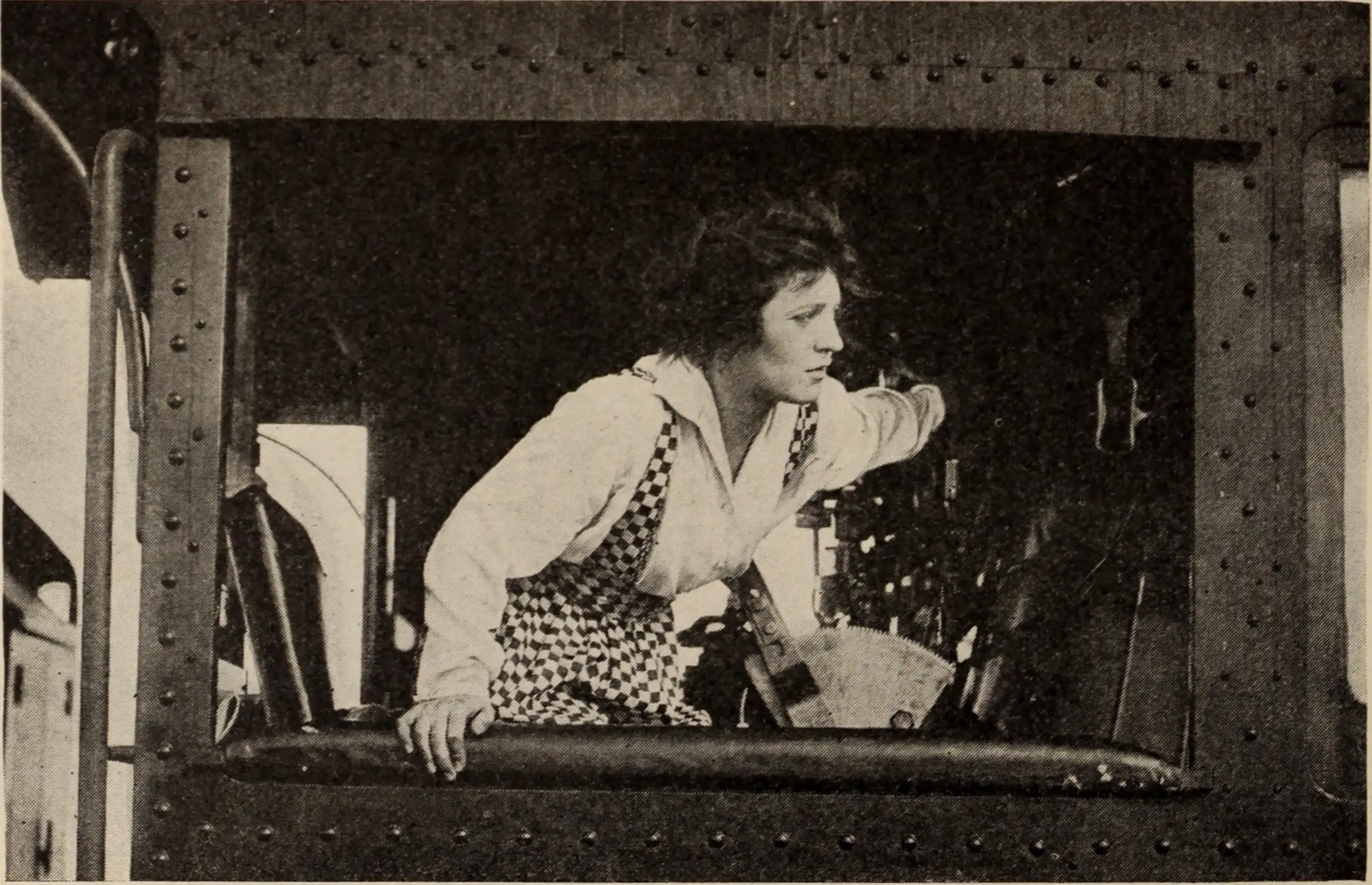
The Hazards of Helen ran for 119 episodes from 1914 to 1917, turning railroad action into a recurring workplace adventure rather than a single novelty.
The preserved record identifies Helen Holmes as both performer and co-director, while AFI records Helen Gibson moving from doubling Holmes in some episodes to taking over the lead.
Period advertising proves that studios sold physical daring; it does not prove that every advertised feat was performed exactly as described, or that one woman can be crowned the universal first stunt performer.
Analysis
Cinema had action before it had a stable way to name the people who made it. In The Hazards of Helen, Helen Holmes and Helen Gibson moved across categories that a contemporary production would separate: star performance, doubling, riding, driving, physical action and, in Holmes's case, direction and company leadership.
That overlap is the real story. The surviving films and trade records support remarkable work. They do not support a frictionless origin myth in which one universally agreed first stuntwoman suddenly invents the profession. The evidence is stronger when it is allowed to remain complicated.
The work arrived before the job title
The Hazards of Helen was not one feature built around one exceptional set piece. It was a weekly production system. Its heroine worked as a railroad telegraph operator at a remote depot, repeatedly encountering failed machinery, criminal interference or institutional doubt and then restoring order through competence and movement. The National Film Preservation Foundation describes the series as a workplace adventure: Helen had a job before she had a hazard.
That premise matters to stunt history. The action was not detached spectacle performed by an anonymous body after the drama stopped. It was the character's method of solving the story. Riding, boarding trains, climbing and driving were part of the heroine's authorship on screen.
The credits did not consistently separate that labour. Cast lists named the actor and character. Direction might be recorded, omitted or shared. Doubling could survive in a later catalog note rather than on the film. Publicity promoted fearlessness because fearlessness sold tickets, but it rarely supplied the department-by-department evidence a modern credit inquiry would demand.
Reading those sources with modern job titles can therefore create false precision. The work is visible; its boundaries are not.
Helen Holmes was not only the face of the danger
The preserved Episode 13, The Escape on the Fast Freight, gives the clearest single record. The National Film Preservation Foundation identifies 22-year-old Helen Holmes in the lead and credits her as co-director with Leo Maloney. Its notes also cite a contemporary Moving Picture World report describing Holmes as managing the company, writing scripts and doing much of the production work.
Those are not interchangeable claims. A cast credit proves performance. A direction credit proves a formal creative role on that episode. A trade report about company management and writing is contemporary evidence, but it still needs to be attributed to the publication that made it. Keeping the categories separate makes Holmes more legible, not less impressive.
The resulting image is of an action performer operating close to narrative and production authority. She was not merely asked to execute a dangerous insert designed elsewhere. At least in the preserved episode and contemporary reporting around the company, she helped shape the work that placed her body in the frame.
That concentration of authority would later become rarer as productions divided action across coordination, specialist performance, rigging, cameras, safety systems and editorial. The modern rigging field guide shows how many separate systems can now sit behind one apparently simple movement.
Helen Gibson shows how quickly doubling became stardom
AFI's catalog record for Helen's Sacrifice states that Gibson had doubled Holmes in some episodes before replacing her in the lead. The exact handoff is source-conflicted. Contemporary Moving Picture World publicity presents A Test of Courage, episode 49, as the first Hazards of Helen picture in which Gibson appears. Motion Picture News reviewed the same episode as introducing a new Helen. A later AFI catalog note instead names A Mile a Minute, episode 50, as Gibson's first lead episode.
The one-episode discrepancy does not change the larger transition. A worker whose contribution could disappear behind another performer's screen identity became the continuing identity of the serial. It does show why a clean modern chronology should not be manufactured where the records disagree.
That transition is often used to support the label 'first professional stuntwoman.' It certainly demonstrates paid, specialist physical work and a career built around action. But it does not create a universal starting line. Other women had already led action-heavy films and serials; the surviving sources do not use one consistent employment category; and the word professional can mean paid performer, dedicated double, recognized specialist or star marketed through physical feats.
Gibson's importance does not depend on winning that semantic race. Her career exposes a foundational connection between doubling and authorship: the person who could make the action work became the person whose face and name carried it.
Public-domain publication still / June 1916
From hidden double to visible action lead
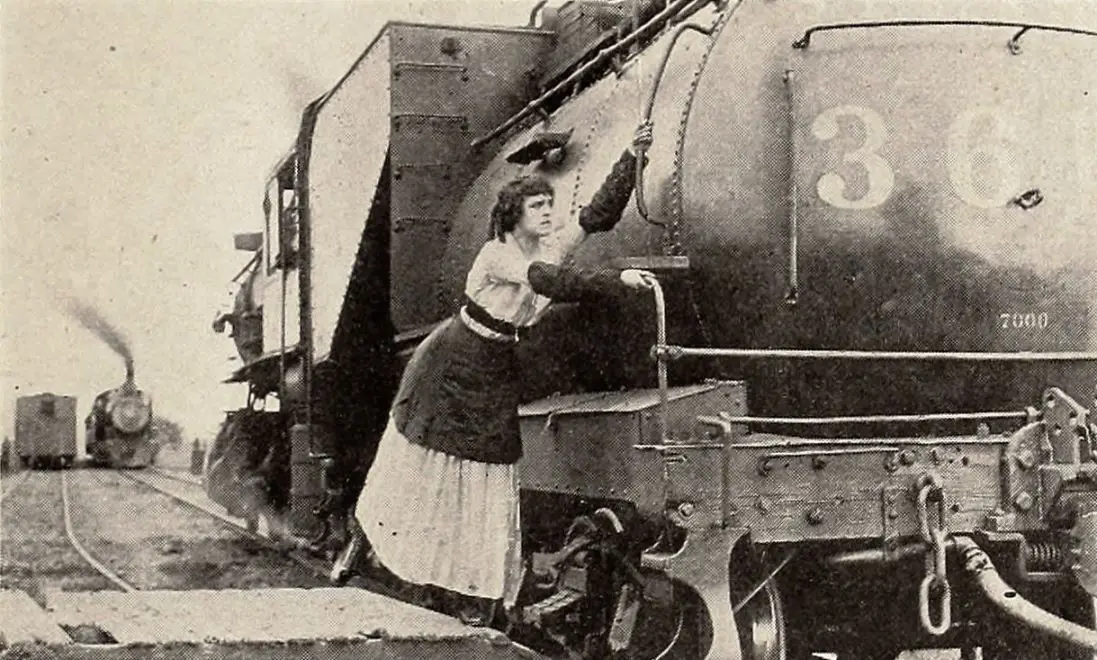
Publicity sold nerve; the frame sold illusion
Kalem's advertising made danger part of Gibson's star identity. The AFI record for Tapped Wires preserves language presenting her as an exceptionally daring actress and promising a dense succession of thrills. That is valuable evidence of marketing. It is not an engineering report, a call sheet or proof that every body in every advertised shot was live.
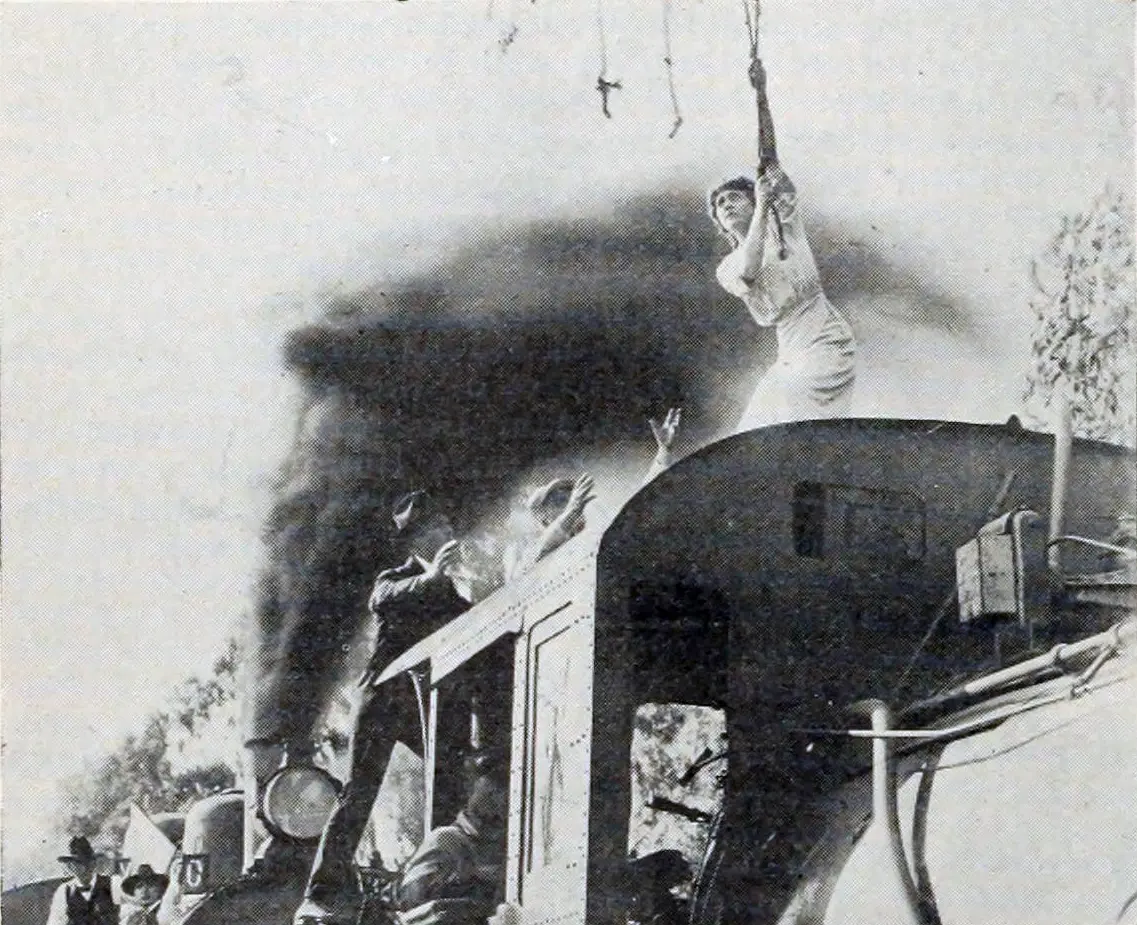
A contemporary Motion Picture News review, also preserved by AFI, noticed exactly that gap. In one vehicle shot, the figures remained so unnaturally still that the substitution became obvious. The reviewer criticized the effect while praising other sensational scenes in the episode.
This is not a debunking of Gibson. It is evidence that screen action already worked through layers: skilled live performance, substitution, staging, camera position and editing. The audience was not buying an untouched record of danger. It was buying a persuasive event.
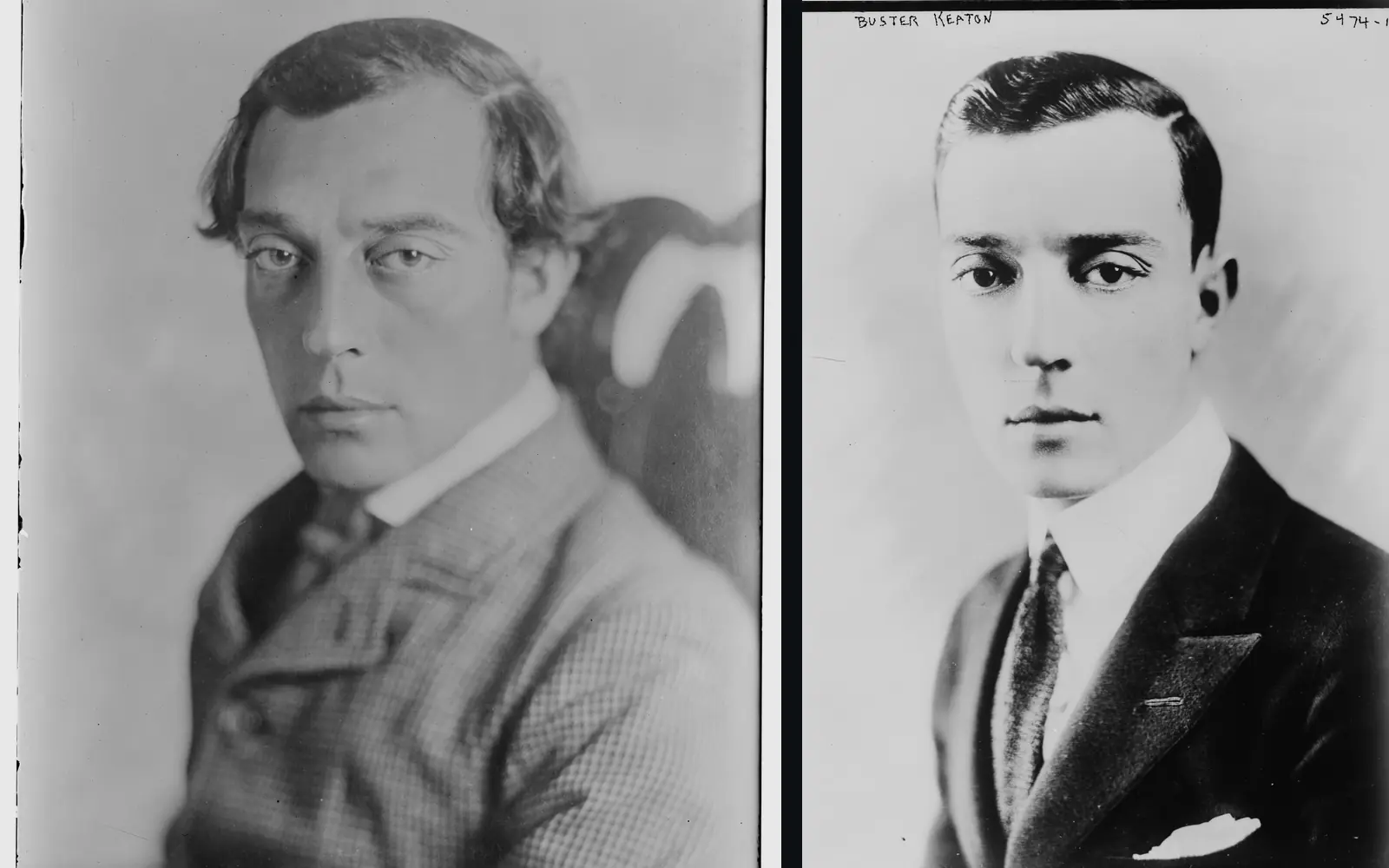
The same distinction remains essential now. A production can document what a performer did, what a double did and what the finished image shows, but those are three different records. The Buster Keaton safety analysis examines how later systems redistributed the authority behind such images without making physical authorship easier to read from the frame alone.
Public-domain trade-paper image / July 1916
Daring became the product
Why the first-stuntwoman crown is unreliable
Modern profiles often call Gibson the first professional stuntwoman. The phrase is memorable because it turns a complex labour history into a clean point of origin. The archive is less cooperative.
The Women Film Pioneers Project traces the serial-queen action heroine through more than one line, including performers active before The Hazards of Helen. Pearl White, Gene Gauntier, Mary Fuller, Grace Cunard and others complicate any claim that action performance by women began with Holmes or Gibson. The question changes again if 'first' means a dedicated double rather than a star performing action, or a person publicly credited with a specialist stunt title rather than a person paid to do the work.
The correct conclusion is narrow. Holmes and Gibson are documented pioneers of early screen action. Gibson's move from doubling to leading The Hazards of Helen is unusually clear. Neither statement requires a global superlative the available records cannot securely prove.
What each record proves—and where it stops
| Record | What it supports | What it does not establish |
|---|---|---|
| Preserved Episode 13 and NFPF notes | Holmes as lead performer and co-director; a contemporary report of wider production duties | A complete credit map for all 119 episodes Source ↗ |
| AFI record for Helen's Sacrifice | Series scale, early action publicity and Gibson's prior doubling in some episodes | A frame-by-frame account of who performed every action Source ↗ |
| AFI record for Tapped Wires | A later catalog chronology; period advertising and a contemporary review of one visible substitution | A conflict-free date for Gibson's first lead, or proof that all publicity claims were literal Source ↗ |
| Moving Picture World notice for A Test of Courage | Contemporary identification of episode 49 as Gibson's first appearance in the series | Why the later AFI catalog instead marks episode 50 as her first lead Source ↗ |
| Modern historical profiles | Biographical synthesis and the later language used to recognize Gibson's career | A universally accepted definition of the first professional stuntwoman Source ↗ |
Recognition arrived after specialization
A century later, the screen-action workforce has far more vocabulary. Productions can distinguish stunt coordination, performance, rigging, driving, action direction, specialist camera work and the wider framework of stunt design. That precision helps assign responsibility, but the finished image can still collapse many contributions into one apparent event.
The Academy's new Achievement in Stunt Design category will begin with films released in 2027. Its existence acknowledges action as designed filmmaking rather than disposable danger, while its still-unpublished recipient rules underline the same old problem: recognition depends on deciding which kind of authorship a credit is meant to capture. Our analysis of the coming award follows that modern recipient question.
The Hazards of Helen cannot be retrofitted cleanly into today's departments. That would replace missing evidence with modern assumptions. What it can show is the cost of weak vocabulary. Holmes's direction, performance and reported management duties sit in different records. Gibson's doubling survives in catalog history while her lead performance survives in the star image. The labour is present, but the credit is scattered.
Resisting an unsupported first is not withholding recognition. It is the more durable form of recognition: name the work the evidence can prove, name the source that proves it and leave the remaining space honestly open.
Sources, archive records and image rights12 entries
- The Hazards of Helen: Episode 13 — The Escape on the Fast Freight — National Film Preservation Foundation. Accessed 2026-07-20.
- Helen's Sacrifice — AFI Catalog of Feature Films, 1914-11-14. Accessed 2026-07-20.
- Tapped Wires — AFI Catalog of Feature Films. Accessed 2026-07-20.
- A Test of Courage — Kalem release notice — Moving Picture World / Media History Digital Library, 1915-10-16. Accessed 2026-07-20.
- A Test of Courage — contemporary review — Motion Picture News / Media History Digital Library, 1915-10-16. Accessed 2026-07-20.
- Helen Holmes — Women Film Pioneers Project / Columbia University Libraries. Accessed 2026-07-20.
- The Two Origins of the Serial Queen Action Heroine — Women Film Pioneers Project / Columbia University Libraries, 2022-10-18. Accessed 2026-07-20.
- Who Was Helen Gibson, Hollywood's First Professional Stuntwoman? — Smithsonian Magazine, 2023-04-24. Accessed 2026-07-20.
- Helen Holmes in Baltimore and Ohio Employes Magazine — Baltimore and Ohio Railroad Company / Wikimedia Commons. Accessed 2026-07-20.
- The Hazards of Helen — June 1916 Cine-Mundial still — Kalem Company / General Film Company / Wikimedia Commons. Accessed 2026-07-20.
- To Save the Road — Moving Picture World illustration — Kalem Company / General Film Company / Wikimedia Commons. Accessed 2026-07-20.
- Academy Establishes Stunt Design Award for 100th Oscars — Academy of Motion Picture Arts and Sciences, 2025-04-10. Accessed 2026-07-12.

_-_1.jpg)

Loading approved comments…