A hand reaches for a door. A cut. A shoulder hits the wall. Another cut. Someone is on the floor. The soundtrack insists that something decisive happened. You saw movement, but you missed the decision that connected it.
Now imagine the same passage with excellent choreography, but a sleeve, a hand and a door handle disappearing into the same dark patch. The story might be coherent; the information carrying it is difficult to see. These are different failures, often bundled into the same complaint: modern action is impossible to follow.
There is no need to claim that every recent film is darker or every contemporary editor cuts too quickly. The useful production question is narrower: at which point did the audience lose the information it needed?
Visibility is whether you can distinguish the image. Legibility is whether you understand what an action changes. A brighter screen can help the first without repairing the second.
Fast cuts, moving cameras, dark lighting and visual effects can all support clear action. The decisive question is which information survives from one beat to the next.
The Academy’s Achievement in Stunt Design award begins with 2027 films at the 100th Oscars in 2028. The craft extends far beyond the isolated moment of impact.
Seeing the image is only the first job
For this analysis, visibility means being able to distinguish a relevant body, object or edge. Legibility means understanding intention, resistance and consequence. You can see every punch in a bright, wide shot and still have no idea why the fight matters. You can also follow a brief silhouette if its intention and result are clear.
Consider that invented door scene again. The character wants to escape; an opponent controls the handle; a move dislodges the opponent; the route opens. The indispensable information is the change in access. An impressive shot of the collision may contribute less than a modest view of the hand releasing the door.
This is where Action Design becomes a storytelling discipline. In this article, the term describes the broader construction of the sequence: objectives, reversals, geography and rhythm. Stunt Design develops the physical action and its integration into a filmable sequence. These working descriptions overlap; they are not universal job definitions or Academy eligibility rules.
A stunt coordinator, fight choreographer, action director, second-unit director, cinematographer and editor may approach the same beat from different responsibilities. Titles and divisions vary between productions. What needs to remain shared is the answer to a very small question: what must the viewer understand now?
Fury Road: speed without making the eye start over
In the ASC’s account of John Seale’s framing on Mad Max: Fury Road, George Miller’s preference for central framing is explicitly connected to fast editing. Keeping important information near the same part of the image helps the next shot arrive where attention already is.
Editor Margaret Sixel describes a complementary principle in her Art of the Cut interview: each cut should advance the sequence. She also discusses working without sound for long stretches. These are specific production accounts, not evidence that every action film should share Fury Road’s style.
The lesson is more useful than ‘cut less’. A cut can save time while preserving an intention. It can also force the audience to locate a new person, discover a new direction and infer a new objective simultaneously. Two shots of equal duration can therefore make very different demands.
Tim J. Smith’s attentional theory of cinematic continuity explains continuity through attention and expectations across edits. Viewers need not reconstruct a complete architectural plan of every room. They need the information relevant to the next event. A door, an eyeline or a moving vehicle can provide that continuity.
There is no universal minimum shot length hidden here. If the decisive detail is already where the viewer expects it, a short shot can be sufficient. If the detail is buried among equally forceful distractions, a longer shot can remain confusing. The editorial unit worth protecting is the understandable change, not the number of seconds.
John Wick: darkness can organize an image
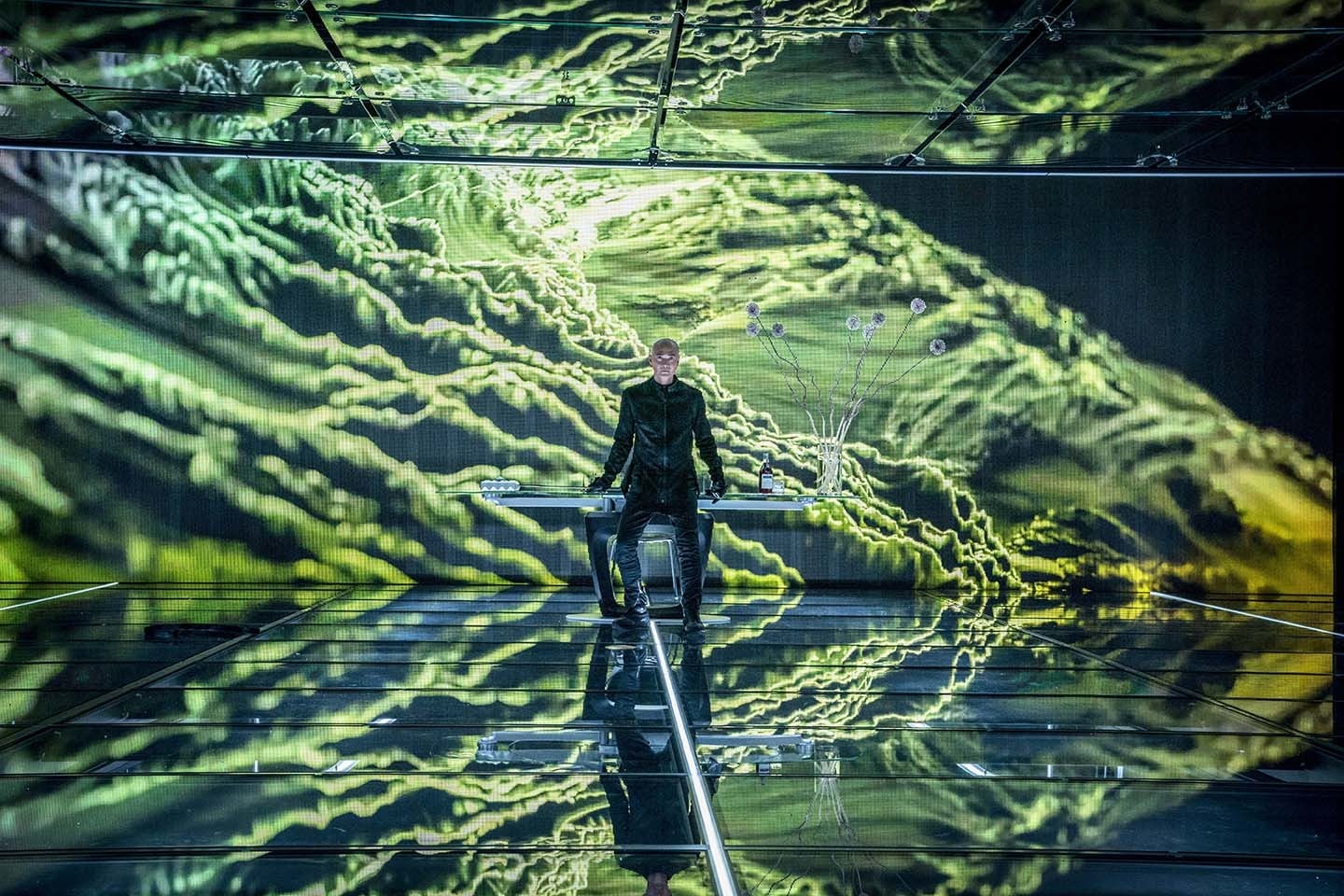
Look at the John Wick: Chapter 3 production still below. Zero’s dark clothing remains distinct against the luminous green wall. The architecture leads toward the figure, while reflections complicate the surrounding space. This is an image with substantial darkness and an identifiable subject. Raising every dark area would change that hierarchy, not automatically improve it.
In American Cinematographer’s production account, Dan Laustsen and Chad Stahelski describe contrasting color, broad views of choreography and a process connecting reference images with stunt rehearsals. The geometry of the glass set also informed the camera approach. Lighting and movement were connected design questions.
Laustsen’s ARRI Rental interview about Chapter 4 distinguishes the intended deep-black look from capture exposure: he describes consistent exposure and recording images close to the desired final appearance. A dark-looking finished image is not, by itself, proof that the cinematographer underexposed the camera.
The practical distinction is between darkness that creates atmosphere and darkness that withholds a necessary event. A face may remain mysterious. If a change of grip explains why someone wins, that detail has a different narrative obligation. The light does not have to illuminate everything equally; the sequence does have to communicate the event it depends on.
Image analysis · John Wick: Chapter 3
A dark figure, a readable outline
The camera has choreography too
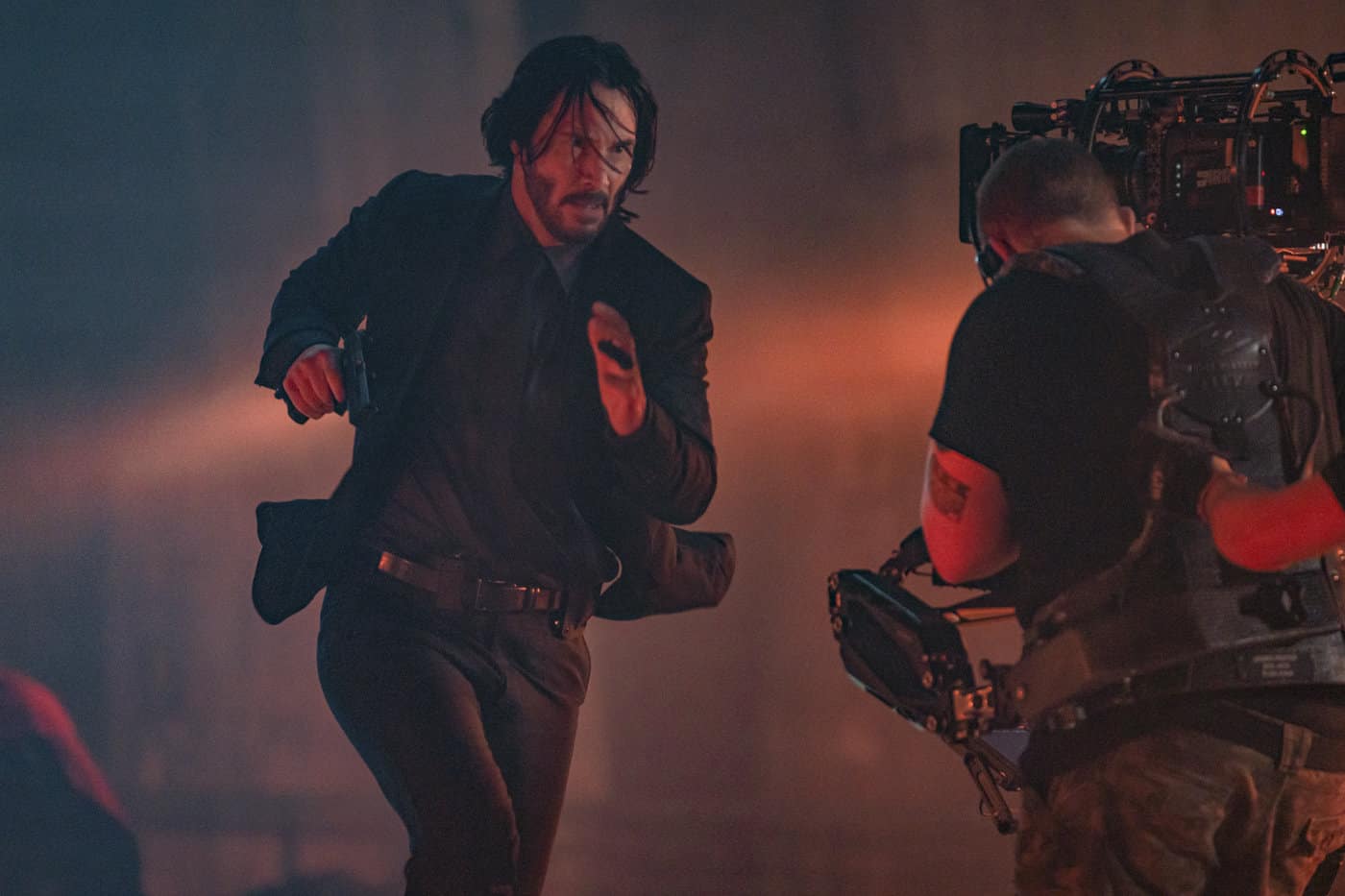
The opening photograph shows Keanu Reeves and operator James Frater facing one another during John Wick: Chapter 4. The camera occupies real space opposite the performance. Its position changes which hand overlaps the torso, what lies behind the body and how much of the movement is available to the lens. The photograph makes that relationship visible; it does not prove how the finished shot was cut.
In his Society of Camera Operators interview, Frater describes the relationship between the stunt team’s preparation and the camera’s response on the day. In a separate interview with The Credits, Laustsen discusses rehearsing with the fight team and adapting lighting and camera work. Their accounts describe different parts of a collaborative process, rather than one identical method for every shot.
Coverage is therefore more than accumulating angles. One view may establish an obstacle; another may register the moment it changes. If every setup emphasizes impact while none makes the obstacle understandable, the edit inherits plenty of energy and little explanation. Conversely, a long take can fail when the decisive action is hidden behind a body throughout it.
Motion rendering adds another choice. RED’s shutter tutorial explains how shorter exposure reduces motion blur but can make movement appear more staccato; longer exposure produces more blur. A crisp paused frame and an easily followed moving sequence are not the same achievement. Camera movement, subject movement and exposure need to be judged in playback. The distinction between stability and useful movement is explored further in why perfectly stable action can feel dead.
Bourne: confusion can be a controlled effect
Paul Greengrass gives a useful counterexample to the idea that clear action requires a calm camera. In the DGA’s discussion of The Bourne Ultimatum’s Tangier sequence, he explains how the rooftop passage establishes a physical challenge, while the bathroom fight changes the scale to confinement. He also describes a reactive camera and the importance of varying pace.
That distinction matters. A scene can make the viewer feel a character’s instability while retaining an understandable pursuit or escape. Feeling disoriented is an expressive result. Being unable to identify what changed can be a communication failure. The two may coexist, but they should not be confused in an evaluation.
A useful review question is whether the sequence eventually pays back its withheld information. After the rush, can the audience recognize who has the advantage and what the next problem is? If so, a brief loss of orientation may be doing dramatic work. If every beat requires retroactive reconstruction, the scene may be spending attention faster than it supplies meaning.
The action still has to survive postproduction
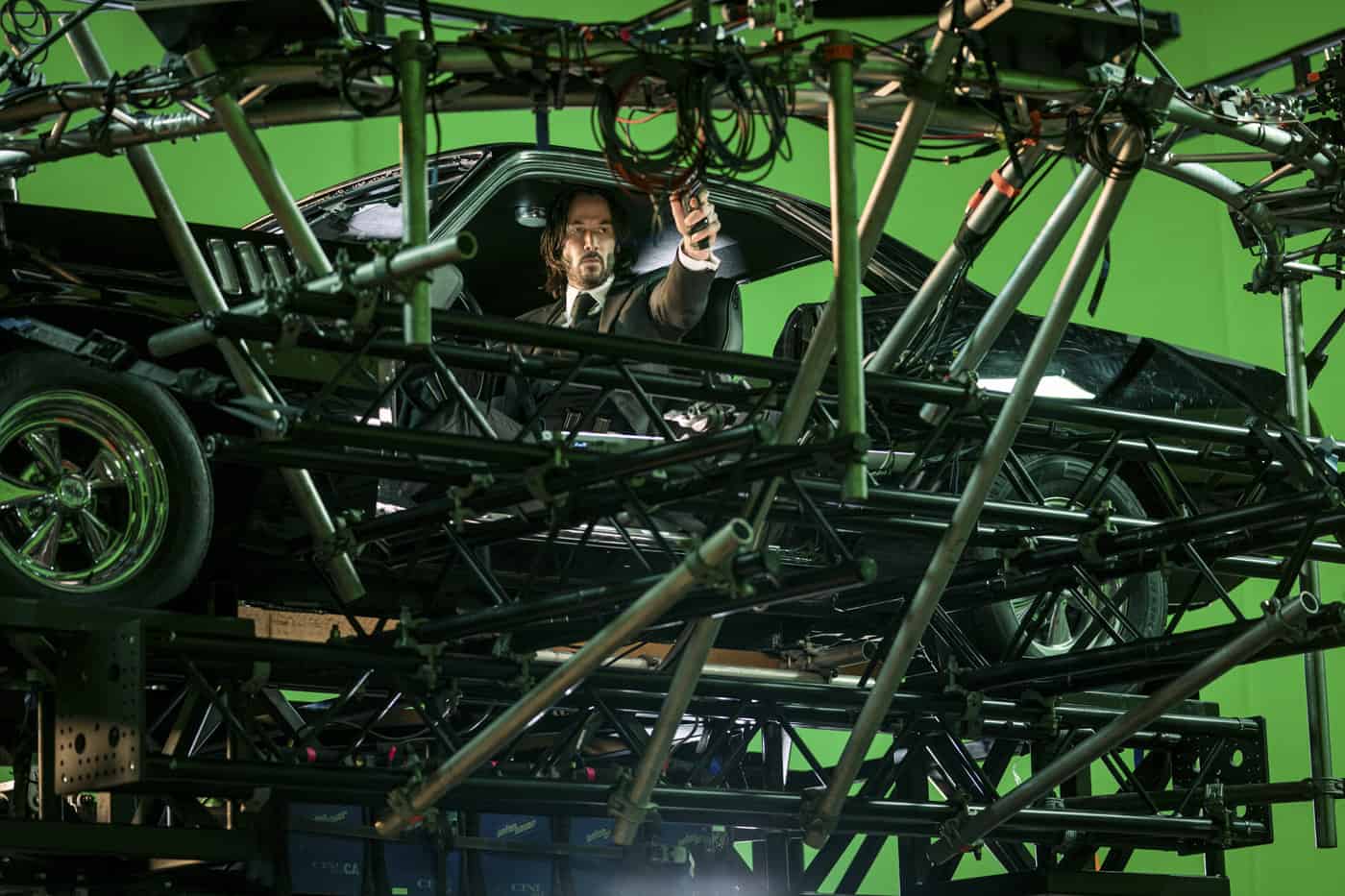
The vehicle photograph below records a different kind of construction: Reeves performs inside a car surrounded by a visible rig, with greenscreen behind it. The final image will present a different visual context from this production photograph. It is a reminder to evaluate the completed relationships between performer, vehicle and environment, rather than treating an on-set image as the finished scene.
Visual effects can preserve a physical performance, remove production apparatus and build the surrounding geography. They can also change what competes for attention. The useful question is not whether pixels were added. It is whether the finished image preserves the cue that explains the action. Sixel’s Fury Road interview, for example, describes effects work including split performances and adjustments within shots.
This suggests a concrete handover between departments. Identify the indispensable story information before finishing: which silhouette must separate, which object must remain visible, which direction must continue, which reaction must register. That is an editorial proposal, not a claim that every production already uses such a document.
The same logic applies to sound. An impact can make contact feel forceful; a change in sound perspective can redirect attention. But adding a louder hit cannot reliably explain an unseen change in possession. Reviewing a passage without its full mix can reveal missing visual information, even when the intended finished scene depends on sound.
Production photograph · John Wick: Chapter 4
The set is one stage of the image
What the screen can change
A coherent sequence can still become difficult to see during delivery or viewing. Dolby’s content-creation guidance describes metadata, tone mapping and review across HDR and SDR targets. Those steps exist because different displays cannot reproduce an identical range of luminance. HDR is not a synonym for a dark picture.
Compression is a separate variable. Netflix’s technical account of shot-based encoding shows how encoding decisions affect artifacts and detail at a given bitrate. That 2018 account explains a mechanism; it does not diagnose any current title or establish that streaming caused a particular confusing scene.
For a viewer, comparing the same moment under different viewing conditions can help separate an image problem from a story problem. If the hand and door become distinguishable but the escape still makes no sense, visibility improved and causality did not. If the scene becomes understandable once the missing detail appears, the display chain deserves closer attention.
A screenshot shared online cannot settle all of this. It removes timing, may have passed through another conversion and tells little about the original display conditions. Production stills in this article are evidence for composition and working relationships, not measurements of the films’ final HDR grades.
A more useful action review
| What breaks | What to ask | Where to investigate |
|---|---|---|
| The event cannot be seen | Can the essential body, object or edge be distinguished? | Framing, lighting, finishing and playback |
| The event can be seen but not explained | What was intended, what resisted it, and what changed? | Action Design, staging and the edit |
| Every cut demands a new search | Which cue carries attention into the next shot? | Coverage, eyelines, direction and cut points |
| The impact registers but the consequence disappears | Does the next beat acknowledge the new situation? | Performance, reaction, continuity and sound |
Why this matters for the Stunt Design Oscar
The Academy has announced a competitive award for Achievement in Stunt Design, starting with films released in 2027. The 100th Oscars are scheduled for 5 March 2028. The announcement says inaugural eligibility and voting rules will be issued in 2027. This article does not infer recipient rules or judging criteria from the category’s name.
What the discussion can already do is become more precise. A stunt performance is the physical execution audiences may recognize. Stunt coordination concerns organizing and controlling the work. Stunt Design also invites attention to how physical events become expressive cinema. These contributions interact with direction, cinematography, editing, sound and visual effects; no single department owns every element of screen clarity.
That is why ‘how dangerous did it look?’ is an incomplete critical question. A less spectacular beat can reveal exceptional design if it communicates character, uses the location and changes the scene with precision. The public conversation around the Stunt Design Oscar benefits from examining those decisions alongside the visible feat.
The analysis of action-camera choreography develops the relationship between physical action and the shot that must capture it.
Return to the door. The audience does not need to admire every mechanism that made the moment possible. It needs to understand that the way out was blocked, a choice changed the situation, and escape is now possible. When that information survives from design to screen, speed can feel exhilarating and darkness can feel intentional. When it disappears, more movement is only more movement.
Sources and method
This feature combines published first-hand production interviews, technical documentation and research on cinematic attention. The door example and the review framework are original editorial analysis, not accounts of an actual shoot. The photographs are real production imagery reproduced with source credits and discussed individually. No AI-generated images were used. Academy information was checked on 30 September 2026.
Read the primary sources13 entries
- John Seale, ASC, ACS: Framing Mad Max: Fury Road — American Society of Cinematographers, 2017-08-08. Accessed 2026-09-30.
- Art of the Cut: Margaret Sixel, editor of Mad Max: Fury Road — ProVideo Coalition / Steve Hullfish, 2016-03-13. Accessed 2026-09-30.
- The Attentional Theory of Cinematic Continuity — Tim J. Smith / Projections / UAL Research Online, 2012-06-01. Accessed 2026-09-30.
- Slayin’ in the Rain: John Wick: Chapter 3 — Parabellum — American Cinematographer / Iain Marcks, 2019-05-24. Accessed 2026-09-30.
- ARRI Rental ALFA lenses on John Wick: Chapter 4 — ARRI Rental, 2023-04-05. Accessed 2026-09-30.
- John Wick: Chapter 4: Planning and Improvisation — Society of Camera Operators / David Daut. Accessed 2026-09-30.
- John Wick: Chapter 4 Cinematographer Dan Laustsen on the Beautiful Brutality of Lensing Wick’s World — The Credits / Daron James, 2023-03-22. Accessed 2026-09-30.
- Shutter Angles & Creative Control — RED Digital Cinema. Accessed 2026-09-30.
- Shot to Remember: The Bourne Ultimatum — Directors Guild of America / Robert Abele. Accessed 2026-09-30.
- Dolby Vision for content creators — Dolby. Accessed 2026-09-30.
- Optimized shot-based encodes: Now streaming! — Netflix Technology Blog, 2018-03-09. Accessed 2026-09-30.
- Academy Establishes Stunt Design Award for 100th Oscars — Academy of Motion Picture Arts and Sciences, 2025-04-10. Accessed 2026-07-12.
- Academy and ABC Announce Show Dates for 99th and 100th Oscars — Academy of Motion Picture Arts and Sciences, 2026-04-07. Accessed 2026-07-12.
Loading approved comments…