The counter looks hard. The body arrives fast. The sound makes you wince. As a viewer, you assemble those cues into one event: somebody has just been hurt. What you cannot see is whether that counter was padded, whether the background was rebuilt, or whether the apparent collision was assembled from different performances. The image has done its job.
That gap between what happens to a character and what happens to a performer is a central creative opportunity in Stunt Design. The craft can make an impact feel worse while asking the body to do less. ‘Safest’ here describes that design ambition, not a ranking of productions or a promise of zero risk.
Screen violence is an authored impression. Production risk depends on the actual action, environment, equipment and people involved.
A controlled performance can look more punishing when camera, reaction, edit and sound communicate the impact clearly. Extra physical force is not the only route to intensity.
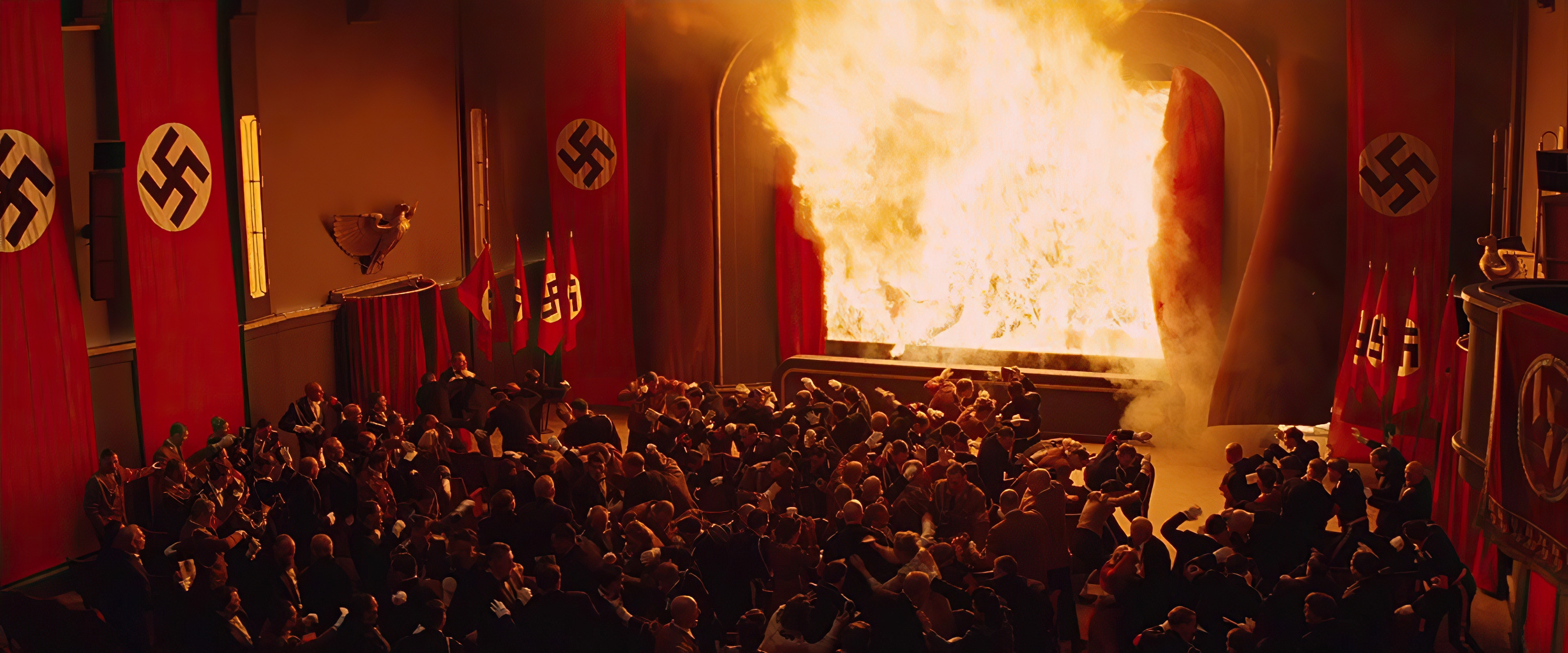
The cinema fire in Inglourious Basterds illustrates spectacular image-making, not a claim of harmless working conditions. Participant accounts must be distinguished from what the frame shows.
The audience experiences a consequence, not a force reading
A screen hit is a relationship between images: an intention, an apparent contact and a reaction that changes the scene. The receiving performer contributes as much to that relationship as the person delivering the move. A broken rhythm, a failed attempt to recover or a suddenly vulnerable expression can make an action feel consequential. None of those qualities can be read from the size of the movement alone. Performance supplies the consequence.
At a demonstration reported by The Credits, stunt coordinator Bobby Sargent showed how apparent contact could depend on camera viewpoint while the performers remained separated. The important principle is cinematic: the lens records an arrangement made for its position, not an objective account of all the space around it.
This does not make camera placement a substitute for stunt coordination. It makes the camera part of the design. Viewpoint is a creative tool. If a change of viewpoint weakens the illusion, increasing physical commitment may be the wrong response. The missing ingredient might be the relationship between the bodies and the frame, or the reaction that tells the audience what the action means.
Clarity matters here. An impact can feel stronger because its cause and consequence are easier to follow. The companion analysis Why You Can’t See Modern Action Scenes explores that distinction between seeing movement and understanding it.
Road House: the protection disappears, the impact remains
Road House offers a particularly direct example. In Grant Hewlett’s interview with befores & afters, the production VFX supervisor describes substantial pads and furniture cleared for safety during the finale. The environment was reconstructed digitally, and one jump’s apparent height was increased. Some fights combined separate performance passes; he explicitly says that method was not used for every fight.
The consequence is easy to miss when watching the finished film. What appears to be an unforgiving environment need not be the environment the performer encountered. Digitally removing visible protection can preserve the character’s apparent vulnerability while retaining the physical performance beneath it. Digital work is participating in the stunt’s expression, rather than merely decorating the aftermath. The protection has become invisible.
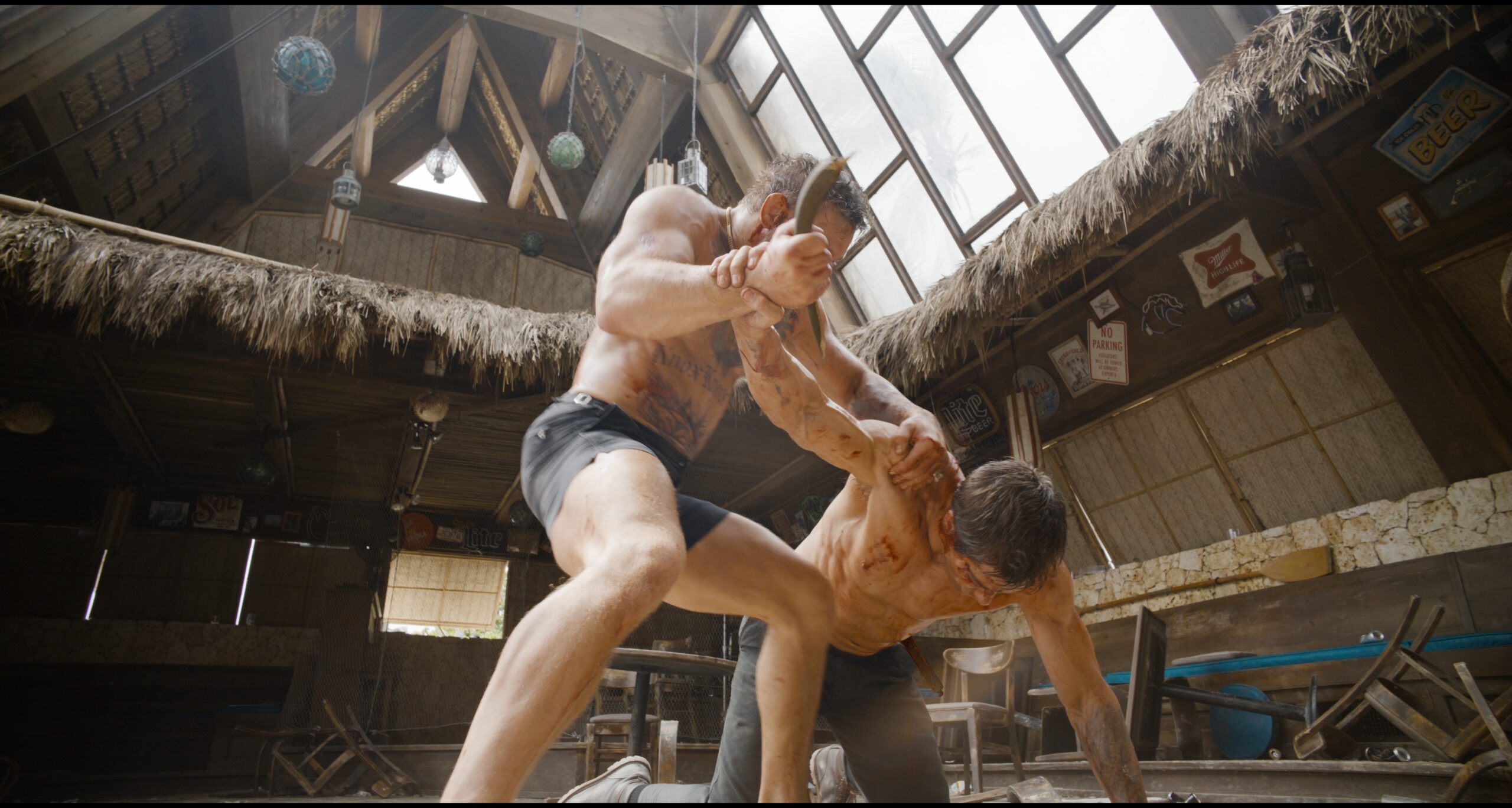
In the finished frame below, a controlling grip, raised arm and wooden weapon concentrate the threat. Cinesite’s own case study describes digital wooden weapons, wounds and blood work in the climax. The visible menace combines performance with information added to the image. The frame shows the result, not the protective setup behind it.
That is not evidence that every filmed element was harmless, or that visual effects automatically reduce risk. It is a documented way of separating two demands that audiences often assume must travel together: an image that looks punishing and a physical environment designed around the people working in it.
The edit can also create an impression of uninterrupted pressure. Editor Doc Crotzer’s account of Road House describes planned invisible joins and action development with the stunt team. Apparent continuity on screen therefore cannot tell a viewer how long a physical passage was performed without interruption. An apparently continuous shot is an aesthetic experience; its production history is a separate question. Continuity is an impression.
Finished VFX frame · Road House
The finished image concentrates the threat
The burning cinema: spectacle is not a safety certificate
The opening frame from Inglourious Basterds works through scale. The screen opening is engulfed, the auditorium converges on it, and the crowd’s movement carries the threat toward the foreground. The composition makes the room feel consumed by one event. It does not show every relationship between performers, flame, camera and the production space.
In an AWN interview, effects designer John Dykstra describes coordinating the projected image, the burning screen and the effects surrounding it. His later ASC account also describes a duplicate set for the burn. The coherent catastrophe seen by the audience was an image-making problem shared across departments.
There is a useful contrast within the same film. A production effects statement hosted by BAFTA describes specially designed simulated bullet impacts in the farmhouse and basement-tavern scenes, intended to appear more violent than their physical effect on nearby performers. Its assurance concerns those effects. It must not be transferred to the cinema fire.
The fire also has a different kind of source record: in a GQ interview, Eli Roth said that he and Omar Doom were scorched during the sequence. That is an attributed participant account, not an independently established injury total. It is sufficient reason not to use this scene as proof of an uneventful or harmless shoot.
Both distinctions matter. A spectacular image does not prove unnecessary danger, and a technically elaborate production account does not prove adequate protection. The film can demonstrate extraordinary screen effect while questions about the working conditions remain questions for a different body of evidence.
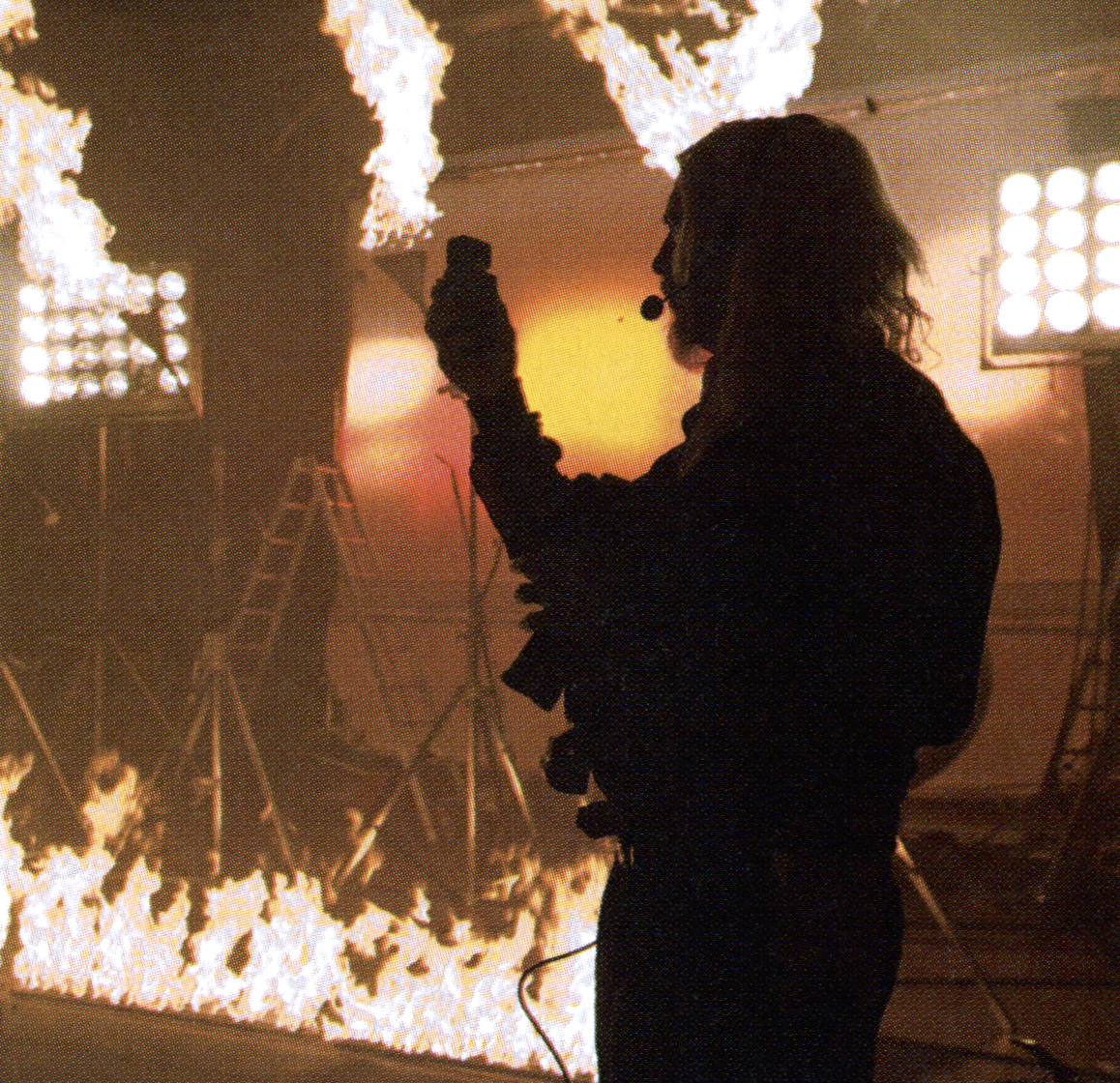
Behind the scenes · Inglourious Basterds
The frame has a working environment outside it
The body never had to produce that sound
Listen to an impact and it becomes difficult to separate the sound from the body. A sharp attack suggests contact; a lower component gives it weight; a vocal response tells you how a character experienced it. These are expressive choices, not measurements taken from the performer. Timing gives the blow its shape.
For Daredevil’s second-season stairway fight, sound designer Jordan Wilby describes building layered impacts and shaping their rhythm. In the same interview, supervising sound editor Lauren Stephens explains replacing noisy production audio and recording vocal efforts in post. The audible violence was constructed separately from the physical event.
The terminology matters. Sound design and editing can build an impact from recordings; Foley supplies performed sounds synchronized to picture; ADR can supply replacement dialogue and vocal efforts. Calling all of this ‘Foley’ hides the collaboration. More importantly, making a hit sound convincing does not require the performer to create that sound through genuine injury.
Nor does intensity simply mean turning everything up. Contrast lets one event stand out from the next. A brief absence, a change in texture or an exhausted response can make a moment feel more final than another undifferentiated crash. Sound can communicate the violence the story needs without asking the set to manufacture its acoustic equivalent.
Control can give a scene more expression
Protection need not weaken the intended screen effect. The examples suggest a productive possibility. When the essential screen effect has been identified, different departments can carry different parts of it. Performance supplies intention and reaction; the camera supplies viewpoint; effects shape the apparent environment; the edit and mix organize the experience. Each contribution carries meaning.
This is where Stunt Design meets Action Design. The physical action is developed for a particular dramatic result, while the sequence’s wider design gives that action a place in the story. ‘More violent’ might mean a sudden loss of control, a devastating reversal or a character’s inability to recover. Those outcomes need precise communication, not merely bigger movement. In an imagined bar fight, a single blow that leaves a character staring at the exit, unable to reach a dropped phone while the aggressor calmly moves between them and the door, may tell a harsher story than a rapid exchange of ten interchangeable punches. The reversal is the violence.
The cinema set photograph makes the division of work tangible. Robert Richardson is visible with a meter, while production lighting and flame occupy the same environment. It reveals work excluded from the audience’s view. It cannot reveal the complete safety arrangements or the conditions of a different take. The photograph is evidence of image-making, not a risk assessment.
Actual risk depends on circumstances that a finished shot usually conceals. The Industry Wide Labor-Management Safety Committee’s Safety Bulletin #4 calls for qualified oversight, preparation and rehearsal, and considers camera placement and the people involved. It is an industry guideline, not a certification of the films discussed here. A stunt risk assessment has to examine the work that is actually proposed.
Two different questions for the same shot
| What the audience perceives | What can create that impression | What the image cannot establish |
|---|---|---|
| A devastating hit | Viewpoint, performance, reaction and sound | The actual contact or load on a body |
| An unforgiving environment | Production design and digital reconstruction | What protection was present during the take |
| Uninterrupted punishment | Choreography, planned joins and editorial rhythm | The duration or repetition of physical exposure |
| A room consumed by fire | Scale, composition, performance and effects | Heat exposure, working conditions or an injury record |
Judge the illusion and the working conditions separately
The creative question is whether the scene communicates the intended force, character and consequence. The production question is what the people making it actually have to encounter. Neither answer can stand in for the other.
The strongest version of this craft can push them in different directions: a more convincing screen event, with less unnecessary exposure behind it. The audience still recoils from the counter. The achievement is that the performer did not have to encounter the counter the audience imagined.
Sources and method
This editorial draws on first-hand production interviews, a BAFTA-hosted effects statement and published industry guidance. It does not rank the safety of productions or assign an injury count to the cinema sequence. Image analysis and the comparison table are editorial interpretation. Real film and production images are reproduced with individual source credits; no generated imagery is used.
Production accounts and references11 entries
- Road House: VFX Case Study — Cinesite. Accessed 2026-10-25.
- How to Shoot Stunts & Action on a Budget — The Credits / Bryan Abrams, 2014-03-20. Accessed 2026-10-25.
- Here’s how those brutal fights in Road House were helped made possible with VFX — befores & afters / Ian Failes, 2024-05-14. Accessed 2026-10-25.
- Bar Brawls and Bands: Editing the Action-Packed Road House — Frame.io / Matt Feury, 2024-04-04. Accessed 2026-10-25.
- Dykstra Talks Inglourious Basterds — Animation World Network / Bill Desowitz, 2009-08-25. Accessed 2026-10-25.
- John Dykstra, ASC: Finding Joy in the Process — American Cinematographer / Joe Fordham, 2023-07-14. Accessed 2026-10-25.
- Inglourious Basterds: Mechanical and Visual Effects Statement — BAFTA-hosted production statement. Accessed 2026-10-25.
- Q+A: Eli Roth — GQ / Jason Chen, 2009-12-07. Accessed 2026-10-25.
- Inglourious Basterds: A Nazi’s Worst Nightmare — American Cinematographer / Benjamin B, 2022-01-11. Accessed 2026-10-25.
- How Daredevil’s Emmy-Nominated Sound Designer Makes the Punches Pop — The Credits / Hugh Hart, 2016-08-25. Accessed 2026-10-25.
- Safety Bulletin #4: Stunts — Industry Wide Labor-Management Safety Committee / Contract Services, 2025-03-27. Accessed 2026-10-25.
Loading approved comments…