In The Fall Guy, a close shot combines Ryan Gosling’s photographed performance with digital fire. Cinesite describes matching the flames to his movement and progressively adding burn damage to his clothing. The completed image carries the actor’s performance and an extensively constructed effect in the same frame. Cinesite’s production account · Universal Pictures: filming the cannon roll
That frame also contains a financial relationship. Photography supplies some of what the audience needs. Visual effects supplies the rest. The producer pays for the completed result.
Yet a production can make each departmental estimate look attractive while making the finished sequence more expensive. Saving a setup may leave additional reconstruction for post. A low finishing bid may depend on material the shoot never delivers. An impressive AI demonstration may leave its difficult frames, revisions and delivery work outside the quoted time.
The useful comparison follows the shot through approval. It includes preparation, photography, data capture, postproduction, review and the work required to turn a rejected version into an accepted one.
For European action teams, this is a substantial commercial opportunity. Offer the producer a connected plan for those costs. Show which parts of the image will be photographed, which will be constructed, where machine learning can assist and who owns the handoffs. A credible offer makes the spending legible before the production becomes dependent on it.
Compare bids by the cost of getting the shot through final approval, including photography, VFX and revisions.
Test machine learning on representative footage and include artist review and cleanup in the price.
The camera decision continues into post
Stunt Design, camera and VFX should agree what the finished shot must preserve. The performer’s timing, the camera’s movement, the foreground crossings and the intended cut all affect what the finishing team receives. A recording can contain the right action and still leave expensive work to make it fit the sequence.
In any action production, the operator’s work on each take deserves scrutiny. Framing, timing and camera movement should be judged against the agreed shot and the sequence it serves. The production’s scale or reputation should never substitute for that assessment.
Specialist capture becomes valuable when it resolves a specific image requirement. WarpCam® offers a concrete example. Its camera ecosystem combines handheld, pole, vehicle, RC and FPV configurations within a supervised action-camera workflow, with camera paths considered alongside performer movement. WarpCam® system and workflow
The production test is whether the chosen configuration supplies the intended perspective, movement and usable material within the agreed shooting plan. That question belongs in the rehearsal and camera test. The answer should then inform the VFX breakdown and the editorial handoff. A platform earns its place through the image it delivers and the work that remains after capture.
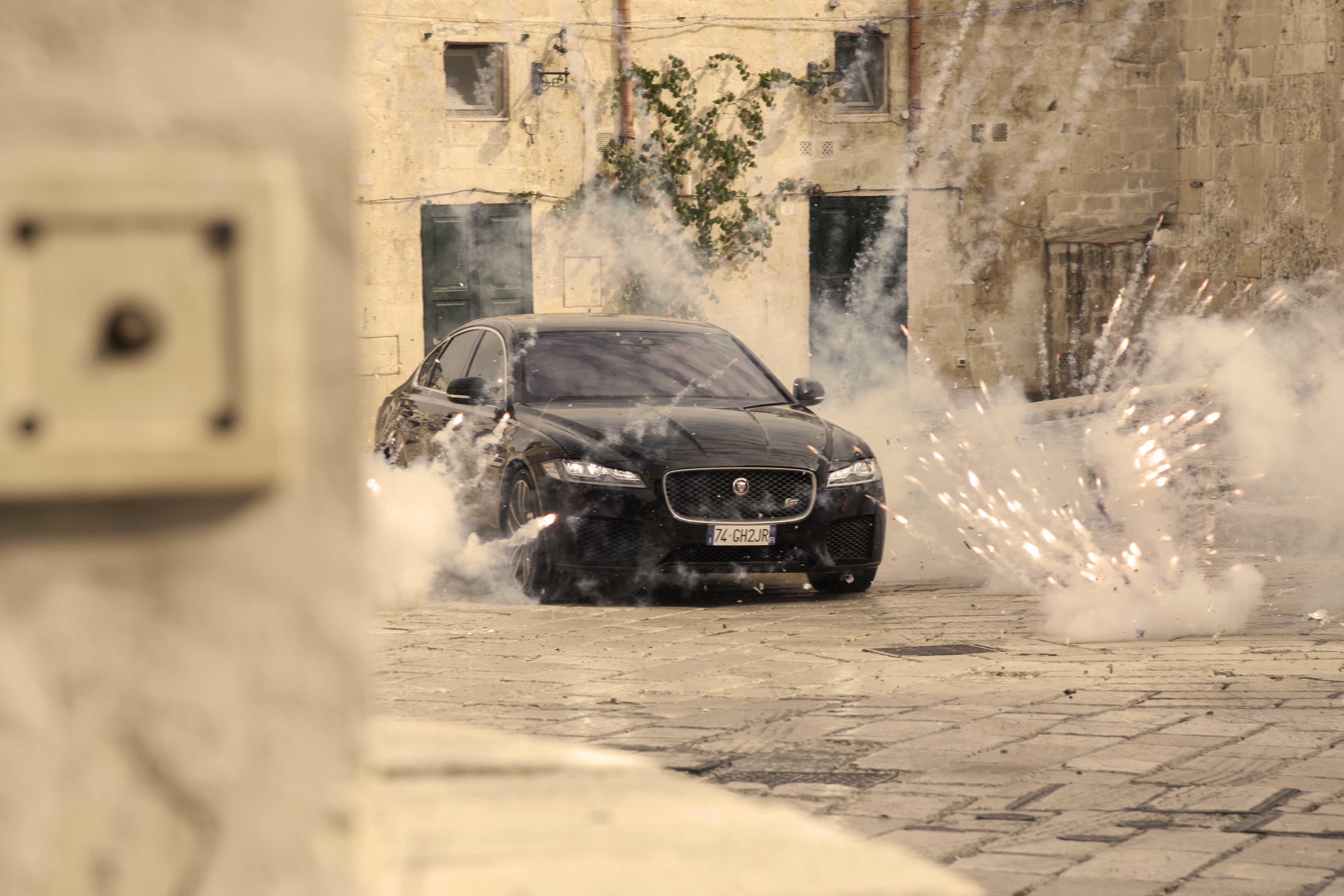
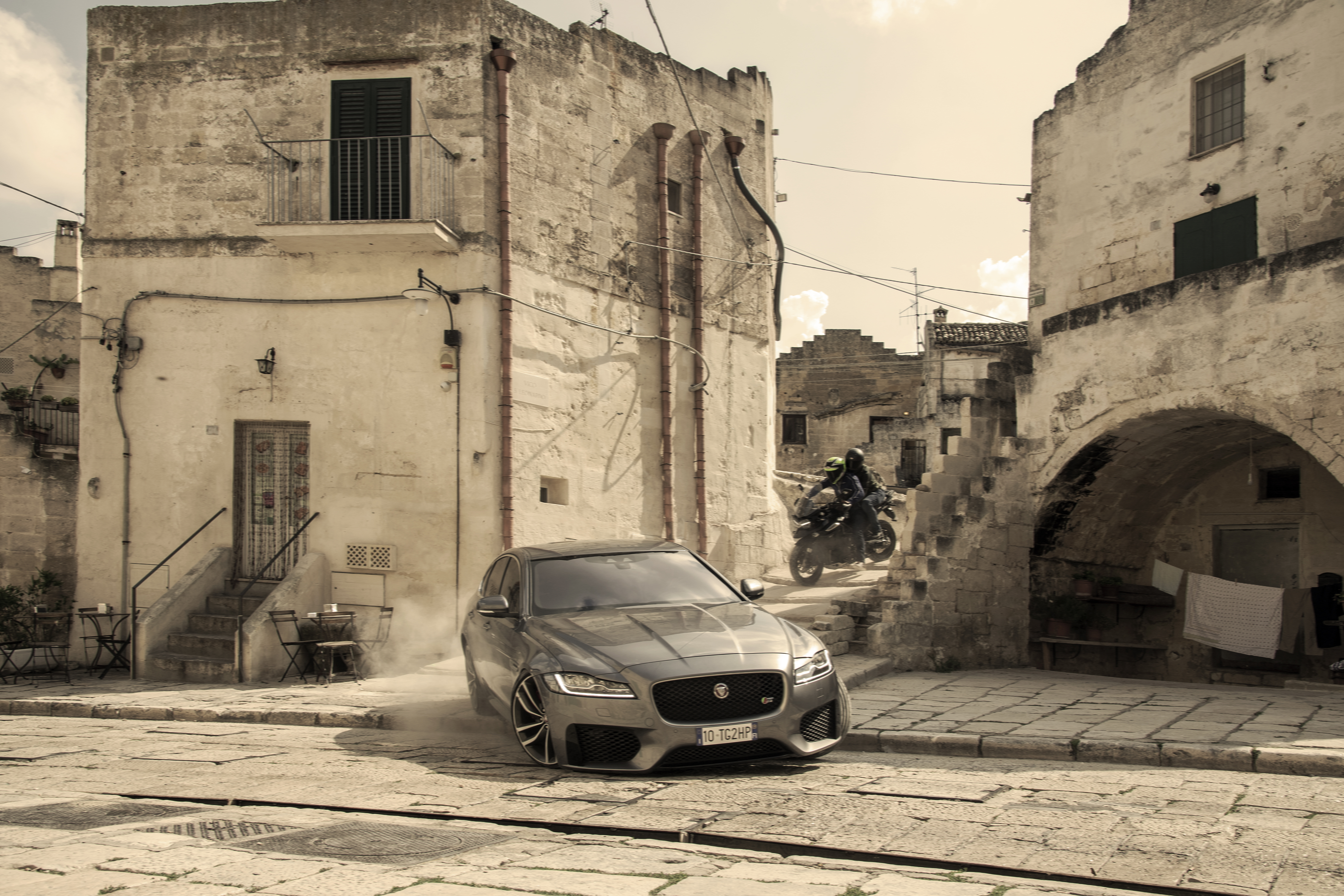
Framestore’s account of No Time to Die shows how deliberately acquired material can support a substantial digital finish. For a London sequence intended to read as sunset, the crew photographed at sunrise to obtain the desired sun position. Framestore added traffic, trains, headlights and architectural lighting to complete the sunset treatment. For Norwegian environments, photographed sunset material provided a lighting reference for the wider digital sequence. Framestore’s production account
The producer’s question becomes specific. What will the additional photography establish, and which finishing tasks will it enable or reduce? Compare that answer with the cost of acquiring it. Camera access, location time and postproduction belong in the same calculation. How framing and cutting affect action legibility
Set photograph · No Time to Die
The crew beside the driving line
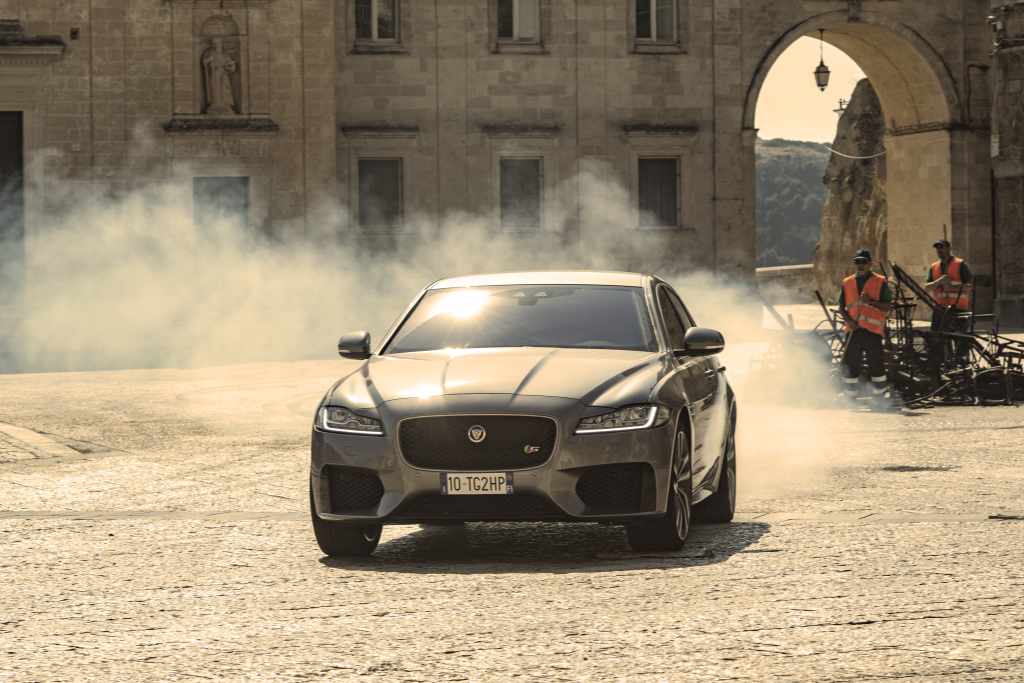
Set photograph · No Time to Die
The Matera chase
A fixed price needs a defined picture
The fourth edition of The VES Handbook of Visual Effects describes fixed bids as the predominant arrangement for feature-film VFX. It calls for explicit assumptions and identifies change orders as a response to work that expands sufficiently beyond the bid. Fixed-price contracting is already part of the industry’s commercial machinery. The VES Handbook, fourth edition, printed pages 6–9
A producer therefore needs to inspect the picture that the price assumes. Which version of the cut? Which source footage? What frame range, delivery resolution and approved look? Which assets and review rounds are included? Who can authorise a change, and when must its cost be disclosed?
Separate shared assets and setup from shot-specific work. The VES Handbook identifies assets and non-shot overhead as separate budget components. If editorial adds or removes shots, the producer can then see which costs change and which remain committed. The VES Handbook, printed page 9
Consider an illustrative change during editorial. A short removal shot becomes a longer shot with a revised camera move and a newly exposed background. The supplier may now have to track more material, reconstruct a different area and revise work already completed. Calling both versions the same shot number obscures the change in what production is buying.
This is where a serious contract earns its value. The initial scope should be sufficiently specific to compare offers. Changes should identify the affected work, the price and the delivery consequence before authorisation. Creative revision needs an agreed allowance and a clear route for decisions beyond it.
Netflix’s published VFX financial-reporting instructions track the locked budget, cost report and projected costs, alongside vendor awards, change orders and payment milestones. They also provide an exposure report for new shots, increased or reduced scope and omitted work. That gives production a place to record a developing cost before it becomes a signed commitment. A useful supplier review should show the current forecast and the unresolved changes that could move it. Netflix VFX financial-reporting instructions
A European finishing offer becomes more persuasive when it can show this level of control against the actual material. A low headline number with unresolved assumptions transfers uncertainty into the production schedule. An accountable offer makes the assumptions available for a purchasing decision.
AI has to survive the difficult frames
Machine learning already supports specific finishing tasks. Foundry’s CopyCat trains on pairs of input frames and artist-prepared target results. The resulting model is applied across a sequence through Nuke’s Inference node. Documented uses include masks, beauty repairs and deblurring. This is a defined image-processing job with examples of the required output. Foundry CopyCat reference
Dune: Part Two also exposes the postproduction burden of an unresolved on-set problem. For the Giedi Prime arena fight, makeup covered a performer’s tattoos, but the infrared camera still revealed them. VFX supervisor Paul Lambert told AWN that the issue became apparent when the fighters arrived for the shoot and that Wylie Co. had to remove the tattoos. In a separate interview with The Credits, he said the correction took months. Lambert’s AWN interview · Lambert’s interview with The Credits
The production had conducted extensive infrared tests. Even so, the actual performer-and-makeup combination reached the shooting day with an unresolved image problem. For a producer, this exposes a gap in camera and makeup validation with substantial downstream consequences. The acquisition workflow has to validate the finished appearance of the people it will photograph. A problem carried through that handoff becomes work somebody must fund, schedule and approve.
For Paul’s vision of a cataclysm, Lambert specifically attributes the close-focus approach to cinematographer Greig Fraser. The photography reduced the plates to “just shapes”. Lambert said effects integration would have been difficult, and the team revised the intended visual approach. Lambert’s AWN interview
In our assessment, Fraser’s close-focus choice was a poor fit for the intended composite. Camera decisions deserve the same scrutiny as the finishing work they create. The responsibility for a workable final image begins with the photographic choices made on set. One personal assessment is that aspects of the camera work on Dune fell short of the production’s own standard.
Foundry’s account connects the tattoo-removal work to CopyCat. It also describes training a model for the Fremen eyes using earlier footage and manually prepared masks, with corrected results fed back into the training material. Both applications belong in the accounting, with the source of each task and the complete effort to finish it visible. Foundry’s Dune production case study
The commercial test must include the work around the model. Someone prepares the examples, runs the process, examines the output, repairs failures and delivers approved frames. A reduction in processing time becomes a production saving when the complete task costs less at the required quality.
Foundry’s own instructions call for checking results across different frames, improving the training examples and, where necessary, applying manual cleanup. They identify shadows and defocus among the details that can require better coverage in the training material. Foundry guidance on applying and improving results
For action, the pilot should contain the material most likely to challenge the proposed workflow. Include the fast movement, changing occlusion, motion blur and lighting variation present in the actual sequence. Inspect the result at delivery resolution, in motion and in the intended edit.
The bid should count setup, training, compute, artist review, corrections and delivery. It should identify the fallback when a shot fails the test. Production also needs an agreed way to handle its footage and project data within the selected tools.
If a supplier proposes an AI saving, ask which task changes and what evidence supports the quoted reduction. The useful proof is a representative piece of finished work with its complete effort recorded. That gives production something it can compare with the existing method.
Official footage · Dune: Part Two
Sandworm ride and ornithopter
Official cover art on the player. © 2024 Warner Bros. Ent. and Legendary. All Rights Reserved.
Europe can offer a joined-up delivery plan
For a production buying action in Europe, the opportunity is to commission capture and finishing against the same approved sequence. The action unit, camera team and post partner can prepare a shared offer while the expensive choices remain open. Their responsibilities should survive every handoff.
The offer can be organised around three connected commitments.
Capture the image elements that carry the performance. Agree the physical action, camera relationship and material the edit needs. Test specialist capture where it can solve a defined shot. Price the supporting reference and data collection required by the finishing team.
Specify the finishing work against that material. Describe the removals, extensions, replacements and composites required for each shot. Identify reusable assets, delivery requirements, review stages and the authority for changes. The producer should be able to see what each approval buys.
Use AI where a production test supports it. Assign a bounded task, agree the quality threshold and include correction time. The supplier remains responsible for the delivered image throughout the workflow.
This gives a European bidder a concrete way to demonstrate value. Present the producer with a photographed test, a finishing breakdown and an evidence-based estimate for the remaining work. Put the costs, dependencies and approval responsibilities on one schedule.
Give competing teams the same source package, shot list and delivery requirements. Ask each to identify shared asset costs, shot-specific work, the revision allowance and the assumptions behind its completion date. European action and finishing teams can use that comparison to demonstrate exactly where their proposed workflow delivers value.
Our companion article examines the separate location, crew and contractual case for considering Europe. This decision follows the material from the shoot into the final image. Why Hollywood Should Bid Its Next Action Sequence in Europe
Buy the approved result
Before awarding an action sequence, ask the proposed team to take one representative shot through its intended workflow. Agree what constitutes acceptance, record the total effort and use the test to expose missing inputs. Include the harder frames and the expected review process.
That test gives the producer a firmer basis for comparing three things together. The image the camera can deliver. The work postproduction must complete. The tasks AI can help finish at a demonstrated cost.
A production that purchases those stages in isolation can discover the real price only after the handoffs have failed. A connected bid gives the producer an earlier chance to change the design, the acquisition plan or the supplier arrangement.
The strongest European offer will show exactly how the sequence reaches approval, with enough of the work tested to make the price credible.
Sources11 entries
- Cinesite / The Fall Guy — Cinesite. Accessed 2026-11-06.
- Framestore / No Time to Die — Framestore. Accessed 2026-11-06.
- The VES Handbook of Visual Effects, fourth edition — The VES Handbook of Visual Effects, fourth edition. Accessed 2026-11-06.
- Netflix / Financial Reporting Instructions — Netflix. Accessed 2026-11-06.
- Foundry / CopyCat — Foundry. Accessed 2026-11-06.
- Foundry / The Untapped Potential of Machine Learning in VFX — Foundry. Accessed 2026-11-06.
- Foundry / Apply and Improve the Results — Foundry. Accessed 2026-11-06.
- WarpCam® Deutschland — WarpCam® Deutschland. Accessed 2026-11-06.
- AWN / Paul Lambert Returns to Arrakis for Dune: Part Two VFX — AWN. Accessed 2026-11-06.
- The Credits / Paul Lambert on Infrared Insanity in Dune: Part Two — The Credits. Accessed 2026-11-06.
- Sky / Dune: Part Two (official cover and editorial image rights) — Sky Deutschland. Accessed 2026-11-06.
Loading approved comments…