
The most convincing beginners bring one testable specialty—movement, vehicles, climbing, water, horses, acting or another production-relevant skill—then learn the separate craft of performing it for camera.
Physical requirements vary by call. Mental steadiness does not: attention beyond your own movement, honest self-assessment, repeatability, communication and the capacity to stop are baseline professional skills.
Los Angeles, Germany, the UK and Australia use different labour, union, insurance and register systems. A workshop, open gym or course can develop skill; none automatically creates a job, a union card or permission to work.
Analysis
The image above puts spectacle and occupation in the same frame: an airborne car commands attention, while the camera vehicle makes the larger system visible. It is original AI-generated editorial illustration, not documentation of a real stunt. The job is not becoming the lone fearless person in the image. It is entering a coordinated production system as a trusted specialist.
The most athletic person in the room is not automatically the safest, the most employable or the one a coordinator calls again. The decisive test may arrive before anybody moves: Stand by. Hold. Reset. Aircraft. Back to one. Camera is not ready. Hold again.
Each false start asks a performer to raise readiness, release it and rebuild it. When the take finally comes, the surface may be slightly different, an eyeline may have shifted, a vehicle may arrive late or another performer may not be where rehearsal placed them. Fitness can execute the movement that was planned. It cannot notice those changes for you.
That is why the most useful answer to ‘How do I become a stunt performer?’ does not begin with a fall, a fire burn or a list of tricks. It begins with a professional operating system: one genuine specialty, film-set literacy, camera awareness, honest evidence, local work rights—and enough mental capacity left over to observe, communicate and stop.
The route in four steps
A four-step career route moves from owning one real specialty, through adapting it for camera and proving it under qualified supervision, to earning professional trust. Mental steadiness supports every step.
The real first test happens before the action
Physical fitness is role-specific. Operational mental steadiness is universal. An acrobat, precision driver, horse performer, diver and rigger do not need the same body or the same peak output. All of them need judgement, communication and awareness outside the narrow task in front of them.
Human-factors research gives useful language to what experienced crews recognise. Attentional tunnelling is the concentration of attention on a limited set of cues while information of equal or greater importance drops out of the working picture. Vigilance research shows why long periods of monitoring are not neutral. Work on startle and surprise shows how an unexpected event can disrupt working memory and problem solving. None of those sources is a stunt-accident database; together they explain why technical skill alone is not enough in safety-critical performance.
Ferdi Fischer's practitioner view is more direct: he has seen serious mistakes begin not with a weak body, but with overconfidence, a plan that was never fully understood or a performer who had no attention left when reality stopped matching rehearsal. That is an experience claim, not a universal statistical ranking—but it identifies a recurring failure mode worth training against.
Physical requirements change from job to job. The need to remain mentally steady does not.— Ferdi Fischer — practitioner position, paraphrased for this guide · Practitioner contribution on mental steadiness and entry routes
Ready, hold, reset: why waiting is part of the job
A performer may be fully prepared ten times before the camera rolls once. Camera, light, weather, aircraft noise, effects, picture vehicles, costume, a missing prop or a change elsewhere in the unit can interrupt the launch. The professional response is not to stay at maximum arousal indefinitely. It is to stand down deliberately and then rebuild the shared picture.
What changed? What remains true? Has the mark moved? Is the abort signal the same? Is everyone still ready? A reset is a new decision, not a continuation of the last one. The current US industry stunt bulletin makes that logic explicit: possible deviations and abort authority belong in the safety meeting, concerns must be resolved before proceeding, and substantive changes require renewed communication.
Adaptability means detecting the mismatch—not inventing a new stunt
Spare cognitive capacity is not hesitation. It is the ability to notice that another performer is late, an object has entered the path, a cue is ambiguous or the setup no longer feels like the rehearsal model. The safe adaptation may be to discontinue the attempt before the action becomes unrecoverable.
This distinction matters. ‘Be adaptable’ does not mean improvising a replacement stunt while cameras roll. A material change belongs back in the briefing, risk assessment and, where necessary, rehearsal. Mental steadiness protects that decision space. Tunnel vision consumes it.
Confidence is valuable only when calibrated. ‘I have done something similar’ is not the same as ‘I am competent for this exact task, in this wardrobe, on this surface, after these delays, with this timing.’ A mature performer can state both capability and limit without exaggerating either.
Readable chaos is collective precision
The tactical-action analysis uses Black Hawk Down to show performers moving through dust, architecture, rotor wash and multiple bodies while the geography remains readable. No single performer can achieve that by staring only at their own mark.
This is the kind of environment in which cognitive reserve becomes production value. Ensemble performers must preserve timing, spacing, continuity and awareness of departments whose work sits outside their own movement. The skill is not frantic intensity; it is controlled behaviour inside apparent chaos.
Start with the skill you already own
Almost every durable route begins outside ‘stunts’. Martial artists bring distance, rhythm and partner reading. Gymnasts and divers bring spatial awareness. Climbers bring systems discipline. Kart and race drivers bring vehicle feel and consistency. Dancers and actors bring character, timing and repeatability. Horse people bring animal awareness. The mistake is assuming that transfer is automatic.
A competitive fight is not a screen fight. Fast driving is not precision driving for camera. Recreational climbing is not entertainment rigging. A brilliant trick is not a repeatable piece of performance that can match costume, lens, mark, story and another person's safety. Your feeder discipline is an asset; stunt design is the conversion process that turns it into repeatable stunt performance for the screen.
Seven credible starting points
| Starting background | What transfers | What still has to be learned |
|---|---|---|
| Martial arts / combat sport | Timing, distance, discipline, partner reading | Screen reactions, choreography, continuity, camera angles and controlled selling |
| Gymnastics / trampoline / parkour / diving | Air awareness, coordination, shapes, repetition | Character, marks, wardrobe limits, partner safety and production-specific surfaces |
| Climbing / rope access | System checks, communication, height familiarity | Entertainment rigging roles, production responsibility and the difference between being a performer and being a qualified rigger |
| Karting / motorsport / motorcycles | Vehicle feel, lines, consistency, mechanical sympathy | Precision for camera, picture-vehicle procedure, communications and the licences required by the jurisdiction and production |
| Horses / animal work | Reading the animal, stable routines, calm handling | Screen choreography, cast and crew interfaces, animal-welfare controls and production-specific competency |
| Swimming / diving / water sport | Water confidence, body control, specialist certification pathways | Production rescue systems, costume and visibility constraints, screen continuity and role-specific medical fitness |
| Acting / dance / live performance | Character, rhythm, rehearsal discipline, repeatability | A genuine physical specialty, screen-action safety and the ability to disclose limits without losing performance |
Unmodified image quotation / §51 UrhG
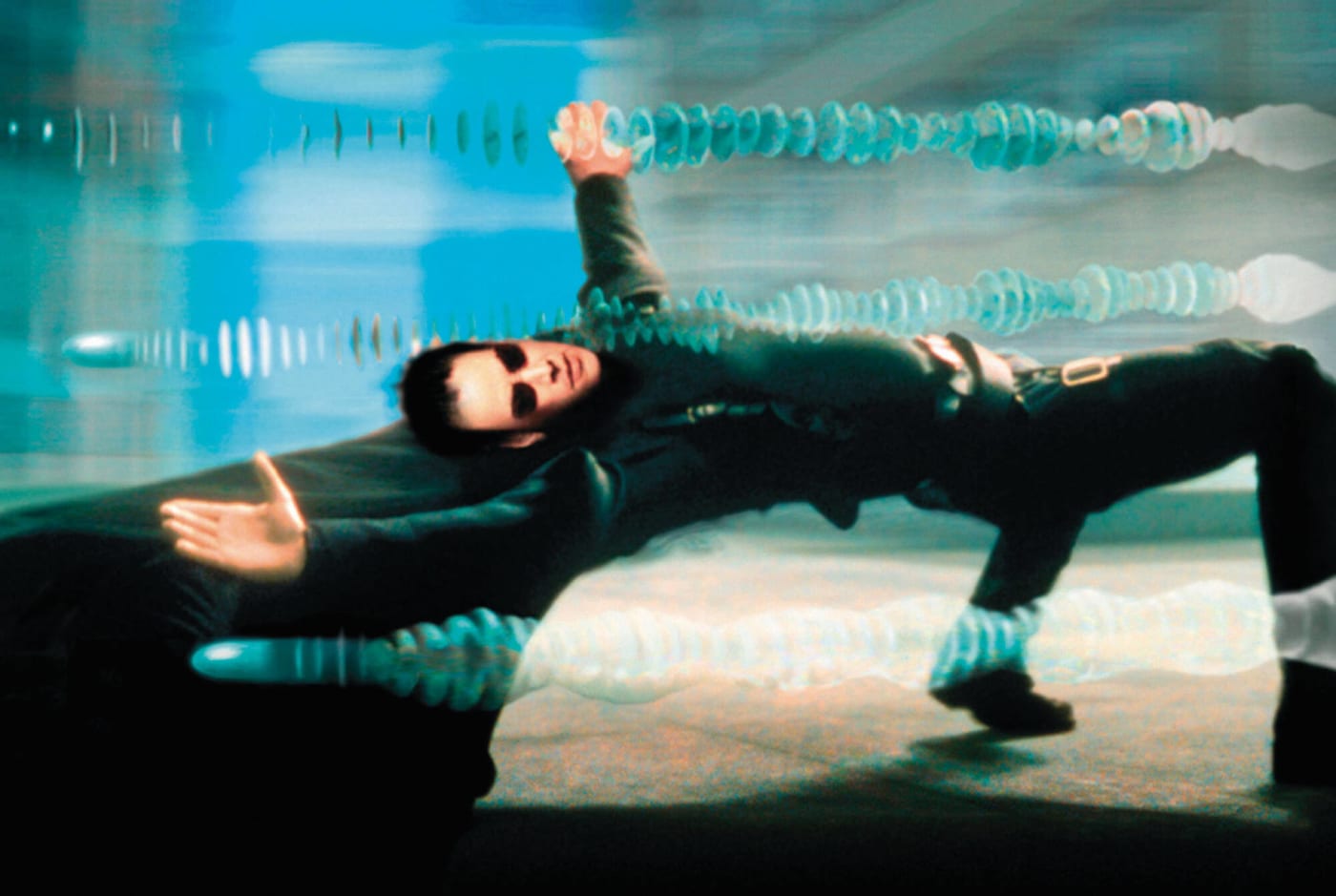
The Matrix — the body performs inside a camera system
Control has to survive the effect
Neo's backward bend is an extreme physical line, but the frame does not belong to the body alone. The wire-supported pose, eyeline, camera path, still-camera array, timing and digital bullet trajectories all have to describe the same instant.
A martial artist or gymnast entering film therefore needs more than fighting or movement ability. They need to repeat shape and direction, hold character, land on the photographic beat and remain aware of partners and rigging while the lens makes a highly artificial event feel continuous.
You do not have to be the best athlete at everything
The business needs different bodies, faces, ages and specialist histories because it doubles different actors and solves different production problems. Some calls demand elite acrobatics. Others depend more on precision driving, acting under physical pressure, specialist water or horse skills, accurate reactions, rehearsal support or the calm experience to keep a sequence readable.
That does not make fitness optional. It makes fitness specific. A veteran whose acrobatic peak has changed may still be valuable in a current specialty if competence, medical readiness, insurance and the exact call align. A young all-round athlete is not automatically qualified for a vehicle, rigging or acting problem. The common standard is not youth; it is current, honest, role-relevant ability.
Learn the film business before chasing danger
A stunt performer is a screen performer inside a production system. You need to understand the AD chain, call times, holding, marks, continuity, lens distance, eyelines, costume, props, effects, resets, confidentiality and who owns which decision. Our stunt-department map explains why a coordinator, assistant director, camera team, effects department and production management can all control different parts of the same moment.
Legitimate background work can teach set rhythm without pretending to be stunt training. Live-action shows and stage combat can build performance timing and repetition when the work is paid, insured and trained for that show. Properly supervised workshops can introduce camera-specific fundamentals. Small films can give early screen experience when the production is insured and the action stays inside verified competence.
Climbers interested in rigging need a separate professional pathway. Knowing ropes is a promising foundation, not an automatic entertainment-rigger credential. Start with recognised safety and access qualifications where they apply, then learn under qualified film or live-entertainment riggers. The STUNT.BLOG rigging guide shows how many departments and responsibilities sit behind an apparently simple wire-assisted image without teaching a setup.
What early experience can—and cannot—prove
| Experience | Useful for | Does not prove |
|---|---|---|
| Qualified workshop | Screen vocabulary, supervised drills, feedback, peer relationships | Professional credit, union eligibility or readiness for every stunt |
| Open gym | Consistent training, observation, becoming known as a reliable partner | That coordinators are scouting or that attendance is an audition |
| Paid background work | Set etiquette, AD structure, continuity, long waits and repeated takes | Stunt competence or permission to improvise hazardous action Source ↗ |
| Live show / stage combat | Audience timing, character, repeatability and show discipline | Automatic screen experience or competence outside the trained show |
| Student or short film | Camera tests, marks, collaboration and early material | A licence to design risk beyond the team's qualified supervision |
| Observation / lawful internship | Understanding workflow and building a professional relationship | Permission to replace paid crew or perform dangerous work for free Source ↗ |
Unmodified image quotation / §51 UrhG
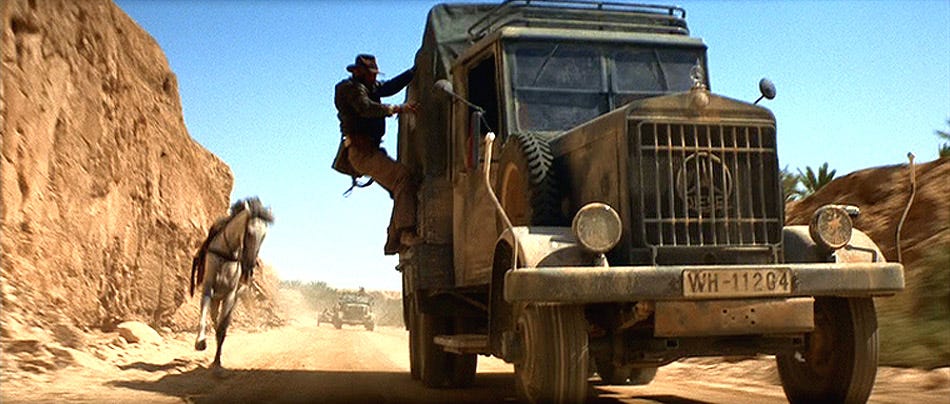
Raiders of the Lost Ark — the handoff has to disappear
A chase is a chain of precise transitions
This wide frame catches Indiana Jones between a running horse and a moving truck while the convoy advances through a narrow desert road. The action reads because performer, horse, vehicle speed, camera position and screen direction remain part of one continuous problem.
AFI's production record describes the truck chase as a planned second-unit construction shaped by Spielberg's sketches and Michael ‘Micky’ Moore's input. The career lesson is not to imitate the move. It is to recognise that doubling and vehicle action are editorial crafts: the transition must preserve character, geography and timing so completely that the audience follows the chase instead of noticing the handoff.
Confirmed fact
Do not offer hazardous work for free
‘Ask a stunt team for an internship and go to set for free’ sounds practical. On a professional production it can be unlawful, uninsured and dangerous. US federal law uses a primary-beneficiary test for for-profit internships. California requires employers using employee labour to maintain workers' compensation coverage. German minimum-wage law also limits when an unpaid internship is permissible.
A lawful observation day, training placement or non-hazardous support role can create context if it is invited, clearly supervised and properly covered. That is different from replacing paid labour, rehearsing productive action or performing a stunt for camera. No serious coordinator should need a beginner to accept hidden risk as proof of commitment.
Build evidence, not mythology
Your first reel does not need to pretend that training was a studio feature. It needs to make you identifiable and your current level easy to judge. Keep it short, front-load the clearest material, show enough of an action to reveal control and label training, live performance and professional credits honestly. If another person, workshop or production owns the footage, obtain permission before using it. Never publish confidential or unreleased material.
A dramatic homemade crash, high fall or vehicle impact can demonstrate exactly the wrong thing: poor judgement. A useful reel shows repeatability, partnering, camera awareness and a skill you can reproduce safely on demand under the proper team. The reel may get attention. Your conduct determines whether anybody trusts you with a second call.
Los Angeles is an ecosystem, not a shortcut
Los Angeles gives an aspiring performer access to specialist gyms, public classes, background casting, agents and a dense professional community. None of those things is permission to work, proof of competence or a guaranteed introduction. One currently verifiable movement facility in Van Nuys advertises classes, open gyms and guest workshops; that establishes access to training, not that coordinators scout there.
Treat public training as training. Arrive consistently, listen, become a safe rehearsal partner and build relationships horizontally with peers. Do not corner a coordinator with a reel during somebody else's session. Ask permission before sending materials and follow up when you have relevant new work—not because another week passed.
Paid background employment can teach how a US set functions. It can also form one route toward SAG-AFTRA eligibility, but the current rule is three separate days of covered background employment—not possession of ‘three vouchers’. SAG-AFTRA says vouchers are not accepted as proof when it must verify missing employment. One covered principal role is another route. A Taft-Hartley report is filed by a legitimate signatory producer after hiring a non-member; it is not a waiver you buy or arrange for yourself.
Eligibility is not membership. Joining brings fees and Global Rule One restrictions, so timing is a business decision to understand rather than a badge to collect. An elite stunt association is not necessarily a school: the Stuntmen's Association of Motion Pictures describes membership as invitation-only and requires SAG-AFTRA membership.
If you do not already have US work authorisation, flying to Los Angeles does not solve that problem. Visa Waiver or visitor travel does not permit employment, and an O-1B route is designed for people who can already document extraordinary achievement—not a beginner plan. Budget, housing, health coverage and lawful status should be settled before the city becomes your strategy.
Four markets, four different systems
There is no worldwide stunt licence. Registers, unions, insurers and safety rules answer different questions, and titles do not transfer automatically. Check the current rules in the market where you will actually work, not the rules in the country whose films you watch.
What entry looks like in 2026
| Market | Realistic early route | Important correction |
|---|---|---|
| United States / Los Angeles | Deep specialty, public training, paid set literacy, legitimate casting and producer-led covered employment | A course does not create SAG-AFTRA eligibility; open gym is not an audition; Taft-Hartley is not self-issued Source ↗ |
| Germany | Existing specialist skill, private courses and workshops, then gradual work under experienced coordinators | There is no single state-recognised dual stunt apprenticeship; GSA membership is a voluntary later-career standard, not a licence Source ↗ |
| United Kingdom | Sport and performance qualifications, camera experience, professional relationships and current register or union guidance | The published 2018 BSR rules required 60 paid front-of-camera days excluding stunt work, plus six qualifications across at least four of five groups; confirm the current rules directly Source ↗ |
| Australia | General stunt training, competence across the required local categories, then grading and supervised provisional work | SAP means Stunt Actor Provisional; it is a local graded pathway, not a global certificate Source ↗ |
Confirmed fact
Germany: training first, association evidence later
The German Stunt Association says there is no indispensable prescribed training route. Its current ordinary-membership criteria belong later in a career: adulthood, two years of professional experience, occupational accident and liability insurance, recommendations from three recognised coordinators and 20 confirmed credits, with an exam used when missing credits must be replaced. That is a useful target for professional evidence, not a beginner entrance ticket.
Insurance must be explicit. VBG notes that self-employed people are not automatically covered against occupational accidents. The German scenic-safety guidance also gives the performer a right to decline or stop action when personal readiness is not present. A workshop certificate cannot replace that ongoing judgement.
Unmodified image quotation / §51 UrhG
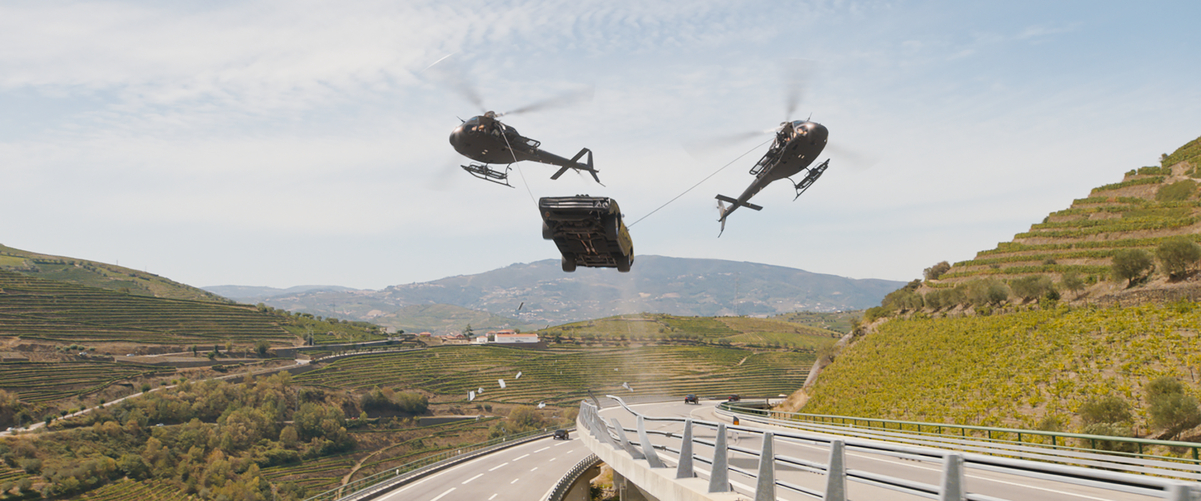
Fast X — the finished frame is a department handoff
Blockbuster scale is built across borders and departments
The finished frame shows two helicopters carrying a car above a Portuguese highway. The image alone cannot tell us which visible elements are practical. DNEG's production account supplies that missing boundary: two real helicopters and multiple stunt cars were filmed, close-proximity and crash beats used digital replacements, and an empty stunt car was launched between highway decks to establish a believable trajectory.
That is a useful career lesson in the middle of a market comparison. International action units do not need a beginner who claims the whole shot. They need specialists whose vehicle, aerial, rigging, camera, effects or performance evidence can survive a precise handoff to the next department.
If you are still at school
Use the time to build foundations: one coached discipline, general strength and mobility appropriate to it, first aid, acting or camera classes, English where it expands your market, and a habit of keeping records. A parent or guardian should be involved in every contract, travel decision and training agreement.
Do not treat being under 18 as a reason to rush dangerous footage before adulthood. Child-performer rules vary. California, for example, requires entertainment work permits for the minor and the employer. School, safeguarding, working-time limits and medical readiness come before a reel.
What the old careers actually teach
The famous historical routes look almost random: rodeo, parachuting, diving, motocross, acting and fencing. They are not random. Each person arrived with a real, testable skill a production could use, then learned how to translate it into screen action. Their biographies are evidence that there is no single feeder discipline—not permission to copy the less regulated working conditions of their era.
Six routes into the profession
| Stunt professional | Documented route | Transferable lesson |
|---|---|---|
| Yakima Canutt (1895–1986) | Ranch skills and professional rodeo into silent-film acting, stunt performance and later coordination | Elite horsemanship solved a production problem; his career then expanded from execution into staging Source ↗ |
| Hal Needham (1931–2013) | Army parachuting, thrill-show and tree work into wing-walking and parachute work, then performance, coordination, invention and directing | The first job matched skills he already had; longevity came from learning planning, engineering and camera logistics Source ↗ |
| Jeannie Epper (1941–2024) | A stunt-family apprenticeship and horsemanship into doubling, performance and coordination | Apprenticeship and community can transmit craft—but her family access also shows that opportunity has never been distributed equally Source ↗ |
| Kitty O'Neil (1946–2018) | Competitive diving redirected by illness and injury into water skiing, motorcycle and speed competition, then professional stunts | A closed athletic path can become a new specialty; deafness did not erase her capacity for elite screen action Source ↗ |
| Rémy Julienne (1930–2021) | Championship motocross into motorcycle performance and international vehicle coordination | Competitive vehicle control was a foundation; film timing, teamwork and coordination became the profession Source ↗ |
| Derek Ware (1938–2015) | RADA acting and fencing into fight arranging, performance, coordination and the specialist team HAVOC | Character and dramatic intention can be as useful as sport; complementary specialists are stronger than one person claiming everything Source ↗ |
Analysis
Copy the pattern, not the mythology
The pattern is simple: bring a difficult skill, prove control, learn the camera, become useful to a team and expand only when your evidence supports it. The mythology is that nerve alone creates access. It did not explain the old careers, and it is even less useful inside today's insured, regulated and contract-controlled productions.
A first-year roadmap
This is a planning scaffold, not a promise that twelve months produces a career. Many performers train and build credits for years. The point is to sequence evidence: market and skill first, supervised screen conversion second, professional materials third, submissions last.
Twelve months of useful proof
Map the market and audit one specialty
Choose where you can legally work. Record your real level, injuries, licences, insurance needs and gaps. Build first aid, acting or camera literacy around the specialty you already practise.
Add supervised screen-specific training
Use qualified workshops and camera exercises to learn marks, reactions, continuity, partnering and repeatability. Treat public gyms as learning environments, not casting rooms.
Build lawful set literacy and labelled footage
Pursue paid background, live performance or properly insured small productions. Keep training footage distinct from professional credits and obtain permission for every clip.
Submit narrowly and build references
Finish a concise reel, current images and an accurate résumé. Submit for work that matches verified skills, train consistently with peers and let reliability create referrals.
Treat every job as a new assessment
Disclose limits, listen to the complete briefing, ask what changed after delays and keep records. Expand specialties only through fresh training and current evidence.
Official stunt-unit video / Universal Pictures
The Fall Guy: one cannon roll, an entire system
Watch the scale before watching the car: picture vehicles, camera platforms, effects, beach geography, reset space and multiple moving teams all share the same frame. The official player remains unloaded until you press play.
What not to do
Do not self-film hazardous falls, burns, impacts, traffic work or improvised rigging to make a reel. Do not hide an injury, inflate a qualification or call workshop attendance a professional credit. Do not pay a supposed scout to secure a job, union waiver or guaranteed introduction. Do not arrive under visitor status and accept employment. Do not assume a famous association takes interns because its members work together.
Most importantly, do not confuse commitment with silence. A performer who asks for clarification, reports a limitation or calls a stop when the shared picture has broken is not being difficult. They are protecting the production from an action that no longer has the conditions under which it was agreed.
What a coordinator is actually hiring
A coordinator is not buying your most dramatic day. They are deciding whether you can join a temporary safety-critical team, understand the story problem, reproduce an agreed action, adapt through communication and remain honest when the answer is no.
The person who gets a second call is often the one who was prepared without performing confidence, attentive without interfering, useful during the long reset and exact about what changed. Athletic talent may win the first look. Calibrated judgement turns talent into trust.
The evidence behind professional trust
| Claim | Weak signal | Strong signal |
|---|---|---|
| ‘I can do it’ | A long list of unverified skills | Current footage, qualifications and an exact description of conditions |
| ‘I am safe’ | Fearlessness or injury stories | Preparation, repeatability, communication and willingness to stop |
| ‘I know sets’ | Dropping famous names | Quiet attention, continuity, AD-chain awareness and respect for every department |
| ‘I can adapt’ | Improvising when the plan changes | Detecting the mismatch early and returning material changes to the team |
| ‘I am ready for more’ | Collecting beginner certificates | One deep specialty plus screen craft, credits and trusted references |
The shortest honest answer
Become very good at one real thing. Learn what the camera, story and production system need from it. Train under qualified people. Build lawful set experience. Show honest evidence. Enter the rules of your local market. Become the colleague who can wait, reset, observe, communicate and stop.
You do not enter the stunt business by proving that you will do anything. You enter by proving that a production can trust you to know exactly what you are doing—and what you are not.
Sources and verification record41 entries
- Practitioner contribution on mental steadiness and entry routes — Ferdi Fischer / retained STUNT.BLOG editorial record. Accessed 2026-07-21.
- Introduction to Human Factors — UK Health and Safety Executive. Accessed 2026-07-21.
- Evidence Report: Risk of Inadequate Human-Computer Interaction — NASA, 2013-06-13. Accessed 2026-07-21.
- Vigilance Decrement and Enhancement Techniques: A Review — Brain Sciences / PubMed Central, 2019-07-26. Accessed 2026-07-21.
- Startle Effect Management — European Union Aviation Safety Agency. Accessed 2026-07-21.
- Steps to Join — SAG-AFTRA. Accessed 2026-07-21.
- Global Rule One — SAG-AFTRA. Accessed 2026-07-21.
- What is a Taft-Hartley Report? — SAG-AFTRA. Accessed 2026-07-21.
- How to Get Cast with Central Casting — Central Casting. Accessed 2026-07-21.
- On-Set Guidance for Background Actors — Central Casting. Accessed 2026-07-21.
- Fact Sheet #71: Internship Programs Under the Fair Labor Standards Act — US Department of Labor. Accessed 2026-07-21.
- Workers' Compensation Frequently Asked Questions — California Labor Commissioner's Office. Accessed 2026-07-21.
- Classes, Open Gyms and Workshops — Joining All Movement. Accessed 2026-07-21.
- About the Stuntmen's Association of Motion Pictures — Stuntmen's Association of Motion Pictures. Accessed 2026-07-21.
- Visa Waiver Program — US Department of State. Accessed 2026-07-21.
- O-1 Visa: Individuals with Extraordinary Ability or Achievement — US Citizenship and Immigration Services. Accessed 2026-07-21.
- Entertainment Work Permits for Minors — California Labor Commissioner's Office. Accessed 2026-07-21.
- Entry, Job Profiles and Professional Support — German Stunt Association. Accessed 2026-07-21.
- Safety for Events and Productions — Special Scenic Representations (DGUV Information 215-315) — German Social Accident Insurance / VBG. Accessed 2026-07-21.
- Insurance for Self-Employed Entrepreneurs — VBG. Accessed 2026-07-21.
- Praktikum und Mindestlohn — German Federal Ministry of Labour and Social Affairs. Accessed 2026-07-21.
- British Stunt Register — British Stunt Register. Accessed 2026-07-21.
- British Stunt Register Physical Entry Criteria — British Stunt Register, 2018-02-01. Accessed 2026-07-21.
- British Stunt Register Upgrade Criteria — British Stunt Register, 2018-02-01. Accessed 2026-07-21.
- Engaging Stunt Co-ordinators and Stunt Performers — Equity. Accessed 2026-07-21.
- National Stunt Grading Application — Media, Entertainment & Arts Alliance / National Stunt Committee. Accessed 2026-07-21.
- Grading Categories and Requirements — Stunt Book Australia. Accessed 2026-07-21.
- Yakima Canutt — National Rodeo Hall of Fame — National Cowboy & Western Heritage Museum. Accessed 2026-07-21.
- Hal Needham — Honorary Award Honoree Biography — Academy of Motion Picture Arts and Sciences. Accessed 2026-07-21.
- Jeannie Epper — The Interviews — Television Academy Foundation. Accessed 2026-07-21.
- Kitty O'Neil's 77th Birthday — Google Doodles, 2023-03-24. Accessed 2026-07-21.
- Disparition de Rémy Julienne — Fédération Française de Motocyclisme, 2021-01-22. Accessed 2026-07-21.
- Derek Ware Obituary — The Guardian, 2015-10-19. Accessed 2026-07-21.
- An Inside Look at Fast X with DNEG — UK Screen Alliance, 2023-07-20. Accessed 2026-07-21.
- Raiders of the Lost Ark — Myke's Movies. Accessed 2026-07-21.
- Raiders of the Lost Ark (1981) — American Film Institute Catalog. Accessed 2026-07-21.
- 23 Movies That Show Why 1999 Was a Peak Year in Cinema — The Matrix — Yardbarker. Accessed 2026-07-21.
- The Matrix: How the Wachowskis Changed Sci-Fi — British Film Institute, 2019-03-26. Accessed 2026-07-21.
- The Fall Guy | Cannon Rolls — Universal Pictures / YouTube. Accessed 2026-07-21.
- Safety Bulletin #4 — Stunts — Industry-Wide Labor-Management Safety Committee / Contract Services, 2025-03-27. Accessed 2026-07-21.
- Black Hawk Down — British Film Institute. Accessed 2026-07-19.
Loading approved comments…