Analysis
There is no fixed stunt-performer retirement age—and no credible global average for the length of a stunt career. Some careers are cut short; others run for decades. What often changes first is not whether somebody can work, but which work still fits.
At sixty-three, Sam is standing on a café street while a car prepares to turn over through the frame. He is outside the designed impact path. Nobody has hired him to prove that he can still hit concrete. His job is to find the same mark, make the same decision and deliver the same reaction while engines, effects and camera movement erase everybody else’s sense of normal.
Thirty-eight years earlier, his job was simply to fall.
No authoritative study gives stunt performers a universal average career span or retirement age. Country, specialty, injury history, employment pattern and the meaning of “active” vary too much.
The work does not become automatically safe or easy with age. In selected assignments, however, the limiting demand can shift from impact tolerance toward timing, precision, repeatability and situational awareness.
Coordinator, rigger or second-unit work are possible later-career routes, not compulsory promotions. A veteran can remain a performer when current ability, casting need and the specific action still match.
Twenty-two: the first mark
Sam enters the business in the early 1980s, when an all-round performer is expected to bring several disciplines to the same call sheet. He can fight, ride, fall and drive. On his first production, the coordinator gives him a simple mark on the floor and an even simpler instruction: do the same thing again.
That route is historical texture, not an entry template. The modern stunt-career guide explains how preparation and access differ by market.
He misses it by half a step on take one. The camera sees the miss. On take two he lands correctly but looks at the explosion instead of staying inside the scene. By take four, Sam understands the first durable rule of his career: bravery may get attention, but repeatability gets hired.
For the next two decades, his body is the obvious instrument. He tumbles down stairs, takes reactions into walls, fights in wet clothes, drives vehicles that are meant to look less controllable than they are and waits through long resets before doing it again. He learns to protect a character's movement when he doubles, to listen for changes and to keep spare attention after the action begins.
The work is physical, but it is never only physical. A missed eyeline can ruin continuity. A late foot can move another performer out of position. A reaction that becomes larger on each take can pull a whole sequence away from its rehearsed geometry. Sam's muscles do the visible work; his judgement makes the work repeatable.
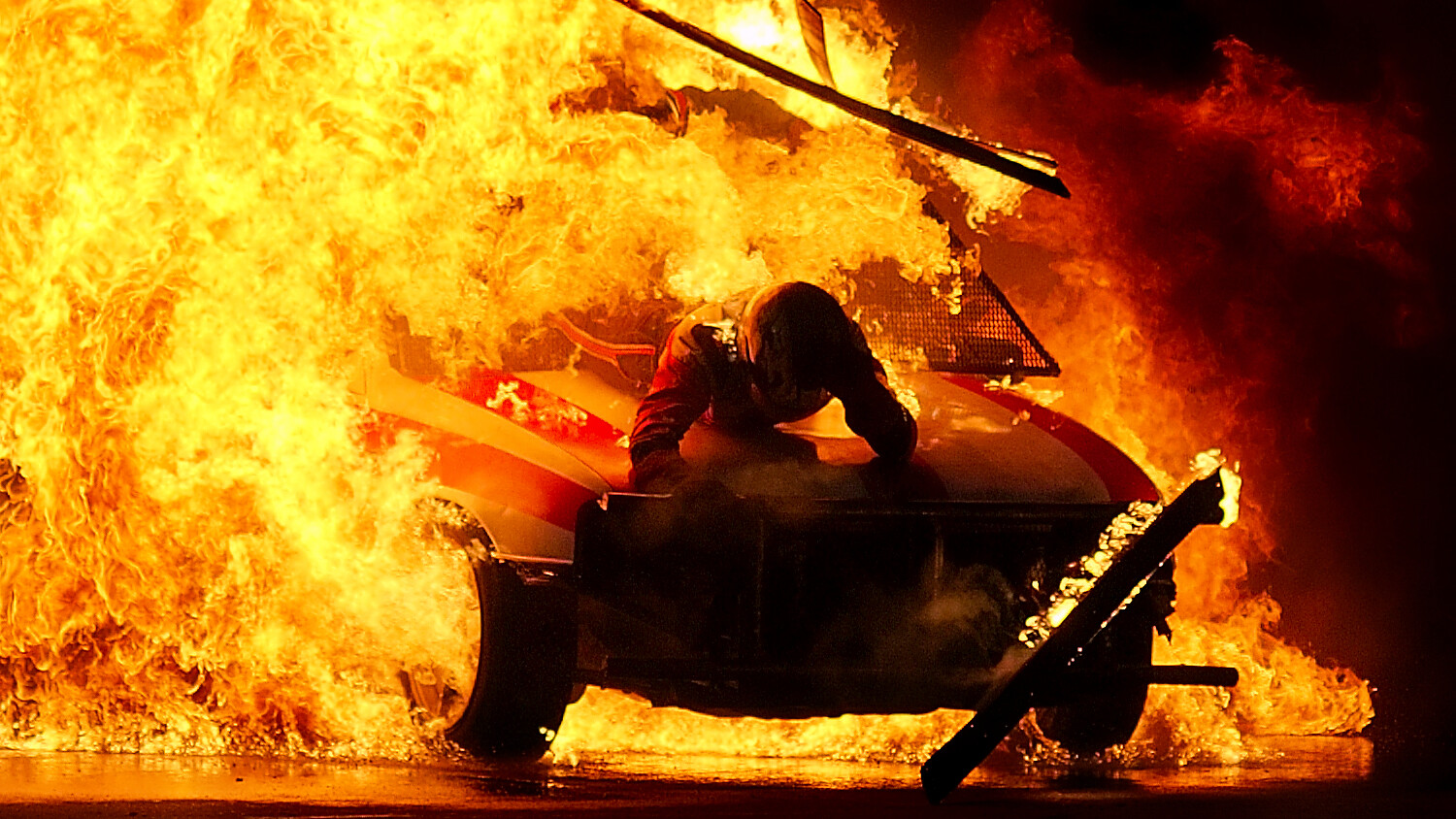
Real stunt / licensed action photograph
The part of the career everybody imagines
Forty-three: the body keeps the books
There is no birthday on which the body sends a resignation letter. There is recovery that takes a day longer, an old joint that changes the warm-up, a head impact that should be reported and a hard surface that no longer belongs in the useful part of a performer's range.
The limited stunt-health research does not give us an average completed career. A 2023 exploratory Canadian survey collected 216 complete responses from performers aged 22 to 71. Experience ranged from one to 43 years, with a mean of 15.8 years; 87.5 percent described themselves as active. That is a snapshot of respondents, not proof that the average career lasts 15.8 years.
The same study found a serious head-trauma burden in its self-selected sample. A related 2024 qualitative study reported performers' concern that disclosing head trauma could make them look like a liability. A culture that turns silence into employability does not prove toughness. It can take usable years away from a career.
A regional Actsafe survey adds another bounded signal: 35 percent of respondents said cumulative physical abuse had negatively affected health or quality of life, and 18 percent reported a permanent condition, corrective surgery or continuing rehabilitation. The figures cannot be globalised. They do explain why Sam's menu starts to change.
He never wanted the promotion
By forty-five, people assume Sam will coordinate. He has enough workdays, enough stories and enough younger performers asking him questions. He says no. Not because coordination is less important, but because it is another job: design, hiring, budgeting, interdepartmental negotiation, documentation and responsibility for the specialist action process.
SAG-AFTRA's US coordinator eligibility process provides one useful benchmark. It requires 500 verified covered workdays and says a working performer takes about five years on average to reach them. That is a threshold for one career track, not evidence that people normally stop performing after five years—or that experience alone proves coordination competence.
Sam remains a performer. Sometimes he helps rehearse a beat. Sometimes he becomes a selected utility performer, though “utility” is not a synonym for older, easy or low-impact: in the SAG-AFTRA digest it describes a performer available for required stunt work and potentially several doubles. Every assignment still has to match the person who accepts it.
Other veterans do expand into rigging, coordination, safety, action direction or second-unit work. The stunt-department map owns those reporting lines. Sam's choice is narrower and just as legitimate: he keeps hitting marks in front of the camera.
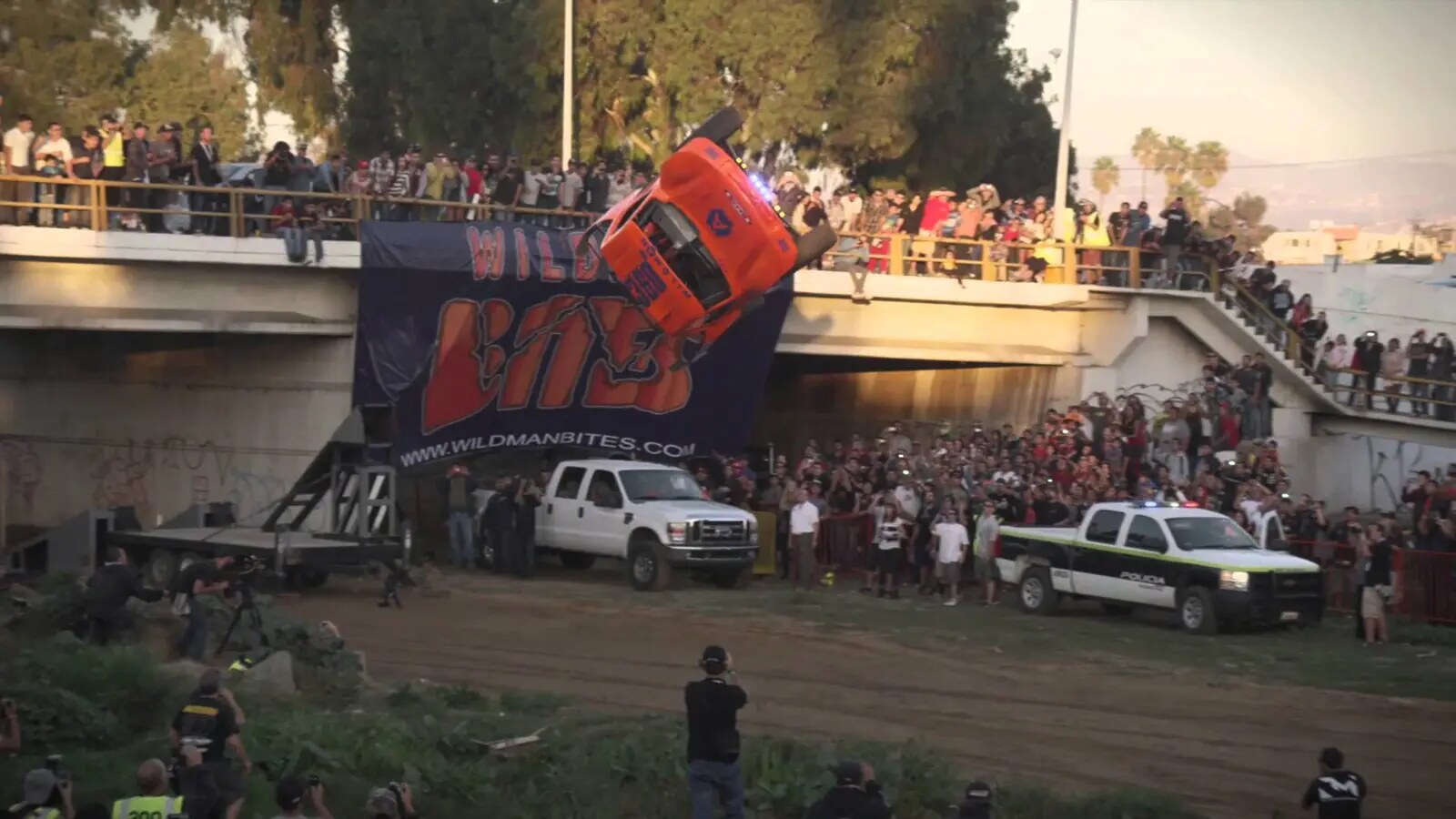
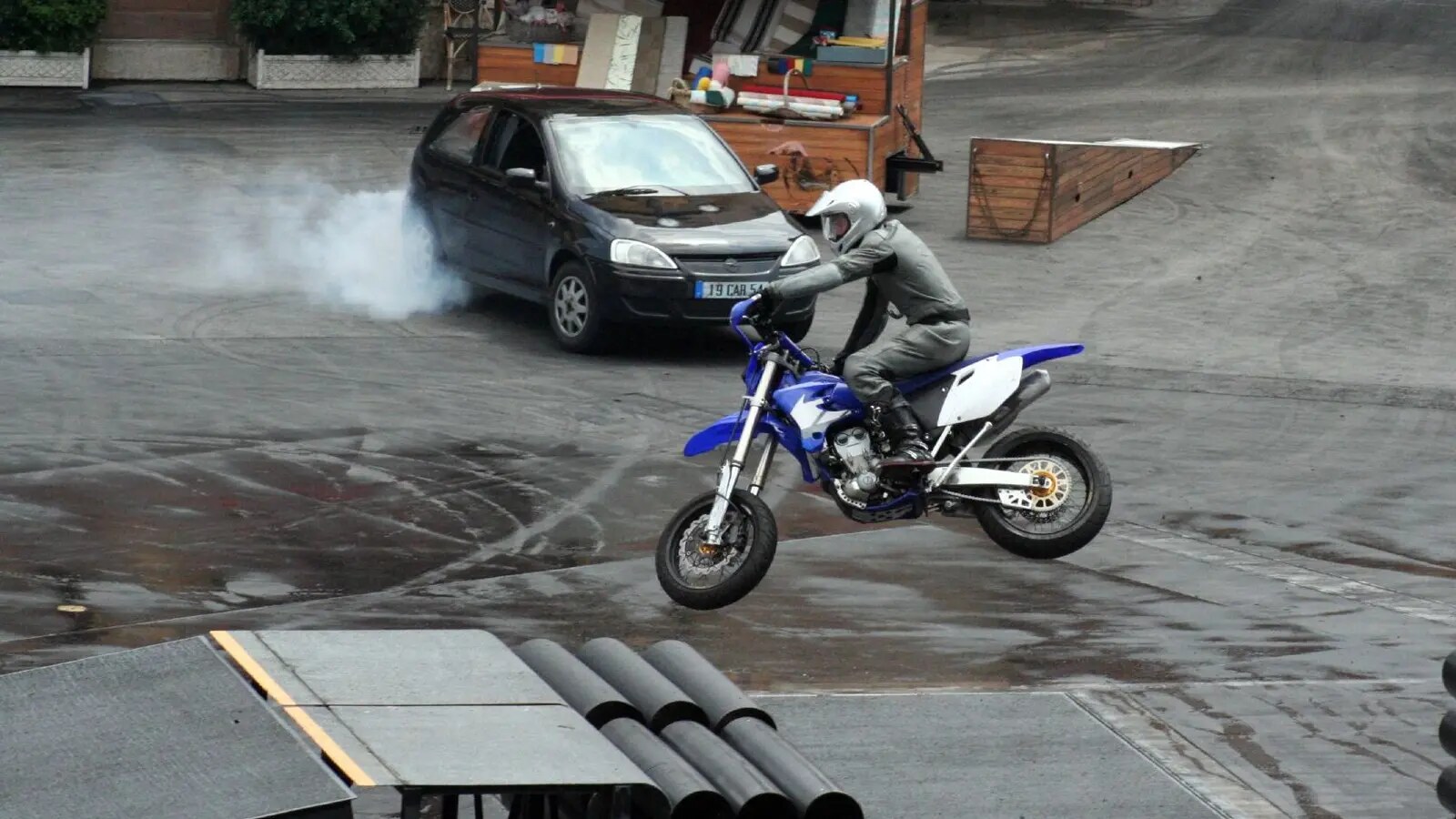
Real stunt / specialist timing
One beat can depend on several specialists at once
Sixty-three: three layers of action
Back on the fictional café street, the car flip is only the centre of the event. Around it are performers, vehicles, effects, camera positions and parts of the street that must remain photographically alive. Sam thinks of the frame in layers.
Closest to the designed action are the specialists executing the vehicle and effect beat. A second layer carries rehearsed proximity performance: timed reactions or evasive movement designed into the shot. A third layer remains outside the designed action while still inhabiting a complex picture—people who must preserve marks, continuity and controlled response if the noise and scale become disorienting.
These are editorial labels, not formal safety zones and never usable distances. Contract Services guidance requires a controlled stunt area, competent personnel, planned placement, rehearsed timing and marks, restricted access and preparation for possible deviations. The coordinator, effects team, assistant directors and production define the real boundaries for the actual sequence. A veteran's reflexes do not repair an inadequate plan.
A conceptual view of the action frame
| Conceptual layer | What the picture needs | What experience can contribute |
|---|---|---|
| Designed-action layer | The principal vehicle, performer or effect executes the choreographed beat. | Current specialist skill, exact timing and demonstrated control. Source ↗ |
| Proximity-performance layer | Rehearsed reactions or evasive movement sell closeness to the designed action. | Marks, timing, repeatability and a controlled performance under noise and pressure. Source ↗ |
| Contingency-aware picture layer | Performers remain outside the designed action while keeping the wider frame credible. | Situational awareness, continuity and disciplined response inside the agreed plan. Source ↗ |
Why the veteran is not interchangeable with an extra
An extra or actor is not inherently unreliable, and a stunt performer is not superhuman. The relevant distinction is preparation for the assignment. A production should not place an untrained person in hazardous proximity simply because the screen action looks like “standing there.”
Sam can arrive at the same mark, in the same posture, at the same beat, across repeated takes. He does not chase the explosion with his eyes unless the character should. He does not make his reaction larger because the first take felt exciting. If the planned conditions change, professionalism means stopping and reopening the decision—not improvising a rescue for the plan.
That predictability has creative value as well as safety value. It preserves focus, eyelines, edit points, vehicle timing and continuity. When the person in frame must visibly read as older, a trained age-matched stunt player can also do what a wig, padded costume or distant double cannot always do: remain credible close to camera while executing the prepared physical beat.
Selected work near edges, moving vehicles or large effects can therefore create a genuine niche for older stunt performers. The niche exists because age, appearance, competence and calm execution meet one particular shot—not because older performers belong near danger by default.
What later-career stunt work can look like
| Selected assignment | Primary demand | Non-negotiable limit |
|---|---|---|
| Precision or stunt driving | Vehicle control, timing, spatial judgement, repeatability and current familiarity with the exact vehicle. | Past reputation cannot replace present vision, reaction, health, rehearsal or assignment-specific competence. |
| Age-matched doubling or stunt-player work | Physical resemblance, character continuity, marks and the demonstrated action skill. | Looking right for the role never qualifies someone for an action they cannot currently perform. |
| Selected utility stunts | Breadth, adaptability and readiness for the defined work. | “Utility” does not mean easy; each required stunt still needs an honest capability decision. Source ↗ |
| Complex action-background performance | Repeatable movement, continuity and calm response around a controlled action environment. | Only trained, rehearsed and authorised personnel belong in the controlled stunt area. Source ↗ |
| Specialist rehearsal and on-camera continuity | Translating a prepared movement into the same character, rhythm and spatial relationship. | Experience supports the process; it does not transfer the coordinator's authority or production's wider duty. |
The veterans who make the fiction believable
Sam is invented. The long careers around him are not.
Henry Kingi was 80 when Vulture profiled him in 2024, after a career strongly associated with vehicle work and recent credits in the John Wick and Fast & Furious worlds. The Taurus World Stunt Awards describes work continuing into his seventies and eighties. Debbie Evans's 2026 Taurus profile records more than four decades and more than 400 film and television projects, with car and motorcycle performance at the centre of an all-round career.
In Britain, the Guardian reported that Gillian Aldam was still working at 83. In a few months during 2023, the six-decade veteran worked on Wicked: For Good, Blitz, Old Guy and Slow Horses before saying she was ready to slow down. Glenn Wilder's Television Academy biography shows another pattern: a career spanning stunt performance, acting, coordination and second-unit direction.
None of them supplies the missing average. They are survivorship examples shaped by individual health, skill, opportunity and history. Their value is more precise: they disprove the idea that credible stunt contribution expires on one universal birthday.
Experience can sharpen the job—and age can still narrow it
The comforting version of this story would say that judgement simply replaces athleticism. The evidence does not support that trade. Age can affect strength, recovery, vision, reaction and cognition, and it affects people unevenly. Experience does not freeze those changes.
Research across skilled sport and other expert domains does show ways high performers preserve ability: anticipation, compensation and selective maintenance. That gives a cautious framework for what colleagues recognise in veterans—the ability to read early cues, filter distraction and spend effort where it matters. It is not stunt-specific proof, and a long résumé is not a fitness test.
Sam's advantage at sixty-three is therefore not that his mind is automatically sharper than a younger performer's. It is that decades of relevant practice may let him recognise a developing pattern sooner and remain emotionally quiet inside a familiar kind of pressure. His obligation is to pair that experience with an honest current assessment. The production's obligation is to cast the demonstrated person, not the legend.
Within Stunt Design, this is a design and casting problem before it is a celebration of longevity. The action, camera, performer, effect and escape logic must be built for the people who are actually present. For practice context, SlamArtist.com's stunt-performance work shows where physical performance sits inside that larger process.
Sixty-eight: the last mark
Five years after the café street, Sam's credits folder crosses 300 productions. There was no grand plan behind the number. He was simply busy: westerns, police shows, commercials, two films nobody remembers, several that everyone does, long nights in rain, morning calls in deserts and a lifetime of vehicles returned with warm brakes.
His final job is not a record attempt. He plays an older neighbour who crosses a corridor during a controlled action beat, turns on the same cue and reaches the same doorway on four takes. The coordinator offers another date the following month. Sam looks at the call sheet, feels the quiet arithmetic of recovery and says no.
He does not retire because sixty-eight is the limit. He retires because his remaining useful range and the work he still wants have finally stopped overlapping. Another performer might make that decision at thirty-five. Henry Kingi, Debbie Evans and Gillian Aldam demonstrate that another might still have meaningful work decades later.
So how long can somebody do stunts? As long as current ability, preparation, health, casting need and the specific assignment continue to meet—and as long as the performer still chooses the work. The hard hits may end first. The career does not always have to end with them.
Sam leaves his last mark taped to the floor. The next morning, somebody else stands on it.
Sources and method12 entries
- BC Film Stunt Performers and Stunt-Related Injuries: Review and Survey — Actsafe Safety Association, 2012-09-01. Accessed 2026-07-28.
- Head Trauma and Concussions in Film and Television Stunt Performers: An Exploratory Study — Journal of Occupational and Environmental Medicine, 2022-11-04. Accessed 2026-07-14.
- Stunt Performers’ Reluctance to Self-Report Head Trauma: A Qualitative Study — Journal of Occupational Medicine and Toxicology, 2024-01-31. Accessed 2026-07-14.
- Ageing and Health — World Health Organization, 2025-10-01. Accessed 2026-07-28.
- Expertise and Aging: Maintaining Skills Through the Lifespan — European Review of Aging and Physical Activity, 2008-04-03. Accessed 2026-07-28.
- Stunt Coordinator Eligibility Process — SAG-AFTRA. Accessed 2026-07-27.
- Safety Bulletin #4 — Stunts — Industry-Wide Labor-Management Safety Committee / Contract Services, 2025-03-27. Accessed 2026-07-14.
- Stunt & Safety Digest — SAG-AFTRA, 2014-01-01. Accessed 2026-07-28.
- Lifetime Achievement Archive — Debbie Evans and Henry Kingi Sr. — Taurus World Stunt Awards, 2026-01-01. Accessed 2026-07-28.
- Everyone Should Know What Henry Kingi Did — Vulture / New York Magazine, 2024-03-04. Accessed 2026-07-28.
- UK Stunt Artists Celebrated with Donation to BFI — The Guardian, 2025-01-12. Accessed 2026-07-28.
- Glenn R. Wilder — Television Academy. Accessed 2026-07-28.

Loading approved comments…